
Form 941 for the 2026 tax year is due April 30 (Q1), July 31 (Q2), October 31 (Q3), and February 2, 2027 (Q4, shifted because January 31, 2027, falls on a Sunday). Those are your filing deadlines, not your deposit deadlines, which follow a separate monthly or semiweekly schedule. If you deposited your quarterly payroll taxes on time and in full, you get a 10-day cushion to file after the standard due date.
TL;DR:
- Employers must follow the specific quarterly due dates for Form 941 in 2026, with the Q4 deadline shifting to February 2, 2027, due to calendar adjustments.
- The 10-day filing extension is only available if all taxes for the quarter were deposited on time and in full, not for late deposits or short payments.
- Deposit schedules depend on the lookback period from July 1, 2024, to June 30, 2025, with large deposits exceeding $100,000 due the next business day regardless of the regular schedule.
- E-filing is strongly recommended for instant confirmation, while paper filings rely on accurate postmarks or private delivery services for timeliness.
- Small employers often overlook deposit timing and schedule accuracy, which can lead to penalties, but regular reconciliation and electronic deposits significantly reduce this risk.
Table of Contents
- When Are the 941 Due Dates for 2026?
- 2026 Form 941 Quarterly Due Dates at a Glance
- Where and How to File Form 941 in 2026
- How Deposit Schedules and the Lookback Period Work
- When Does the 10-Day Extended Filing Date Apply?
- What Mistakes Trigger 941 Penalties, and How Do You Fix Them?
- Building Systems That Prevent Missed Deposits
- Which Form 941 Revision Should You Use for 2026?
- Your Quarterly Form 941 Compliance Checklist
- Why Small Employers Underestimate How Fragile This System Is
- Let Glendale Payroll Handle Your Deposit Schedule and Filings
- Useful IRS Resources for Form 941 Compliance
- Sources
When Are the 941 Due Dates for 2026?
Every employer who withholds federal income tax, Social Security, or Medicare tax from employee wages owes a quarterly Form 941. The IRS instructions for Form 941 set four fixed windows for the year, and missing even one triggers a failure-to-file penalty regardless of how current your deposits are.
Here's what makes 2026 slightly different from a typical year: the fourth-quarter deadline doesn't land on January 31 like usual. Because that date falls on a Sunday in 2027, the IRS due-dates table pushes it to the next business day, February 2, 2027. This is a routine calendar mechanic. Any Form 941 deadline landing on a Saturday, Sunday, or federal holiday automatically rolls to the next business day.
Deposit due dates operate on a different clock entirely. You can file Form 941 perfectly on time and still owe a failure-to-deposit penalty if your periodic tax deposits missed their own schedule during the quarter.
2026 Form 941 Quarterly Due Dates at a Glance
| Quarter | Period Covered | Quarter Ends | Form 941 Due Date | Notes |
|---|---|---|---|---|
| Q1 2026 | January 1 to March 31 | March 31, 2026 | April 30, 2026 | Standard deadline, no shift |
| Q2 2026 | April 1 to June 30 | June 30, 2026 | July 31, 2026 | Standard deadline, no shift |
| Q3 2026 | July 1 to September 30 | September 30, 2026 | October 31, 2026 | Standard deadline, no shift |
| Q4 2026 | October 1 to December 31 | December 31, 2026 | February 2, 2027 | Shifted from January 31, 2027 (a Sunday) |
Use the March 2026 revision of Form 941 for every quarter filed this year. The Employment tax due dates page confirms these same dates and adds one more wrinkle worth remembering: employers who timely deposited all taxes owed for the quarter, in full, can push their filing deadline out by 10 calendar days. That grace period applies to the filing deadline only, never to the deposits themselves.
Where and How to File Form 941 in 2026
The IRS strongly favors electronic filing through the Modernized e-File (MeF) system, and for good reason. E-filing gives you an instant, timestamped acceptance receipt. That receipt is your proof of timely filing if the IRS ever questions the date, which eliminates the guessing that comes with paper submissions.
If you mail a paper return instead, the postmark matters as much as the date on the form itself. According to the Form 941 instructions, a paper return counts as filed on time only if the envelope carries a USPS postmark, or is handed to an IRS-designated private delivery service, on or before the due date. Drop it in the mailbox a day late, and the postmark alone can sink an otherwise complete return.
A few filing rules employers frequently overlook:
- File Form 941 only once per quarter. Never submit both a paper copy and an e-filed version "just to be safe."
- If you need to correct a previously filed return, use Form 941-X, not a duplicate 941.
- Keep your e-file confirmation or certified mail receipt for at least four years.
- Choose an IRS-approved private delivery service if you mail close to the deadline; regular first-class mail carries more risk.
How Deposit Schedules and the Lookback Period Work
Your Form 941 due date stays fixed. Your deposit schedule, on the other hand, depends entirely on how much payroll tax you reported during a specific 12-month window called the lookback period. For 2026, the lookback period runs from July 1, 2024, through June 30, 2025, covering the four quarters ending in that span.
- Monthly depositor: If your total 941 tax liability during the lookback period was no more than a specified threshold, you deposit monthly, generally by the 15th of the following month.
- Semiweekly depositor: If your lookback-period liability exceeded the monthly depositor threshold, you deposit semiweekly on a schedule determined by your payroll days.
- New employers: If you have no lookback history, you default to monthly deposits until your liability history establishes otherwise.
There's a wrinkle that catches a surprising number of otherwise disciplined employers off guard: the Next-day deposit rule for large tax accumulations. If your accumulated tax liability hits $100,000 or more on any single day, you must deposit it by the next business day, no matter what your normal schedule says. 757](https://www.irs.gov/taxtopics/tc757).
Pro Tip: Your deposit schedule is set by IRS lookback data, not by how often you run payroll. A biweekly payroll calendar and a monthly deposit schedule can coexist perfectly, but confusing the two is one of the most common ways employers accidentally miss a deposit deadline.
For a closer look at how the lookback calculation works quarter by quarter, see Glendale Payroll's breakdown of deposit scheduling.
When Does the 10-Day Extended Filing Date Apply?
The 10-day extension is one of the most misunderstood provisions in the entire Form 941 process. It exists, and it's genuinely useful, but it comes with a strict condition.
- The extension applies only if you deposited every dollar of tax owed for that quarter on time, in full.
- If Q1 2026 deposits were all timely, your Form 941 filing deadline moves 10 calendar days beyond the standard due date.
- Missing even one deposit deadline, or shorting a deposit by even a small amount, disqualifies you from the extension entirely.
- The extension covers filing paperwork only. It does not extend when your tax payments are due, and penalties for late deposits still apply even if your filing arrives within the extended window.
Treat this provision as a reward for clean deposit habits, not a built-in buffer you can plan around.
What Mistakes Trigger 941 Penalties, and How Do You Fix Them?
Two distinct penalty regimes apply here, and employers routinely mix them up. Failure-to-deposit penalties scale with how late the deposit is: 2% if you're one to five days late, climbing to 15% once the IRS has to send a delinquency notice. Failure-to-file penalties start at 5% of unpaid tax for each month the return is late, capping at 25%, according to the IRS employment tax due dates guidance.
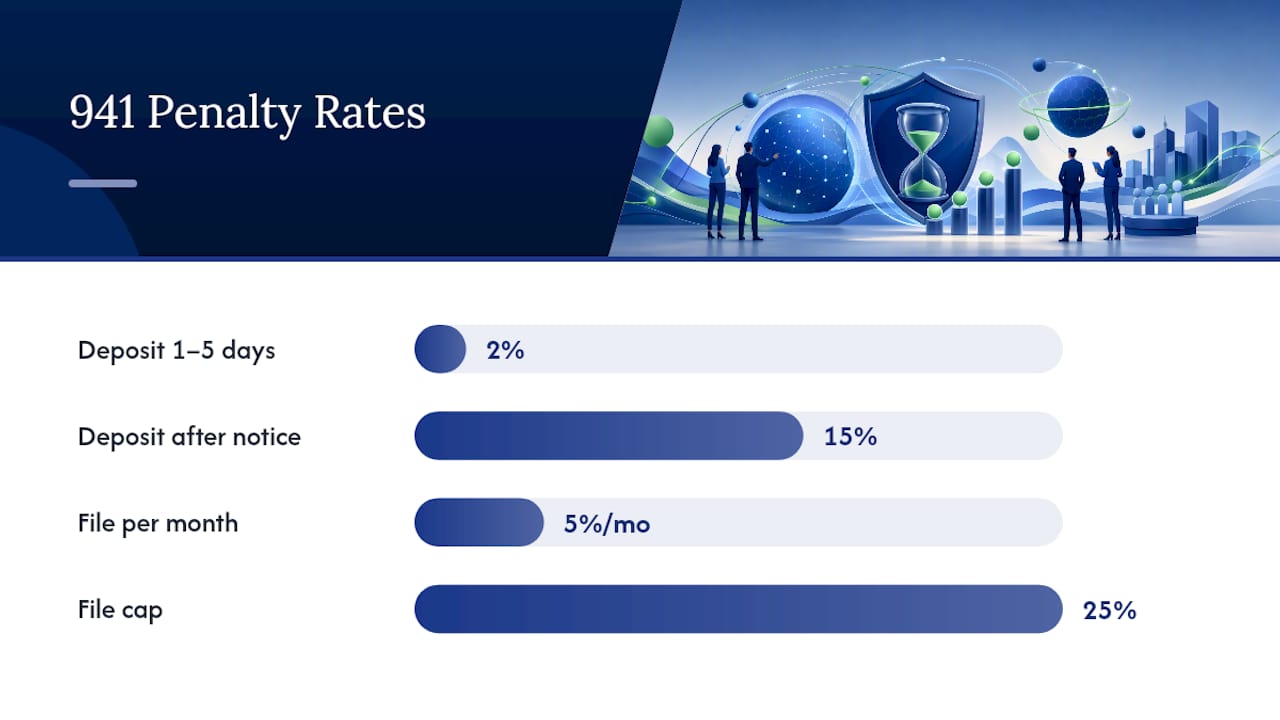
The failure-to-deposit penalty structure means a deposit that's just six days late can cost three times more than one that's four days late. That escalation curve is steep enough that catching an error on day one instead of day six genuinely changes the math.
Common employer errors that lead here:
- Assuming payroll pay frequency and IRS deposit frequency are the same thing.
- Leaning on the de minimis "pay with the return" fallback as a routine habit instead of an occasional safety valve.
- Scheduling EFTPS payments too close to the cutoff and missing same-day processing windows.
- Forgetting that a single oversized payroll run can trigger the $100,000 next-day rule mid-quarter.
If you discover a missed deposit or a late filing, deposit the amount owed immediately, document the reason in writing, and request penalty abatement if you have reasonable cause (a natural disaster, a documented system failure, or a first-time error with a clean prior history often qualifies).
Building Systems That Prevent Missed Deposits
The single most effective operational change most small employers can make is enrolling in Eftps and scheduling deposits electronically rather than relying on manual submissions. EFTPS removes the postmark question entirely, since electronic deposits confirm instantly and can be scheduled days ahead of the actual due date.
- Enroll in EFTPS as soon as you have an EIN, and schedule deposits at least one business day before the deadline to buffer against processing delays.
- Build a payroll calendar that separates pay dates from deposit due dates so nobody on your team confuses the two.
- Require two-person review on every deposit before submission, even in a small office; a second set of eyes catches transposed numbers and missed schedules.
- Reconcile payroll tax liability against actual deposits monthly, not just at quarter end, so discrepancies surface while they're still small.
Pro Tip: A monthly reconciliation habit catches a shorted deposit while it's still a small correction. Waiting until quarter end to reconcile often means discovering the error only after the failure-to-deposit penalty clock has already been running for weeks.
Employers generally land in one of three camps: manual in-house tracking with spreadsheets, payroll software that automates deposit calculations, or an outsourced payroll service that handles scheduling and filing on your behalf. For guidance on mapping your specific pay dates to deposit deadlines, Glendale Payroll's payroll date management guide walks through the calendar logic in detail.
Which Form 941 Revision Should You Use for 2026?
Use the March 2026 revision of Form 941 for every quarter of 2026, including any late or amended filings for prior periods within the year. The IRS periodically revises Form 941 when tax law changes, and filing an outdated version can delay processing or trigger a rejection notice.
- Download the current form and the Instructions for Form 941 (03/2026) directly from IRS.gov before each filing, since revisions can happen mid-year if legislation requires it.
- Confirm the revision date printed in the top corner of the form matches the current quarter's requirement before you submit.
- If you need a prior-year revision for an amended return, the IRS archives past versions on its forms and publications page; never substitute a current-year form for a historical filing.
Your Quarterly Form 941 Compliance Checklist
A repeatable quarterly rhythm keeps deposit and filing deadlines from sneaking up on you.
- Reconcile total payroll tax liability for the quarter against every deposit already made.
- Confirm your deposit schedule (monthly or semiweekly) still matches your current lookback-period totals.
- Schedule any remaining EFTPS deposits at least one business day ahead of their due dates.
- Gather Form 941 inputs: total wages, withheld income tax, Social Security and Medicare tax, and any adjustments.
- File by the quarterly due date, or by the 10-day extended date if every deposit that quarter was timely and complete.
Keep payroll records, deposit confirmations, and filed returns for at least four years, since the IRS can request documentation well after a quarter closes. A useful example timeline: biweekly paydays on the 1st and 15th generate semiweekly deposit deadlines the following Wednesday or Friday, all of which must clear before you assemble the quarter's Form 941 for the standard or extended due date. For California employers layering state obligations on top of federal ones, Glendale Payroll's 2026 California payroll tax updates covers how state deadlines interact with this federal calendar.
Why Small Employers Underestimate How Fragile This System Is
The 941 deposit-and-filing system looks simple on paper: four due dates a year, a deposit schedule, done. In practice, it's fragile in ways that don't show up until something breaks. A single oversized payroll run can trigger the $100,000 next-day rule without warning. A bookkeeper who leaves mid-quarter can take institutional knowledge of the deposit schedule with them. A postmark that arrives one day late can undo months of otherwise clean compliance.
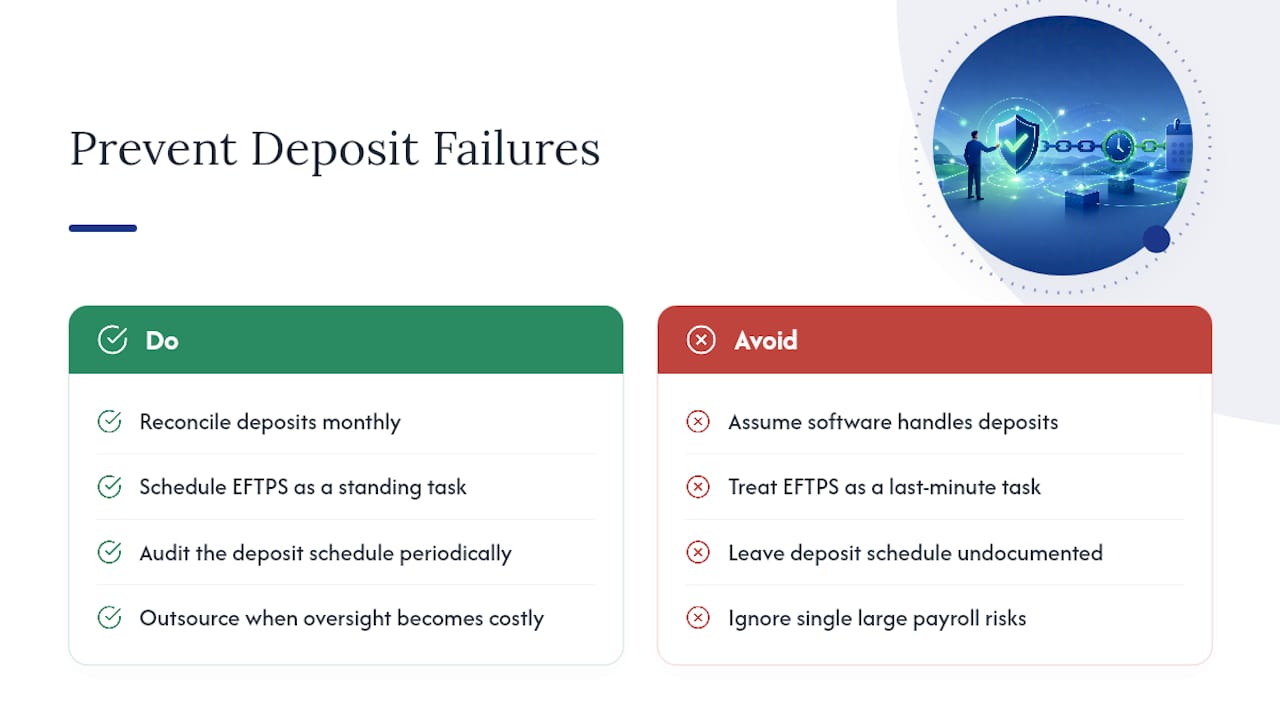
What surprises us most, working with employers across Glendale, Burbank, and Pasadena, is how often the failure isn't ignorance of the rules. It's the assumption that payroll software running quietly in the background means deposits are handled correctly. Software calculates; it doesn't catch a misclassified employee or a lookback period that shifted a depositor from monthly to semiweekly without anyone noticing.
Three practitioner habits consistently separate employers who never see a penalty notice from those who do: reconciling deposits against liability monthly instead of quarterly, treating EFTPS scheduling as a standing calendar task rather than a last-minute scramble, and running a periodic audit of the deposit schedule itself, not just the numbers going into it. Glendale Payroll builds its free comprehensive payroll audit around exactly that third gap, because it's the one employers are least equipped to catch on their own. Outsourcing makes the most sense once the cost of a single missed deposit or late filing starts to outweigh the cost of dedicated, ongoing oversight.
— Glendale Payroll Staff
Let Glendale Payroll Handle Your Deposit Schedule and Filings
A payroll service can manage your federal and California state filings, schedule your deposits, and flag schedule changes like the $100,000 next-day rule before they become penalties.

New clients may start with a free comprehensive payroll audit that maps deposit schedules, checks Form 941 history for errors, and identifies risk points specific to their business, regardless of location. Instead of relying on software that calculates numbers but may miss a misapplied lookback period, professional review of the whole picture is offered. If you're ready to stop tracking deposit deadlines manually, visit Glendale Payroll's services page to schedule your free audit, or explore California payroll compliance guidance built specifically for employers navigating both federal and state obligations at once.
Useful IRS Resources for Form 941 Compliance
Bookmark these primary sources for anything that changes between now and your next filing:
- Instructions for Form 941 (03/2026), for the current form revision and 10-day extension rule.
- Employment tax due dates, for the full IRS calendar.
- Tax Year 2026 94x MeF Forms return due dates, for the official quarterly due-date table.
- Topic No. 757, for deposit schedule and lookback-period rules.
- Eftps, to enroll and schedule federal tax deposits electronically.
This article is general information, not a substitute for advice from a qualified financial advisor. Consult a qualified financial professional about your own circumstances before acting on anything here.
Sources
- Instructions for Form 941 (03/2026)
- Tax Year 2026 94x MeF Forms return due dates
- Employment tax due dates
- Topic No. 757, Forms 941 and 944 – deposit requirements
- Eftps