
California employers must carry workers' compensation insurance regardless of how many employees they have, and that legal duty extends to accurate payroll reporting under rules set by the Workers' Compensation Insurance Rating Bureau of California (WCIRB), not the IRS. The two definitions diverge in ways that routinely trigger audit adjustments, premium overcharges, and compliance penalties. Getting your payroll classifications and remuneration figures right from the start is the most direct way to control your workers' comp costs.
Here is what the WCIRB includes and excludes when calculating your workers' compensation premium:
Included as payroll (remuneration):
- Gross wages and salaries
- Commissions and all bonuses
- Vacation, holiday, and sick pay
- Straight-time portion of overtime pay
- Most profit sharing
- Automobile allowances (less documented expense reimbursements)
- Market value of gifts
Excluded from payroll:
- Tips (prepaid or voluntary)
- Premium portion of overtime pay (the amount above the regular rate, when separately documented)
- Severance pay (except accrued vacation, sick pay, commissions, and bonuses)
- Employer contributions to qualified insurance, stock, or retirement plans
- Stock options
- Value of an employer-furnished automobile
- Employee discounts for merchandise and uniform allowances
The California Department of Workers' Compensation reinforces that payroll reporting accuracy is a regulatory duty, not a clerical formality. Errors expose your business to audit disputes, retroactive premium adjustments, and potential penalties.
Table of Contents
- How payroll classifications and limitations work in California workers' comp
- What counts as payroll under WCIRB rules
- How to report payroll for workers' compensation premiums
- Common compliance mistakes in California workers' comp payroll reporting
- Glendale Payroll takes the complexity out of workers' comp payroll compliance
- Key Takeaways
How payroll classifications and limitations work in California workers' comp
Classification codes are the foundation of every workers' compensation premium calculation. The WCIRB's Standard Classification System groups businesses by the type of work performed, and each code carries its own pure premium rate reflecting the risk level of that work. Assigning payroll to the wrong code, or failing to divide payroll across multiple codes when an employee performs different operations, directly inflates or distorts your premium.
Two categories of classifications require special attention because they carry payroll limits.
Classifications with maximum payroll limitations apply to executive officers, partners, individual employers, and members of limited liability companies. The California Basic Underwriting Manual, effective September 1, 2025, adjusted these minimum and maximum payroll limits to reflect wage inflation since the prior update. These caps mean that even if an executive officer earns well above the maximum, only the capped amount counts toward the premium calculation for their classification.
Classifications with minimum payroll limitations work in reverse. If an executive officer or owner earns below the minimum threshold, the premium is still calculated using the minimum figure. This prevents artificially low payroll from understating the exposure.
Dual wage classifications add another layer. These apply primarily to construction and erection work, where the classification code assigned to an employee depends on whether their regular hourly wage meets or exceeds a specified threshold. Employees earning at or above the threshold qualify for a lower-rated classification; those below it fall into the higher-rated one. The practical impact on premium can be significant, so you must verify and document each employee's regular hourly wage with original time cards or a valid collective bargaining agreement.
Key recordkeeping requirements for classification compliance:
- Maintain original time cards or time book entries showing operations performed, total hours per day, and start and stop times
- For collective bargaining agreements, keep an employee roster by job classification that reconciles individual employees to the agreement's wage rates
- Summaries must be verifiable against the original individual records, not derived from estimates or averages
What counts as payroll under WCIRB rules
Payroll for workers' compensation purposes is audited against the WCIRB's Uniform Statistical Reporting Plan (USRP), not your general ledger or IRS W-2 figures. The USRP explicitly states that workers' compensation payroll is not necessarily the same as the IRS definition of payroll, and that divergence is where most employers run into trouble.
Overtime pay is one of the most misunderstood items. The straight-time portion of overtime is always included as payroll. The premium portion (the extra half-time or double-time increment above the regular rate) is excluded, but only when your records separately document, by employee and by operation, either the remuneration earned at regular rates for all hours worked and the premium portion, or the regular-rate pay for non-overtime hours and total pay for overtime hours. Without those records, all overtime pay counts as payroll.
Automobile allowances are included less any documented expense reimbursements. If you provide a flat monthly car allowance without tracking actual business expenses, the full allowance is payroll.
Meals and lodging follow the classification phraseology. Free meals provided to employees are generally excluded, but meals purchased by the employee from the employer (shown as a payroll deduction) are included. Lodging is included when the classification rules specifically require it or when it is provided in lieu of wages.
Pro Tip: Review your payroll register against the WCIRB's Appendix II, Payroll/Remuneration Table in the USRP, at least once per policy period. It lists virtually every compensation type and tells you whether it counts as payroll, which removes guesswork before an audit.
How to report payroll for workers' compensation premiums
Accurate reporting starts with assigning each employee's payroll to the correct classification code based on the work they actually perform. The State Compensation Insurance Fund (State Fund) requires you to report the number of employees and gross wages per assigned class code, and the WCIRB's classification rules make clear that correct code assignments are foundational to premium accuracy.
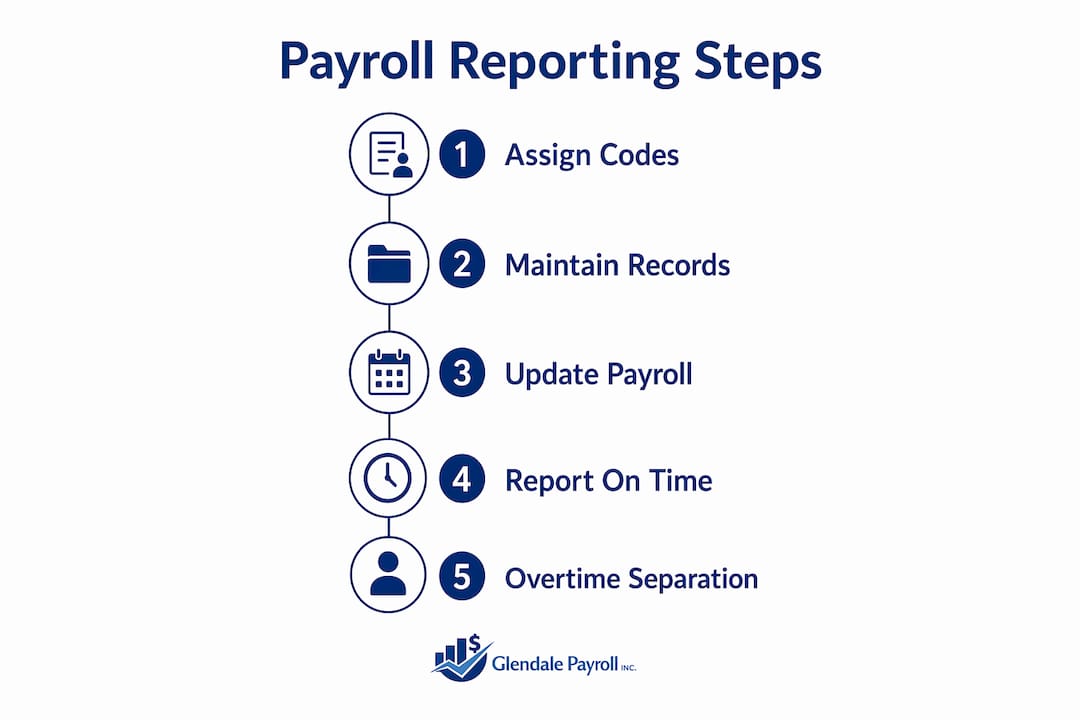
Step 1: Assign classification codes by operation. If an employee performs only one type of work, assign all their payroll to that code. If they perform multiple operations, you must divide their payroll across the applicable codes using specific time records, not estimates or percentages.

Step 2: Maintain contemporaneous time records. The WCIRB's USRP requires that records be original and contemporaneous, summarized by operation, and verifiable against individual employee records. A spreadsheet built from memory at audit time does not meet this standard.
Step 3: Handle payroll changes during the policy period. Raises, reclassifications, and seasonal workforce changes all affect your premium. When an employee receives a raise that pushes their hourly rate above a dual wage classification threshold, update their classification assignment prospectively and document the change date. For payroll process reviews, quarterly reconciliations catch these shifts before they become audit surprises.
Step 4: Report on time. State Fund billing plans vary by policy size. Policies with a base premium of $5,000 or more may use monthly payroll reporting and payment or a stipulated billing plan with semi-annual payroll reporting. Smaller policies typically use annual or semi-annual reporting. Late or inaccurate submissions risk penalties and audit exposure.
Step 5: Separate the premium portion of overtime. Before submitting each payroll report, confirm that your payroll system tracks regular-rate pay and overtime premium pay separately by employee and operation. If it does not, the full overtime amount is included in your reportable payroll.
A practical example: an employee earns $4,000 in straight-time wages and $600 in overtime during a reporting period, of which $200 is the premium portion. If your records document the split, you report $4,400 as payroll ($4,000 plus $400 straight-time equivalent). Without those records, you report the full $4,600.
Common compliance mistakes in California workers' comp payroll reporting
The most expensive mistake California employers make is treating workers' compensation payroll the same as IRS payroll. The WCIRB's FAQ guidance identifies this confusion as a leading cause of audit adjustments. Stock options, employer retirement contributions, and the premium portion of overtime are excluded from workers' comp payroll but may appear in your IRS-defined compensation figures. Pulling numbers directly from your W-2 totals without adjustment almost guarantees a discrepancy.
The second most costly error is inadequate time records. When an employee performs work across multiple classification codes and you cannot produce original, contemporaneous time records, the WCIRB's USRP rule is unambiguous: the entire payroll defaults to the highest-rated classification applicable to any part of that employee's work. For a business with employees who split time between office work and field operations, that default can multiply the premium for a significant share of your workforce.
Compliance Alert: Payroll may not be divided by percentages, averages, or estimates under any circumstances. Only specific, verifiable time records support a payroll division between classifications.
Dual wage classification errors are the third major pitfall. Misidentifying an employee's regular hourly wage, or failing to document it properly, can push their payroll into the higher-rated classification tier even when they qualify for the lower one. The cost difference between the two tiers in construction classifications can be substantial.
Best practices to stay audit-ready:
- Reconcile your workers' comp payroll figures against WCIRB definitions quarterly, not just at renewal
- Keep original time cards for at least the duration of the policy period plus any applicable audit window
- Separate overtime premium pay in your payroll system at the point of processing, not retroactively
- Review dual wage classification thresholds annually, since they can change with WCIRB rule updates
- Use job hazard analysis tools to document employee operations, which supports both safety compliance and classification accuracy
- Cross-check your classification codes against the WCIRB's published pure premium rates each policy year
For a structured approach to audit preparation, documenting your payroll division methodology before an auditor requests it is far less disruptive than reconstructing records under pressure.
Glendale Payroll takes the complexity out of workers' comp payroll compliance
California workers' compensation payroll rules are detailed enough that even experienced HR teams miss the WCIRB-specific exclusions and recordkeeping requirements that trigger audit adjustments. Glendale Payroll is built for exactly this situation.

Unlike generalist payroll providers staffed by call centers, Glendale Payroll assigns dedicated payroll professionals who understand California's WCIRB classification rules, dual wage thresholds, and USRP recordkeeping standards. Every new client receives a free comprehensive payroll audit that identifies misclassifications, overtime reporting gaps, and IRS-versus-WCIRB definition mismatches before they cost you money. Glendale Payroll serves employers across Glendale, Burbank, Pasadena, and Greater Los Angeles, with a focus on 100% compliance with California's workers' comp and payroll tax requirements. For California payroll compliance support tailored to your business, schedule your free audit with Glendale Payroll today.
Key Takeaways
Accurate California workers' compensation payroll reporting requires WCIRB-specific definitions, contemporaneous time records, and correct classification codes, not IRS payroll figures.
| Point | Details |
|---|---|
| WCIRB definitions govern | Workers' comp payroll is not the same as IRS payroll; exclusions include tips, stock options, and the premium portion of overtime when separately documented. |
| Time records are mandatory | Without original, contemporaneous time records, all employee payroll defaults to the highest-rated classification, inflating your premium. |
| Dual wage thresholds matter | Construction classification assignments depend on verified regular hourly wages; missing documentation forces the higher-rated tier. |
| Overtime must be split | The premium portion of overtime is excluded only when records separately document regular-rate and overtime-premium pay by employee and operation. |
| Glendale Payroll | Provides a free payroll audit and dedicated California compliance professionals to correct classification errors before they trigger audit adjustments. |