
DE 88 is the payroll tax deposit coupon California employers use to pay Unemployment Insurance (UI), Employment Training Tax (ETT), State Disability Insurance (SDI) withholding, and Personal Income Tax (PIT) withholding to the EDD. The fastest, most reliable way to submit one is through EDD e-Services for Business, with Express Pay as a solid backup for one-time payments. DE 88 only records deposits; your DE 9 reconciles the actual quarterly liability, and errors on either form can trigger penalties if you don't correct them quickly.
TL;DR:
- Submitting DE 88 payments via e-Services for Business is the most reliable method, with Express Pay as a quick alternative for single deposits.
- The pay date on the form must reflect the actual payment date, as it determines the applicable quarter and affects reconciliation.
- Errors such as incorrect deposit schedules or misreading payment sources often cause processing delays or penalties if not corrected promptly.
- Mistakes like underpayments or overpayments should be addressed before filing the DE 9, either by submitting a corrected deposit or claiming a credit during reconciliation.
- Scheduling deposits a day or two early and retaining confirmation numbers helps prevent penalties and ensures timely processing, especially during high-volume periods.
Table of Contents
- How Do You Submit a DE 88 Payment?
- What Information Belongs on a DE 88 Payment?
- When Is a DE 88 Payment Required?
- How Do You Correct an Underpaid or Overpaid DE 88?
- What Penalties Apply to Late or Incorrect DE 88 Payments?
- DE 88 Payment Checklist: Complete, Submit, Verify
- A Payroll Professional's View on Avoiding DE 88 Errors
- Get Help With DE 88 Payments and Payroll Compliance
- Official EDD Resources for DE 88 Payments
- Sources
- FAQ
How Do You Submit a DE 88 Payment?
You have three practical options, and two of them are strongly preferred over the third.
- e-Services for Business. Log into your account, select Make a Payment, then choose Pay and Report Payroll Taxes (DE 88). Enter the payment period, select your payment source (bank account or credit card), input the pay date, break out amounts by tax type, then review and submit. Save the confirmation number immediately.
- Express Pay. This lets you pay without enrolling in a full e-Services account, using either EFT or a credit card through ACI Payments Inc. Express Pay works well for a quick one-off deposit, but credit card transactions carry a processing fee.
- DE 88ALL mail coupon. Mailing a paper coupon is only appropriate if you hold an approved e-file/e-pay waiver. Everyone else is required to file and pay electronically. Paper submissions without a waiver can draw a penalty rather than avoid one.
Most processing headaches trace back to selecting the wrong bank account type or misreading the payment source options. If your bank rejects an ACH debit because of a routing number mismatch, you'll need to resubmit, and that delay can push you past your due date.
What Information Belongs on a DE 88 Payment?
The pay date is the single most important field on the form. It's the date wages were actually paid, not the date you're submitting the deposit, and it determines which quarter the payment applies to for DE 9 reconciliation.
Beyond the pay date, you need to allocate the total deposit across four categories:
- UI (Unemployment Insurance) contribution amount
- ETT (Employment Training Tax) amount
- SDI (State Disability Insurance) withholding
- PIT (Personal Income Tax) withholding
Any penalty or interest owed from a prior deposit gets entered as a separate line item, not folded into your current tax amounts. One structural quirk trips up a lot of employers: DE 88 doesn't accept negative numbers. You cannot enter a credit directly on the form to offset an overpayment. That has to happen on a later deposit or get resolved through your DE 9 reconciliation instead.
Pro Tip: Before you submit, double-check that you selected the correct deposit schedule for your account. A single wrong click here can misalign your entire quarter's reporting, even if every dollar amount is accurate.
When Is a DE 88 Payment Required?
Your deposit frequency depends on the same federal deposit schedule that governs your payroll taxes with the IRS. If you're a monthly depositor federally, you generally deposit SDI and PIT withholding monthly as well. If you're on a semiweekly or next-day federal schedule, your California deposits follow that same accelerated cadence.
A few distinctions matter here:
- Pay date vs. pay period. The quarter a deposit belongs to is set by the pay date, not the period the wages were earned in. A late December pay date for hours worked earlier in the month still counts toward that quarter.
- DE 9 is the reconciliation, DE 88 is the running tally. Your DE 9 reports and reconciles the full quarterly liability; DE 88 deposits accumulate against that liability throughout the quarter.
- Waivers change your paperwork, not your deadlines. If you hold an approved e-file/e-pay waiver, you'll receive DE 88ALL coupons by mail, but your deposit due dates stay the same as everyone else's.
How Do You Correct an Underpaid or Overpaid DE 88?
Mistakes happen, and the fix depends on timing relative to your DE 9 filing.
- Underpayment discovered before DE 9 is filed. Submit another DE 88 for the difference, using the correct original pay date. Penalty and interest will likely apply to the shortfall, but paying promptly limits how much accrues.
- Overpayment discovered before DE 9 is filed. Subtract the overpaid amount from your next scheduled DE 88 deposit. If you can't subtract it cleanly, claim the credit on your DE 9 instead.
- Funds applied to the wrong tax type. Many misallocations between UI, ETT, SDI, and PIT sort themselves out automatically during DE 9 reconciliation. If a misapplied payment is large or the quarter has already closed, contact the EDD directly rather than waiting.
- Need to move, split, or reschedule a payment? e-Services for Business includes options to adjust pending payments and, in qualifying situations, set up a payment plan without a phone call.
What Penalties Apply to Late or Incorrect DE 88 Payments?
A key figure to know: EDD guidance commonly references a 15% penalty for late payroll tax payments, on top of interest that accrues on the unpaid balance.
EDD doesn't process most corrections automatically. If you underpay, expect an account statement or assessment rather than a quiet adjustment on their end. The safest habit is scheduling deposits a few days ahead of your actual deadline, verifying the pay date and tax-type totals before you submit, and saving every confirmation number in a dedicated folder. If a disaster declaration affects your area, ask about a filing extension or penalty waiver before your due date passes, not after.
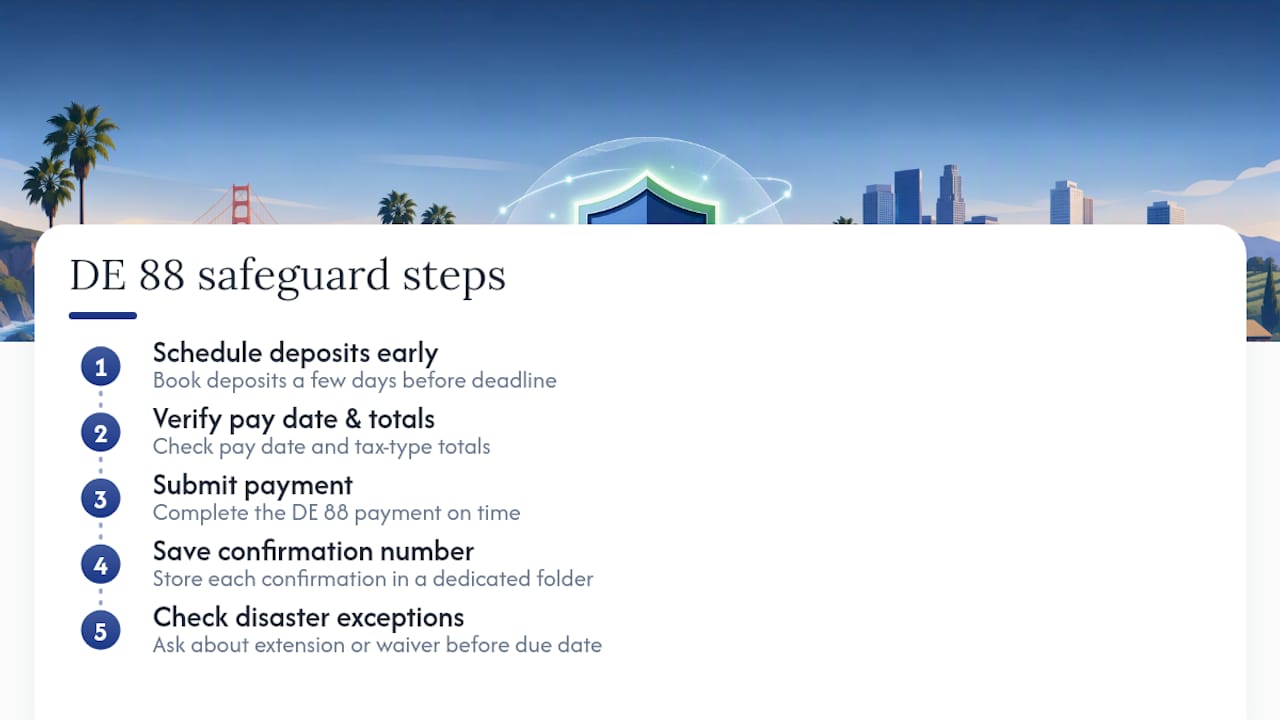
DE 88 Payment Checklist: Complete, Submit, Verify
Run through this sequence every time, especially if you're not filing weekly.
- Before you submit: Confirm your EDD account number, bank routing and account numbers, current deposit schedule, exact pay date, and totals for UI, ETT, SDI, and PIT.
- During submission: Choose e-Services or Express Pay, re-check the total amount against your payroll register, and submit.
- Immediately after: Save or screenshot the confirmation number and note the expected bank debit date.
- Within a few days: Verify the debit hit your bank account on schedule, then reconcile the deposit against your payroll records.
- If something's off: Document the discrepancy immediately and start the correction process rather than waiting for your DE 9 to surface it.
Pro Tip: Submit your DE 88 a day or two before the actual deadline whenever possible. EDD's system and your bank's processing window both need time, and a same-day submission leaves zero room for a technical hiccup.
A Payroll Professional's View on Avoiding DE 88 Errors
Most DE 88 problems during a free payroll audit come down to two things: a mistyped pay date or a deposit schedule that no longer matches the business's actual payroll volume. Both are quiet errors. They don't announce themselves until an EDD notice shows up months later, and penalty and interest have already accrued. A second set of eyes on your deposit schedule, run once a year, catches these before they become expensive.
— Glendale Payroll Staff
Get Help With DE 88 Payments and Payroll Compliance
Between pay dates, deposit schedules, tax-type allocations, and the ever-present risk of a penalty for one wrong entry, DE 88 leaves very little room for error, and Glendale Payroll built its service around closing that gap. Instead of routing your account to a call center, some payroll services assign dedicated payroll professionals who handle your filings directly and start every new relationship with a free payroll audit to catch timing or allocation mistakes before the EDD does.

If your DE 88 deposits, deposit schedule, or EDD account setup need a second look, explore payroll services in Glendale, CA or review the California payroll compliance guide to see how a professional audit works. Scheduling that free audit is the fastest way to find out whether your current process is exposing you to penalties you don't know about yet.
Official EDD Resources for DE 88 Payments
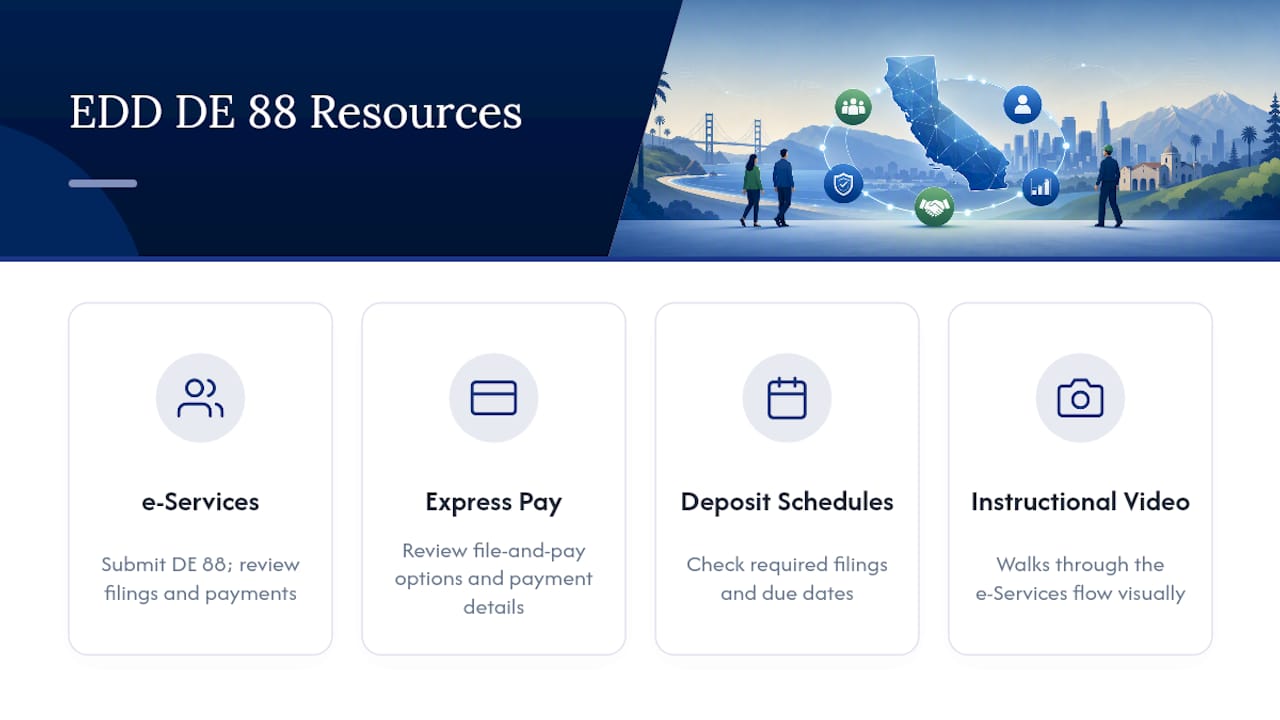
For step-by-step instructions straight from the source, use e-Services for Business for submissions, review file and pay options for Express Pay details, and check required filings and due dates for deposit schedules. The EDD's own
walks through the e-Services flow visually.FAQ
What Is a DE 88 Payment?
A DE 88 payment is a payroll tax deposit California employers submit to the EDD to pay UI, ETT, SDI withholding, and PIT withholding, typically through e-Services for Business or Express Pay.
Who Pays the Majority of Payroll Taxes in the US?
Employers and employees share responsibility for most federal and California payroll taxes, with employers directly responsible for depositing withheld amounts like SDI and PIT through vehicles such as DE 88, alongside their own UI and ETT contributions.
What Is the 110% Rule for Estimated Tax Payments?
The 110% rule is a federal safe-harbor provision letting higher-income taxpayers avoid an underpayment penalty by paying at least 110% of the prior year's tax liability; it applies to individual estimated taxes, not to DE 88 payroll deposits.
What Is a US Payroll Payment?
A payroll payment in the US covers wages paid to employees along with the associated tax deposits, such as federal withholding and California's DE 88 deposits for UI, ETT, SDI, and PIT.
How Do I Know My DE 88 Payment Was Received?
Check your e-Services for Business account for a confirmation number and payment status immediately after submitting, then confirm the corresponding debit posted to your bank account within the expected timeframe.