
Direct deposit payroll is defined as the electronic transfer of employee wages directly into bank accounts via the Automated Clearing House (ACH) network, replacing paper checks entirely. The ACH network processes these payments as batch file transfers, bundling multiple transactions together to reduce costs and remove manual intervention. For small business owners in California and across the country, understanding this system is not optional. It affects your cash flow timing, your compliance obligations, and your employees' trust in you as an employer. Glendale Payroll works with businesses in Glendale, Burbank, Pasadena, and Greater Los Angeles to manage exactly these details, and the fundamentals covered here apply to any small business setting up or auditing its payroll process.
How does direct deposit payroll work, step by step?
The direct deposit process begins when you run payroll and your payroll system generates a payment file. That file contains each employee's bank routing number, account number, payment amount, and pay date. Your bank or payroll provider submits this file to the ACH network as a batch, typically one to two business days before the scheduled payday.
The ACH network routes each transaction to the receiving bank. Standard ACH processing requires submission one to two business days before payday, with funds available by 9:00 AM on payday when that window is met. Missing that window by even a few hours can push payment to the next business day.

The prenote process
Before the first live payroll run for a new employee, most payroll systems send a prenote test transaction. This is a zero-dollar deposit that verifies the employee's banking information is valid before any real money moves. The prenote catches errors like transposed routing numbers or closed accounts before they cause a failed payment. Skipping this step is one of the most common reasons first payroll runs fail.
Timing around weekends and holidays
Payroll schedules must account for bank holidays and weekends, since ACH transactions only process on business days. If your regular payday falls on a Monday holiday, you must submit the payroll file by the prior Thursday to meet the two-day window. Some banks offer early direct deposit, giving employees access to funds up to two days before the official payday based on their internal processing. That early access is a short-term advance pending final ACH settlement, not a guaranteed feature of every bank.
Pro Tip: Build your payroll calendar at the start of each year by marking all federal and California state banking holidays. Submit payroll one day earlier than usual whenever a holiday falls within the two-day ACH window.
Paper checks, by contrast, require printing, signing, mailing or hand delivery, and manual bank deposits. Each of those steps adds time and cost that ACH eliminates entirely.
How to set up direct deposit payroll for your small business
Setting up direct deposit starts with confirming that your business bank account supports ACH transactions. Most commercial checking accounts do, but you should verify this with your bank before committing to a payroll schedule.
Your next decision is whether to process ACH transactions directly through your bank or through a payroll provider. Banks offer lower per-transaction fees but require you to manage file formatting and submission manually. Payroll providers handle file generation, submission timing, and error reporting automatically, which reduces the risk of formatting errors that trigger ACH rejections.
Collecting employee banking information
Employers must collect a signed direct deposit authorization form from each employee before initiating any transfer. That form must capture:
- Bank name (for verification purposes)
- Account type (checking or savings)
- Routing number (nine digits, specific to the bank and region)
- Account number (unique to the employee's account)
- Employee signature and date (required for legal authorization)
Modern payroll systems offer employee self-service portals where employees enter their own banking details directly. This reduces transcription errors and keeps sensitive data out of paper forms that can be lost or mishandled.
Pro Tip: Store signed authorization forms in a secure, access-controlled location. California labor law requires you to maintain payroll records for a minimum of three years, and authorization forms are part of that record.
Data security is not optional here. Routing and account numbers are enough to initiate unauthorized transactions. Limit access to this data to payroll administrators only, and use encrypted storage for any digital records.
You also need to set your payroll funding date carefully. Businesses remain responsible for having sufficient funds in the payroll account before the scheduled ACH debit, even when using a third-party payroll provider. Your provider submits the file, but you are the payer. If your account lacks funds on the debit date, the entire payroll run fails.
What are the key benefits of direct deposit payroll?
Direct deposit saves costs on paper checks, postage, and manual processing labor while improving security and payment speed. For a small business running biweekly payroll, those savings add up across printing supplies, envelope costs, and the staff time spent distributing checks.
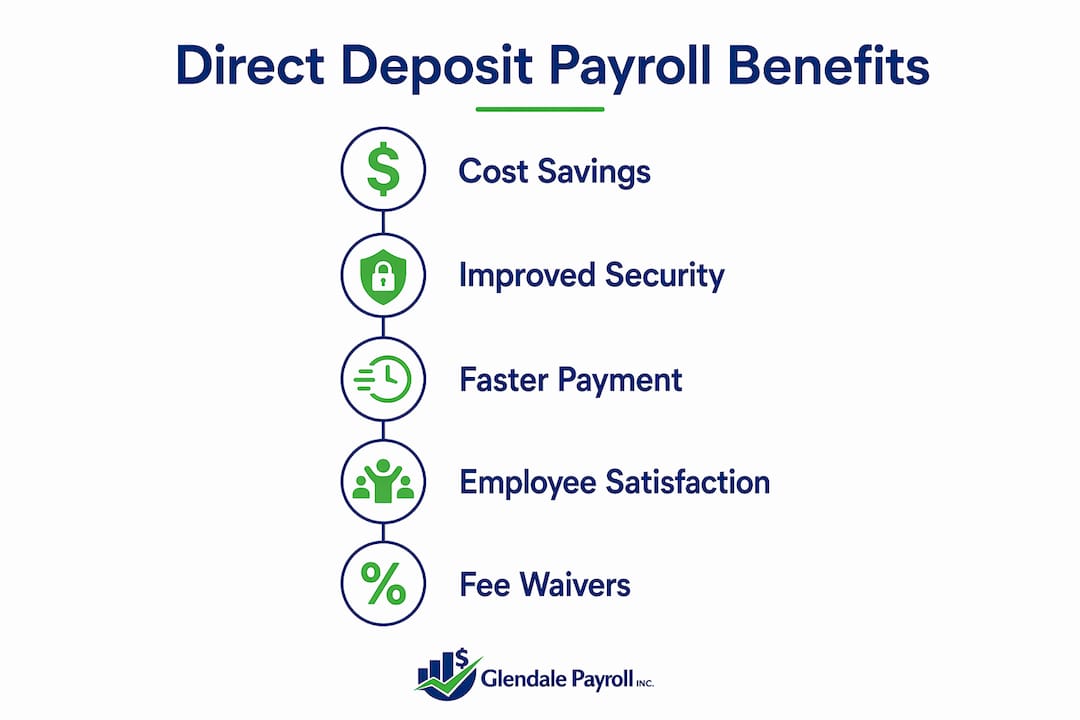
The security advantages are significant. Paper checks can be lost in the mail, stolen, or altered. ACH transfers move funds electronically between verified accounts, with no physical document to intercept. Fraud through check washing and forgery is a real risk for businesses that still use paper; direct deposit eliminates both.
Employees benefit directly as well. Faster access to wages improves satisfaction and reduces the number of payroll inquiries your HR or admin staff handles each pay period. Split deposits allow employees to allocate portions of their paycheck to multiple accounts, which many employees use to automate savings. This feature depends on your payroll provider's capabilities and regional banking rules, so confirm availability before advertising it to your team.
Some banks offer fee waivers or reduced service charges for accounts that receive regular direct deposits. Encouraging employees to set up direct deposit can actually save them money on monthly banking fees, which is a genuine benefit worth communicating during onboarding.
Common challenges and compliance issues in direct deposit payroll
Failed payments are the most disruptive problem in direct deposit payroll. They happen when employee banking information is incorrect, an account has been closed, or the account structure does not match what was submitted. ACH return codes like R03 and R04 identify the specific failure type. R03 means the account was not found; R04 means the account number structure is invalid. Both require manual resolution and delay the employee's payment.
Common sources of payroll errors and compliance risks include:
- Incorrect banking data entered during onboarding, often from misread handwritten forms
- Closed or changed accounts when employees switch banks without notifying payroll
- Skipped prenote verification, which allows bad account data to reach a live payroll run
- Miscalculated submission timing around holidays or weekends, causing late payments
- Missing or unsigned authorization forms, which expose the employer to legal liability
- Insufficient account funds on the ACH debit date, causing the entire payroll batch to fail
The prenote process directly prevents the first three issues on that list. Prenote zero-dollar tests catch banking errors early and minimize payroll disruptions before real money is at risk.
From a compliance standpoint, California employers face additional obligations. You must provide itemized wage statements on each payday, and late or failed payments can trigger waiting time penalties under California Labor Code Section 203. Those penalties accrue daily until the employee is paid in full. A single missed payroll run can cost more in penalties than the entire annual cost of a payroll provider.
Payroll audit preparation requires maintaining complete records of authorization forms, payroll registers, and ACH transaction confirmations. If the EDD or IRS audits your payroll, those records are your primary defense.
Key Takeaways
Direct deposit payroll is the most cost-effective, secure, and legally defensible way for small businesses to pay employees, provided the ACH timing, authorization, and data accuracy requirements are met consistently.
| Point | Details |
|---|---|
| ACH timing is non-negotiable | Submit payroll files 1–2 business days before payday to guarantee funds by 9:00 AM. |
| Prenotes prevent first-run failures | Always send a zero-dollar test transaction before the first live deposit for any new employee. |
| Authorization forms are a legal requirement | Collect signed forms with bank name, account type, routing number, and account number before processing. |
| Return codes require fast action | R03 and R04 failures need manual resolution; delayed action means delayed employee payment. |
| Employer funding responsibility stays with you | Your payroll account must hold sufficient funds before the ACH debit date, regardless of who submits the file. |
What I've learned from watching small businesses manage direct deposit
The biggest mistake I see small business owners make is treating direct deposit as a "set it and forget it" system. They hand off payroll to a provider, assume everything runs automatically, and stop paying attention to the details. That works fine until an employee changes banks, a holiday shifts the submission deadline, or an account gets flagged with an R04 return code at 8:00 PM the night before payday.
Understanding the full ACH process, even at a high level, changes how you manage payroll. You start checking your payroll account balance two days before the debit date instead of the morning of. You build a holiday-adjusted payroll calendar in january instead of scrambling in november. You make prenote verification a non-negotiable step during employee onboarding instead of an optional one.
The compliance dimension matters just as much. California's waiting time penalties are not theoretical. I have seen businesses absorb thousands of dollars in penalties from a single late payroll run that could have been avoided with a better submission schedule. Aligning payroll schedules with banking calendars is not just good practice. It is a direct cost-control measure.
My strongest recommendation is to treat your payroll process as a documented system, not a recurring task. Write down your submission deadlines, your funding dates, your authorization form storage process, and your error-resolution steps. When something goes wrong, and eventually something will, that documentation is what gets you back on track quickly and keeps you compliant.
— Glendale Payroll Staff
How Glendale Payroll supports your direct deposit setup
Glendale Payroll specializes in direct deposit payroll setup and ongoing management for small businesses across Glendale, Burbank, Pasadena, and Greater Los Angeles. Every client account is handled by a dedicated payroll professional, not a call center, so you get accurate answers about ACH timing, authorization requirements, and California-specific compliance obligations.

Glendale Payroll's free payroll audit identifies gaps in your current process before they become penalties. From California payroll compliance requirements to ACH submission scheduling, the team manages the details that protect your business. Visit Glendale Payroll's services page to learn how the firm handles direct deposit payroll for businesses like yours, or review the payroll tips for California small businesses for practical guidance you can apply immediately.
FAQ
What is direct deposit payroll?
Direct deposit payroll is the electronic transfer of employee wages into bank accounts via the ACH network, replacing paper checks. Employers submit a payment file to their bank or payroll provider, which routes funds to each employee's account.
How long does direct deposit processing take?
Standard ACH processing takes one to two business days, with funds available by 9:00 AM on payday when submitted within that window. Some banks offer early access up to two days before the official payday.
What information do employees need to provide for direct deposit?
Employees must submit a signed authorization form with their bank name, account type, routing number, and account number. Modern payroll systems allow employees to enter this data directly through a self-service portal.
What happens if a direct deposit payment fails?
Failed payments generate ACH return codes such as R03 (account not found) or R04 (invalid account structure), requiring manual resolution and causing payment delays. Running a prenote test before the first payroll deposit prevents most first-run failures.
Is direct deposit required by law in California?
California law does not require employers to use direct deposit, but it does require employee consent before enrolling them. Employers must also provide itemized wage statements on each payday, and late payments trigger waiting time penalties under California Labor Code Section 203.
Recommended
- Why Direct Deposit Benefits Your Employees and Your Business | Glendale Payroll Inc.
- Payroll Process Documentation: A Guide for Small Business | Glendale Payroll Inc.
- How Payroll Automation Saves Small Businesses Time and Money | Glendale Payroll Inc.
- Employee Self-Service Payroll Setup: A 2026 Guide | Glendale Payroll Inc.