
Every equity taxable event — a vest, an exercise, a disqualifying disposition, a payment — is a payroll event. Treat it as wages for federal income tax withholding and FICA unless a specific statutory exception applies, withhold using either the aggregate method or the supplemental flat rate: 22% for supplemental wages up to $1,000,000 and 37% for amounts over $1,000,000, deposit on your established schedule or by the next banking day if accumulated employment taxes reach $100,000, and report amounts on Form W-2, Form 941, and any required information returns. That is the core rule for equity compensation payroll reporting, and everything else in this guide builds on it.
Key authorities to keep at your desk:
- IRS Publication 15 (Circular E): supplemental wage withholding rules and deposit schedules
- IRC §83: defines the taxable event for stock transferred subject to restrictions
- Instructions for Forms W-2 and W-3: box-by-box mapping for equity income and Code V
- Glendale Payroll: hands-on compliance support for teams that need a dedicated partner
Immediate action checklist for any equity event in your queue:
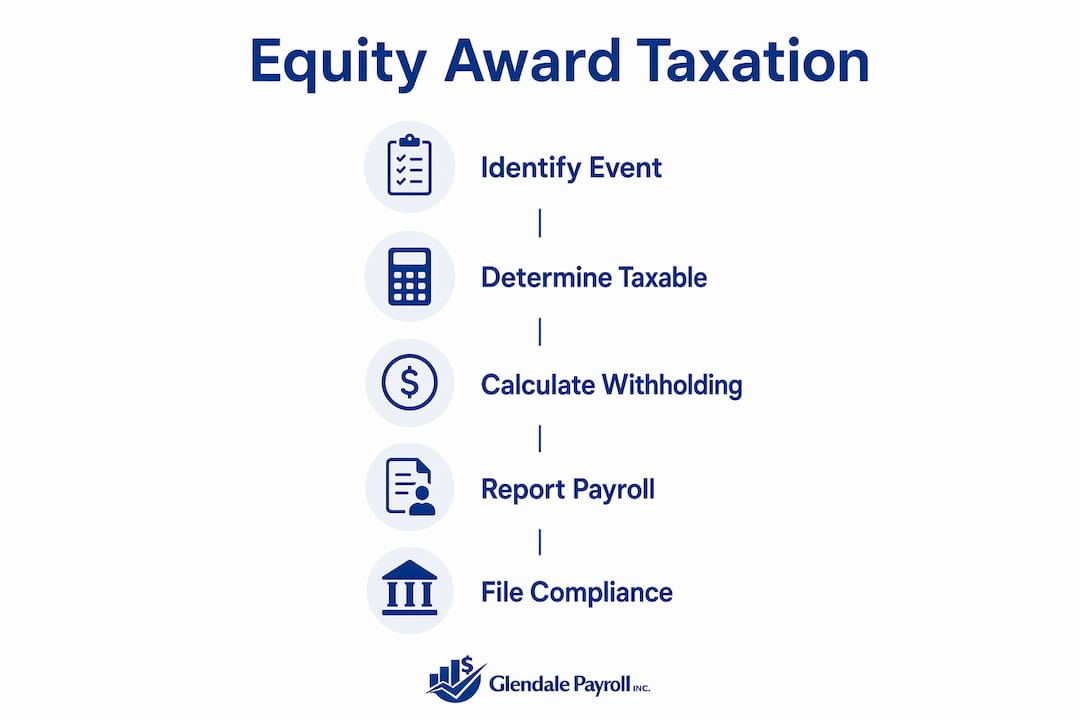
- Identify the event type (vest, exercise, ESPP purchase, disposition) and confirm the taxable date.
- Select the withholding method: aggregate or flat supplemental rate.
- Check whether accumulated employment taxes will hit $100,000 — if so, the next-day deposit rule applies.
- Post the transaction to the payroll ledger and flag it for pre-W-2 reconciliation.
Table of Contents
- How is each type of equity award taxed, and when does payroll act?
- What are your withholding options, and how do you calculate them?
- When is FICA due, and what triggers a next-day deposit?
- How do state withholding rules affect equity events for mobile employees?
- How do equity compensation items map to payroll forms?
- How do you build controls that hold up in an IRS exam?
- What withholding policies should your team standardize?
- Operational checklist for every equity event
- Key Takeaways
- What payroll teams often get wrong about equity compliance
- Glendale Payroll makes equity payroll compliance manageable
- Authoritative sources and further reading
How is each type of equity award taxed, and when does payroll act?
The taxable event and the payroll obligation differ by instrument. Getting this mapping right is the first step in any compliant equity compensation reporting process.
| Award Type | Taxable Event | Income Character | Payroll Taxes | Key Reporting |
|---|---|---|---|---|
| NQSO | Exercise | Ordinary income = spread (FMV minus exercise price) | FIT withholding, SS, Medicare, Additional Medicare if applicable | W-2 Boxes 1, 3, 5, 12 (Code V) |
| RSU | Delivery/vest | Ordinary income = FMV × shares delivered | FIT withholding, SS, Medicare | W-2 Boxes 1, 3, 5 |
| RSA (no §83(b)) | Restriction lapse | Ordinary income = FMV at lapse | FIT withholding, SS, Medicare | W-2 Boxes 1, 3, 5 |
| RSA (§83(b) filed) | Grant date | Ordinary income = FMV at grant | FIT withholding, SS, Medicare at grant | W-2 in grant year |
| ISO — qualifying | No regular income at exercise | No ordinary income; potential AMT | No withholding at exercise | Form 3921 required |
| ISO — disqualifying disposition | Sale before holding period | Ordinary income = lesser of spread or gain | FIT withholding, SS, Medicare | W-2; Form 3921 |
| ESPP — qualifying | Sale | Ordinary income = discount portion | No withholding at purchase | Form 3922; W-2 at sale |
| ESPP — disqualifying | Sale before holding period | Ordinary income = spread at purchase | FIT withholding, SS, Medicare | W-2; Form 3922 |
| SAR (cash-settled) | Settlement | Ordinary income = cash paid | FIT withholding, SS, Medicare | W-2 Boxes 1, 3, 5 |
| Phantom Stock | Payment | Ordinary income = payment amount | FIT withholding, SS, Medicare | W-2 |
A few points deserve extra attention. Under IRC §83, the fair market value of stock transferred when restrictions lapse is ordinary income at that moment — so for RSAs without a §83(b) election, the clock starts at lapse, not grant. For ISOs, the absence of regular withholding at exercise does not mean payroll is off the hook: you must still file Form 3921 by January 31 of the year following exercise, and a disqualifying disposition converts the spread into wages that require immediate W-2 treatment. Equity compensation tax treatment by instrument is one of the most common sources of misclassification errors in payroll audits.
Partnership interests and profits interests follow different rules under IRC §83 and related guidance, and FICA treatment can vary. When your company grants these instruments, escalate to tax counsel before processing.
What are your withholding options, and how do you calculate them?
The two federal methods
IRS Publication 15 permits two approaches for supplemental wages like equity income:
-
Aggregate method. Combine the equity income with the employee's regular wages for the payroll period, apply the W-4 withholding tables to the total, then subtract the withholding already computed on regular wages. The result is the withholding on the equity portion. This method is required when the employer has not withheld income tax from the employee's regular wages in the current or prior year.
-
Flat supplemental rate. Withhold at 22% on supplemental wages up to $1,000,000 cumulative for the year, and at 37% on any amount above that threshold. This is the simpler path for most equity events and the default choice for off-cycle transactions.
Worked example: RSU vest
An employee vests in 500 RSUs. The closing FMV on the vest date is $40.00 per share.
- Taxable wage: 500 × $40.00 = $20,000
- Federal income tax (flat rate): $20,000 × 22% = $4,400
- Social Security (6.2%, assuming wage base not yet exceeded): $20,000 × 6.2% = $1,240
- Medicare (1.45%): $20,000 × 1.45% = $290
- Total withholding: $5,930
- Net shares delivered (if net-share settlement): $5,930 ÷ $40.00 = 148.25 shares withheld (round up to 149); employee receives 351 shares.
Worked example: NQSO exercise
An employee exercises 1,000 NQSOs with an exercise price of $10.00. The FMV on the exercise date is $35.00.
- Spread (taxable wage): ($35.00 − $10.00) × 1,000 = $25,000
- Federal income tax (flat rate): $25,000 × 22% = $5,500
- Social Security: $25,000 × 6.2% = $1,550
- Medicare: $25,000 × 1.45% = $362.50
- Total withholding: $7,412.50
- Sell-to-cover shares needed: $7,412.50 ÷ $35.00 = 211.8 shares sold (round up to 212).
Settlement methods and their payroll implications
- Sell-to-cover: The broker sells enough shares to fund withholding. Cash arrives in payroll's account; deposit timing starts on the date of exercise/vest, not the date cash is received.
- Net-share withholding: The company retains shares equal in value to the withholding obligation. No cash changes hands, but the company must fund the deposit from operating cash.
- Cash payment by employee: Employee writes a check or wires funds. Simplest for payroll, but requires coordination before the event settles.
- Gross-up: Company covers the employee's tax obligation. Increases the taxable wage and the withholding amount; see Section 8 for policy details.
Pro Tip: Set up an automated daily feed from your equity administration platform to payroll that includes FMV, transaction date, shares, exercise price, and employee ID. Reconcile that feed against payroll postings every morning after a vest or exercise event — catching a mismatch on day one is far cheaper than correcting a W-2 after January 31.
When is FICA due, and what triggers a next-day deposit?
FICA timing: standard vs. special rule
For most equity awards, FICA is due when wages are actually or constructively paid — which aligns with the taxable event date (vest, exercise, or settlement). Deferred compensation arrangements can trigger a special FICA timing rule: under IRC §3121(v)(2), FICA on nonqualified deferred compensation is generally owed at the later of when services are performed or when there is no longer a substantial risk of forfeiture. This means FICA can be due at vest, before the employee receives any cash, which creates a funding challenge payroll must plan for.
Deposit schedule and the $100,000 next-day rule
Your deposit schedule (monthly or semi-weekly) is determined by your lookback period liability. Equity events do not change your base schedule, but they can trigger an override:
- If accumulated employment taxes reach $100,000 on any single day during a deposit period, you must deposit by the next banking day, regardless of your normal schedule. This rule, under reg. sec. 31.6302-1(c)(3), commonly applies after large vest or exercise events.
- Missing a deposit deadline triggers penalties under IRC §6656 ranging from 2% to 15%, depending on how late the deposit is.
Practical deposit timeline example:
- Monday: 2,000 employees vest in RSUs; total employment taxes computed = $140,000.
- Monday (same day): $100,000 threshold is crossed.
- Tuesday: Next-day deposit due by close of business at a Federal Reserve Bank or authorized financial institution.
Practitioners note that next-day deposit obligations are a frequent surprise after large exercises or vests. Planning for immediate funding or maintaining a pre-funded cash reserve reduces missed-deposit exposure significantly.
Key deposit checklist items:
- Confirm total employment taxes accumulated on the event date before end of business.
- If $100,000 threshold is crossed, initiate the deposit wire immediately.
- Document the deposit date, amount, and confirmation number in the equity event file.
- Verify the deposit clears before the next banking day deadline.
How do state withholding rules affect equity events for mobile employees?
State income tax withholding on equity awards is one of the most error-prone areas in equity compensation payroll reporting. Most states tax the portion of equity income attributable to services performed within their borders, which means the withholding calculation is not simply "apply the employee's resident state rate."
Sourcing rules and why they matter
When an employee receives an RSU grant, works in multiple states during the vesting period, then vests while living in a different state, the taxable income may need to be apportioned across several states. The resident state typically taxes all income, but the source states (where services were performed) may also have a claim. California, New York, and several other states are aggressive in asserting source-state jurisdiction over equity income earned while the employee worked there, even after the employee has relocated.
Practical steps for multi-state equity events
- Validate employee residence at the time of each taxable event. A stale address in your HRIS is a compliance risk.
- Collect work-location history for the vesting period. Your equity administration platform should store grant date, vest date, and any location changes in between.
- Confirm withholding requirements with each state's published guidance or a tax advisor. Some states follow federal supplemental rates; others require specific calculations.
- Coordinate with your equity plan administrator to ensure the transaction feed includes the correct state codes and apportionment percentages.
- Use employee self-service tools to prompt employees to update their residence and work location data before vest dates. Outdated records are a leading cause of incorrect state withholding.
Red flags that require immediate attention
A transaction with no state withholding code, a mismatched employee ID between the equity system and payroll, or a missing residence update should stop processing until resolved. Document every resolution step: who identified the issue, what correction was made, and when. California employers face additional scrutiny from the EDD, and California compliance requirements for equity events are among the most detailed in the country.
How do equity compensation items map to payroll forms?
W-2 box mapping and Code V
| Award / Event | W-2 Box 1 | W-2 Box 3 | W-2 Box 5 | Box 12 | Other Form |
|---|---|---|---|---|---|
| NQSO exercise (spread) | Yes | Yes (up to SS wage base) | Yes | Code V | None required |
| RSU vest (FMV at delivery) | Yes | Yes | Yes | None | None required |
| ISO disqualifying disposition | Yes | Yes | Yes | None | Form 3921 |
| ISO qualifying exercise | No | No | No | None | Form 3921 |
| ESPP disqualifying disposition | Yes | Yes | Yes | None | Form 3922 |
| ESPP qualifying disposition | Discount portion | No | No | None | Form 3922 |
Per the W-2 instructions, NQSO income is reported in Box 1 as wages, in Boxes 3 and 5 for FICA purposes, and in Box 12 with Code V to identify the amount as income from the exercise of nonqualified stock options. RSU income goes into Boxes 1, 3, and 5 but does not use Code V.
Quarterly Form 941 flow
Equity withholding feeds directly into Form 941 totals. The wages you report in Box 1 of the W-2 must reconcile to Line 2 of Form 941 across all four quarters. Withheld federal income tax maps to Line 3, and FICA taxes map to Lines 5a through 5d. If an equity event falls in Q3 but the W-2 is not prepared until January, the Q3 Form 941 must already reflect the correct withholding — a common reconciliation gap.
Sample W-2 snippet: RSU vest
An employee vests in 500 RSUs at $40.00 FMV. Total wages from the vest: $20,000. Withholding: $4,400 federal income tax, $1,240 Social Security, $290 Medicare.
- Box 1: $20,000 (plus regular wages)
- Box 3: $20,000 (subject to SS wage base limit)
- Box 5: $20,000
- Box 2: $4,400 (federal income tax withheld)
- Box 4: $1,240 (SS withheld)
- Box 6: $290 (Medicare withheld)
Correcting errors: W-2c and amended Form 941
If equity income was omitted or misreported, file a W-2c with the Social Security Administration and furnish a corrected copy to the employee. For FICA underpayments, file Form 941-X. Income tax adjustments on Form 941-X can only be made during the calendar year in which the wages were paid. FICA adjustments can be made for any open tax period. Late W-2 filing carries penalties starting at $50 per form (filed within 30 days of the due date) up to $290 per form after August 1, with no maximum cap for intentional disregard.
How do you build controls that hold up in an IRS exam?
Discrepancies between equity administration systems and payroll platforms are a leading source of reporting risk. Automated transmission and audit reports reduce errors and the time it takes to find them.

Integration design
A reliable equity-to-payroll integration sends at minimum: employee ID, FMV on the transaction date, transaction date, number of shares, exercise price (for options), and award type. Per J.P. Morgan Workplace Solutions guidance, including all of these fields in each transaction feed enables correct withholding and reporting without manual re-entry. Use API or SFTP connections where your equity platform supports them; payroll software integration best practices recommend building validation rules that reject transactions with missing or mismatched employee IDs before they reach the payroll ledger.

Reconciliation routine
Run a four-way reconciliation before each W-2 issuance:
- Equity system taxable income vs. payroll posted wage amounts — any gap signals a missed or duplicated transaction.
- Payroll posted wage amounts vs. deposits made — confirms withholding was actually remitted.
- Deposits made vs. Form 941 totals — verifies quarterly filings match actual payments.
- Form 941 totals vs. W-2 aggregate wages — the final cross-check before year-end close.
Common reconciliation exceptions and how to fix them:
- FMV used in the equity system differs from FMV used in payroll (often a timing issue when feeds run overnight). Resolve by establishing a single authoritative FMV source and locking it before the feed runs.
- Shares withheld for taxes in the equity system not reflected in payroll cash. Confirm the net-share withholding entry was posted as a liability, not a payroll deduction.
- Off-cycle events processed outside the normal payroll cycle and not captured in the quarterly 941. Add a standing reconciliation step for off-cycle transactions.
Documentation to retain
- Transaction-level records: equity provider report, FMV source, employee election form, and withholding calculation worksheet.
- Reconciliation reports: the four-way reconciliation above, signed off by a supervisor.
- Policy documents: written withholding methodology, settlement method elections, and gross-up policy.
- Approval records: who authorized each off-cycle equity event and when.
Maintaining documented methodology and controls around equity withholding, including who approves off-cycle transactions, is what keeps an IRS exam from expanding in scope. Retain these records for at least four years, consistent with general payroll record retention guidance. For a deeper look at building an audit-ready documentation process, structured checklists are the fastest way to close gaps before an examiner arrives.
What withholding policies should your team standardize?
Policy choices around settlement methods and gross-ups have real consequences for cashflow, employee net pay, and administrative burden. Documenting these choices before an equity event occurs is far easier than reconstructing them afterward.
Settlement method options
Sell-to-cover is the most common default. The broker sells shares to fund withholding, so the company does not need to advance cash. The administrative burden is moderate: payroll must reconcile the broker proceeds to the withholding liability and confirm deposit timing. Employees receive fewer shares but no out-of-pocket cost.
Net-share withholding keeps the transaction entirely within the company. No broker involvement, but the company must fund the deposit from operating cash on the event date. This approach works well for private companies where a broker market does not exist.
Cash payment by employee is the simplest for payroll processing but requires the employee to have liquid funds available. It is rarely practical for large grants.
Gross-ups shift the entire tax burden to the company. The grossed-up amount increases the taxable wage, which in turn increases the withholding obligation. The formula: Net desired pay ÷ (1 − combined tax rate) = gross wage. Gross-ups are common for executive relocation and certain retention awards, but they are expensive and create accounting complexity under ASC 718.
Policy language to include in your payroll procedures
- State the default settlement method and any award-type exceptions.
- Define who may approve a deviation from the default (e.g., CFO sign-off required for gross-ups above a threshold).
- Specify how employee elections are collected, the deadline for submission, and what happens if no election is received.
- Document the FMV source (closing price, average of high and low, or other method) and confirm it is consistent with the equity plan document.
Standardizing these procedures in writing protects you in an audit and reduces the number of ad hoc decisions your team has to make under time pressure. Standardizing payroll procedures across equity event types is one of the highest-leverage compliance investments a payroll team can make.
Operational checklist for every equity event
Run this checklist for each vest, exercise, ESPP purchase, or disposition event before closing the transaction.
Pre-event:
- Confirm event type, taxable date, and applicable award agreement terms.
- Verify employee ID matches between equity system and payroll platform.
- Confirm current employee residence and work-location history for state withholding.
- Identify FMV source and lock the value before the feed runs.
Withholding calculation:
- Select withholding method (aggregate or flat supplemental rate).
- Compute federal income tax withholding, Social Security, Medicare, and Additional Medicare Tax if applicable.
- Apply state withholding based on sourcing rules; apportion if multi-state.
- Confirm settlement method (sell-to-cover, net-share, cash, or gross-up).
Deposit timing:
- Total accumulated employment taxes for the deposit period.
- If total reaches $100,000, initiate next-day deposit immediately.
- Record deposit date, amount, and confirmation number in the event file.
Payroll ledger and reconciliation:
- Post transaction to payroll ledger with award type, taxable amount, and withholding breakdown.
- Reconcile equity-system taxable income to payroll posting before end of day.
- Attach equity provider report, FMV proof, and employee election form to the transaction record.
Year-end preparation:
- Flag transaction for W-2 box mapping review (Box 1, 3, 5, 12 Code V as applicable).
- Confirm Form 3921 or 3922 filing requirement if ISO or ESPP event.
- Include in pre-W-2 four-way reconciliation.
Off-cycle events: If the event falls outside the normal payroll cycle, process it as a standalone off-cycle run, confirm the deposit schedule override applies, and notify the supervisor who must approve the off-cycle transaction per your written policy.
Key Takeaways
Equity compensation payroll reporting requires treating every taxable event as wages, applying the correct withholding method, meeting deposit deadlines, and reconciling all amounts to W-2 and Form 941 before year-end close.
| Point | Details |
|---|---|
| Taxable event timing drives everything | Identify the event type first — vest, exercise, or disposition — because the taxable date determines when withholding and FICA are due. |
| Use the correct withholding rate | Apply the supplemental wage flat rate: 22% for supplemental wages up to $1,000,000 and 37% for amounts over $1,000,000, unless the aggregate method is required by Publication 15 rules. |
| Watch the $100,000 next-day deposit trigger | Any day accumulated employment taxes reach $100,000, deposit by the next banking day or face IRC §6656 penalties. |
| Reconcile before W-2 issuance | Run a four-way reconciliation (equity system, payroll ledger, deposits, Form 941) to catch mismatches before January 31. |
| Glendale Payroll supports equity event compliance | Glendale Payroll provides equity-event payroll handling, off-cycle deposit support, and reconciliation assistance for teams in Greater Los Angeles. |
What payroll teams often get wrong about equity compliance
The most common mistake we see is treating equity events as an accounting problem rather than a payroll problem. Finance teams book the expense under ASC 718, and payroll assumes the withholding will sort itself out. It does not. The taxable event under IRC §83 and the accounting recognition date under ASC 718 are often different, and payroll must act on the IRC §83 date, not the financial statement date.
A second pattern: companies that handle equity events manually, without an automated feed, tend to discover FMV mismatches only at year-end when the W-2 totals do not reconcile to the equity administrator's records. By then, the deposit deadlines have passed and the penalties are already accruing. One client scenario we encounter regularly involves a mid-year vest event where the equity platform used a different FMV than the payroll system, resulting in under-withholding that was not caught until the four-way reconciliation in December. The fix required a W-2c, an amended Form 941-X, and a late deposit penalty abatement request. All of that was avoidable with a same-day reconciliation step.
The immediate audit step we recommend: pull your last quarter's equity transactions from the equity administration platform and compare the taxable income totals to what was posted in payroll. If those numbers do not match to the dollar, find out why before year-end. That single reconciliation step has prevented more IRS notices than any other control we have seen in practice.
Glendale Payroll makes equity payroll compliance manageable
Equity compensation payroll reporting is one of the highest-risk areas in payroll compliance, and it is also one of the most time-sensitive. When a large vest event hits on a Monday morning and the $100,000 next-day deposit rule kicks in, you need a payroll partner who already knows the process, not one you have to brief from scratch.

Glendale Payroll serves companies across Glendale, Burbank, Pasadena, and Greater Los Angeles with dedicated payroll professionals who handle equity-event processing, off-cycle deposit coordination, reconciliation support, and W-2 correction services. Unlike call-center-based payroll firms, every client works with a professional who understands the specific compliance requirements for their plan. The free payroll audit includes a review of your current equity event workflow, deposit history, and reconciliation controls so you can see exactly where your exposure is before the IRS does. For California employers, payroll compliance guidance specific to your state adds another layer of protection.
Request your free payroll audit at Glendale Payroll and get a clear picture of your equity compensation compliance posture before year-end.
This article provides general information for payroll and finance professionals and does not constitute legal or tax advice. Confirm current rules with IRS guidance or a qualified tax professional for your specific situation.
Authoritative sources and further reading
| Source | What it covers | Best for |
|---|---|---|
| IRS Publication 15 (Circular E) | Supplemental wage withholding rates, deposit schedules, aggregate vs. flat-rate methods | Federal withholding and deposit rules |
| Instructions for Forms W-2 and W-3 | Box-by-box W-2 mapping, Code V guidance, correction procedures | Year-end reporting and W-2c filings |
| IRS Publication 5992 | IRC §83 taxable event timing, exam guidance on documentation | Award tax treatment and audit defense |
| IRS reconciliation guidance | Reconciliation best practices for payroll and employment taxes | Building four-way reconciliation controls |
| Andersen — Withholding on Equity Compensation | Penalty schedules, W-2 vs. contractor treatment, employee vs. contractor rules | Penalty reference and non-employee equity |
| RSM US — Tax withholding for equity compensation | Next-day deposit rule, practical withholding guidance | Deposit timing and large-event planning |
| Baker Tilly — How to structure equity compensation | Automation, reconciliation, and audit-report recommendations | Systems integration and controls |
| J.P. Morgan Workplace Solutions | Required data fields for equity-to-payroll feeds | Integration design and FMV sourcing |
For state-level questions, consult your state's department of revenue or franchise tax board directly — state sourcing rules for equity income vary significantly and change more frequently than federal rules. For complex ISO/AMT scenarios, disqualifying dispositions involving large spreads, or partnership interest grants, escalate to a qualified tax advisor before processing. For guidance on director liability for unpaid payroll taxes, the T-Ledgers resource covers the governance responsibilities that apply when withholding obligations go unmet.