
Expense reimbursement payroll compliance is defined as the practice of handling employee expense repayments according to IRS rules so those payments remain non-taxable wages. When your business follows the IRS accountable plan framework, reimbursements stay off the W-2 and out of payroll taxes entirely. When you do not follow those rules, every dollar you repay an employee becomes a taxable wage, triggering Social Security, Medicare, and federal income tax withholding. For small business owners and finance managers in California and across the country, the cost of getting this wrong is not just a penalty. It is a full reclassification of every reimbursement you paid.
What are the IRS accountable plan requirements for expense reimbursements?
The IRS accountable plan is the legal framework that determines whether reimbursements are tax-free or treated as taxable wages. Three tests must all pass. Miss any one of them, and the reimbursement fails.
The three core requirements are:
- Business connection. The expense must be directly tied to your business. A sales rep's client dinner qualifies. A personal grocery run does not. The connection must be documentable and defensible.
- Timely substantiation. The employee must submit receipts, the amount, the date, and the business purpose within a reasonable time. The IRS safe harbor deadline is 60 days after the expense is incurred. Missing this window shifts the reimbursement into taxable wages automatically.
- Return of excess. If you advance funds and the employee spends less, the difference must come back to the company. The IRS allows 120 days after the expense for excess to be returned before it becomes taxable income.
These deadlines are not suggestions. The IRS treats them as bright lines. A reimbursement that meets two out of three requirements still fails. The entire payment becomes a wage, subject to withholding and employer payroll tax.
Pro Tip: Build the 60-day substantiation deadline directly into your expense report submission form. A visible due date on the form reduces late submissions far more reliably than a policy document employees rarely read.

The consequences of a failed accountable plan are significant. Non-accountable plans eliminate tax advantages and increase employer costs by adding payroll tax liability on top of the reimbursement itself. You pay more, and the employee receives a higher W-2 income figure, which can affect their personal tax return as well.
How to design a compliant expense reimbursement process
A compliant employee reimbursement process follows a defined sequence. Each step creates a control point that protects your business during a payroll audit.
- Submission. The employee submits an expense report with receipts, the amount, the date, and a clear business purpose. Your policy should specify the format, whether that is a paper form, a spreadsheet, or software like Expensify or SAP Concur.
- Managerial approval. A direct manager reviews the claim for business relevance and policy compliance before it moves forward. This step catches personal expenses before they enter the reimbursement queue.
- Finance verification. Your finance team or payroll processor confirms that documentation meets IRS standards and that the submission falls within the 60-day window. Any claim missing a receipt or business purpose is returned to the employee for correction.
- Reimbursement processing. Payment is issued through either payroll or accounts payable, depending on your system setup. Both routes can be compliant, provided the accountable plan rules are satisfied first.
- Excess reconciliation. If an advance was issued, the finance team confirms the return of any unspent funds within 120 days. Unrecovered advances are added to the employee's wages for that pay period.
Pro Tip: Set a monthly reconciliation calendar event to review all open advances. Advances that age past 90 days are a red flag. Catching them before the 120-day deadline gives you time to recover the funds without a tax consequence.
A written and communicated reimbursement policy that spells out documentation requirements, deadlines, and consequences is the foundation of this process. Employees who do not know the rules cannot follow them. Distribute the policy at onboarding and review it annually.
Payroll vs. accounts payable: how each route handles reimbursements
| Factor | Payroll processing | Accounts payable |
|---|---|---|
| Tax compliance driver | Accountable plan rules | Accountable plan rules |
| Timing of payment | Tied to pay cycle | Processed on demand |
| W-2 impact | Included if non-compliant | Included if non-compliant |
| Audit trail | Payroll records | Invoice and AP records |
| Best suited for | Regular, recurring expenses | Vendor-style or large claims |
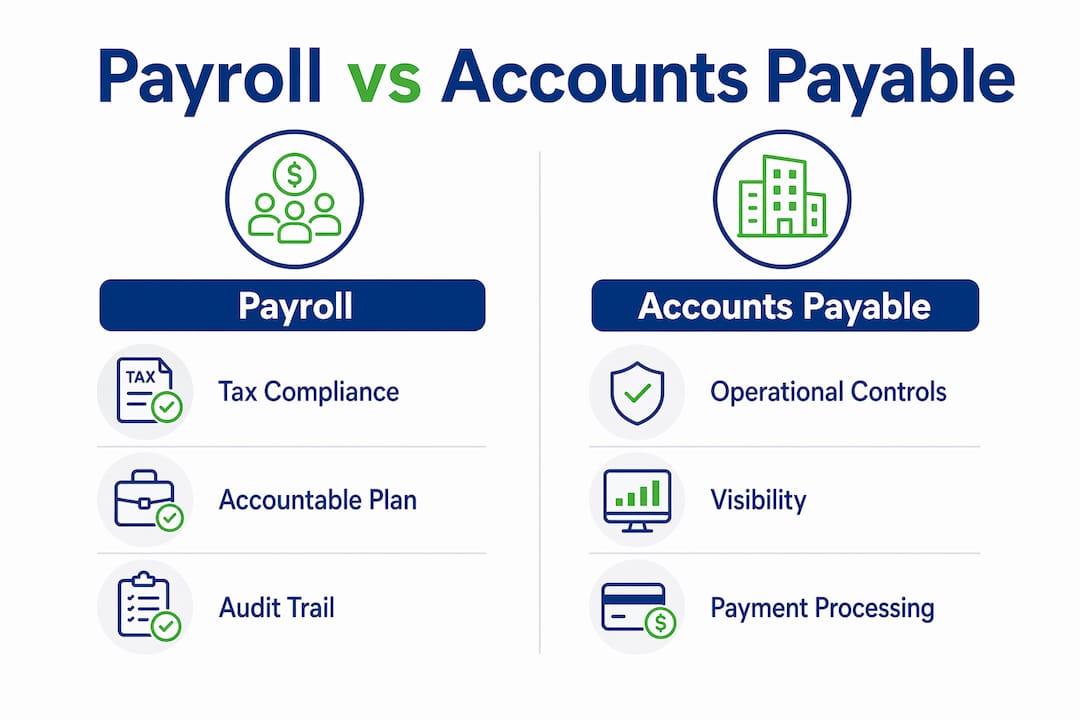
The table makes one point clear: the payment route does not determine taxability. Compliance does.
What are common mistakes in expense reimbursement payroll processing?
The most frequent compliance failures in expense report management are not complex. They are operational breakdowns that a clear process would prevent.
- Late receipt submission. Employees submit receipts weeks after the 60-day window closes. Missed or late receipts automatically convert the reimbursement to a taxable wage under IRS rules. No exception exists for honest forgetfulness.
- Missing business purpose. A receipt showing a restaurant charge is not enough. The documentation must state who attended, the business reason, and the client or project involved. Without that detail, the IRS can reclassify the expense.
- Excess funds not returned. Employees who receive travel advances and spend less than the advance often do not return the difference. If the company does not enforce the 120-day return rule, the excess becomes taxable income.
- Informal or undocumented policies. A verbal understanding between a manager and an employee is not a policy. The IRS expects a written framework that employees can reference and that auditors can review.
- No operational proof. This is the failure that surprises most employers during an audit. You may have a written policy, but audit risk rises sharply when you cannot produce batch-level evidence showing that each claim met documentation, timing, and excess return requirements.
The IRS does not audit your policy document. It audits your records. A written policy with no supporting transaction-level evidence provides almost no protection during an examination.
Non-compliant reimbursements lead to W-2 reporting and payroll tax liabilities that increase business expenses significantly. For a small business processing dozens of expense claims per month, the cumulative tax exposure can be substantial. Internal controls, such as automated deadline reminders, required field validation in your expense software, and monthly reconciliation reviews, are the practical defense against these risks.
How does routing reimbursements through payroll vs. accounts payable affect compliance?
The IRS position is unambiguous: routing does not determine taxability. Accountable plan rules are decisive. A reimbursement processed through payroll that lacks proper substantiation is taxable. A reimbursement processed through accounts payable with full documentation is not taxable. The payment method is irrelevant to the tax outcome.
That said, the routing decision does affect your operational controls and audit trail. Payroll routing ties reimbursements to pay stubs and payroll records, which creates a clear paper trail but also means any compliance failure shows up directly on the W-2. Accounts payable routing keeps reimbursements separate from wage records, which can simplify year-end reporting when the accountable plan is properly maintained.
Both methods can be fully compliant when the accountable plan criteria are met before payment is issued. The choice between payroll and AP typically comes down to your company's system capabilities and internal workflow preferences, not tax strategy.
The practical guidance is straightforward. Use whichever system gives your finance team the best visibility into submission dates, documentation status, and excess return tracking. The system that makes compliance easier to monitor is the right system for your business.
Pro Tip: If your payroll software and your expense management tool do not communicate with each other, you are creating manual reconciliation work and audit risk at the same time. Integration between these systems is one of the highest-value process improvements a small business can make.
Key takeaways
Expense reimbursement payroll compliance depends entirely on meeting all three IRS accountable plan requirements: business connection, timely substantiation, and return of excess funds.
| Point | Details |
|---|---|
| Accountable plan is mandatory | All three IRS tests must pass, or reimbursements become taxable wages. |
| Deadlines are firm | Substantiate expenses within 60 days and return excess within 120 days. |
| Routing does not determine taxability | Both payroll and accounts payable can be compliant; documentation quality decides the outcome. |
| Written policy alone is not enough | Batch-level operational records are what protect you during an IRS audit. |
| Late receipts are the top risk | Missing the substantiation window automatically converts reimbursements to wages. |
What I have learned from years of watching reimbursement audits unfold
The most common mistake I see small business owners make is confusing having a policy with being compliant. A well-written reimbursement policy is a starting point. It is not a shield. What actually protects you during an IRS examination is a batch of records showing that every claim in every pay period met the documentation, timing, and excess return requirements.
The second thing I have learned is that employee training matters more than most finance managers expect. Employees who understand why the 60-day rule exists, and what happens to their own tax situation when it is violated, submit receipts on time. Employees who see the policy as a bureaucratic hurdle find workarounds. Spend 20 minutes at onboarding explaining the tax consequences of late submission. That conversation pays for itself the first time an employee submits a receipt on day 58 instead of day 65.
Technology helps, but only if you use it correctly. Expense tools like Expensify or SAP Concur can enforce required fields and flag late submissions automatically. Those features are only valuable if your finance team acts on the alerts. Automation without follow-through is just a more expensive version of the same compliance gap.
The businesses I have seen handle this best treat reimbursement compliance as a payroll function, not an HR function. When the payroll team owns the process, the deadlines get enforced, the records get maintained, and the audit risk stays low. You can review California payroll compliance guidance to see how this applies specifically to businesses operating under California labor law.
— Glendale
Glendalepayroll can help you stay compliant on every reimbursement
Glendalepayroll works with small businesses across Glendale, Burbank, Pasadena, and Greater Los Angeles to build reimbursement processes that meet IRS accountable plan standards from day one.

Our payroll professionals review your current expense claim workflow, identify documentation gaps, and help you set up the controls that protect you during an audit. We do not hand you off to a call center. You work directly with a dedicated payroll specialist who understands your business. If you are ready to reduce your compliance risk and get your reimbursement process on solid ground, explore our California payroll compliance guide or review our payroll tips for small businesses to see where your process stands today.
FAQ
What is an IRS accountable plan for expense reimbursements?
An IRS accountable plan is a reimbursement arrangement that meets three requirements: business connection, timely substantiation within 60 days, and return of excess funds within 120 days. Reimbursements that satisfy all three conditions are excluded from taxable wages.
What happens if my reimbursements do not meet accountable plan rules?
Reimbursements that fail the accountable plan tests become taxable wages, requiring W-2 reporting and payroll tax withholding from both the employer and the employee.
Does routing reimbursements through payroll make them tax-free?
No. The IRS determines taxability based on whether the accountable plan criteria are met, not on whether payment flows through payroll or accounts payable.
What documentation does the IRS require for expense reimbursements?
Each expense claim must include the amount, date, business purpose, and a receipt. Missing any of these elements can cause the IRS to reclassify the reimbursement as taxable income.
How can small businesses reduce audit risk on expense reimbursements?
Maintain batch-level records for every reimbursement cycle showing that each claim met documentation, timing, and excess return requirements. A written policy without supporting transaction records provides limited protection during an IRS audit examination.