
If you're fired or laid off in California, your employer must pay all final wages immediately (Labor Code §201). If you quit with at least 72 hours' notice, wages are due on your last day (Labor Code §202); quit without notice, and your employer has 72 hours. Final pay must include all earned wages, overtime, earned commissions, and accrued unused vacation.
TL;DR:
- Employers must pay discharged employees' final wages and accrued vacation immediately, with no exception for delays or payroll processing times.
- If an employee quits with at least 72 hours' notice, wages are due on the last day, but if they quit without notice, employers have 72 hours to pay.
- Final pay must include all earned wages, overtime, vested commissions, and unused accrued vacation, but unused sick leave and some benefits are excluded.
- Mailing a check is compliant only if the mailing date is within the deadline, as the date of mailing counts as payment.
- Employers face a penalty of one day's wages for each day wages are late, up to 30 days, with no defense for cash flow issues or payroll mistakes.
Table of Contents
- What Are California's Final Paycheck Timing Rules?
- What Must a Final Paycheck Include?
- How Should Employers Deliver a Final Paycheck?
- How Are Waiting Time Penalties Calculated?
- What Defenses Can Employers Use Against Waiting Time Penalties?
- What Should You Do If Your Final Paycheck Is Wrong or Late?
- Final Paycheck Compliance Checklist for California Employers
- A Payroll Professional's Take on Final Pay Compliance
- How Glendale Payroll Helps You Get Final Pay Right Every Time
- Sources
- FAQ
What Are California's Final Paycheck Timing Rules?
California draws a sharp line between being let go and walking away on your own terms, and that line determines exactly when your last check is due.
Discharged employees get paid immediately. Whether it's a layoff, a firing, or the end of a seasonal job, Labor Code §201 requires the employer to hand over all earned, unpaid wages at the moment of termination. There's no grace period and no "we'll cut the check on the next payroll run" exception.
Employees who quit face a two-track rule under Labor Code §202:
- Give at least 72 hours' notice, and your final wages are due on your last day of work.
- Quit on the spot with no notice, and your employer has up to 72 hours to pay you.
Here's how that plays out in practice:
- Sarah is laid off on a Tuesday afternoon. Her employer must hand her a final check before she leaves the building that day. No exceptions for "the payroll department already ran this week's checks."
- Marcus tells his boss on Monday that he's quitting effective Thursday. Because he gave more than 72 hours' notice, his final paycheck is due Thursday, his last working day.
- Priya walks out mid-shift with no warning. Her employer has three full days, including weekends, to get her final wages to her.
Mailing complicates the "due" date. If an employee requests that their final check be mailed, the date of mailing counts as the date of payment, not the date it lands in the mailbox. That distinction matters when you're calculating whether an employer met the deadline. An employer who postmarks a check within the 72 hour window has technically complied, even if postal delivery takes another few days.
What Must a Final Paycheck Include?
A final paycheck isn't just your regular hourly or salary rate. Under Labor Code §200, wages include far more than base pay, and missing any piece of it is one of the fastest ways an employer ends up owing penalties.
Your final pay must include:
- All base wages and overtime earned through the last day worked
- Earned commissions that vested on or before the termination date
- Accrued, unused vacation time, paid out as wages under Labor Code §227.3
Commissions trip up more employers than any other line item. DLSE guidance is explicit: once a commission has vested, meaning the sale or milestone triggering it happened before termination, it must be paid on the final-pay date. An employer can't wait for the next regular commission cycle just because that's when the number would normally get calculated.
Accrued vacation gets the same treatment as cash wages because California treats it as earned compensation, not a "use it or lose it" perk. Sick leave is different. Unused accrued sick pay generally does not have to be cashed out at termination, and neither do most unused benefits like floating holidays, unless a company policy or contract says otherwise. Expense reimbursements owed to the employee should also be settled, though they run on a separate legal track from wage law.
Pro Tip: If a commission amount isn't fully calculable by the termination date, pay what can reasonably be determined now and true up the balance as soon as the number is final. Sitting on the entire payment because "the exact figure isn't ready yet" is the argument that loses in a DLSE hearing.
How Should Employers Deliver a Final Paycheck?
Final wages generally get paid at the place of discharge, meaning wherever the termination happens, whether that's the worksite, a manager's office, or a video call for a remote employee. Employers have a few compliant ways to get the money into an employee's hands, but each carries its own timing wrinkle.
- In-person payment is the cleanest option. Handing over a check (or confirming a direct deposit has landed) at the moment of discharge satisfies the immediacy requirement with no ambiguity.
- Direct deposit works for final pay, but only if the employer confirms the deposit will actually post by the legal deadline. Bank cutoff times matter here. A deposit initiated late in the day may not settle until the next business day, which can blow the 72 hour window for a quitting employee.
- Mailed checks are permitted when an employee requests it, and the date of mailing serves as the date of payment. An employee who lives far from the worksite or has already relocated often prefers this route.
- Pick-up arrangements let an employee collect the check from a specific office location, which some employers use when the discharge happens somewhere the check can't be issued on the spot.
Whichever method applies, the safest posted policy is to default to immediate, on-site payment for discharges and to confirm the employee's preferred method the moment a resignation is announced.
How Are Waiting Time Penalties Calculated?
Miss the deadline, and the clock starts running against you. Labor Code §203 imposes a waiting time penalty on employers who willfully fail to pay final wages on time. The penalty equals one full day's wages for every day the payment is late, up to a maximum of 30 calendar days.
Waiting Time Penalty at a Glance: Daily wage × number of late days (up to 30) = total penalty owed. Penalty accrual runs on calendar days, including weekends and holidays, not just business days.
Here's the math in practice. Suppose an employee earned $25 an hour and typically worked 8 hour shifts, for a daily rate of $200. If the employer pays the final wages late, the penalty is one day's wages times the number of days late, up to a maximum of 30 calendar days, totaling significant penalties depending on the daily wage, regardless of how small the underlying unpaid wage amount was.
A few details determine whether that clock keeps ticking:
- Payment stops the accrual. The moment the employer actually pays the wages, the penalty stops growing.
- Filing a court action stops it too. Once litigation commences, the penalty period is locked in.
- Filing a DLSE wage claim does not stop accrual. A common misconception among both employees and employers is that submitting a claim to the Division of Labor Standards Enforcement freezes the clock. It doesn't. The penalty keeps building until wages are actually paid or a lawsuit is filed.
The "willfully" standard in §203 doesn't require malice. An employer only needs to have had control over the payment and known wages were due. Simple payroll disorganization, not bad intent, is usually enough to trigger the penalty.
What Defenses Can Employers Use Against Waiting Time Penalties?
California gives employers exactly one meaningful defense here, and it's narrower than most people assume: a good-faith dispute over whether wages are actually owed. If an employer genuinely and reasonably disputes a specific amount, say, a disagreement over whether a commission actually vested, that disputed portion may be shielded from penalties while the dispute gets resolved.
The catch is that the defense only protects the disputed amount. Any undisputed wages must still be paid immediately. An employer who withholds an entire final paycheck because one line item is contested loses the good-faith defense on everything that wasn't actually in dispute.
Inability to pay is not a defense. Cash flow problems, a bounced payroll run, or a business winding down doesn't excuse late final wages. The obligation exists independent of the employer's financial situation.
Common payroll mistakes that trigger penalties:
- Waiting for the "next scheduled payroll run" instead of processing an off-cycle payment
- Withholding the entire check over a disputed commission instead of paying the undisputed base wages
- Assuming a mailed check is timely simply because it was written on time, without confirming the actual mailing date
- Failing to calculate accrued vacation payout before the termination meeting
Pro Tip: Never let a payroll system's default cycle dictate a termination payment date. If your software can't process an off-cycle check on short notice, that's a process gap worth fixing before it costs you 30 days of penalty wages on a single terminated employee.
What Should You Do If Your Final Paycheck Is Wrong or Late?
If your final paycheck doesn't show up on time or is missing money you earned, act quickly. Waiting time penalties reward employees who move, and evidence gets harder to gather the longer you wait.
- Document everything immediately. Save pay stubs, commission statements, time records, and any termination paperwork.
- Send a written demand. A short, dated email or letter asking for the specific amount owed creates a paper trail and often resolves the issue without further action.
- File a wage claim with the DLSE if the employer doesn't respond. This is typically the fastest, lowest-cost path for recovering unpaid wages and waiting-time penalties.
- Consider small claims court for straightforward disputes under the court's dollar limit, or civil litigation for larger or more complex claims.
Bring your final pay stub, any prior pay stubs showing your regular rate, termination date documentation, and copies of your written demand to whichever venue you choose.
Final Paycheck Compliance Checklist for California Employers
Payroll professionals see the same handful of mistakes drive nearly every waiting-time penalty claim. The fix isn't complicated, but it does require treating terminations as a distinct payroll event rather than an afterthought squeezed into the regular cycle.
- Run terminations off-cycle. Don't wait for the next scheduled payroll date. Precompute final wages, including accrued vacation, the moment a termination decision is made.
- Document proof of payment. Keep a bank trace for direct deposits, a signed receipt for in-person checks, or a postmark record for mailed payments.
- Post required payday notices and maintain a written termination procedure your managers actually follow, not just one buried in an employee handbook.
- Audit commission calculations before the termination meeting, not after, so vested amounts are ready to pay immediately.
- Pay undisputed amounts immediately, even when part of the final pay is genuinely contested.
Pro Tip: Build a termination checklist into your offboarding process now, before you need it under time pressure. Glendale Payroll's payroll process review guide walks through the exact sequencing small businesses often miss.
A Payroll Professional's Take on Final Pay Compliance
Most waiting-time penalty cases we see aren't the result of employers trying to shortchange anyone. They're the result of a payroll cycle that wasn't built to handle terminations as their own event. A commission that hasn't finished calculating. A direct deposit batch that already closed for the week. A manager who tells HR about a termination two days after it happened.
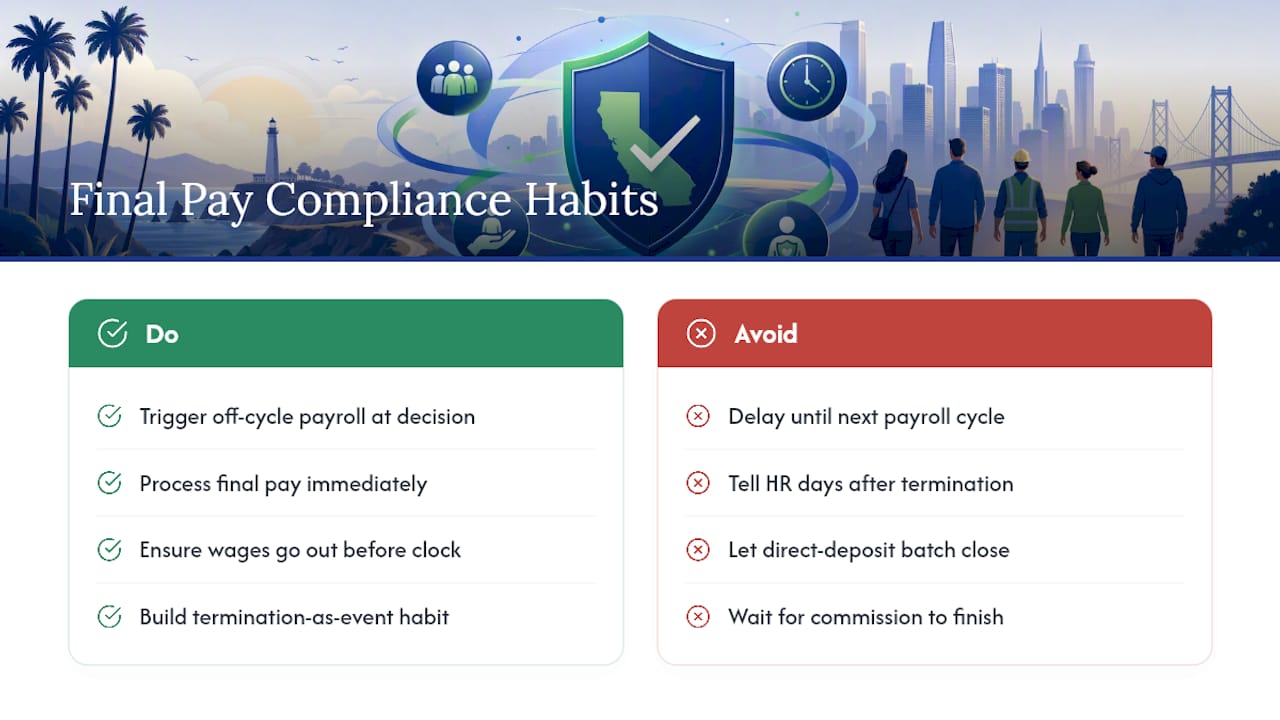
The fix isn't more paperwork. It's treating every termination, voluntary or not, as an off-cycle payroll trigger the moment it's decided, not the moment someone remembers to process it. Employers who build that habit rarely see a waiting-time penalty claim, because the wages simply go out before the clock starts.
For employers who want to dig deeper into building that habit, Glendale Payroll's blog covers the practical mechanics of California payroll compliance beyond just final pay.
— Glendale Payroll Staff
How Glendale Payroll Helps You Get Final Pay Right Every Time
Final paycheck compliance is unforgiving. Miss a 72 hour deadline or shortchange a commission calculation, and the penalty math outpaces the original wage owed within a month. Termination payments should be built into the payroll process as a standalone event, not an afterthought squeezed into the next scheduled run, which is exactly the gap that creates most waiting-time penalty exposure for small businesses.

A payroll team that includes dedicated payroll professionals, not call-center staff reading from a script, can handle off-cycle terminations, verify vacation payout calculations, and keep proof-of-payment documentation on file to help protect against claims. A payroll audit can help identify where your current process leaves you exposed before it becomes a penalty. Review California payroll compliance guidance or check out practical payroll tips for California small businesses to assess your termination process.
Sources
Verify these figures directly against primary sources before filing a claim or finalizing payroll policy, since statutory language and DLSE interpretations occasionally shift.
FAQ
How long does an employer have to pay final wages in California?
Discharged employees must be paid immediately. Employees who quit with at least 72 hours' notice are paid on their last day; those who quit without notice must be paid within 72 hours.
Can a final paycheck be direct deposited in California?
Yes, but only if the employer confirms the deposit will actually post by the legal deadline, since bank processing times can push the funds past the 72 hour window for quitting employees.
Do you still get your last paycheck if you're fired?
Yes. Being fired doesn't reduce or delay what you're owed. Labor Code §201 requires immediate payment of all earned wages, including accrued vacation, at the time of discharge.
Can an employer mail a final paycheck in California?
Yes, if the employee requests it. The date the check is mailed counts as the date of payment, not the date it arrives, so a timely postmark satisfies the deadline even with postal delays.
What happens if an employer pays a final paycheck late?
The employer owes a waiting-time penalty equal to one day's wages for each day late, up to 30 calendar days, under Labor Code §203. Payment or a filed lawsuit stops the accrual; a DLSE claim alone does not.