
The 2026 statutory FUTA tax rate stays at 6.0% on the first $7,000 of each employee's wages, capping potential liability at $420 per worker. Most employers pay far less. A full state credit brings the typical net rate down to a low rate, but California and the U.S. Virgin Islands are on the Department of Labor's watch list for a 2026 credit reduction, with final numbers locked in after November 10. Combine that with the $500 quarterly deposit trigger and you have four things to check on your payroll calendar right now.
TL;DR:
- Employers should model a potential FUTA rate increase up to 1.8% for 2026 if California or U.S. Virgin Islands face credit reductions, affecting liability beyond the standard 0.6%.
- Confirm timely payment of state unemployment taxes and flag employees earning close to the $7,000 threshold to avoid missing FUTA wage caps or losing full credits.
- Deposit FUTA quarterly once liabilities exceed $500, using electronic systems like EFTPS or IRS Direct Pay, to avoid penalties from late or missed payments.
- File Form 940 by January 31 or February 10 if deposits are on time, and include Schedule A for multi-state workforces or credit reduction states.
- Build a Q4 compliance plan that includes cash reserves for worst-case scenarios, automated deposit checks, and prompt final rate calculations after November 10 updates.
Table of Contents
- What Is the 2026 FUTA Tax Rate and How Is It Calculated?
- How Do FUTA Credit Reductions Work, and Who's on the 2026 List?
- How Do You Calculate and Deposit FUTA Tax Each Quarter?
- When Is Form 940 Due, and What About Schedule A?
- Building a FUTA Compliance Checklist for 2026
- A Payroll Provider's View on 2026 FUTA Risk
- Sources
What Is the 2026 FUTA Tax Rate and How Is It Calculated?
Every employer covered by FUTA owes 6.0% on the first $7,000 paid to each employee during the year, according to the IRS guidance on Form 940. That produces a maximum federal liability of $420 per employee before any credit is applied. Wages above $7,000 per employee are not subject to FUTA at all, which is why the tax hits low-wage and seasonal payrolls harder, proportionally, than high-wage ones.
Here's how the math typically plays out:
- One employee earning $50,000: FUTA taxable wages are capped at $7,000. Gross liability is $420, reduced to $42 with the full 5.4% credit.
- A five-person staff, each earning at least $7,000: Gross FUTA liability is $2,100 ($420 x 5), dropping to $210 net after the credit.
- A part-time worker earning $4,000 for the year: FUTA applies to the full $4,000, producing $240 gross and $24 net.
These figures assume the employer qualifies for the full state credit. The Form 940 instructions walk through the line-by-line adjustments if your state doesn't grant that credit in full.
How Do FUTA Credit Reductions Work, and Who's on the 2026 List?
The 5.4% credit exists because your state already collects unemployment tax through its own program. When a state borrows from the federal government to cover unemployment claims and doesn't repay the loan on schedule, the Department of Labor cuts that state's employers' credit. The result: your effective FUTA rate climbs above the standard 0.6%, sometimes well above it if a Benefit Cost Rate add-on gets layered on top.
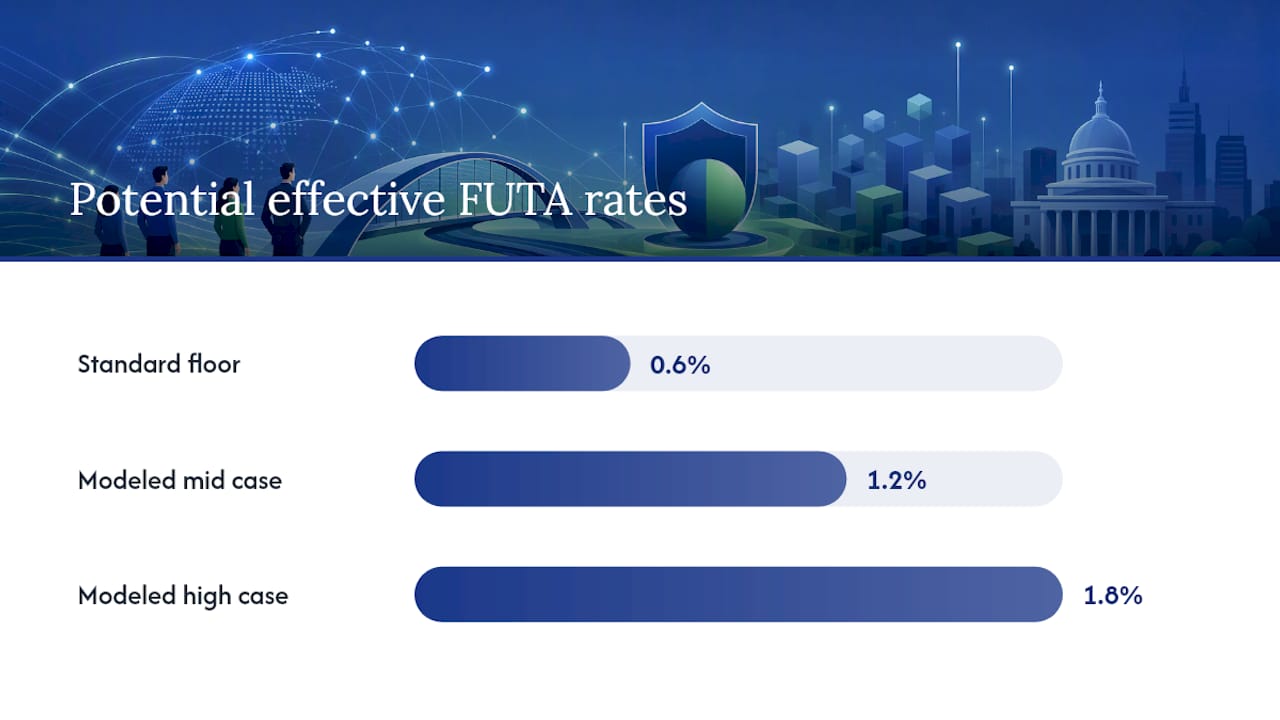
For 2026, California and the U.S. Virgin Islands appear on the DOL's potential credit-reduction list. That designation is preliminary. Final rates aren't confirmed until after November 10, 2026, which means payroll systems need to be ready to apply a different, higher effective rate retroactively for the full year if your state ends up on the confirmed list.
A few things worth building into your Q4 planning:
- Model a range, not a single number. Treat 0.6% as your floor and reserve for a scenario where the effective rate lands closer to 1.2% to 1.8% if a Benefit Cost Rate add-on applies.
- Flag every location with California-based employees, even a small satellite office, since credit reductions apply per state, not per company headquarters.
- Hold back a Q4 reserve equal to the difference between the 0.6% rate and your modeled worst case, so a November announcement doesn't create a cash crunch.
Employers with workers in a listed jurisdiction should expect a real chance of paying more than $42 per employee this year. That's the number to model, not hope against.
How Do You Calculate and Deposit FUTA Tax Each Quarter?
FUTA is a running calculation, not an annual lump sum. Once your cumulative unpaid FUTA liability for the year exceeds $500, you must deposit that amount electronically by the last day of the month following the end of the quarter. If your liability stays at or under $500 for a quarter, it simply carries forward to the next one.
A quick example: a business owes $180 in Q1 FUTA liability. That's under $500, so it rolls into Q2. If Q2 liability brings the running total to $560, a deposit is due by the end of the month following Q2's close, covering the full $560.
Deposits must go through one of these channels:
- EFTPS (Electronic Federal Tax Payment System), the standard method most payroll providers use.
- IRS Direct Pay, for employers making payments directly rather than through a payroll system.
- IRS Business Tax Account, which lets you view payment history alongside deposit due dates.
Paying a required deposit with your Form 940 filing instead of depositing on time can trigger penalties, according to the Form 940 instructions. Electronic deposit isn't optional once you cross the $500 threshold.
Pro Tip: Set an automatic reconciliation check the day after each quarter closes. Comparing your running FUTA liability against the $500 threshold in real time catches the deposits people miss when they only look at this once a year.
When Is Form 940 Due, and What About Schedule A?
Form 940 reports your full-year FUTA liability and reconciles it against the deposits you made throughout the year. Here's the sequence to follow:
- File by January 31 of the year following the tax year, unless you deposited the full amount owed on time, which extends your filing deadline to February 10.
- Attach Schedule A if you have employees in a state with a credit reduction, or if you have employees in more than one state at all, since it allocates taxable FUTA wages by state, per the Form 940 draft instructions.
- Confirm state unemployment tax payments were made on time before you file, because the 5.4% credit depends on it. Late state payments can shrink or eliminate the credit, pushing your effective rate back toward the full 6.0%.
- Reconcile deposits against Form 940 line totals before submitting, so a shortfall from an unconfirmed credit reduction doesn't surface as a surprise balance due.
Multi-state employers should treat Schedule A as mandatory paperwork, not an optional add-on. It's where a California credit reduction actually gets applied to your bottom-line number.
Building a FUTA Compliance Checklist for 2026
Turning these rules into daily practice comes down to a handful of concrete controls:
- Flag employee wages at $6,500 so payroll gets an early warning before the $7,000 FUTA wage base is reached, giving you time to catch coding errors.
- Reconcile state unemployment tax payments before every Form 940 filing, confirming timeliness so the 5.4% credit isn't at risk.
- Automate quarterly deposit checks against the $500 threshold rather than relying on a year-end review.
- Hold a Q4 reserve sized to your worst-case credit-reduction scenario if you have California-based employees.
- Calendar the November 10 DOL announcement and rerun your FUTA calculations the same week final rates are confirmed.
If building and monitoring these controls feels like more than your internal team can absorb during Q4, that's exactly the gap Glendale Payroll's free comprehensive payroll audit is built to close, checking wage-base tracking, deposit timing, and state credit exposure before it becomes an IRS problem.
A Payroll Provider's View on 2026 FUTA Risk
The mistakes we see aren't complicated. They're timing failures: a state unemployment payment posted a few days late, a Q3 deposit that quietly crossed $500 without anyone noticing, or a payroll calendar that never got updated after the November 10 credit-reduction announcement. None of these require a hard problem to solve. They require someone checking the right number on the right date.
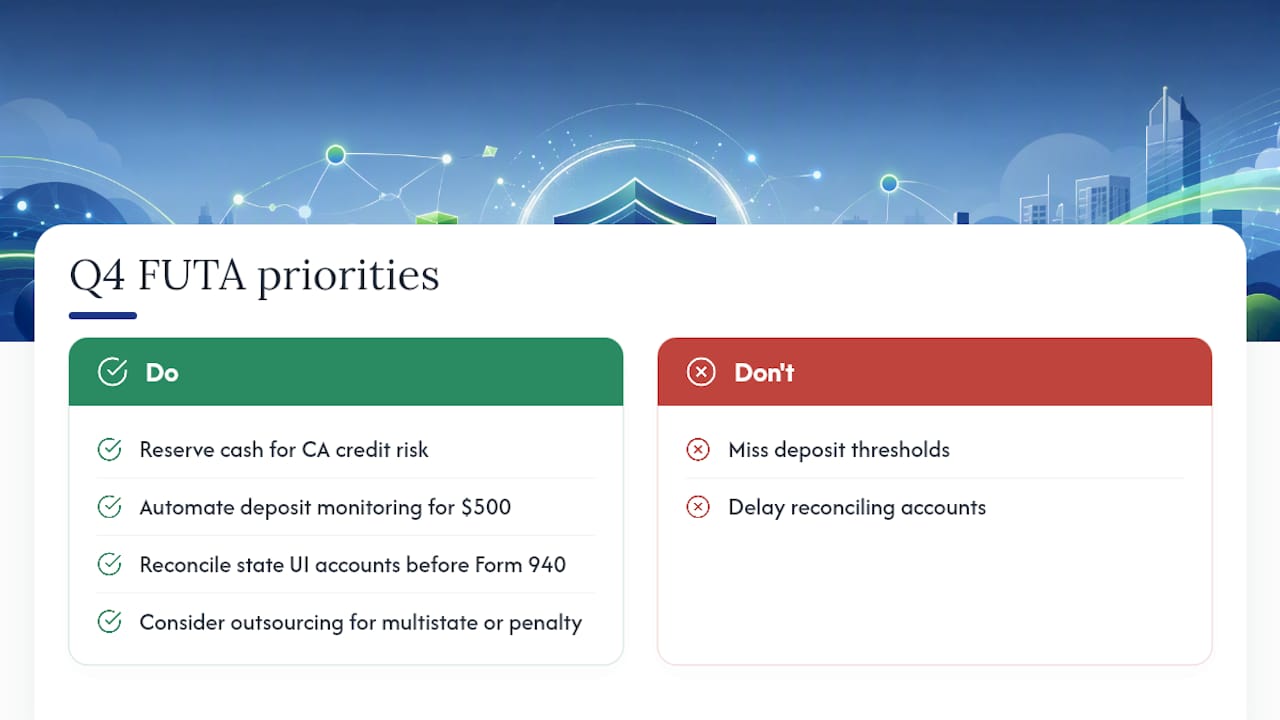
Our priority list for Q4 2026 is short. Reserve cash for the worst-case California credit-reduction scenario, automate deposit monitoring so the $500 threshold never gets missed, and reconcile state unemployment accounts before touching Form 940. When a business has employees in more than one state, or has already had a deposit penalty, that's usually the point where handing FUTA and broader payroll compliance to a dedicated provider stops being a convenience and starts being a cost-saving decision.
— Glendale Payroll Staff
Sources
- Topic no. 759, Form 940, Employers Annual Federal Unemployment (FUTA) Tax Return – filing and deposit requirements
- FUTA Credit Reductions