
Gross wages are your total earnings before any taxes or deductions are taken out. The formula is straightforward: for hourly workers, multiply your hourly rate by hours worked; for salaried employees, divide your annual salary by the number of pay periods in the year. A quick example: multiply your hourly rate by hours worked to find your gross wages for the week. That $1,000 is your pre-tax income, the starting point for every payroll calculation.
- Hourly formula: Hourly rate × Hours worked = Gross wages
- Salaried formula: Annual salary ÷ Number of pay periods = Gross wages per period
- Overtime included: (Regular hours × Rate) + (Overtime hours × Rate × 1.5)
Table of Contents
- What gross wages mean in U.S. payroll — and why the number matters
- What counts toward gross wages — and what doesn't
- How to calculate gross wages for any pay arrangement
- How gross wages become net pay — a sample paystub walkthrough
- Why your gross wages and your W-2 wages are not the same number
- How employers compute and use gross wages in payroll
- When to get professional payroll help
- Key Takeaways
- The payroll detail most employers underestimate
- Useful sources and further reading
What gross wages mean in U.S. payroll — and why the number matters
Gross wages are the foundation of every payroll calculation in the United States. Before your employer withholds a single dollar for federal income tax, Social Security, or your health insurance premium, the gross figure is established first. Everything else flows from it.
You will see gross wages on your paystub as the top-line number, typically labeled "Gross Pay" or "Current Gross." At year-end, the wages reported in Box 1 of your Form W-2 are derived from that gross figure, adjusted for certain pre-tax deductions. Lenders, landlords, and government benefit programs also ask for gross income when evaluating applications, because it reflects your full earning capacity before personal spending choices or tax obligations reduce it.
For small-business owners, gross wages drive payroll tax deposits, unemployment insurance calculations, and benefits eligibility thresholds. Getting the gross figure right is not optional — it is the legal starting point for every downstream compliance obligation.
- Paystubs: Gross pay appears as the first line; net pay (take-home) appears last.
- Tax bases: Federal and state withholding, Social Security, and Medicare taxes are all calculated from gross wages or a close variant of them.
- Benefits eligibility: Many employer benefit plans, government programs, and loan underwriting decisions reference gross income rather than net.
- Payroll reporting: Employers report gross wages to the IRS, the Social Security Administration, and state agencies such as California's EDD.
What counts toward gross wages — and what doesn't
According to AIHR, gross wages typically include every form of cash compensation an employer pays before deductions. The list is broader than most employees expect.
Included in gross wages:
- Base salary or regular hourly pay
- Overtime pay (at 1.5× the regular rate for nonexempt employees under the FLSA, or higher if your employer or state requires it)
- Bonuses (performance, signing, holiday)
- Commissions and sales incentives
- Tips reported by the employee to the employer
- Paid time off (PTO) and paid holiday payouts
- Shift differentials and premium pay
- Severance payments
- Taxable fringe benefits (e.g., personal use of a company vehicle, certain employer-paid moving expenses)
Common exclusions:
- Non-taxable expense reimbursements (mileage at the IRS standard rate, business travel costs)
- Employer contributions to health insurance premiums (generally excluded from employee gross wages)
- Certain employer-paid benefits that qualify as excludable under the Internal Revenue Code
When in doubt about a specific payment, check your paystub for separate line items or codes. Employers are required to itemize taxable and non-taxable amounts, and a dedicated payroll professional can clarify which items affect your gross total.
Pro Tip: Look for a column labeled "YTD Gross" on your paystub. That year-to-date figure accumulates every taxable payment made to you since January 1 and is the number that will most closely match your W-2 wages at year-end, after pre-tax benefit adjustments.
How to calculate gross wages for any pay arrangement
The calculation method depends on how you are paid. Below are the formulas, a conversion table, and three worked examples.
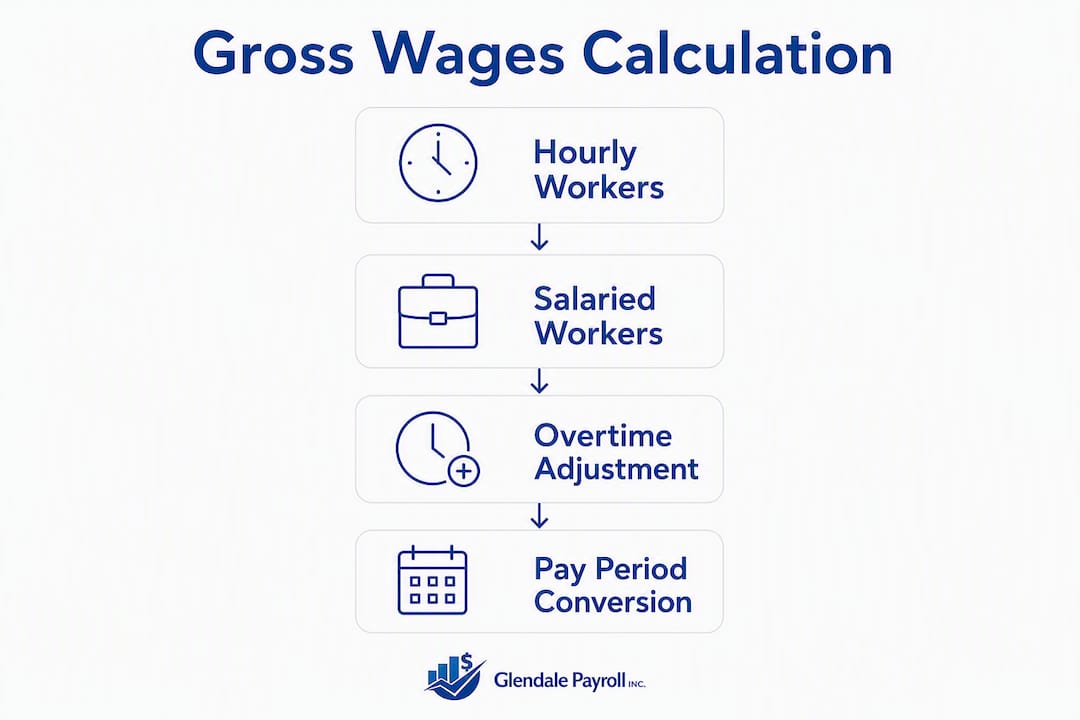
Hourly workers
Formula: Hourly rate × Regular hours + (Hourly rate × 1.5 × Overtime hours)

Overtime applies to nonexempt employees who work more than 40 hours in a workweek under the Fair Labor Standards Act. Some states, including California, require daily overtime as well.
Salaried workers
Formula: Annual salary ÷ Pay periods per year

| Pay Frequency | Pay Periods per Year | Example: — |
|---|---|---|
| Biweekly | 26 | — |
Three worked examples
1. Hourly base (no overtime) Maria earns $22/hour and works 40 hours this week; her gross wages equal her hourly rate times hours worked.
2. Salaried conversion (biweekly) James earns an annual salary paid biweekly, so his gross wages per pay period are the annual salary divided by the number of pay periods.
3. Overtime week Sofia earns $20/hour and works 46 hours in one week; her total gross wages include pay for regular hours plus overtime calculated at 1.5 times the regular rate.
Calculation checklist
- Confirm the correct hourly rate or annual salary in your payroll system.
- Verify total hours worked, including any overtime hours separately.
- Add all supplemental payments (bonuses, commissions, PTO payouts) for the period.
- Apply the correct overtime multiplier (1.5× federal minimum; check your state).
- Round per your written payroll policy — and apply it consistently.
- Compare the result to the prior period; a large variance warrants a review.
How gross wages become net pay — a sample paystub walkthrough
Net pay is what actually lands in your bank account. The IRS confirms that take-home pay is gross wages minus mandatory and voluntary deductions, including income taxes and FICA contributions.
Common deductions that reduce gross to net:
- Federal income tax withholding — based on your W-4 elections and IRS tax tables
- State income tax withholding — varies by state; California uses its own SDI and income tax schedules
- Social Security tax — 6.2% of covered wages up to the annual wage base
- Medicare tax — 1.45% of all covered wages (an additional 0.9% applies above certain income thresholds)
- Pre-tax benefit deductions — 401(k) contributions, HSA deposits, and employer-sponsored health premiums reduce taxable wages before income tax is calculated
- Post-tax deductions — Roth 401(k) contributions, certain life insurance premiums, and wage garnishments come out after taxes
Sample paystub: biweekly pay period
Gross wages: the full earnings before any taxes or deductions Less: Federal income tax withholding based on elections and IRS tables Less: State income tax withholding varies by state Less: Social Security tax at the statutory rate up to the annual wage base Less: Medicare tax at the statutory rate, with possible additional amounts above thresholds Less: Pre-tax 401(k) contribution as per employee elections Less: Health insurance premium pre-tax deduction Net pay (take-home): the remaining amount after all deductions
The pre-tax 401(k) and health insurance deductions reduce the amount subject to federal and state income tax, but they do not reduce the wages subject to Social Security and Medicare. That distinction matters when you reconcile your W-2 at year-end.
Why your gross wages and your W-2 wages are not the same number
Gross wages and the figures reported on your Form W-2 are related but rarely identical. Pre-tax deductions, employer-paid benefits, and specific fringe benefits each affect different tax bases in different ways.
| W-2 Box | What It Reports | How It Relates to Gross Wages |
|---|---|---|
| Box 1 | Federal taxable wages | Gross wages minus pre-tax 401(k), HSA, and health premiums |
| Box 3 | Social Security wages | Gross wages minus health premiums; 401(k) deferrals still included |
| Box 5 | Medicare wages | Same as Box 3 in most cases; no annual wage base cap |
| — | Social Security tips | Reported tips added to Box 3 wages |
| Box — | Coded benefit amounts | 401(k) deferrals, HSA contributions, employer health costs |
| — | State wages | Mirrors Box 1 or state-specific taxable amount |
Example: An employee earns $50,000 in gross wages and contributes $3,000 to a traditional 401(k) and $2,400 to an employer-sponsored health plan. Box 1 (federal taxable wages) will show $44,600. Box 3 (Social Security wages) will show $47,000, because 401(k) deferrals do not reduce Social Security wages. Box 5 (Medicare wages) will also show $47,000. The gross wages figure of $50,000 appears nowhere on the W-2 directly, which surprises many employees when they compare their final paystub to their tax form.
When reconciling year-end forms, employer-paid benefits can shift taxable wages differently across Social Security, Medicare, and federal income tax bases — so both payroll records and the W-2 need to be checked together.
How employers compute and use gross wages in payroll
For employers, calculating gross wages is a multi-step process that runs every pay period. Accurate time records are the starting point for any hourly or nonexempt worker; errors at that stage compound through every downstream calculation.
Employer steps each pay period:
- Collect time and attendance data for all nonexempt employees.
- Apply the correct pay rate, including any rate changes effective during the period.
- Add supplemental payments: bonuses, commissions, PTO payouts, and shift premiums.
- Calculate overtime for any nonexempt employee who exceeded 40 hours in the workweek (or daily thresholds in California).
- Round hours per your written policy, applied consistently across all employees.
- Produce a gross wages figure per employee before running tax calculations.
Exempt vs. nonexempt employees
Exempt (salaried) employees receive their full salary regardless of hours worked in a given week, with limited exceptions. Nonexempt employees must be paid overtime for hours beyond the applicable threshold. Misclassifying a nonexempt worker as exempt is one of the most common and costly payroll errors small employers make — it exposes the business to back-pay liability and potential payroll compliance penalties.
Employer reporting obligations
Gross wages feed directly into:
- Federal payroll tax deposits (Form 941 filings with the IRS)
- State unemployment insurance (FUTA/SUTA wage bases)
- California EDD reporting for SDI and UI purposes
- Year-end W-2 preparation and distribution
Pro Tip: Document your payroll procedures in writing, including your overtime calculation method, rounding rules, and supplemental pay timing. A written payroll process makes audits faster and reduces errors when staff changes occur.
When to get professional payroll help
Some payroll errors are easy to catch on a single paystub. Others accumulate quietly for months before an IRS notice or a disgruntled employee surfaces the problem. The following risk checklist covers the issues small employers most commonly miss.
- Misapplied overtime — Failing to include bonuses in the "regular rate of pay" when calculating overtime is a frequent FLSA violation.
- Incorrect tax deposits — Late or underpaid federal tax deposits trigger penalties that compound quickly.
- Worker misclassification — Treating an employee as an independent contractor eliminates payroll tax obligations on paper but creates significant liability if the classification is wrong under the IRS or California ABC test.
- Missing state or local filings — California employers must register with the EDD, file DE 9 and DE 9C returns, and remit SDI and UI contributions on schedule. Missing a filing date has direct financial consequences.
- Incorrect pre-tax benefit handling — Deducting a benefit post-tax when it qualifies as pre-tax (or vice versa) changes every tax base for that employee.
Questions to ask a payroll provider before you sign:
- How do you handle mid-period rate changes or retroactive pay corrections?
- What is your process for federal and California state tax deposits?
- Do you prepare and distribute W-2s, and how do you handle corrections?
- Can you set up and manage our California EDD employer account?
- What happens if we receive an IRS or EDD notice?
When to escalate to a professional: If you are running payroll manually and have experienced recurring pay discrepancies, are adding employees in a second state, are uncertain about year-end W-2 reconciliation, or have received any IRS or EDD correspondence, those are clear signals to bring in dedicated payroll expertise. Glendale Payroll offers a free payroll audit for businesses in Glendale, Burbank, Pasadena, and Greater Los Angeles to identify exactly these kinds of gaps before they become penalties.
For California-specific guidance on EDD registration, state deposit schedules, and SDI obligations, the Payroll Tips for California Small Businesses resource covers the state-level steps in practical detail.
Pro Tip: Before your first payroll run with a new provider, request a parallel calculation for one pay period — run your numbers alongside theirs and compare gross wages, tax withholdings, and net pay line by line. Discrepancies caught before the first live run are far easier to resolve than corrections filed after the fact.
Key Takeaways
Gross wages are the total earnings before any deductions, and every payroll tax, benefit calculation, and year-end W-2 figure traces back to that single starting number.
| Point | Details |
|---|---|
| Gross wages defined | Total earnings before taxes or deductions; the starting point for all payroll math. |
| Core formulas | Hourly rate × hours worked; annual salary ÷ pay periods per year. |
| W-2 wages differ | Pre-tax 401(k) and benefit deductions reduce Box 1 wages below gross; Social Security wages stay higher. |
| Common deductions | Federal/state income tax, FICA (6.2% Social Security + 1.45% Medicare), pre-tax benefits, and garnishments reduce gross to net. |
| When to get help | Recurring pay errors, multi-state payroll, or any IRS/EDD notice are clear signals to consult a payroll professional. |
The payroll detail most employers underestimate
Most conversations about gross wages focus on the math, and the math is genuinely straightforward. What gets employers into trouble is not the formula — it is the classification decisions that sit underneath it. Whether a worker is exempt or nonexempt, whether a bonus must be blended into the regular rate for overtime purposes, whether a fringe benefit is taxable or excludable: these are the questions that determine whether your gross wages figure is legally correct, not just arithmetically tidy.
The W-2 reconciliation point in this article is a good example. Many employees assume their Box 1 wages should equal their annual salary. They don't, and they shouldn't. But when the difference is larger than expected, it often signals a pre-tax benefit that was handled incorrectly somewhere during the year. Catching that in December is manageable. Catching it after a W-2 has been distributed is expensive.
For small employers in Greater Los Angeles, the California layer adds real complexity. The EDD has its own deposit schedules, SDI rates, and reporting forms that run parallel to federal obligations. A payroll error that is minor at the federal level can carry a disproportionate penalty at the state level. The most practical thing a small employer can do is have a professional review the payroll setup before problems accumulate, not after.
Useful sources and further reading
- IRS — Tax withholding and W-2 guidance: Primary federal authority on income tax withholding, FICA obligations, and Form W-2 reporting requirements.
- 26 U.S.C. § 61 — Gross income defined: The statutory definition of gross income under the Internal Revenue Code, including compensation, fringe benefits, and commissions.
- Legal Information Institute — Gross income (Wex): Plain-language legal explanation of gross income for individuals and businesses under U.S. law.
- U.S. Bureau of Labor Statistics — Earnings (CPS): National earnings data measuring usual weekly and hourly wages before taxes, including overtime, commissions, and tips.
- Investopedia — Gross income definition: Accessible explanation of gross income versus gross wages, useful for personal finance and loan application contexts.
- AIHR — Gross wages definition: HR-focused glossary entry covering inclusions, exclusions, and payroll application of gross wages.
- Glendale Payroll — California payroll compliance guide: State-specific guidance on EDD registration, SDI, and California payroll filing obligations for employers.
- Glendale Payroll — Payroll best practices for small business: Practical checklist for accurate payroll setup and ongoing compliance for small employers.