
For small businesses in Glendale, Burbank, Pasadena, and Greater Los Angeles, the right HR technology decision is straightforward: hire an outsourced payroll provider that guarantees IRS and EDD filing, handles California-specific obligations, and assigns you a dedicated professional. Glendale Payroll is that local option. Three things to confirm before signing with any provider:
- EDD filings covered: DE 9 and DE 9C filed every quarter, including quarters with zero payroll activity.
- Tax deposit handling: provider makes federal and state deposits on your behalf and manages IRS/EDD correspondence.
- Free audit scheduled: request Glendale Payroll's no-cost payroll audit before your first payroll run.
Pro Tip: Schedule the free audit before your next payroll run. It takes less than an hour and surfaces EDD registration gaps, misclassified workers, and missed deposit deadlines before they become penalties.
Key Takeaways
Outsourced payroll HR technology for California small businesses must cover EDD and IRS filing, AB5 classification checks, and secure year-end processing to protect against the state's stacked per-employee penalties.
| Point | Details |
|---|---|
| EDD filing is non-optional | DE 9 and DE 9C must be filed every quarter, even when no wages were paid that period. |
| AB5 classification matters | Worker misclassification triggers retroactive taxes, SDI, and penalties; audit at onboarding. |
| Wage statements carry penalties | California Labor Code §226 requires nine specific items; errors cost up to $4,000 per employee. |
| E-file/e-pay is mandatory | Providers must use EDD e-Services and EFTPS; paper filing is not compliant for most employers. |
| Glendale Payroll free audit | Schedule a no-cost audit to surface EDD gaps, deposit errors, and classification risks before they escalate. |
Table of Contents
- What does HR technology cover for federal payroll taxes?
- New-hire reporting and year-end filings for California employers
- Direct deposit, pay stubs, and recordkeeping requirements
- Payroll compliance audits and common penalties to avoid
- Questions to ask a provider and red flags to watch for
- How a provider handles tax deposits, filings, and IRS/EDD correspondence
- Does your payroll provider integrate with your existing software?
- California payroll law changes you need to know in 2026
- Glendale Payroll's free audit and onboarding process
- What good payroll providers actually do differently
- Sources
What does HR technology cover for federal payroll taxes?
Federal payroll compliance centers on two filings. Form 941 is filed quarterly and reports wages paid, federal income tax withheld, and both the employer and employee shares of Social Security and Medicare taxes. Form 940 covers the annual Federal Unemployment Tax Act (FUTA) obligation. Tax deposits must follow a schedule tied to your lookback period: monthly or semi-weekly. A qualified provider deposits on schedule, files both forms, and handles any IRS notices directly.
New-hire reporting and year-end filings for California employers
California requires employers to report new hires and rehires to the EDD within 20 days of the hire date. Year-end brings W-2s for employees and 1099-NEC forms for qualifying independent contractors, both due to recipients by January 31. Under California's AB5 law and the ABC test, worker classification errors can reclassify contractors as employees retroactively, triggering back taxes, SDI, and penalties. Your provider should run an AB5/ABC test review at onboarding and flag any borderline classifications before year-end.
Direct deposit, pay stubs, and recordkeeping requirements
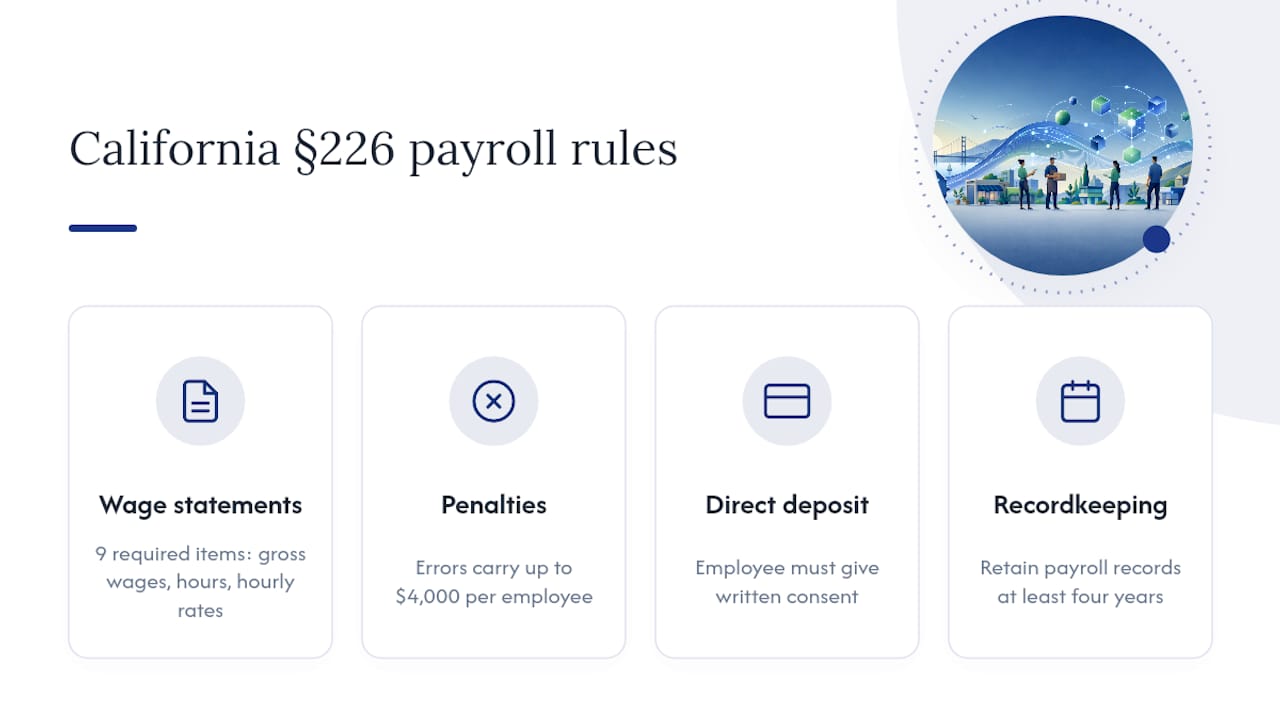
California Labor Code §226 requires nine specific items on every wage statement, including gross wages, total hours worked, and all applicable hourly rates. Errors on pay stubs carry penalties of up to $4,000 per employee. Direct deposit is standard, but California employees must consent in writing. Payroll records must be retained for at least four years under state rules. An employee self-service portal for pay stub and W-2 access reduces administrative burden and supports that retention requirement.
Payroll compliance audits and common penalties to avoid
California adds daily overtime, missed-meal premium pay, and SB 1162 pay data reporting to the standard federal obligations. Stacked penalties per employee, per pay period accumulate fast. A compliance audit reviews EDD account registration, deposit history, DE 9/DE 9C filing accuracy, worker classification, and wage-statement format. The EDD payroll taxes resource page lists current forms, deadlines, and employer tutorials worth bookmarking.
Questions to ask a provider and red flags to watch for
Ask every candidate these directly:
- Do you file DE 9 and DE 9C for zero-payroll quarters?
- Who handles IRS and EDD notices, and what is your written penalty-mitigation policy?
- Is your pricing all-in, including year-end W-2 and 1099 preparation?
- Do your staff work locally, or is support routed through an offshore call center?
Red flags: vague "starting at" pricing that excludes year-end filings, no written escalation procedure for tax notices, and rotating support agents with no assigned contact. Review why businesses switch payroll providers to understand the most common failure points before you commit.
How a provider handles tax deposits, filings, and IRS/EDD correspondence
A compliant provider uses EDD's e-Services for Business to file returns, make payroll tax deposits, and manage your employer account electronically, as required under the EDD e-file/e-pay mandate. For federal obligations, they remit deposits through EFTPS. When a notice arrives from the IRS or EDD, the provider should respond directly, document the resolution, and report back to you in writing. Providers that forward notices to you without acting are not managing compliance; they are processing payroll.
Does your payroll provider integrate with your existing software?
Most small businesses in Greater Los Angeles already use QuickBooks, Xero, or a time-tracking platform. A payroll provider should connect to your existing tools to pull hours, sync general ledger entries, and reconcile tax deposits without manual re-entry. Poor integration creates duplicate data entry and increases the risk of deposit errors. Read more about how payroll software integration reduces filing errors and supports EDD reconciliation. For businesses exploring co-employment or benefits coordination, a PEO broker arrangement can layer additional compliance support on top of payroll processing.
California payroll law changes you need to know in 2026
California's minimum wage increased to a range around the mid-teens per hour statewide in 2026, with higher rates in certain cities and for specific industries. SDI withholding rates and the UI Tax Rate Schedule are updated annually by the EDD. SB 1162 pay data reporting obligations continue for employers with 100 or more employees. Your provider should push rate-table updates to your payroll configuration before each effective date, not after the first payroll run of the new period.
Glendale Payroll's free audit and onboarding process
Glendale Payroll's free payroll audit is the fastest way to find out where your current setup is exposed. The audit covers EDD registration status, DE 9 and DE 9C filing history, worker classification under AB5, payroll tax deposit reconciliation, and year-end W-2/1099 readiness.
Onboarding typically requires your EIN, state payroll tax account numbers, recent payroll journals, employee list with addresses and Social Security numbers, and your PTO and benefit rules. Setup runs one to two weeks; your first managed payroll run follows shortly after. Pricing follows a base monthly fee plus a per-employee charge, with a one-time setup fee at onboarding. Review the service overview and pricing framework for current plan details, or visit the California compliance page to see the full scope of what Glendale Payroll covers. Every client is assigned a dedicated payroll professional, not a call-center queue, and penalty-mitigation support is included. Schedule your free audit at Glendalepayroll.
What good payroll providers actually do differently
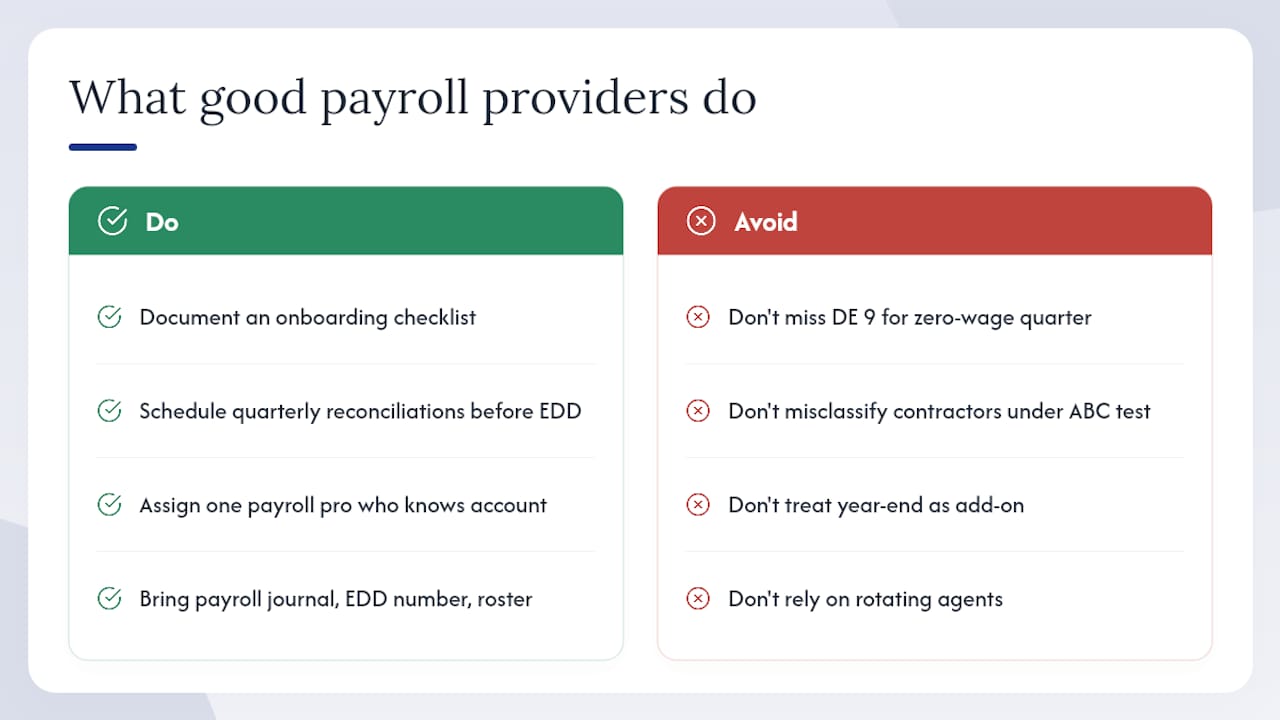
The most common California payroll failures we see are not exotic: a missed DE 9 for a zero-wage quarter, a contractor who should have been classified as an employee under the ABC test, and W-2s sent late because the provider treated year-end as an add-on. Each one is preventable with a documented process and a professional who knows California law.
What separates a quality provider is operational discipline: a documented onboarding checklist, scheduled quarterly reconciliations before each EDD deadline, and a single assigned payroll professional who knows your account. When an IRS or EDD notice arrives, that professional responds, not a rotating agent reading from a script.
When you call Glendale Payroll to schedule your free audit, have your most recent payroll journal, your EDD employer account number, and your current worker roster ready. That preparation cuts the audit time in half and gets you to a compliant first payroll run faster.
This article is general information, not a substitute for advice from a qualified financial advisor. Consult a qualified financial professional about your own circumstances before acting on anything here.
Sources
Share these with any provider you are vetting and confirm they use each one actively:
- 2025 California Employer's Guide (DE 44) Rev. 52 (4-26)
Save your EDD employer account number alongside these links. Quarterly DE 9/DE 9C deadlines fall on the last day of the month following each quarter's close; year-end W-2s are due to employees by January 31.