
If you completed Section 2 within three business days of hire for every current employee, and you can locate a Form I-9 for anyone who left within the last year, you are closer to audit-ready than most small employers. That's the whole test. USCIS requires verification within three business days and retention for three years after hire or one year after termination, whichever is later. The problem isn't usually the rule. It's the paperwork drift that happens over months of hiring.
Do these three things this week: run a completeness sweep on every active employee's I-9, sort the gaps you find into "substantive" and "technical" so you fix the riskiest ones first, and write down exactly how you reviewed the forms. That last step matters more than most HR teams realize.
- Sweep every active I-9 for missing signatures, dates, and document details
- Rank errors by severity, not by how easy they are to fix
- Document your review method, sample size, and reviewer
Per-form fines for I-9 violations run from roughly $288 to $2,861, adjusted annually, and recent ICE guidance has made more errors fineable outright. Glendale Payroll sees the same gaps repeatedly in client audits: missing hire dates, blank employer addresses, and unsigned attestations.
Key Takeaways
Audit-ready I-9 compliance depends on completing Section 2 within three business days, retaining forms per the USCIS rule, and correcting substantive errors before ICE reclassifies them under 2026 guidance.
| Point | Details |
|---|---|
| Verify within three days | Complete Section 2 within three business days of hire, or by day one for very short-term jobs. |
| Retain the right length | Keep each I-9 for three years after hire or one year after termination, whichever is later. |
| Prioritize substantive fixes | Correct unsigned sections and missing document details first, since 2026 guidance treats these as fineable. |
| Document your audit | Record scope, sampling method, reviewer names, and dates to create defensible mitigation evidence. |
| Get a professional review | Glendale Payroll's free payroll audit checks I-9 completeness alongside California payroll compliance risks. |
Table of Contents
- The I-9 Compliance Checklist by Form Section and Hiring Stage
- How Do You Run a Defensible Internal I-9 Audit?
- What Are the Most Common I-9 Mistakes and How Do You Fix Them?
- How Long Must You Retain Form I-9 Records?
- When Can You Use Remote I-9 Verification and E-Verify?
- How Do ICE I-9 Inspections Work in 2026?
- Glendale Payroll's Free I-9 Audit for California Employers
- What the 2026 Enforcement Shift Really Means for Employers
- Get a Free I-9 and Payroll Compliance Audit
- Frequently Asked Questions
- Sources
The I-9 Compliance Checklist by Form Section and Hiring Stage
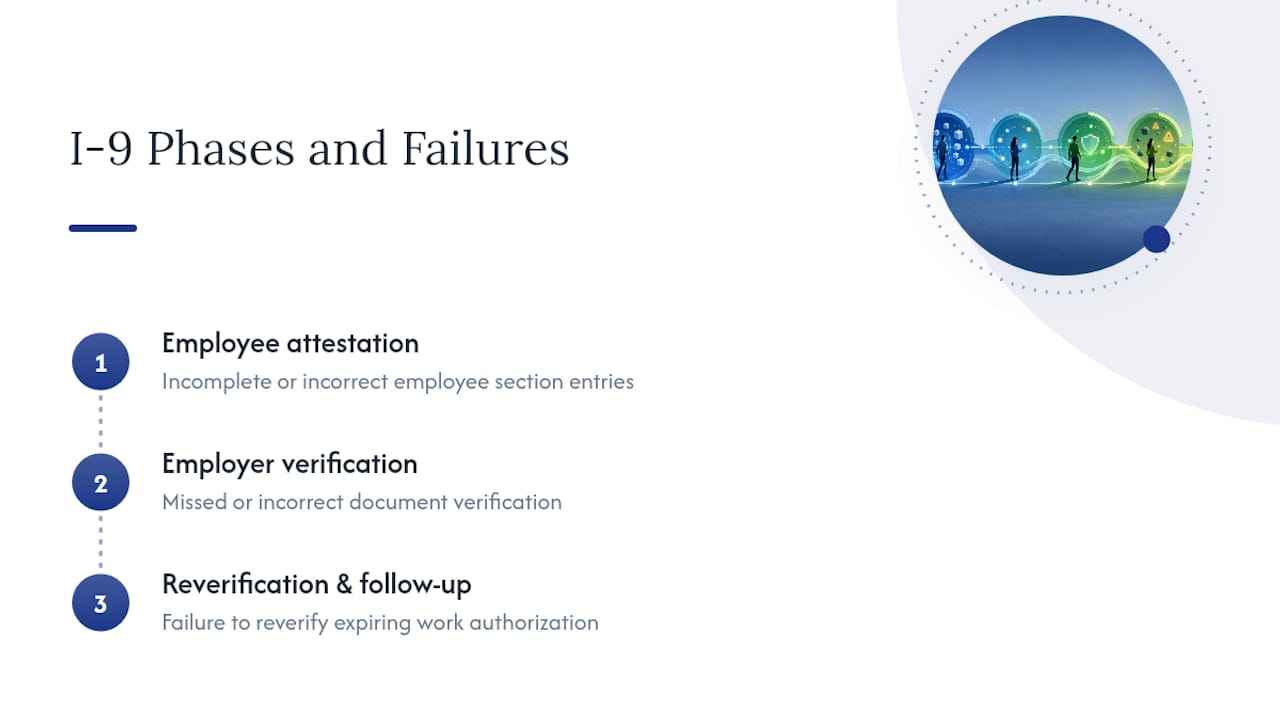
A Form I-9 lives in three phases: what the employee fills out, what you verify, and what happens later if their work authorization needs a fresh look. Each phase has its own failure points, and treating them as one blob is how errors slip through.
Section 1: employee attestation
The employee completes Section 1 no earlier than the day they accept the job offer, and no later than their first day of employment. Confirm they've checked one citizenship or immigration status box, signed, and dated the form themselves. If someone under 18 or with a disability needs help, a preparer or translator fills out Supplement A and signs their own certification.
Section 2: your verification duty
- Physically examine original, unexpired documents from the USCIS Lists of Acceptable Documents within three business days of the hire date (or by the first day, if the job is scheduled to last fewer than three days).
- Record the document title, issuing authority, document number, and expiration date exactly as they appear.
- Enter your business name and complete business address, not just a suite number or department.
- Sign and date Section 2 yourself, in your own hand, with your title.
- If the employee presents a receipt for a lost, stolen, or damaged document, note it and require the actual document within 90 days.
Pro Tip: Keep a laminated card at the front desk listing acceptable document combinations from the M-274 handbook. New hires and hiring managers make fewer mistakes when they can see the options instead of guessing.
Reverification and Supplement B
Reverification applies only to employees whose work authorization has an expiration date, not to List B identity documents like a driver's license. Track expiration dates on a calendar and reverify on Supplement B before the current authorization lapses. Some Employment Authorization Documents receive automatic extensions under USCIS guidance in the M-274 handbook; check the current extension notice before assuming a card has expired.

When a form is missing
Complete a new Form I-9 immediately using the employee's true, original hire date in Section 2. Never backdate it. Attach a signed, dated memo explaining why the original is missing, according to Constangy's internal audit guidance. That memo is what turns a gap into a documented, defensible correction instead of an unexplained hole in your files.

How Do You Run a Defensible Internal I-9 Audit?
Pick your scope before you touch a single form: either review every active employee's I-9 or pull a neutral random sample by hire date or department. ICE and DOJ guidance specifically warns against selecting forms based on an employee's perceived citizenship or national origin, since that shifts an audit from a compliance exercise into a discrimination claim.
Write down four things before you start: the purpose of the audit, how you chose which forms to review, your sample size if you didn't review everyone, and who conducted the review with the date they did it.
- Confirm every date field is filled in and internally consistent (hire date, verification date, signature date).
- Check that signatures exist in both Section 1 and Section 2, with printed names where required.
- Verify document details match an acceptable combination for the version of the form used at the time of hire.
- Flag any field left blank, any use of correction fluid, and any missing preparer certification.
Sort what you find into two buckets. Technical or procedural errors are things like a missing middle initial or an omitted phone number. Substantive violations, like a missing signature or a completely blank Section 2, carry real fine exposure and get fixed first. Assign a specific person to each correction, log the date it was fixed, and keep that remediation log alongside the forms themselves. Glendale Payroll's audit preparation guide walks through building that log from scratch if you're starting cold.
What Are the Most Common I-9 Mistakes and How Do You Fix Them?
The same handful of errors show up in almost every internal audit Glendale Payroll runs for clients:
- Section 2 completed after the three-business-day deadline, or not at all
- Document title, number, or expiration date left blank
- Employer business address missing or incomplete
- Section 2 unsigned, or signed by someone who never examined the documents
- Correction fluid or heavy strikeouts obscuring the original entry
- Preparer/translator certification started but not finished
USCIS guidance on self-audits lays out the fix: draw a single line through the incorrect entry, write the correct information nearby, then initial and date the change. Never use white-out, and never erase. If a form is so marked up it's illegible, prepare a new one, attach the old form behind it, and staple a signed explanation to both.
One rule employers routinely violate without realizing it: you cannot tell an employee which specific document to bring. They choose from the acceptable lists themselves. Specifying documents is "document abuse" under USCIS rules, and it carries its own penalty exposure separate from paperwork errors.
Pro Tip: Under the 2026 enforcement changes, fix unsigned sections and missing document details before anything else. ICE now treats many of these as substantive rather than technical, which strips away the cure period employers used to count on.
How Long Must You Retain Form I-9 Records?
Retain each Form I-9 for three years after the date of hire, or one year after termination, whichever date lands later. That means a five-year employee's form stays in your files for one year past their last day, while a seasonal worker's form might need to stay for nearly three years even though they only worked a few weeks.
- Store paper I-9s in a secure, separate binder or file, not mixed into general personnel files
- If you use an electronic system, confirm it produces a legible, indexed copy on demand and keeps an audit trail of edits
- Index forms by employee name and termination date so you can pull the right one fast during an inspection
- Purge forms only after their retention period has fully expired, and log the purge date
Glendale Payroll's guide to essential payroll records covers how I-9 retention fits alongside wage and tax recordkeeping, and TaxBatchPro's overview of financial record retention is a useful companion reference for small businesses juggling multiple retention clocks at once.
When Can You Use Remote I-9 Verification and E-Verify?
Form I-9 must be fully completed before you ever create an E-Verify case. Skipping that order, or creating a case before Section 2 is signed, is a compliance error on its own.
Remote document examination is not a general option. It's available only under the authorized alternative procedure described in the M-274 handbook, generally for employers enrolled in E-Verify in good standing. If your remote hire qualifies, mark the alternative procedure box in Section 2 and retain copies of the documents examined.
- Confirm E-Verify eligibility and enrollment status before offering remote verification to any hire
- Mark the alternative procedure checkbox in Section 2 when you use it
- Respond to a Tentative Nonconfirmation by following E-Verify's instructions exactly, and take no adverse action against the employee while the case is pending
- Check whether your state mandates E-Verify for public contractors or certain employer categories, since requirements vary by state
A misused remote-verification claim on a form that doesn't qualify for the alternative procedure is one of the fastest ways to turn a single hire into a substantive violation.
How Do ICE I-9 Inspections Work in 2026?
An inspection starts with a Notice of Inspection (NOI), and you get three business days to produce the requested Forms I-9 along with supporting records. ICE's inspection fact sheet notes agents commonly request payroll records, lists of active and terminated employees, and business licensing alongside the I-9s themselves.
After review, ICE issues one of several notices: a Notice of Suspect Documents, a Notice of Technical or Procedural Failures, a Notice of Intent to Fine, or a Compliance Letter if everything checks out. Historically, technical notices came with a short cure window to fix the problem before fines attached.
The March 2026 ICE update reclassified many of those previously technical errors as substantive violations, which means the automatic cure window many employers relied on no longer applies to a wide range of paperwork gaps. A missing document expiration date that once earned a warning can now draw an immediate fine.
- Keep your documented audit trail current, since it's the single best mitigation evidence you can hand an inspector
- Fix substantive errors the moment you find them, not on a quarterly schedule
- Train whoever completes Section 2 on the current acceptable document lists at least once a year
- Loop in employment counsel before responding to an NOI if you're unsure how serious your exposure is
Glendale Payroll's Free I-9 Audit for California Employers
Running this checklist alone takes hours you probably don't have between payroll cycles. Glendale Payroll builds I-9 review into the same payroll compliance services it provides to employers across Glendale, Burbank, Pasadena, and the greater Los Angeles area, so your forms get checked by the same team that already handles your tax filings and new hire reporting.
The free comprehensive payroll audit covers I-9 completeness alongside wage, tax, and California EDD compliance risks in one pass. You get a dedicated payroll professional reviewing your files, not a call-center queue.
Employers who catch substantive I-9 errors before ICE does almost always fare better than those who discover them mid-inspection.
- Full I-9 completeness sweep across active and recently terminated employees
- A prioritized remediation list separating substantive fixes from technical ones
- Secure retention setup that matches USCIS's three-year/one-year rule
- California-specific payroll compliance support layered on top of federal I-9 requirements
Pro Tip: Ask your payroll provider whether their audit produces a written, date-stamped record of what was reviewed. That record is exactly what ICE guidance recommends keeping, and it's often missing from DIY reviews.
Request your free audit through Glendale Payroll's California compliance guide and get a documented starting point before your next hiring wave.
What the 2026 Enforcement Shift Really Means for Employers
Most compliance advice still treats I-9 errors as low-stakes paperwork issues that get fixed on a cure period. That assumption is outdated. The 2026 reclassification means a form that used to earn a warning letter can now draw a direct fine, and the employers who get hurt worst are the ones who never ran an internal audit because their forms "looked fine" at a glance.
The overlooked piece isn't the rule itself, it's the documentation habit around it. An audit that finds and fixes ten errors without a written record of the review is barely better than no audit at all if ICE ever asks how those errors were caught. Write down your method before you write down your findings.
Prioritize substantive gaps over polish. A missing signature matters more than a messy handwriting fix, and treating them with equal urgency wastes time you don't have once an NOI lands.
Get a Free I-9 and Payroll Compliance Audit
Glendale Payroll is the practical alternative to guessing your way through an I-9 audit alone: instead of a generic compliance checklist and no follow-through, you get a dedicated payroll professional who reviews your forms, flags substantive errors, and helps you fix them before an inspector ever asks.

That matters most for small employers in Glendale, Burbank, Pasadena, and the greater Los Angeles area juggling payroll processing, California EDD requirements, and new hire reporting without a compliance department to lean on. Glendale Payroll's payroll tips resource walks through the compliance basics California employers ask about most, and the free comprehensive payroll audit extends that same scrutiny to your I-9 files at no cost. Request your audit today and get a documented, prioritized list of what needs fixing before your next hire or your next inspection.
Frequently Asked Questions
What is the deadline to complete Form I-9 for a new hire? Section 1 must be completed by the employee's first day of employment, and Section 2 must be completed by the employer within three business days of the hire date. Jobs lasting fewer than three days require same-day completion.
How long do I need to keep Form I-9 records? Retain each form for three years after the hire date or one year after termination, whichever is later, per USCIS retention rules.
Can I tell an employee which document to bring for verification? No. Employees choose which acceptable documents to present. Specifying a particular document is considered document abuse under USCIS rules.
What should I do if I find an error on an old I-9? Draw a single line through the incorrect entry, write the correct information, then initial and date the change. Never use white-out or erase the original entry.
Is E-Verify required for all employers? No, but some states mandate it for public contractors or specific employer categories. Confirm your state's requirements and always complete Form I-9 before creating an E-Verify case.