
Starting January 1, 2026, California's minimum wage rises to $16.90 per hour, which pushes the annual salary floor for most exempt employees to at least $70,304. That figure alone does not make an employee exempt. You still need to pass the duties test for executive, administrative, or professional exemptions, and you need to update payroll systems before the new year begins.
TL;DR:
- Employers must update their payroll systems to reflect a $70,304 annual salary minimum for exempt employees starting January 2026, based on double the state minimum wage.
- Meeting the salary threshold alone is insufficient; employees must also pass a duties test confirming they perform exempt-appropriate tasks.
- Higher salary thresholds apply for computer professionals and physicians, with separate schedules different from the general exemption floor.
- Part-time or variable-hour exempt roles require full salary compliance, not prorated, or reclassification as nonexempt with time tracking.
- Regular audits and documentation are essential to maintain compliance and prevent costly misclassification penalties, especially as thresholds increase annually.
Table of Contents
- Minimum Salary Exempt California 2026: The Numbers You Need
- Salary Alone Doesn't Make Someone Exempt
- Special Salary Floors for Computer Professionals and Physicians
- Your Compliance Checklist for the New Threshold
- Local Wage Ordinances Add Another Layer
- When an Employee No Longer Meets the Salary Test
- Where the Exempt Threshold Goes After 2026
- Calculating Exemptions for Part-Time and Variable-Hour Employees
- What Misclassification Actually Costs Employers
- Documenting Duties to Support an Exemption
- Collective Bargaining Agreements and Exemption Exceptions
- What Payroll Audits Actually Find
- Get a Free Payroll Audit Before the New Threshold Hits
- Sources
Minimum Salary Exempt California 2026: The Numbers You Need
The math behind $70,304 is straightforward, and you'll want to double check it against your own payroll configuration before the new year starts. California law sets the exempt salary threshold at twice the state minimum wage for full-time work, calculated as $16.90 × 2 × 40 × 52.
That produces the following figures for 2026:
- Annual salary minimum: at least twice the state minimum wage for full-time work, which is about $70,304
- Monthly equivalent: approximately $5,858.67
- Weekly equivalent: approximately $1,352.00
- Hourly wage basis: $16.90 per hour
The $70,304 threshold isn't a company policy or a guideline. It's a statutory floor set by California's minimum wage law, confirmed in the Department of Industrial Relations' official announcement of the 2026 wage increase.
For payroll configuration, enter $70,304 as the new annual salary minimum for any employee classified under the standard executive, administrative, or professional exemption, effective the first pay period starting on or after January 1, 2026. If your payroll software calculates thresholds automatically based on state minimum wage inputs, update that base rate first. The salary figure will follow.
Salary Alone Doesn't Make Someone Exempt
Meeting the $70,304 threshold gets you halfway there. California requires a two-part test: the employee must earn at least the minimum salary, and their actual job duties must satisfy one of the recognized exemption categories. Miss either half, and the exemption doesn't hold up, regardless of what the paycheck says.
Here's how the duties tests break down at a high level:
- Executive exemption: The employee primarily manages a department or subdivision, regularly directs the work of at least two full-time employees, and has real authority over hiring, firing, or promotion decisions.
- Administrative exemption: The employee performs office or non-manual work directly related to management policies or general business operations, and exercises discretion and independent judgment on significant matters.
- Professional exemption: The employee works in a recognized field requiring advanced knowledge, typically through specialized education, such as law, medicine, engineering, or accounting.
The duties test remains a separate legal requirement from the salary test, and courts consistently look at what an employee actually does day to day rather than their job title. A "manager" who spends 80% of their time on the same tasks as hourly staff, with little real decision-making authority, is a classic setup for a misclassification claim.
Pro Tip: Job titles don't win wage-and-hour disputes. If an "Operations Manager" spends most of the week doing the same data entry and customer service work as the team they supposedly supervise, that title won't hold up under scrutiny.
Special Salary Floors for Computer Professionals and Physicians
Two exemption categories operate on entirely separate salary schedules, and treating them like the general white-collar exemption is one of the more common compliance mistakes.
For 2026:
- Computer software employee exemption: a higher hourly and annual salary threshold applies
- Licensed physicians and surgeons exemption: a separate higher hourly rate applies
These figures come from a different statutory formula than the "twice minimum wage" calculation used for standard exemptions, and they adjust on their own schedule rather than tracking the general minimum wage increase directly.
Both exemptions also carry narrower duties requirements. The computer professional exemption applies to employees primarily engaged in systems analysis, programming, or software engineering, not general IT support or help desk work. The physician exemption is limited to licensed practitioners performing duties that require that license. Applying the general $70,304 floor to a software engineer or a staff physician, instead of checking their specific exemption category, is a mistake that shows up regularly in audit findings.
Your Compliance Checklist for the New Threshold
Treat this as a sequence, not a menu. Each step depends on getting the one before it right.
- Update pay-rate tables in your payroll system to reflect the $70,304 annual floor (or $5,858.67 monthly) for every employee classified under a standard exemption, effective the first pay period of January 2026.
- Retest every salaried-exempt employee's duties, not just their pay. Document the specific tasks that satisfy the executive, administrative, or professional test, and flag anyone whose actual responsibilities have drifted from their original job description.
- Reclassify or redesign roles where needed. If someone doesn't meet the salary or duties test, you'll either raise their pay, convert them to nonexempt status with timekeeping in place, or adjust their actual responsibilities.
- Update required workplace postings and internal wage notices to reflect the new minimum wage and salary figures, and make sure managers understand what changed.
- Audit a full pay cycle after January 1 to confirm the new numbers actually flowed through correctly, including overtime calculations for any nonexempt employees affected by the change.
Retesting exemptions annually, rather than treating a past classification as permanent, is the single habit that prevents most wage-and-hour exposure down the line. The Ogletree Deakins guidance on the 2026 increase specifically flags commissioned-pay logic and premium pay calculations as areas where errors cluster after a minimum wage jump, since those formulas often reference the base wage indirectly.
Pro Tip: Run your post-increase audit on a pay cycle that includes at least one employee near the salary threshold and one commissioned employee. Errors tend to surface at the edges, not in the middle of your pay bands.
For a structured walkthrough of this process, Glendale Payroll's payroll process review guide covers the mechanics of auditing a pay cycle for accuracy.
Local Wage Ordinances Add Another Layer
The $70,304 figure is a statewide floor tied to California's minimum wage, but dozens of cities and counties, including several in Los Angeles County, set their own minimum wage rates above the state number. Those local ordinances don't automatically raise the exempt salary threshold, since that calculation is tied to the state minimum wage specifically. But they do affect nonexempt employees working in those jurisdictions, and they matter enormously for multi-location employers.
Practical rules for your payroll setup:
- Configure payroll to apply the minimum wage rate for each employee's actual work location, not your company's headquarters address.
- For employees who split time across multiple cities or counties in a single pay period, apply the higher applicable rate for hours worked in that jurisdiction.
- Review local ordinance updates separately from the state announcement each year. Local minimum wage schedules often change on different dates than the state's January 1 effective date.
- Document which rate applies to remote employees based on where they physically perform the work, not where the company is registered.
If you employ people across Glendale, Burbank, Pasadena, and other Greater Los Angeles cities, this is worth a dedicated line item on your compliance checklist, separate from the state-level salary update.
When an Employee No Longer Meets the Salary Test
If someone's current pay falls under $70,304 once the new year hits, you have three real options, and the right one depends on the role, not just the budget.
- Raise the salary to meet the threshold. This is the simplest fix when the employee genuinely performs exempt-level duties and the pay gap is small.
- Reclassify to nonexempt status. This means implementing reliable timekeeping immediately, since nonexempt reclassification carries retroactive overtime exposure if the switch isn't handled cleanly from day one.
- Restructure the role's actual duties, with legal review, if the position was never a clean fit for exemption in the first place.
Before implementing any of these, assess your retro-pay exposure for the affected employee, adjust benefit proration if their pay structure changes, and update timekeeping systems before the change takes effect, not after. Communicate the change to the employee clearly, and keep contemporaneous documentation of why the decision was made. If the situation involves a borderline duties determination or a long-tenured employee, loop in employment counsel before finalizing anything. That documentation is often the difference between a clean reclassification and a claim two years later.
Pro Tip: Never announce a reclassification the same week you implement it. Give payroll at least one full cycle to test the new timekeeping setup quietly before the employee's pay structure actually changes.
Where the Exempt Threshold Goes After 2026
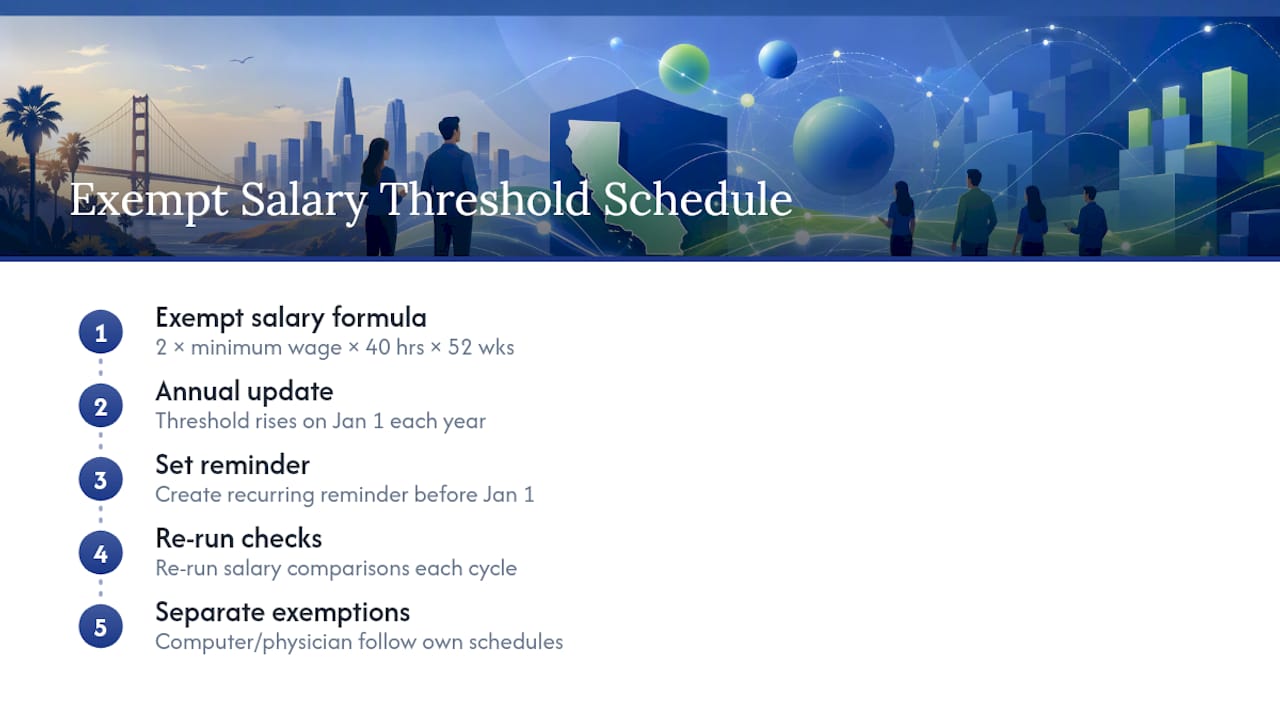
California's exempt salary minimum moves in lockstep with the state minimum wage, which means it's built to rise every year the minimum wage does, not just in 2026. Since the calculation is a fixed formula, twice the minimum wage times a 40 hour week times 52 weeks, any future minimum wage increase automatically pushes the exempt threshold higher on the same January 1 schedule.
That has a practical consequence most employers underestimate: an employee who clears the salary floor comfortably this year can fall below it again in a future cycle without you doing anything wrong. If wages stay flat while the statutory floor climbs, an exempt employee's classification can lapse quietly, often without anyone noticing until an audit or a departing employee's attorney flags it.
The safest posture is treating the exempt threshold as a moving target rather than a one-time fix. Build a recurring calendar reminder tied to the state's minimum wage announcement, which typically comes out months ahead of the January 1 effective date, and re-run your salary comparison for every exempt employee each cycle. Employers who wait until January to check are already behind, since payroll adjustments, communications, and any needed reclassifications take real lead time to execute cleanly. The computer professional and physician exemption thresholds move on their own separate schedules too, so they need their own recurring check rather than getting bundled into the general review.
Calculating Exemptions for Part-Time and Variable-Hour Employees
Part-time salaried employees create one of the more common compliance blind spots, because the exempt salary threshold doesn't scale down for reduced hours. An employee working 25 hours a week under an exempt classification generally still needs to earn the full $70,304 annual equivalent, not a prorated fraction based on hours worked.
This surprises a lot of employers who assume exempt status can flex with a part-time schedule the way hourly pay does. It can't, at least not safely. The standard guidance for part-time exempt employees is to either pay the full threshold regardless of reduced hours, or reclassify the position as nonexempt and track time worked, paying at least minimum wage plus applicable overtime.
Variable-hour employees add a second layer of complexity. If someone's schedule fluctuates significantly week to week, exempt classification becomes even harder to justify, since the exemption assumes a consistent, predetermined salary that doesn't fluctuate based on hours or quality of work. A salary that changes because hours changed is functionally an hourly wage wearing an exempt label, and that's exactly the pattern that draws scrutiny in a wage claim.
The safe approach for both scenarios: if the role genuinely doesn't require full-time exempt-level responsibility, classify it as nonexempt and track hours. If the role does require exempt-level duties on a reduced schedule, pay the full annual threshold anyway. Trying to split the difference is where most part-time exemption claims originate.
What Misclassification Actually Costs Employers
Misclassifying a nonexempt employee as exempt doesn't just create a compliance gap. It creates a specific, quantifiable liability that compounds the longer it goes uncorrected. Once an employee is found to have been misclassified, employers typically owe back overtime pay for all hours worked beyond eight in a day or forty in a week, going back as far as the applicable statute of limitations allows.
On top of unpaid overtime, misclassified employees are often owed missed meal and rest break premiums, since exempt employees aren't tracked for breaks the way nonexempt employees are. Waiting-time penalties can apply if the misclassification is discovered after an employee separates from the company and wages weren't paid correctly at termination. Civil penalties under the Private Attorneys General Act (PAGA) add another layer of exposure, particularly if multiple employees share the same misclassified job title, since a single claim can expand into a broader representative action covering everyone in that role.
The pattern that triggers most of these claims isn't a single dramatic error. It's usually a job description that hasn't been reviewed in years, sitting next to actual day-to-day duties that quietly drifted toward nonexempt work. A title stays the same. The role changes underneath it. Nobody updates the classification until a departing employee's attorney does the comparison for you.
Catching this internally, before an external claim forces the issue, is almost always cheaper and faster than responding to litigation after the fact.
Documenting Duties to Support an Exemption
If your exempt classifications are ever challenged, your documentation is what actually gets examined, not your job titles or your intentions. A written record showing what an employee actually does, updated regularly, is the strongest defense available when an exemption is questioned.

Start with a job description that reflects real, current duties rather than a template written years ago. Update it whenever a role changes meaningfully, not just during annual reviews. Alongside the description, keep a record of the specific decision-making authority the role carries: who they supervise, what they can approve independently, and what judgment calls fall within their discretion.
Performance evaluations help too, particularly when they reference the same duties the exemption relies on. If an executive exemption depends on someone managing a team and making staffing decisions, evaluations that reference those exact responsibilities reinforce the classification. Time logs, even informal ones, showing how a role's hours break down between exempt-level work and routine tasks can also matter if a dispute ever goes to a wage claim or lawsuit.
The goal isn't building a legal defense file for every employee. It's making sure that if a classification is ever questioned, you have more to point to than a job title and a salary number.
Collective Bargaining Agreements and Exemption Exceptions
Employees covered by a valid collective bargaining agreement (CBA) sometimes fall under different exemption rules than the general workforce, but the exceptions are narrower than many employers assume. California law allows certain CBA provisions to modify overtime and exemption rules for specific categories, most notably in construction, drilling, and a handful of other specialized industries, provided the agreement meets specific statutory requirements around wage rates and premium pay.
A CBA doesn't automatically exempt an employer from the standard salary threshold just because a union contract exists. The agreement has to explicitly address wage rates, hours of work, and working conditions, and it generally needs to provide a regular hourly rate of pay that's at least a specified percentage above the state minimum wage to qualify for any modified treatment.
For most California employers outside these specialized categories, a union contract doesn't change the exempt salary math. The $70,304 threshold, and the accompanying duties test, still apply to bargaining unit employees the same way they apply to non-union staff, unless the specific CBA provisions meet the narrow statutory exceptions. If your workforce includes unionized employees and you're unsure whether your agreement qualifies for modified treatment, that's a question worth routing to employment counsel rather than assuming either way.
What Payroll Audits Actually Find
Reviewing payroll setups across small businesses in the Glendale, Burbank, and Pasadena area, certain errors show up again and again once a new minimum wage takes effect. The most common finding is a salary threshold that got updated in spirit but not in the actual payroll system, meaning HR knows the new number but the software is still running last year's figure. Close behind that is a duties reclassification that never happened, where a role's responsibilities shifted months earlier, but nobody revisited the exemption status until an audit forced the question.
Commissioned pay logic is a frequent trouble spot too, since commission structures sometimes reference the base minimum wage indirectly, and a wage increase can throw off the calculation without anyone noticing until numbers stop reconciling.
A periodic payroll audit catches these before they become claims. What we look for: whether every exempt employee's current salary and actual duties still match their classification, whether local wage ordinances are correctly applied by work location, and whether recent role changes got reflected in payroll records. A lightweight pre-audit checklist for employers: pull your exempt employee roster, confirm each salary against the current threshold, and pull each person's current job description against what they're actually doing week to week.
— Glendale Payroll Staff
Get a Free Payroll Audit Before the New Threshold Hits
If you're managing payroll compliance in-house and the 2026 salary threshold is one more thing on a growing list, Glendale Payroll gives Greater Los Angeles employers a direct alternative to hiring an in-house compliance specialist or piecing together updates from advisory articles: a dedicated payroll professional who actually reviews your specific setup, not a call center reading from a script.

Services relevant to this update include:
- Comprehensive payroll audits to catch outdated thresholds, misclassified roles, and commission-logic errors before they become claims
- Ongoing payroll processing with California-specific tax filing and compliance built in
- EDD employer account setup and new hire reporting
- Continuous compliance monitoring as state and local wage rules change
Every new client engagement starts with a free comprehensive payroll audit, designed to flag risks like the ones covered above before they turn into penalties. If you want a clear picture of where your payroll stands against the 2026 requirements, start with Glendale Payroll's California Payroll Compliance Guide to see how a managed compliance review works, or reach out directly to schedule your audit before the January 1 deadline arrives.
Sources
The DIR's official 2026 minimum wage announcement is the authoritative source for the $16.90 hourly rate and the $70,304 exempt salary calculation. The California Labor & Workforce Development Agency hosts general wage and hour guidance, while the DLSE Know Your Rights notice is the required posting employers should download and display. For deeper legal analysis on the duties test and special exemption categories, the Fenton & Keller 2026 wage advisory and Ogletree Deakins compliance update both offer practical, employer-focused breakdowns worth bookmarking.
- California’s minimum wage set to increase to $16.90 per hour on January 1, 2026
- 2026 Minimum Wage and Salary - Fenton & Keller
- What California Employers Must Update for Minimum Wage
- California's 2026 minimum wage increase: what employers must update when the floor moves