
Yes, every California employer must report new and rehired employees to the state's New Employee Registry, and the clock starts the moment work begins. You have a limited time period from the employee's start-of-work date to file, which is commonly about three weeks. You can submit through e-Services for Business, the paper DE 34 form, or a copy of the employee's W-4 with two fields added. Miss the window, and penalties follow.
TL;DR:
- Employers must report any employee working in California within three weeks of their start date using e-Services, DE 34 form, or a W-4 with added info.
- Rehiring employees after a 60-day or longer absence requires a new report, but shorter furloughs or rehires after 45 days do not.
- Filing late incurs penalties of $24 per failure, increasing to $490 if the delay results from an employer-employee conspiracy.
- Multistate employers can file all California hires in one state electronically but must notify the U.S. Department of Health and Human Services.
- Consistent onboarding procedures, including start dates and payroll account info, help prevent compliance gaps and delays.
Table of Contents
- Who Must Report New Hires in California
- What Information the EDD Requires
- How Do You Report New Hires in California?
- Multistate Employers and Special Hiring Situations
- What Happens If You Report Late?
- Best Practices That Keep You Off the EDD's Radar
- A Payroll Professional's Take on New Hire Compliance
- Let Glendale Payroll Handle Your EDD Reporting
- Where to File and Who to Contact
- Sources
Who Must Report New Hires in California
If a worker performs services in California, you must report that hire, regardless of where your company is headquartered. A retailer based in Nevada with one Sacramento employee still owes a report to California's registry, not Nevada's.
The state distinguishes between a new hire and a rehire. A rehire is anyone who returns to your payroll after a separation of approximately two months or more, and you report them exactly as you would a brand-new employee. Bring someone back after a 45-day gap, and no new report is required, since the break falls short of the threshold.
Independent contractors follow a separate reporting track under EDD's contractor rules, with different thresholds and forms, so don't fold them into your new-hire workflow. The DE 231Y information sheet walks through those distinctions in detail.
Quick reference for who counts:
- Any employee who starts work physically located in California
- Rehired employees separated 60+ days from their last day worked
- Employees hired through a business acquisition or merger who are new to your payroll
- Seasonal or part-time staff, with no exemption for hours worked
What Information the EDD Requires
The DE 34 form spells out exactly which fields the EDD needs, and missing even one can delay processing or trigger a rejection.
Employer information:
- EDD payroll tax account number
- Federal Employer Identification Number (FEIN)
- Business name and address
- Contact name and branch code, if applicable
Employee information:
- Full legal name
- Social Security number
- Home address
- Start-of-work date
If you'd rather skip the DE 34 entirely, you can submit a copy of the employee's federal W-4 (or state DE 4). But that copy is only acceptable once you've handwritten or stamped two additions: the start-of-work date and your EDD payroll account number. Neither field appears on a standard W-4, and their absence is one of the most common reasons employers get bounced back for resubmission.
Pro Tip: Build a rubber stamp or digital field into your onboarding packet that captures the start-of-work date and EDD account number automatically. It costs nothing and eliminates the single most common rejection reason on W-4 submissions.
How Do You Report New Hires in California?
You have three legitimate paths, and the EDD strongly favors one of them.
- e-Services for Business (recommended). Register your account at e-Services for Business, then submit new-hire data directly through the portal. Electronic filers submitting on a recurring basis must transmit at least twice monthly, with transmissions spaced no less than 12 and no more than 16 days apart, per UIC section 1088.5.
- DE 34 paper filing. Print, complete, and mail the form, or fax it to 1-916-319-4400. Mailed forms go to the address printed on the DE 34 itself, and EDD accepts batches covering multiple employees on one submission.
- W-4 copy option. Submit a copy of the completed W-4 with the start-of-work date and EDD payroll account number added by hand.
Whichever method you choose, keep proof. For electronic filings, the transmission timestamp is your record. For paper filings, the postmark date is what EDD uses to judge timeliness, so mail early rather than on the deadline itself. If you're processing hires in bulk after a seasonal ramp-up, batch them into a single DE 34 submission rather than filing one at a time; it's faster and reduces the odds of a missed form slipping through.
Multistate Employers and Special Hiring Situations
Multistate employers get one meaningful shortcut: if you have employees working in more than one state, you can choose a single state and file all new-hire reports there electronically, instead of reporting separately to each state's registry. Take that option, though, and you must notify the U.S. Department of Health and Human Services' Office of Child Support Services in writing.
A few scenarios trip employers up regularly:
- Business acquisitions. Employees who come with a purchased business count as new hires if they weren't previously on your payroll.
- Furloughs. An employee returning from furlough is treated as a rehire only if the gap hits 60 days; shorter furloughs don't trigger a new report.
- Remote workers. A worker logging in from a home office in Fresno counts as working in California, even if your company's payroll office sits in another state.
What Happens If You Report Late?
The 20-calendar-day deadline is measured strictly. Electronic submissions are judged by transmission timestamp; paper filings, by postmark date. There's no rounding and no informal grace period built into the statute.
Penalties under UIC 1088.5 run $24 per failure to report, and $490 if the failure results from an intentional conspiracy between employer and employee to avoid reporting.
Those numbers sound small on a single hire. They add up fast for a business bringing on a dozen seasonal workers without a system in place. If you discover a missed report, file it immediately rather than waiting; a late report still causes less exposure than one that never gets submitted at all.
- Run a monthly audit comparing new payroll entries against your NER filing log
- Flag any hire without a matching submission before the next pay cycle closes
- Document the correction date if you catch and fix a miss internally
Best Practices That Keep You Off the EDD's Radar
Most reporting failures aren't willful. They're onboarding gaps that nobody catches until an audit flags them.
- Add the start-of-work date to your onboarding checklist as a required field, not an optional note. It's the single date the entire 20-day clock depends on.
- Require the EDD payroll account number on every W-4 copy before it leaves HR's hands, if that's your chosen filing method.
- Schedule recurring e-Services transmissions tied to your payroll calendar rather than filing reactively. If you're required to submit twice monthly, build the 12 to 16-day spacing into a recurring calendar reminder.
- Keep a proof-of-filing log with timestamps or postmark copies for every submission, going back at least a year.
Watch specifically for two recurring mistakes: employers who confuse a short leave of absence with a qualifying 60-day rehire gap, and employers who assume out-of-state payroll systems automatically route California hires to the right registry. They don't. A short internal audit each quarter, comparing new hires against filed reports, catches both before they become a penalty notice. For a broader look at how these gaps show up in practice, our payroll process review breaks down where onboarding data most often falls through the cracks. If your workforce includes documentation-heavy onboarding, such as I-9 or E-Verify steps, this compliance guide for specialized employers is a useful companion reference.
A Payroll Professional's Take on New Hire Compliance
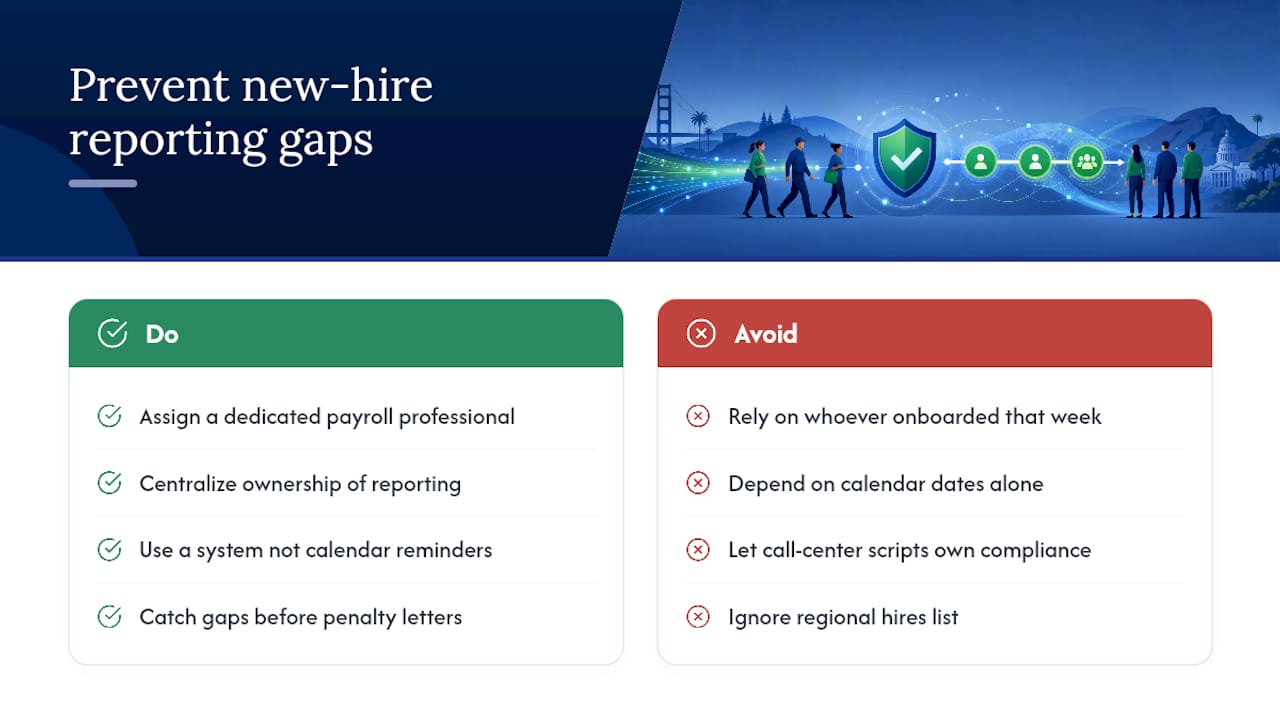
New hire reporting looks simple on paper: one form, one deadline, one government office. In practice, it's one of the most quietly common compliance gaps we see across small businesses in Glendale, Burbank, Pasadena, and the greater Los Angeles area, usually not because owners are careless, but because the task falls to whoever handled onboarding that week, and nobody owns it consistently.
The fix isn't more paperwork. It's a system that doesn't depend on someone remembering a date on a calendar. A dedicated payroll professional, rather than a call center reading from a script, catches these gaps before they turn into a penalty letter.
— Glendale Payroll Staff
Let Glendale Payroll Handle Your EDD Reporting
Professional payroll services can be an alternative to handling e-Services logins and paper DE 34 forms yourself, managing new-hire reporting as part of a comprehensive payroll process including EDD account setup, e-Services transmissions, DE 34 filings, and compliance audits to help ensure deadlines are met.

If you're not sure whether your current process has gaps, consider requesting a comprehensive payroll audit that reviews your onboarding data flow, checks past filings against payroll records, and identifies potential exposures before government agencies do. If you're a solo owner with two or three employees and a simple hiring cadence, filing directly through e-Services yourself is perfectly reasonable. Once you're hiring regularly, running multiple pay schedules, or managing rehires and furloughs, the math tips toward professional handling. Visit our California payroll compliance guide to see how the audit works and what it covers.
Where to File and Who to Contact
File electronically at e-Services for Business, or submit paper forms using these EDD resources:
- DE 34 form: download and complete the Report of New Employee(s) for mail or fax submission
- Fax number: 1-916-319-4400
- EDD phone assistance: 1-888-745-3886
- DE 44 Employer's Guide: the California Employer's Guide covers full NER rules and worked examples
- Legal basis: UIC section 1088.5 governs the reporting requirement and penalty structure
- Independent contractor rules: the DE 231Y information sheet explains reporting differences for contractors
Sources
- California's New Employee Registry - EDD
- REPORT OF NEW EMPLOYEE(S) (DE 34)
- California Unemployment Insurance Code §1088.5
- DE 44 California Employer's Guide (excerpt)