
Under California Labor Code §510, nonexempt employees earn 1.5x their regular rate after 8 hours in a workday or 40 hours in a workweek, and double time after 12 hours in a single day. A separate double-time trigger applies to the seventh consecutive day of work in a workweek: the first 8 hours pay at 1.5x, and every hour beyond 8 that day pays at 2x. The California Department of Industrial Relations (DIR) and its Labor Commissioner's Office (DLSE) enforce these rules and handle wage claims when employers fall short.
The immediate payroll implication: you must track hours both daily and weekly, then pay whichever calculation produces the higher amount. A payroll system that only watches the 40-hour weekly threshold will miss daily overtime entirely, and that gap creates real liability.
California overtime law is more protective than federal law. The Fair Labor Standards Act requires overtime only after 40 hours in a week. California adds daily triggers that the FLSA does not, meaning employers operating here must comply with both regimes and apply whichever standard benefits the employee more.
Key Takeaways
California overtime law requires employers to track daily and weekly hours separately, compute a weighted regular rate when bonuses or multiple rates apply, and pay whichever overtime calculation yields the higher amount for each qualifying hour.
| Point | Details |
|---|---|
| Core daily and weekly triggers | Overtime begins after 8 hours/day or 40 hours/week; double time after 12 hours/day. |
| Seventh-day rule | First 8 hours pay at 1.5x, and every hour beyond 8 pays at 2x. |
| Regular rate includes bonuses | Nondiscretionary bonuses must be included in the regular rate before computing any overtime premium. |
| Recordkeeping and pay timing | Labor Code §204 requires overtime to be paid in the same pay period it was earned; retain records for at least three years. |
| Filing a wage claim | Employees can file with the DLSE at dir.ca.gov; collect paystubs, time records, and written communications before filing. |
| Glendale Payroll compliance audit | Glendale Payroll offers a free payroll audit to identify overtime calculation errors before they become wage claims. |
Table of Contents
- What are the overtime rules in California?
- How to calculate overtime pay in California
- Daily, weekly, and seventh-day overtime thresholds at a glance
- Who is exempt or covered by special rules?
- How do alternative workweek schedules change overtime?
- What are employers required to do for timekeeping and records?
- What can you do if overtime isn't paid correctly?
- Worked calculations and common payroll mistakes
- California employer overtime compliance checklist
- Why California payroll errors are harder to fix than they look
- Glendale Payroll's free audit for California overtime compliance
- Sources
What are the overtime rules in California?
California's overtime framework rests on Labor Code §510 and the Industrial Welfare Commission (IWC) Wage Orders that govern specific industries. The statute defines a "day's work" as 8 hours, a workweek as any seven consecutive days, and sets the premium rates that apply once those thresholds are crossed.
The rules apply to nonexempt employees. That category covers most hourly workers and many salaried workers who do not meet the strict duties and salary-basis tests for an exemption. Whether a worker is nonexempt is a legal determination, not simply a matter of how they are paid.
Workday and workweek defined
A workday is any consecutive 24-hour period established by the employer. Employers can set a workday that starts at any hour, but once set, it must be consistent. A workweek is any fixed, regularly recurring period of 168 hours, made up of seven consecutive 24-hour periods. Employers choose when the workweek begins, and that choice directly affects overtime calculations. Changing a workweek definition to avoid overtime is prohibited.
What counts as "hours worked"
California uses a broad "suffered or permitted to work" standard. If an employer knows or reasonably should know that an employee is working, those hours are compensable, even if the employer never authorized the work. The DLSE's overtime guidance makes clear that unauthorized overtime must still be paid, though the employer may discipline the employee for violating a policy.
Compensable time typically includes:
- Pre-shift and post-shift work required by the employer (setting up equipment, closing out a register)
- Work-related travel during the workday, such as traveling between job sites
- On-call time when the employee's freedom is so restricted that they cannot use the time for personal purposes
- Mandatory training and meetings that occur during work hours
Time that does not count toward overtime includes paid holidays, paid sick leave, and vacation pay. Those amounts may appear on a paycheck, but they are not "hours worked" for overtime threshold purposes.
Pro Tip: Document your workday and workweek start times in a written policy and in your payroll system. Inconsistent or undocumented workweek boundaries are one of the first things a DLSE investigator examines when a wage claim is filed.
How to calculate overtime pay in California
The foundation of every overtime calculation is the regular rate of pay, which is not simply an employee's stated hourly wage. Under California law, the regular rate is a weighted average of all remuneration paid for employment in a workweek, divided by total hours worked that week.
What goes into the regular rate
Included:
- Base hourly wages
- Nondiscretionary bonuses (production bonuses, attendance bonuses, bonuses promised in advance)
- Shift differentials
- Commissions paid as part of a compensation plan (in most cases)
- Piece-rate earnings
Excluded:
- Discretionary bonuses (holiday gifts, bonuses given at the employer's sole discretion with no prior promise)
- Expense reimbursements
- Premium pay for overtime itself
- Vacation pay, holiday pay, and sick pay
The weighted-average method
When an employee works at two or more different hourly rates in the same workweek, you must compute a weighted average. Divide total weekly earnings (at straight time) by total hours worked. That result is the regular rate. Then multiply by 0.5 to get the overtime premium for 1.5x hours, or by 1.0 for double-time hours (since the straight-time portion is already included in the base pay).
Worked examples
Example A: Daily overtime only, under 40 hours for the week
Regular rate = $18.00. Overtime premium = $18.00 × 0.5 = $9.00 per overtime hour.
Total overtime premium = 3 × $9.00 = $27.00
Total gross pay = $630.00 + $27.00 = $657.00
Note: weekly hours are only 35, so no weekly overtime applies. California's daily trigger adds $27.00 that a federal-only calculation would miss entirely.

Example B: Weekly overtime with a nondiscretionary bonus
An employee works 44 hours at $20/hr and receives a $100 nondiscretionary production bonus.
- Straight-time earnings: 44 × $20 = $880.00
- Total remuneration: $880.00 + $100.00 = $980.00
- Regular rate: $980.00 ÷ 44 = $22.27
- Overtime premium (4 hours over 40): $22.27 × 0.5 × 4 = $44.54
- Total gross pay: $980.00 + $44.54 = $1,024.54
Skipping the bonus in the regular-rate calculation would have produced a lower overtime premium and a wage underpayment.
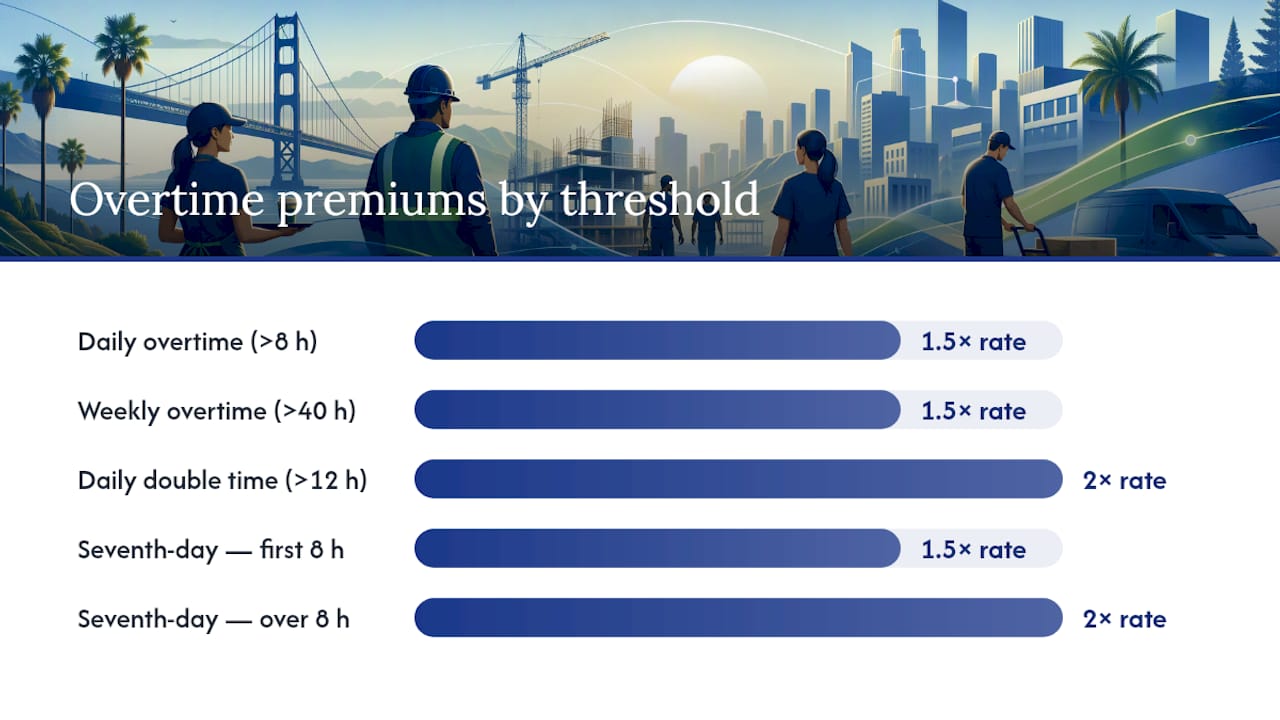
Daily, weekly, and seventh-day overtime thresholds at a glance
California's threshold structure is layered. Each trigger is independent, and when more than one applies to the same hour, the employer pays the higher premium.
| Threshold | Hours | Premium |
|---|---|---|
| Daily overtime | Over 8 hours in a workday | 1.5x regular rate |
| Weekly overtime | Over 40 hours in a workweek | 1.5x regular rate |
| Daily double time | Over 12 hours in a workday | 2x regular rate |
| Seventh-day, first 8 hours | First 8 hours | 1.5x regular rate |
| Seventh-day, over 8 hours | Over 8 hours | 2x regular rate |
How overlapping triggers work
Labor Code §510 states that employers are not required to pay more than one overtime premium for the same hour. When two triggers apply simultaneously, you pay the higher rate, not both stacked on top of each other.
Seventh-day example: An employee works Monday through Sunday. Sunday is the seventh consecutive day. They work 10 hours.
- Hours 1–8: 1.5x (seventh-day premium)
- Hours 9–10: 2x (over 8 hours on the seventh consecutive day)
If those same 10 hours also push the weekly total past 40, the employer pays the seventh-day rate because it equals or exceeds the weekly overtime rate for those hours.
California vs. federal FLSA
The FLSA requires overtime only after 40 hours in a workweek. It has no daily overtime trigger and no seventh-day rule. California employers must satisfy both laws simultaneously, applying whichever standard is more protective to the employee for each hour in question.
Who is exempt or covered by special rules?
Not every California worker is entitled to overtime. Exemptions fall into two broad categories: statutory exemptions (where the employee owes no overtime at all) and industry exceptions (where a different calculation applies).
Executive, administrative, and professional exemptions
These three "white-collar" exemptions require the employee to meet both a duties test and a salary-basis test. In California, the minimum salary threshold for these exemptions is set at twice the state minimum wage for full-time employment. As of 2026, that threshold is higher than the federal equivalent, so the California floor controls.
The duties tests are strict. An executive employee must have genuine management authority and the ability to hire or fire. An administrative employee must exercise independent judgment on matters of significance, not just follow procedures. A professional employee must work in a field requiring advanced knowledge typically acquired through prolonged specialized education.
The burden of proving an exemption falls entirely on the employer. Courts and the DLSE construe exemptions narrowly. If the employer cannot demonstrate that the employee satisfies both the duties test and the salary-basis test, the employee is nonexempt and entitled to overtime for all qualifying hours. CalChamber's guidance on exempt vs. nonexempt status warns that paying an exempt employee hourly for nonexempt tasks can destroy the exemption and trigger retroactive overtime exposure.
IWC Wage Orders and industry-specific rules
The IWC issues Wage Orders that govern specific industries and occupations. The most commonly referenced for overtime purposes include:
- Order 4 (Professional, Technical, Clerical, Mechanical, and Similar Occupations)
- Order 5 (Public Housekeeping Industry, which covers hotels, restaurants, and hospitals)
- Order 14 (Agricultural Occupations)
- Order 15 (Household Occupations)
- Order 16 (On-Site Construction, Drilling, Logging, and Mining Industries)
The DLSE exceptions page details how each order modifies the general overtime rules. Healthcare workers under Order 5, for example, may work alternative shifts under specific conditions. Agricultural workers under Order 14 have historically operated under phase-in schedules that differ from the general 8-hour trigger.
Live-in domestic workers, commissioned inside salespeople, and certain transportation workers also fall under modified rules. The key distinction: an exemption removes overtime obligations entirely, while an exception changes how overtime is calculated, not whether it applies.
Misclassifying a nonexempt worker as exempt is one of the most expensive payroll errors a California employer can make. Back pay, interest, civil penalties, and attorney's fees can accumulate quickly, particularly when the misclassification affects multiple employees over several years.
How do alternative workweek schedules change overtime?
Under California Labor Code §511 and the applicable IWC Wage Orders, employers may adopt an alternative workweek schedule (AWS) that allows employees to work up to 10 hours per day without triggering daily overtime, provided the schedule is properly adopted.
An alternative workweek schedule does not eliminate overtime. It shifts the daily threshold. Under a validly adopted 4×10 schedule, overtime begins after 10 hours in a day (not 8), and double time still applies after 12 hours. Hours beyond the regularly scheduled shift on any day, and any hours worked on a day not included in the schedule, revert to the standard overtime rules.
How overtime is computed under an AWS
If an employee on a 4×10 schedule works 11 hours on a scheduled day, they earn 1.5x for hour 11. If they work on an unscheduled fifth day, all hours that day are compensable at 1.5x from the first hour, because that day falls outside the adopted schedule.
Adopting an alternative workweek: the basic process
Employers cannot simply announce an alternative workweek. The process under §511 requires:
- A written proposal describing the proposed schedule
- A secret ballot election in which at least two-thirds of affected employees in the work unit vote in favor
- A 14-day waiting period before the election
- Reporting the results to the DLSE within 30 days of the election
- Maintaining records of the election and the schedule
Healthcare employers under Order 5 have additional specific language governing alternative schedules, including provisions for 12-hour shifts that differ from the general §511 process. Adopting an AWS without following these steps means the schedule has no legal effect, and the standard 8-hour daily overtime threshold continues to apply.
What are employers required to do for timekeeping and records?
Accurate timekeeping is not optional in California. It is a legal obligation, and gaps in records almost always work against the employer in a wage claim.
Required recordkeeping
California employers must maintain accurate records of:
- Daily start and stop times for each employee
- Total daily and weekly hours worked
- Applicable pay rates and any rate changes
- Gross wages earned, deductions, and net wages paid
- Payroll period dates and the date of each payment
Records must be retained for at least three years and made available to the DLSE upon request.
Timing of wage payments
Labor Code §204 sets the payroll timing rules. For most employees, wages earned between the 1st and 15th of the month must be paid by the 26th, and wages earned between the 16th and the last day of the month must be paid by the 10th of the following month. Overtime earned in a pay period must be included in that period's paycheck, not deferred.
Required workplace postings
The DIR requires employers to post the applicable IWC Wage Order in a conspicuous location at each worksite. The Wage Order summarizes minimum wage, overtime, meal and rest break rules, and other rights. Failure to post is a separate violation.
Best practices for accurate time capture
- Use a time and attendance system that records punches at the minute level
- Require supervisor review and sign-off on timecards each pay period
- Maintain a written policy on overtime authorization and off-the-clock work
- Audit payroll registers against time records at least quarterly
- Configure payroll software to apply both daily and weekly overtime triggers, not just weekly
Pro Tip: Rounding policies are a frequent source of wage claims. California courts scrutinize rounding practices closely. If your system rounds time, verify that the rounding is neutral over time and does not systematically reduce employee pay. When in doubt, round up or eliminate rounding entirely. Automating payroll can reduce these errors significantly — see how to automate payroll processing for practical system options.
What can you do if overtime isn't paid correctly?
Employees who believe they have been underpaid overtime have several paths to recovery. Employers facing a claim have options too, but the window to respond effectively is narrow.
Available remedies for employees
- Back wages for all unpaid overtime, calculated at the correct premium rate
- Interest on unpaid wages from the date they were due
- Liquidated damages equal to the amount of unpaid wages in some circumstances
- Civil penalties under the California Labor Code, including waiting-time penalties under Labor Code §203 when final wages are willfully withheld
- Attorney's fees and costs in successful wage claims
The statute of limitations for most California wage claims is three years for statutory violations and four years for claims brought under the Unfair Competition Law (Business & Professions Code §17200).
How to file a wage claim with the DLSE
The DLSE filing guide walks employees through the process step by step. The basic sequence:
- Gather evidence: paystubs, time records, offer letters, any written communications about hours or pay
- Complete the DLSE Initial Report or Claim form (available on the DIR website)
- Submit the form to the local Labor Commissioner's Office
- Attend the conference and hearing scheduled by the DLSE
The DLSE will schedule a settlement conference first. If the matter is not resolved, it proceeds to a hearing before a deputy labor commissioner, who issues an Order, Decision, or Award.
Employer response steps
When a wage claim is filed, employers should immediately:
- Preserve all payroll records, timecards, and communications related to the claimant
- Conduct an internal payroll audit to identify whether the claimed underpayment exists
- Review the employee's classification and the applicable Wage Order
- Consult with a payroll compliance professional or employment attorney before the conference date
The DIR's enforcement activity shows that the Labor Commissioner actively pursues wage claims and has secured multi-million-dollar settlements in recent enforcement actions. Proactive compliance is far less costly than reactive defense.
Worked calculations and common payroll mistakes
Example A: Employee with mixed hourly rates
Maria works two roles in the same workweek. She earns $18/hr as a cashier and $22/hr as a shift lead.
- Cashier hours: 20 hours × $18 = $360
- Shift lead hours: 24 hours × $22 = $528
- Total hours: 44 | Total straight-time earnings: $888
Regular rate = $888 ÷ 44 = $20.18
Overtime premium = $20.18 × 0.5 × 4 = $40.36
Total gross pay = $888.00 + $40.36 = $928.36
Using only the lower rate ($18) for the overtime premium would have underpaid Maria by roughly $8.72 for that week alone.
Example B: Daily overtime but under 40 hours for the week
| Day | Hours | Daily OT Hours |
|---|---|---|
| Monday | 11 | 3 (hours 9–11 at 1.5x) |
| Tuesday | 11 | 3 (hours 9–11 at 1.5x) |
| Wednesday | 8 | 0 |
| Thursday | 8 | 0 |
| Friday | 0 | 0 |
| Total | 38 hours | 6 OT hours |
Employee earns $20/hr. Weekly hours are 38, so no weekly overtime. But 6 daily overtime hours still apply.
Overtime premium = $20 × 0.5 × 6 = $60.00
A payroll system set to weekly-only overtime would pay $760 (38 × $20) and miss the $60 premium entirely.
Most common payroll mistakes
- Excluding nondiscretionary bonuses from the regular rate. This is the single most common calculation error and produces systematic underpayment whenever bonuses are paid.
- Using the wrong regular rate for multiple-rate weeks. Applying the rate in effect at the time of the overtime hours, rather than the weighted average, understates the premium.
- Ignoring seventh-day premiums. Many payroll systems do not track consecutive-day counts. The seventh-day rule requires a workweek-level view of scheduling.
- Off-the-clock work. Employees checking email, finishing tasks, or attending brief pre-shift meetings without clocking in creates unrecorded compensable time.
- Incorrect rounding. Rounding practices that consistently favor the employer are unlawful under California standards.
Verification checklist for a single pay period:
- Confirm workday and workweek boundaries match the written policy
- Verify all hours worked are captured, including pre-shift and post-shift time
- Check whether any nondiscretionary bonus was paid and recalculate the regular rate if so
- Confirm daily overtime hours are counted separately from weekly overtime hours
- Check for a seventh consecutive workday and apply the correct premium
- Verify double-time hours (over 12 in a day) are coded at 2x, not 1.5x
California employer overtime compliance checklist
Reducing overtime liability starts before the first paycheck. The following checklist covers the actions that matter most.
Audit and classification
- Audit your workforce classifications annually. Every employee coded as exempt must satisfy both the duties test and the salary-basis test under California law. Review exempt vs. nonexempt guidance and document your analysis.
- Identify which IWC Wage Order covers each employee group and confirm your overtime settings match that order's thresholds.
- Review independent contractor classifications. California's ABC test applies strict criteria, and misclassified contractors may be entitled to overtime as employees.
Payroll system configuration
- Configure your payroll software to calculate daily overtime (over 8 hours), daily double time (over 12 hours), and seventh-day premiums, not just weekly overtime.
- Set up weighted-average regular-rate calculations for any employee who works at multiple rates or receives nondiscretionary bonuses.
- Run a parallel calculation for the first payroll period after any system change to confirm the output matches manual math.
Documentation and posting
- Retain timecards, payroll registers, and pay stubs for a minimum of three years.
- Post the applicable IWC Wage Order at each worksite in a location visible to employees.
- Maintain written policies on overtime authorization, off-the-clock work, and meal and rest breaks.
- Document any alternative workweek schedule elections, including the vote results and the DLSE filing confirmation.
Ongoing monitoring
- Schedule a payroll process review at least once per year. A structured payroll process review catches configuration drift before it becomes a wage claim.
- Review payroll registers each period for anomalies: employees with zero overtime in high-hour weeks, missing seventh-day premiums, or bonus weeks without a recalculated regular rate.
Pro Tip: Glendale Payroll offers a free payroll audit for California employers. A single audit cycle often uncovers systematic errors that, left uncorrected, compound into significant liability over a three-year lookback period. It costs nothing to find out where you stand.
Why California payroll errors are harder to fix than they look
From Glendale Payroll's perspective, the most dangerous overtime mistakes are not the obvious ones. Employers who miss the 40-hour weekly threshold usually catch it quickly. The errors that generate the largest claims are the quiet, structural ones: a payroll system configured for federal rules only, a bonus plan that never gets folded into the regular rate, or an alternative workweek schedule that was never properly adopted but has been running for years.
The misapplied regular rate is particularly costly because it affects every overtime hour in every pay period. A $50 underpayment per week across 20 employees over three years is a six-figure exposure before penalties. And because California's statute of limitations extends to four years under the Unfair Competition Law, the lookback period is longer than most employers expect.
The seventh-day premium is the other consistent blind spot. Scheduling systems and payroll platforms often track hours within a shift but do not flag when an employee has worked six consecutive days and is about to trigger the seventh-day rule. That requires a workweek-level view that many off-the-shelf systems do not provide by default.
When Glendale Payroll conducts a compliance review, the first three things we examine are the regular-rate calculation method, the daily overtime configuration, and the documentation trail for any alternative workweek schedule. Those three areas account for the majority of the overtime exposure we find. If your payroll team cannot quickly answer how your system handles a nondiscretionary bonus week, that is a signal worth acting on before a wage claim makes it urgent.
The decision to bring in outside expertise is not always about complexity. Sometimes it is simply about having a second set of eyes on a process that has been running unchecked. A payroll compliance review is a low-cost way to confirm that your current setup is sound, or to find out exactly where it is not.
Glendale Payroll's free audit for California overtime compliance
California's overtime rules create real financial exposure for employers who get the calculations wrong, and the complexity only grows when you add nondiscretionary bonuses, multiple pay rates, or alternative workweek schedules into the mix. Glendale Payroll specializes in exactly this: payroll processing and compliance for small businesses in Glendale, Burbank, Pasadena, and Greater Los Angeles, with a focus on getting California's daily and weekly overtime rules right from the first paycheck.

Unlike generalist payroll firms, Glendale Payroll assigns dedicated payroll professionals to each client, not a call center. Every engagement includes a review of your current overtime configuration, regular-rate calculation method, and recordkeeping practices. For employers who want to verify their current setup before a wage claim surfaces, Glendale Payroll offers a free comprehensive payroll audit with no obligation.
To schedule your free audit or learn more about California payroll compliance services, contact Glendale Payroll directly. You can also review the full service overview to see how ongoing payroll management reduces overtime risk month after month.
Sources
The following official resources contain the primary texts and agency guidance referenced throughout this article:
- Overtime - California Department of Industrial Relations
- California Labor Code § 510
- Fair Labor Standards Act (FLSA) - U.S. Department of Labor
This article provides general information about California overtime law and is not a substitute for legal or professional payroll advice. Overtime rules vary by industry, Wage Order, and individual employment circumstances. Confirm current requirements with the California Department of Industrial Relations or a qualified payroll professional.