
California employers must provide at least 40 hours (five days) of paid sick leave per year to eligible employees in 2026, and three tasks belong at the top of your to-do list this week: post the updated January 2026 Labor Commissioner poster, distribute compliant hire notices, and audit your payroll settings for the expanded permitted uses now written into law.
TL;DR:
- Employers must ensure sick leave accrual formulas comply with the one-hour-per-30-hours worked rule and verify caps are correctly set at 80 hours annually.
- Employees become eligible for paid sick leave after 30 days of work, with no minimum weekly hours, and can use leave starting on their 90th day.
- The list of permissible reasons for sick leave has expanded to include jury duty, witness service, and judicial proceedings related to victims, effective from late 2025 onward.
- Employers must update posters, notices, and policies immediately to reflect 2026 requirements and retain records for at least three years to avoid penalties.
- A payroll audit focused on poster compliance, accrual accuracy, and pay timing can prevent legal disputes and is recommended before any pay cycle or policy update.
Table of Contents
- What Are the Paid Sick Leave Rules in California for 2026?
- How Do Accrual, Front-Loading, and Payroll Timing Work?
- What New Uses Does Paid Sick Leave Cover in 2026?
- What Posting and Notice Requirements Apply in 2026?
- How Should Employers Handle Recordkeeping and Avoid Payroll Mistakes?
- What Should California Employers Do Before Q1 Ends?
- What Payroll Audits Actually Reveal
- Get a Free Payroll Audit Before Your Next Pay Cycle
- Sources
- FAQ
What Are the Paid Sick Leave Rules in California for 2026?
California's baseline hasn't shifted from the standard set in 2024, but the permitted reasons for using that leave expanded again heading into 2026. Every employer operating in the state needs a working grasp of who qualifies, how much leave they're owed, and when they can start using it.
Who is covered?
Coverage is broad by design. Any employee who works for the same employer for 30 or more days within a year in California qualifies, regardless of full-time, part-time, or temporary status, unless they fall under one of a small number of statutory exclusions. That means a seasonal retail hire working three days a week at your Pasadena location accrues sick leave just like your full-time office manager.
- Part-time and temporary employees are covered once they cross the 30-day threshold, with no minimum hours-per-week requirement.
- Independent contractors who are properly classified under the ABC test generally fall outside the law, but misclassification is one of the fastest ways to trigger a wage claim.
- In-home supportive services workers and a handful of other categories have distinct statutory treatment, so don't assume a one-size-fits-all policy covers every worker on your payroll.
The baseline entitlement and waiting period
The statutory minimum is 40 hours or five days per year, whichever calculation method benefits the employee more for that pay period. Employees can begin drawing on their accrued balance starting on their 90th day of employment, per Labor Code §246. That 90-day mark applies even if your onboarding paperwork or handbook language says something different, so it's worth checking that your employee handbook actually reflects the statute rather than an outdated internal policy.
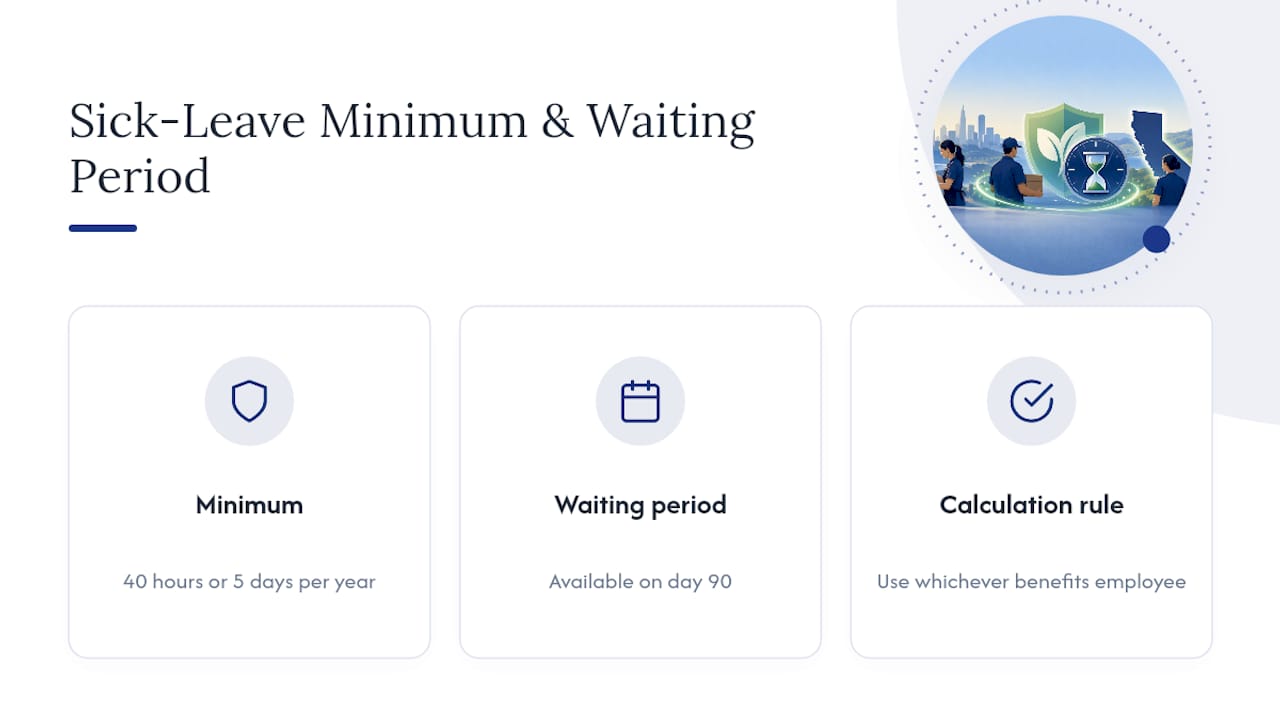
A common mistake among growing businesses: treating the 90-day waiting period as a full-year probation and denying leave requests that come in during month four or five. If the employee has been on payroll 90 calendar days and has accrued hours, they're entitled to use them, full stop.
How Do Accrual, Front-Loading, and Payroll Timing Work?
Accrual mechanics are where most payroll errors actually happen, not in the big-picture policy language. Get the formula wrong and you'll either underpay employees or overcomplicate your payroll system for no legal benefit.
- Standard accrual runs at a minimum of one hour of paid sick leave for every 30 hours worked, or an alternative accrual method meeting statutory minimums, starting on the employee's first day.
- Alternative accrual or front-loading is allowed if it results in at least 24 hours available by the 120th day of employment and 40 hours by the 200th day, or if the employer simply grants the full 40 hours up front at the start of each year.
- Accrual caps may be set at 80 hours (10 days) total, though usage in any single year can still be capped at 40 hours (five days).
- Exempt employee accrual assumes a 40-hour workweek unless the employee's normal workweek is genuinely shorter. This is a frequent audit finding: employers who accrue exempt staff based on actual hours logged instead of the deemed 40-hour standard.
- Payment timing requires that sick leave wages be paid no later than the payday for the next regular pay period following the leave taken, calculated using either the regular rate of pay for that workweek or a 90-day weighted average.
Pro Tip: If your payroll software defaults to a generic accrual rate, verify it against Labor Code §246's 1-hour-per-30-hours formula manually at least once a quarter. Software templates lag behind statutory updates more often than vendors admit.
What New Uses Does Paid Sick Leave Cover in 2026?
Assembly Bill 406 and its companion amendments to Labor Code section 246.5 widened the list of reasons employees can tap their sick leave balance, phased in across two effective dates. Jury duty and witness service obligations became covered uses on October 1, 2025, and additional protections for victims involved in specified judicial proceedings took effect January 1, 2026.
Practically, this means an employee summoned for jury duty, subpoenaed as a witness, or appearing in court related to a protective order can now use accrued paid sick leave to cover that time, in addition to the existing categories like personal illness, preventive care, and care for a family member.
- An employee who receives a jury summons and asks to use sick leave for the appearance days: approve it.
- A worker subpoenaed as a witness in a civil or criminal case: approve the request, oral or written.
- An employee attending a court hearing tied to a restraining order they've filed: this now falls squarely within protected use.
Employers must accept these requests whether they arrive in writing or verbally, and you cannot demand medical documentation or court paperwork as a blanket condition of approval. Reasonable notice is appropriate when the leave is foreseeable, but you're on thin ground if you deny a same-day request tied to an emergency court appearance. Keep verification requests narrow and tied only to confirming the leave category, not the underlying details of the case.
What Posting and Notice Requirements Apply in 2026?
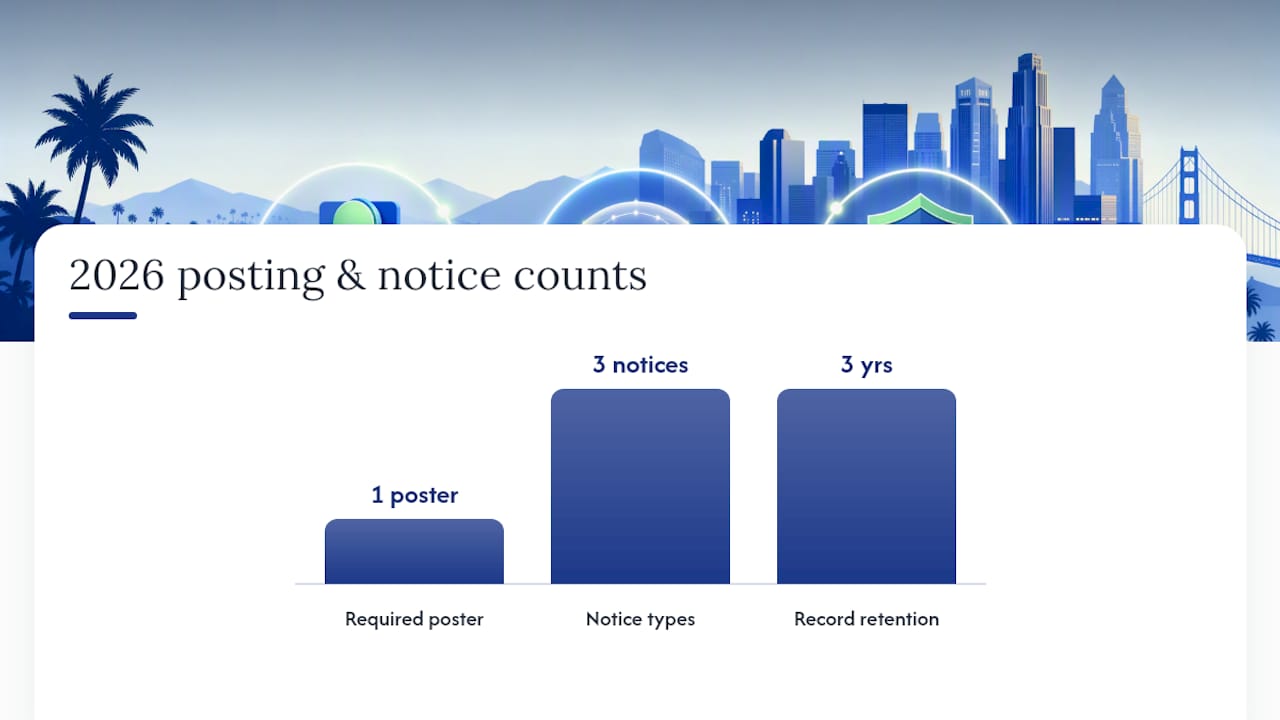
Every California employer needs to display the January 2026 Paid Sick Leave poster in a conspicuous location, and older versions need to come down immediately rather than sit alongside the new one. The DLSE has also issued translated versions of the poster and required notices covering Spanish, Korean, Tagalog, Simplified Chinese, and Vietnamese, which matters directly if your workforce in Glendale, Burbank, or greater Los Angeles includes employees whose primary language isn't English.
Beyond the poster, three separate notice obligations apply:
- A written Notice to Employee under Labor Code §2810.5, provided at hire, disclosing available paid sick leave terms.
- Disclosure of available paid sick leave balances on the employee's wage statement, or in a separate written notice issued on the same date as the paycheck.
- Annual or updated notice obligations whenever leave policy terms change materially, which they just did with AB 406's expanded categories.
By the numbers: California employers must retain hours-worked and sick leave accrual/use records for a minimum of a minimum of three years, and a missing poster or notice can expose an employer to civil penalties assessed per employee and per pay period, on top of the cost of defending a wage claim.
Skipping the poster update might feel like a minor administrative lapse, but Labor Commissioner enforcement treats it as a standalone violation independent of whether any employee was actually denied leave.
How Should Employers Handle Recordkeeping and Avoid Payroll Mistakes?
Recordkeeping isn't a paperwork afterthought here. It's the difference between winning and losing a wage claim you didn't even know was coming.
California requires employers to retain records of hours worked and sick leave accrued and used for at least a minimum of three years. When those records are incomplete or missing, the DLSE presumes the employee is owed the maximum allowable sick leave, which means a sloppy filing system can cost you a dispute you'd otherwise have won on the facts.
- Keep contemporaneous accrual logs tied to actual pay periods, not reconstructed after the fact from memory or spreadsheets.
- Calculate sick leave pay using the correct method for the workweek: either the regular rate of pay or the 90-day weighted average, and apply it consistently.
- Watch for exempt employee misclassification, since deemed 40-hour accrual only applies correctly if the exemption itself is valid.
- Reconcile payroll caps annually. A system still capping accrual at an old threshold, or failing to track separate accrual and use limits, is one of the most common findings in an outside audit.
Pro Tip: Run a quarterly reconciliation between your time-tracking system and your payroll accrual ledger. Discrepancies tend to compound quietly for months before they surface as a five-figure back-pay exposure during an audit.
Frequent mistakes worth flagging to your payroll team now: inconsistent accrual rates across different employee classes, forgetting to update the 80-hour cap after a policy change, and treating attendance discipline and protected sick leave as separate processes when they need to be reviewed together before any write-up goes in a personnel file.
What Should California Employers Do Before Q1 Ends?
A prioritized checklist beats a vague compliance memo every time. Here's the order to work through it in.
- Post the January 2026 poster in every physical location and confirm remote employees receive equivalent electronic notice.
- Distribute updated hire notices reflecting the expanded permitted uses, and re-issue notice to current employees if your policy language changed.
- Update your handbook to explicitly name jury duty, witness service, and victim-related proceedings as covered uses.
- Verify your payroll accrual method against Labor Code §246, confirm caps are set correctly, and confirm sick leave wages post by the next regular payday.
- Set a three-year record retention plan for hours worked and leave accrual/use, and confirm your payroll provider can produce these records on demand.
- Train supervisors to check for protected leave status before issuing any attendance-related discipline, since CalChamber's guidance identifies this as one of the most common paths to a retaliation claim.
- Escalate to counsel or a payroll provider when a request involves ambiguous documentation, a disputed classification, or a pattern of denied leave across multiple employees.
| Task | Owner | Deadline |
|---|---|---|
| Post updated poster | HR/Office manager | Immediately |
| Distribute hire notices | HR | At every new hire |
| Audit payroll accrual settings | Payroll | This quarter |
| Supervisor training on protected leave | HR/Legal | This quarter |
| Record retention review | Payroll | Ongoing (3-year minimum) |
What Payroll Audits Actually Reveal
Every payroll audit for a Los Angeles area employer often uncovers some version of the same three problems: an outdated poster still hanging next to the new one, an accrual formula that hasn't been touched since the software was installed, and sick leave wages paid on the wrong payday because nobody flagged the leave request to payroll in time.
None of these are dramatic failures. They're small administrative gaps that compound into real exposure, especially once the DLSE's missing-records presumption gets involved in a dispute. A free payroll audit tends to catch these before they become a claim, not after. The fix is rarely complicated. It's usually a matter of resetting the accrual formula, correcting the pay timing rule, and putting a retention schedule in writing so nobody has to reconstruct a minimum of three years of records from memory during an actual dispute.
— Glendale Payroll Staff
Get a Free Payroll Audit Before Your Next Pay Cycle
Handling sick leave accrual, payroll timing, and record retention correctly takes more than good intentions. It takes payroll infrastructure built to California's specific rules, not a generic national template. This service is an alternative to a call-center payroll processor for employers in the Los Angeles area: clients get a dedicated payroll professional familiar with Labor Code §246 rather than a rotating support queue.
Every engagement typically starts with a comprehensive payroll audit, designed to catch poster gaps, accrual errors, and pay-timing mistakes before they turn into a Labor Commissioner claim. From there, Glendale Payroll's payroll processing and compliance services cover tax filing, direct deposit, W-2 preparation, new hire reporting, and EDD account setup, all aimed at 100% compliance with federal and California regulations. Monthly service runs $105 per company plus $12 per employee, with a one-time $100 setup fee for onboarding and EDD registration. If your current payroll process hasn't been reviewed since before AB 406 passed, book your free audit and find out exactly where you stand.
Sources
- Paid Sick Leave in California
- California Labor Code Section 246
- California Labor Code section 246.5 (statutory amendments / AB 406)
This article is general information, not a substitute for advice from a qualified lawyer. Consult a qualified legal professional about your own circumstances before acting on anything here.
FAQ
How Many Sick Days Am I Entitled to in 2026?
California employees are entitled to a minimum of 40 hours or five days of paid sick leave per year, whichever calculation benefits the employee. Employers may cap total accrual at 80 hours but cannot cap the annual entitlement below that five-day minimum.
What Are the Rules for Paid Sick Leave in California?
Employees who work 30 or more days for the same employer within a year accrue paid sick leave at a minimum rate of one hour per 30 hours worked, per Labor Code §246. They can begin using accrued leave on their 90th day of employment, and covered reasons now include jury duty, witness service, and specified victim-related judicial proceedings.
Do California Employers Have to Pay Out Sick Time if You Quit?
No. Unlike vacation time, accrued but unused paid sick leave does not need to be paid out at separation under California law. If your policy blends sick leave into a single PTO bank rather than tracking it separately, that combined PTO balance typically must be paid out like vacation, so how you structure the policy matters.
Is California Paid Sick Leave the Same as PTO?
Not automatically. Paid sick leave is a statutory minimum tied to specific qualifying uses, while PTO is often a broader, employer-designed benefit that can include vacation and personal days. Many employers satisfy the sick leave requirement through a combined PTO policy, but only if that policy meets or exceeds the statutory accrual, cap, and use provisions under §246.
What Does a Payroll Compliance Audit Typically Check?
A payroll audit reviews your accrual formulas, caps, pay-timing practices, poster and notice compliance, and record retention against current Labor Code requirements. Glendale Payroll's free comprehensive payroll audit covers all of these areas for employers in the Greater Los Angeles area.