
To stay payroll-compliant in Pasadena and Burbank, you must register with the California Employment Development Department (EDD) within 15 days of paying wages exceeding the minimum threshold set by California in a quarter, withhold State Disability Insurance (SDI) at the California-mandated rate on all wages, calculate Unemployment Insurance (UI) and Employment Training Tax (ETT) on wages up to the California taxable wage base, issue wage statements that meet all nine requirements under Labor Code §226, and apply California's daily overtime rules — all on top of your federal IRS and Fair Labor Standards Act (FLSA) obligations.
Three actions to take this week:
- Verify your EDD registration status. If you have paid any employee more than $100 in a quarter and have not registered, do it now. The 15-day window is firm.
- Pull a sample wage statement and check it against all nine §226 line items. Missing even one field creates per-employee, per-pay-period statutory liability.
- Run a single-pay-period reconciliation to confirm meal and rest break premiums are being paid and recorded. Courts presume breaks were missed unless your timekeeping records show otherwise.
These three steps address the most common triggers for audits and penalties that the California Labor Commissioner and the IRS pursue against employers in Pasadena and Burbank.
Table of Contents
- What payroll compliance actually covers for Pasadena and Burbank employers
- Key federal payroll obligations you must meet alongside California rules
- California payroll rules that change your calculations and processes
- Pasadena and Burbank city-level ordinances and local resources you must check
- Employer registration, deposit schedules, and key filing timelines to calendar
- What payroll records to keep and how to prepare a §226-compliant wage statement
- Employee vs. independent contractor in California: what the ABC test requires
- Common violations that trigger penalties and how they arise
- A practical monthly and quarterly payroll calendar for Pasadena and Burbank employers
- How Glendale Payroll reduces compliance risk for Pasadena and Burbank employers
- Key Takeaways
- What Glendale Payroll sees most often in Pasadena and Burbank businesses
- Glendale Payroll's free compliance audit for Pasadena and Burbank employers
- Authoritative resources to keep bookmarked
What payroll compliance actually covers for Pasadena and Burbank employers
Payroll compliance is not just cutting checks on time. It covers every obligation that arises from employing people: tax withholding and deposits, wage-and-hour rules, wage statement formatting, new-hire reporting, recordkeeping, workers' compensation insurance, and proper classification of workers as employees or independent contractors.

At the federal level, the IRS and the Department of Labor set the floor. California then adds a second, more demanding layer. The California Department of Industrial Relations (DIR) and the Labor Commissioner enforce daily overtime thresholds, mandatory meal and rest break premiums, and the nine-item wage-statement standard under Labor Code §226 — none of which exist at the federal level. AB5 and the ABC test create a strong presumption that workers are employees, which shifts classification risk sharply toward employers. Workers' compensation insurance is mandatory the moment you hire your first employee, and independent contractors without their own coverage may need to be added to your policy.
The risk of getting any of this wrong is not linear. California penalties stack per employee per pay period, meaning a single recurring error on a wage statement or a missed break premium can compound into a six-figure liability across a workforce. PAGA (the Private Attorneys General Act) lets employees sue on behalf of the state and collect a share of civil penalties, which is why audit-ready documentation is the primary defense, not post-claim explanations.
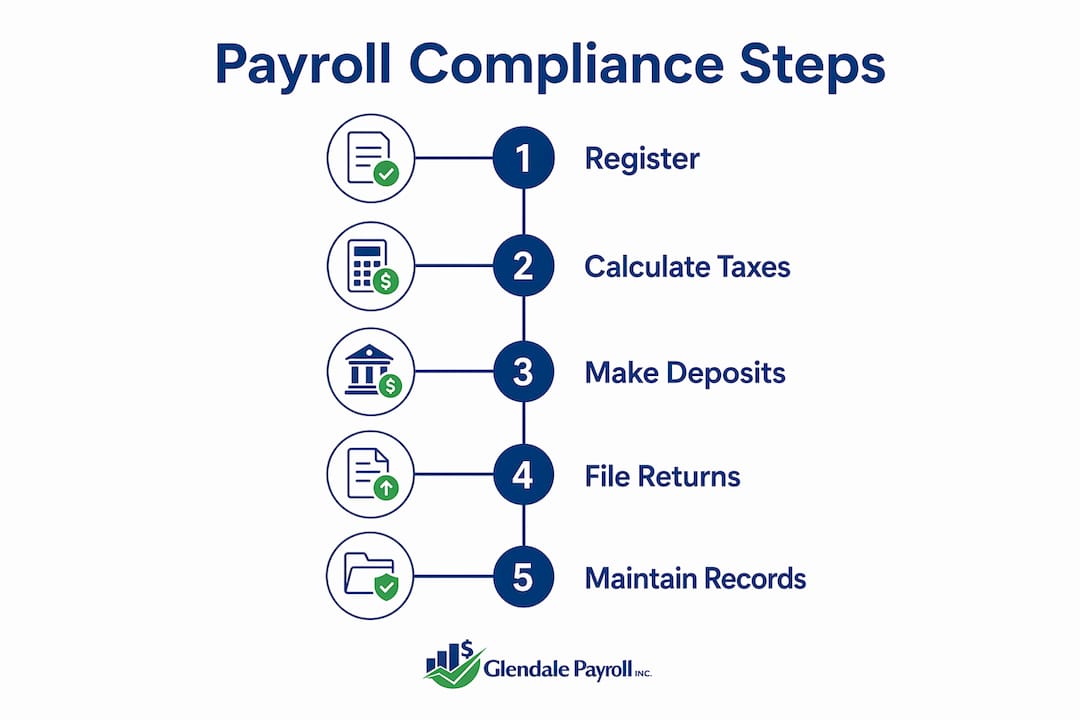
Key federal payroll obligations you must meet alongside California rules
Federal law sets the baseline, and California builds on top of it. You need both layers running correctly at the same time.
Core federal requirements for Pasadena and Burbank employers:
- Federal minimum wage: The federal floor is $7.25 per hour, but California's state minimum wage is higher, and local ordinances in Pasadena and Burbank may be higher still. Always apply the highest applicable rate.
- FLSA overtime: Federal law requires 1.5x pay for hours worked over 40 in a workweek. California's daily overtime rules are stricter and override this where they produce a higher result — you must apply whichever standard benefits the employee more.
- FICA withholding: You withhold Social Security and Medicare from each employee's paycheck and match that amount as the employer. Social Security is withheld at 6.2% (employee) with a matching 6.2% employer share, and Medicare at 1.45% each side.
- FUTA: The Federal Unemployment Tax Act tax is an employer-only obligation. You pay it on the first $7,000 of each employee's wages per year. California employers who pay state UI on time generally qualify for a credit that reduces the effective FUTA rate.
- Form 941: Filed quarterly with the IRS to report wages paid, federal income tax withheld, and FICA taxes. Deadlines fall on April 30, July 31, October 31, and January 31.
- Form 940: Filed annually to report FUTA liability. Due January 31 of the following year.
- W-2 / W-3: W-2s must be furnished to employees and filed with the Social Security Administration by January 31.
Federal deposit schedules — monthly or semi-weekly — are assigned by the IRS based on your lookback period liability. Confirm your deposit frequency at the start of each calendar year; it can change.
Pro Tip: Reconcile your Form 941 totals to your payroll ledger every quarter before filing. Discrepancies between what you deposited and what you report on 941 are one of the most common triggers for IRS notices and penalty assessments. Catching a $200 shortfall before the deadline costs nothing; catching it after costs interest plus a failure-to-deposit penalty.
California payroll rules that change your calculations and processes
California's state-level requirements go well beyond federal law in ways that directly affect how you run payroll every pay period.

State payroll tax rates and wage bases
The table below shows the key California employer and employee payroll tax items for 2026.
| Tax | Who Pays | Rate | Taxable Wage Base |
|---|---|---|---|
| SDI (State Disability Insurance) | Employee | 1.3% (uncapped) | All wages — no cap |
| UI (Unemployment Insurance) | Employer | Varies by schedule | First $7,000 per employee |
| ETT (Employment Training Tax) | Employer | — | First $7,000 per employee |
| PIT (Personal Income Tax) | Employee | Graduated rate | All wages |
SDI is withheld from every dollar of wages with no annual cap, which is a significant change from prior years. UI rates vary by the employer's experience rating and the applicable UI Tax Rate Schedule; check your annual EDD rate notice for your specific rate. For current 2026 rate details, the 2026 California payroll tax updates page covers SDI, UI, ETT, and PIT changes in full.
Daily overtime and meal/rest break premiums
California requires overtime at 1.5x the regular rate for hours worked over 8 in a single workday and over 40 in a workweek. Hours over 12 in a single workday are paid at 2x. The seventh consecutive day of work in a workweek triggers 1.5x for the first 8 hours and 2x beyond that.
Missed meal or rest breaks each generate a one-hour premium at the employee's regular rate of pay. That premium must be included in the regular rate calculation for overtime purposes, which means a missed break can affect overtime calculations for the same pay period. These daily overtime and premium rules make California payroll materially more complex than federal-only compliance.
Labor Code §226 wage-statement requirements
Every wage statement issued to a California employee must include all nine required items under Labor Code §226:
- Gross wages earned
- Total hours worked (for non-exempt employees)
- All deductions
- Net wages earned
- Inclusive dates of the pay period
- Employee name and last four digits of Social Security number (or employee ID)
- Employer name and address
- All applicable hourly rates and corresponding hours worked
- All applicable piece rates and corresponding units (if applicable)
Statutory penalties for a knowing and intentional violation are $50 per employee for the first pay period and $100 per employee for each subsequent pay period, up to $4,000 per employee. PAGA allows employees to pursue these penalties on behalf of the state, which multiplies exposure across your entire workforce.
Pro Tip: Build your wage-statement template as a checklist. Before you run your first payroll with a new software setup or after any system change, print a sample stub and verify all nine fields are populated and accurate. A five-minute check at setup prevents months of compounding liability.
Pasadena and Burbank city-level ordinances and local resources you must check
California state law sets the minimum wage floor, but cities and counties may set higher local rates that supersede the state floor for employees who work within city limits. Pasadena and Burbank both fall within Los Angeles County, and local ordinances can affect your payroll obligations in ways that state law alone does not capture.
What to verify for each city where your employees work:
- Local minimum wage: Check the current rate for Pasadena and Burbank separately. If the local rate exceeds the California state minimum wage, you must pay the higher rate to any employee whose primary worksite is within that city. The UC Berkeley Labor Center's inventory tracks city and county minimum wage ordinances across the U.S. and is a reliable cross-reference.
- Paid sick leave: California's statewide paid sick leave law sets a floor, but local ordinances may require additional accrual or different carryover rules. Confirm whether Pasadena or Burbank has enacted supplemental sick leave requirements beyond the state standard.
- Local business tax registration: Both Pasadena and Burbank require businesses operating within city limits to hold a valid local business license or tax certificate. Payroll compliance starts with being properly registered as a business in each city where you operate.
- Required workplace postings: California law mandates specific labor law posters at every worksite. Check whether Pasadena or Burbank requires any additional local postings beyond the state and federal sets.
City pages to bookmark and check each January:
- City of Pasadena: cityofpasadena.net — search "minimum wage" and "business tax"
- City of Burbank: burbankca.gov — search "business license" and "labor ordinances"
- California DIR minimum wage page: dir.ca.gov — confirms the current state floor and any scheduled increases
Review local rates every January. Minimum wage schedules often update on January 1, and missing a local increase creates back-pay liability from the effective date.
Employer registration, deposit schedules, and key filing timelines to calendar
Getting registered correctly and on time is the foundation of payroll compliance. Missing a registration or deposit deadline creates penalties before you have even made a payroll error.
EDD registration
The EDD registration trigger is straightforward: if you pay more than $100 in wages in a calendar quarter, you must register as an employer with the EDD within 15 days. There is no grace period beyond that window. Registration gives you your California employer account number, which you need to file DE 9/DE 9C returns and make state payroll tax deposits.
Key filing deadlines
| Filing | Agency | Frequency | Typical Deadline |
|---|---|---|---|
| DE 9 / DE 9C (Quarterly Contribution Return) | EDD | Quarterly | Last day of the month following quarter end (April 30, July 31, Oct 31, Jan 31) |
| Form 941 (Employer's Quarterly Federal Tax Return) | IRS | Quarterly | Same as above |
| Form 940 (Annual FUTA Return) | IRS | Annual | January 31 |
| W-2 / W-3 | SSA / IRS | Annual | January 31 (to employees and SSA) |
| 1099-NEC (for contractors paid $600+) | IRS | Annual | January 31 |
| New Hire Report | California EDD | Per hire | Within 20 days of hire date |
Deposit frequency
Federal deposit schedules are either monthly or semi-weekly, determined by your IRS lookback period. If your total tax liability during the lookback period was $50,000 or less, you deposit monthly; above $50,000, you deposit semi-weekly. State payroll tax deposits to the EDD follow a similar cadence tied to your payroll frequency and liability level. Confirm both schedules at the start of each year — they can change if your payroll grows.
What payroll records to keep and how to prepare a §226-compliant wage statement
Payroll bookkeeping is distinct from payroll processing. Running payroll correctly is one task; maintaining the records that prove you ran it correctly is another, and it is the one that determines your outcome in an audit.
Records to maintain every pay period:
- Clock-in and clock-out times (start and end of each shift)
- Meal and rest break start and end times, with digital timestamps where possible
- Hourly rates in effect for each pay period
- Commission and bonus calculations, including how they factor into the regular rate
- Completed DE 4 (California withholding allowance) and W-4 (federal withholding) for every employee
- Completed Form I-9 (employment eligibility verification) for every employee
- Copies of DE 9 and DE 9C filings each quarter
- Wage statements issued each pay period
Retention windows:
The EDD and IRS both require a minimum of four years for payroll tax records. California wage-and-hour records should be retained for at least three years under the Labor Code, but maintaining four years across all records simplifies compliance and aligns with the EDD standard. I-9 forms have their own rule: retain for three years from the date of hire or one year after termination, whichever is later.
Pro Tip: Run a monthly three-way reconciliation: compare your payroll software output, your bank statement (payroll account), and your DE/IRS filings. A discrepancy that shows up in month two is a minor correction; the same discrepancy discovered at year-end audit is a material finding. Integrated payroll solutions that link payroll to your general ledger make this reconciliation faster and more reliable.
Employee vs. independent contractor in California: what the ABC test requires
California presumes that every worker is an employee. To classify someone as an independent contractor, you must satisfy all three prongs of the ABC test under AB5:
- A: Free from control. The worker is free from your direction and control in performing the work, both under the contract and in practice.
- B: Outside usual course of business. The work performed is outside the usual course of your business. A graphic designer hired by a marketing agency fails this prong; a plumber hired by that same agency likely passes.
- C: Independently established trade. The worker is customarily engaged in an independently established trade, occupation, or business of the same nature as the work performed.
Failing any single prong means the worker must be treated as an employee for payroll purposes — with all associated withholding, UI, SDI, and workers' comp obligations.
Practical audit steps to reduce misclassification risk:
- Review job duties for every contractor relationship against all three ABC prongs annually.
- Confirm that written agreements accurately describe the scope of work and that the contractor operates independently (their own tools, their own clients, their own business entity).
- Check how payments are reported: W-2 or 1099-NEC. If someone is receiving a 1099-NEC but their work pattern looks like an employee's, that is a red flag worth addressing before an audit does.
- When reclassifying a worker from contractor to employee, consult a payroll professional before making the change to handle back taxes and benefits correctly.
Misclassification under AB5 can trigger back UI, SDI, and ETT assessments from the EDD, plus workers' comp exposure and Labor Commissioner penalties. The cost of a proactive review is a fraction of the cost of a retroactive correction.
Common violations that trigger penalties and how they arise
Most payroll penalties do not come from deliberate wrongdoing. Employment attorneys consistently report that poor timekeeping and classification errors, not malicious intent, drive the majority of wage and hour disputes. The problem is that California's penalty structure does not distinguish between accidental and intentional violations once a pattern is established.
Common violation triggers:
- §226 wage-statement errors: Missing a required line item, using the wrong employer address, or omitting the pay period dates. Each pay period with a deficient stub is a separate violation.
- Missed meal and rest break premiums: Failing to pay the one-hour premium when a break is missed, short, late, or interrupted. Courts presume breaks were missed unless timekeeping records show otherwise.
- Late DE 9/DE 9C filings: The EDD assesses percentage-based penalties on late quarterly filings, and interest accrues on unpaid balances.
- EDD deposit underpayments: Depositing less than the full amount owed triggers a penalty on the shortfall, separate from any late-filing penalty.
- AB5 misclassification: Treating an employee as a contractor avoids UI, SDI, and ETT deposits — which the EDD can assess retroactively with penalties and interest when discovered.
On PAGA exposure: A single employee can file a PAGA representative action on behalf of all current and former employees for the same violation. If your wage statements have been missing a required field for two years across 30 employees paid biweekly, the math on statutory penalties alone can reach six figures before attorney fees. The best defense is documentation that shows the violation never occurred — not an explanation of why it did.
Pro Tip: California has a voluntary disclosure and self-audit process through the EDD and the Labor Commissioner's office. If you identify a compliance gap before an audit or claim is filed, proactive correction typically results in significantly reduced penalties. Self-auditing annually and correcting errors early is almost always cheaper than waiting for an agency to find them.
A practical monthly and quarterly payroll calendar for Pasadena and Burbank employers
A repeatable payroll routine prevents the timing errors that generate most penalties. The checklist below is organized by frequency.
Every pay period:
- Calculate gross wages, including daily overtime and any meal/rest break premiums
- Withhold SDI (1.3%), PIT (per DE 4), federal income tax (per W-4), and FICA
- Issue wage statements with all nine §226 fields populated
- Log break times with digital timestamps
- Make federal tax deposits on your assigned schedule (monthly or semi-weekly)
Monthly:
- Reconcile payroll software output to bank statements and to your DE/IRS deposit records
- Confirm no new employees have been missed on new-hire reporting (due within 20 days of hire)
- Review any contractor payments made and confirm 1099-NEC tracking is current
Quarterly:
- File DE 9 and DE 9C with the EDD by the last day of the month following quarter end
- File Form 941 with the IRS on the same schedule
- Run a break-audit: pull timekeeping records for a sample of employees and verify meal and rest break compliance
- Check local minimum wage rates if a mid-year ordinance change is scheduled
Annually (January):
- Issue W-2s to employees and file with the SSA by January 31
- File 1099-NEC for any contractor paid $600 or more by January 31
- File Form 940 with the IRS by January 31
- Review local minimum wage schedules for Pasadena and Burbank and update payroll setup for any increases effective January 1
- Confirm your IRS deposit schedule for the new year (lookback period recalculates)
- Verify EDD UI rate notice and update your payroll system with the new rate
Multi-jurisdiction note: If you have employees working in both Pasadena and Burbank, apply the higher local minimum wage for each employee based on their primary worksite. Track worksites in your payroll system so the correct rate applies automatically. For employers operating across multiple California cities, outsourcing payroll to a local provider becomes especially practical once you have five or more employees, because local rate monitoring and overtime calculations compound in complexity quickly.
How Glendale Payroll reduces compliance risk for Pasadena and Burbank employers
Glendale Payroll works specifically with employers in Pasadena, Burbank, Glendale, and Greater Los Angeles. The firm's approach is built around dedicated payroll professionals rather than a call center model, which means the person handling your account understands California's specific rules and your local obligations.
Services that directly address the compliance risks covered in this guide:
- EDD registration and DE filing reconciliation: Glendale Payroll handles initial EDD registration, quarterly DE 9/DE 9C preparation and filing, and reconciliation to your payroll ledger.
- Wage-statement formatting: Every wage statement is built to meet all nine §226 requirements, with a review process that catches formatting errors before they generate liability.
- AB5 screening: The team reviews contractor relationships against the ABC test and flags arrangements that carry reclassification risk.
- Local minimum wage monitoring: Pasadena and Burbank rate schedules are tracked and applied automatically when they update, so you are never running payroll at a rate that has already been superseded.
- Audit-ready documentation: Records are maintained in a format that supports a Labor Commissioner or EDD audit response without scrambling to reconstruct files.
Glendale Payroll's free compliance audit reviews your EDD registration status, DE filing history, §226 wage-statement fields, AB5 contractor screening, and local minimum wage application. It is designed to surface the gaps that generate penalties before an agency or employee finds them first. The California payroll compliance guide explains the full scope of what the audit covers and how to request it.
Key Takeaways
Pasadena and Burbank employers must register with the EDD within 15 days of paying over $100 in wages per quarter, withhold SDI at 1.3% on all wages, issue §226-compliant wage statements every pay period, apply California daily overtime rules, and retain all payroll records for at least four years.
| Point | Details |
|---|---|
| EDD registration is time-sensitive | Register within 15 days of paying more than $100 in wages in a quarter — no grace period. |
| SDI is uncapped in 2026 | Withhold SDI at 1.3% on all employee wages with no annual wage cap. |
| §226 wage statements carry per-period penalties | Missing any of the nine required line items creates statutory liability per employee, per pay period. |
| Records must be retained for four years | Keep all payroll tax records to meet EDD and IRS minimum retention requirements. |
| Glendale Payroll offers a free compliance audit | The audit covers EDD registration, DE reconciliation, wage-statement fields, AB5 screening, and local wage rates. |
What Glendale Payroll sees most often in Pasadena and Burbank businesses
The compliance issues that generate the most real-world penalties for local employers are rarely the dramatic ones. They are the quiet, recurring errors that compound across pay periods before anyone notices.
The most common pattern: a business sets up payroll software, runs it for a year, and never audits the wage-statement template. The employer address field pulls from the billing address instead of the worksite address. The pay period dates are missing. Total hours worked is suppressed because the system was configured for salaried employees and no one switched the setting for hourly staff. None of these feel like serious errors in the moment. Multiplied across 20 employees over 26 biweekly pay periods, they become a PAGA exposure that a single departing employee can activate.
The second pattern involves meal and rest breaks. An employer has a break policy in the handbook. Managers know the rules. But the timekeeping system does not capture break times separately, so there is no record that breaks were taken. When a Labor Commissioner complaint arrives, the employer cannot demonstrate compliance for a single pay period. Courts presume the breaks were missed. The employer ends up paying premiums for breaks that were almost certainly taken, simply because the records do not exist.
The third pattern is local minimum wage. A Pasadena business hires employees who work at a Burbank location. The payroll system is set to the California state minimum wage. No one checks whether Burbank's local rate is higher. The gap is small per hour, but it accumulates into back-pay liability from the date the local rate took effect.
All three of these are preventable with a structured audit and a payroll setup that accounts for California's specific requirements. The fix is rarely complicated. The cost of not fixing it is.
Glendale Payroll's free compliance audit for Pasadena and Burbank employers
Payroll compliance in California is not a one-time setup task. Rates change, local ordinances update, and workforce changes create new classification questions every year. Glendale Payroll offers a free compliance audit specifically designed for employers in Pasadena, Burbank, Glendale, and Greater Los Angeles who want to confirm their payroll is running correctly before an agency or employee finds a problem.

What the free audit covers:
- EDD registration status and account verification
- DE 9/DE 9C filing history and reconciliation to payroll records
- §226 wage-statement field review against all nine required items
- AB5 contractor screening for current independent contractor relationships
- Local minimum wage application for Pasadena and Burbank worksites
- Federal deposit schedule confirmation and Form 941 reconciliation
The audit is conducted by dedicated payroll professionals, not a call center. You get a written summary of findings and a prioritized list of corrections. There are no obligations attached. For employers who want to move forward, Glendale Payroll's full-service payroll and compliance offerings cover everything from EDD registration through annual W-2 filing, with local ordinance monitoring built in.
To request your free audit, visit glendalepayroll.com or call the office directly. The process starts with a brief intake call to understand your workforce structure and current payroll setup.
This article provides general information about payroll compliance requirements and is not legal or tax advice. Confirm current rates, deadlines, and requirements with the EDD, IRS, California DIR, and your city's official resources, or consult a qualified payroll professional for your specific situation.
Authoritative resources to keep bookmarked
These are the primary sources for payroll compliance updates, forms, and official rate schedules. Check them at the start of each year and whenever you hire in a new city.
- California Employment Development Department (EDD): Employer registration, DE 9/DE 9C forms, UI rate notices, SDI rates, new-hire reporting, and EDD deposit instructions. This is your primary state payroll tax authority.
- IRS Publication 15-T: Federal income tax withholding tables, deposit schedules, and lookback period guidance. Update your withholding tables every January.
- California Department of Industrial Relations (DIR): Current state minimum wage, overtime rules, meal and rest break requirements, and Labor Code enforcement. The DIR's wage order page lists industry-specific rules.
- California Legislative Information (Labor Code §226): The full text of the wage-statement statute, including the nine required items and statutory penalty amounts.
- City of Pasadena official site: Local minimum wage schedule, business tax registration, and any city-specific labor ordinances.
- City of Burbank (burbankca.gov): Business license requirements, local labor ordinances, and any supplemental posting requirements.
- UC Berkeley Labor Center — City and County Minimum Wage Inventory: A regularly updated database of local minimum wage ordinances across the U.S., useful for cross-referencing Pasadena and Burbank rates against the state floor.
- Social Security Administration: FICA rates, Social Security wage base updates, and W-2 filing guidance.
- Hackler Flynn & Associates — Wage and Hour: Employer-side wage and hour legal guidance for Pasadena employers, including PAGA defense and Labor Commissioner response strategy.