
Pasadena's minimum wage rises to the rate effective July 1, 2026. If you employ anyone who works two or more hours per week within city limits, that rate applies to them, full stop.
The City of Pasadena's official announcement confirms both the rate and the coverage rule, and the official notice sets out the posting requirement every covered employer must follow. You have two jobs before that date arrives: update your payroll system and post the notice where employees can see it.
Quick Reference: New Pasadena minimum wage effective July 1, 2026. Covers: employees working at least two hours per week in Pasadena.
Here's what needs to happen immediately:
- Adjust base wage rates and salary calculations tied to hourly equivalents in your payroll system
- Confirm the change applies to your first July 2026 pay period, not a later one
- Download and post the official bilingual notice at every Pasadena worksite
Key Takeaways
Pasadena's minimum wage compliance in 2026 requires payroll updates, official notice posting, and coverage verification completed before the July 1 effective date.
| Point | Details |
|---|---|
| New rate takes effect | Pasadena's minimum wage rises to the rate effective on July 1, 2026. |
| Coverage threshold is low | Anyone working 2+ hours weekly in Pasadena qualifies, including split-shift and part-time staff. |
| Highest wage always wins | Apply state fast-food's $20.00 rate over Pasadena's rate when a business qualifies for that classification. |
| Documentation prevents disputes | Keep dated records of payroll changes, posted notices, and employee communications. |
| Rates rise annually | Pasadena adjusts by CPI each year, so expect another increase in 2027. |
Table of Contents
- City of Pasadena Minimum Wage 2026: What Changed and Why
- Compliance Checklist: Payroll, Postings, and Quick Legal Checks
- Who the Ordinance Covers, Exemptions, and Transitional Delays
- How Pasadena's Rate Interacts With State and Federal Wage Rules
- Payroll Implementation Steps, Recordkeeping, and Audit Preparation
- How Glendale Payroll Helps Pasadena Employers Get This Right
- Where Pasadena's Minimum Wage Is Headed After 2026
- Pasadena vs. Glendale, Burbank, and the California State Floor
- What the 2026 Increase Means for Pasadena Businesses and Workers
- The Compliance Gap Most Employers Don't See Coming
- Sources
City of Pasadena Minimum Wage 2026: What Changed and Why
Pasadena's local ordinance isn't a one-time adjustment; its annual adjustments by Consumer Price Index explain why municipal rates differ, as detailed in Living Wage Disclosures: Methodology and Pitfalls. The city recalculates its minimum wage annually based on the Consumer Price Index, which is why Pasadena's rate has consistently climbed faster than California's statewide floor. That CPI link matters for planning purposes: you should expect another increase in 2027, not treat $18.57 as a fixed number you'll revisit "eventually."
This is a good moment to distinguish two things employers often conflate. California's state minimum wage laws set a baseline. Pasadena's municipal ordinance sets a higher local floor. State law does not preempt or override the city rate, so if you're only tracking Sacramento's announcements and ignoring Pasadena's Planning & Community Development notices, you're missing half the compliance picture. The California Department of Industrial Relations is explicit on this point: when a city ordinance and state law overlap, the higher wage governs.
Compliance Checklist: Payroll, Postings, and Quick Legal Checks
Getting ahead of this rate change takes less than a day of focused work if you follow a clear sequence rather than tackling pieces randomly. Here's the order that actually reduces risk:
- Update payroll before the first July pay date. Change base hourly wages and any recurring salary calculations that assume an hourly equivalent, and do this before you run payroll, not after an employee flags a shortfall.
- Verify timekeeping captures Pasadena hours specifically. If your workforce moves between Pasadena and other cities during a shift or a week, your time system needs to isolate hours worked in Pasadena rather than lumping them into a general Los Angeles County bucket.
- Post the official notice at every worksite. Print the city's official notice in English and Spanish, since Pasadena's Planning & Community Development Department publishes both versions and expects both displayed where applicable.
- Recheck exempt versus non-exempt classifications. A wage increase is a natural trigger to confirm you're applying tip-credit rules and overtime calculations correctly, since California does not permit a tip credit against minimum wage the way federal law does in some states.
- Keep a dated record of every change you make. Save timestamps on payroll edits, internal memos to staff, and photos of posted notices.
Pro Tip: Screenshot your payroll system's rate change confirmation the day you make it. If a wage claim surfaces months later, that timestamp is often the difference between a quick resolution and a drawn-out dispute.
Who the Ordinance Covers, Exemptions, and Transitional Delays
Pasadena's ordinance uses a low bar for coverage: any employee who works two or more hours per week within city limits qualifies for the local rate, according to the official notice. That threshold catches more workers than employers typically expect.
- A delivery driver who spends part of a shift in Pasadena and part in Glendale still qualifies once weekly Pasadena hours hit two.
- A part-time employee working a single four-hour Pasadena shift per week is covered, even without a regular schedule there.
- Split-shift workers who cross city boundaries mid-day are one of the most commonly missed coverage cases, since employers often track total hours worked rather than location-specific hours.
- Tipped employees still must receive the full $18.57 hourly rate; California does not allow tips to count toward the minimum wage obligation.
Some small employers and certain nonprofit categories may qualify for delayed compliance timelines under specific municipal provisions, but you need to verify eligibility directly with the city's Code Compliance Division rather than assuming an exemption applies. Remote or hybrid schedules don't exempt you either. If an employee's home office or client visits fall within Pasadena and total two hours weekly, the ordinance applies to that time.
How Pasadena's Rate Interacts With State and Federal Wage Rules
The governing principle is simple: apply the highest wage that applies to each employee. When city, state, and federal minimum wage rules overlap, the California Department of Industrial Relations directs employers to pay whichever rate benefits the employee most.
Key Figure: California's fast-food minimum wage is higher than Pasadena's city rate.
This creates one important carve-out. Employees of qualifying national fast-food chains fall under a separate state-mandated minimum, set higher than Pasadena's municipal rate. If your business meets the state's definition of a covered fast-food establishment, your employees receive the $20.00 rate regardless of what the city ordinance sets.
- Classify your business against the state's fast-food criteria before assuming Pasadena's $18.57 rate is your ceiling.
- Document that classification decision, since state guidance recommends keeping records that support how you determined coverage.
- Apply the higher of the two rates automatically in payroll rather than manually checking each pay period.
Payroll Implementation Steps, Recordkeeping, and Audit Preparation
A wage change this size touches more than the hourly rate field in your payroll software. Treat it as a small project with a checklist rather than a single edit.
- Identify every impacted employee, including part-timers, seasonal staff, and anyone whose location varies week to week.
- Update payroll codes so the system applies $18.57 automatically to Pasadena-designated shifts rather than relying on manual overrides.
- Run a test payroll cycle before the live July run to catch calculation errors while they're still cheap to fix.
- Communicate the change to staff in writing, which doubles as documentation if a wage dispute arises later.
For hybrid or mobile employees, attach a location flag to each shift in your timekeeping system, essentially a "Pasadena: yes/no" field, and reconcile it weekly to confirm anyone crossing the two-hour threshold gets paid correctly. This single habit resolves most of the coverage confusion that trips up multi-location employers.
Pro Tip: Retain payroll records, posted notices, and employee communications for at least four years. City and state auditors typically request this exact combination first, and having it organized in advance turns a stressful inquiry into a routine document request.
If the city or an employee raises a question, respond promptly and in writing, and route the inquiry through whoever manages your payroll compliance records rather than letting it sit. A quick, documented response often prevents a minor question from becoming a formal complaint.
How Glendale Payroll Helps Pasadena Employers Get This Right
You don't have to untangle overlapping city, state, and fast-food wage rules alone. Glendale Payroll offers a free comprehensive payroll audit built specifically to catch gaps like Pasadena's two-hour coverage rule before they become penalties.
Our services relevant to this wage change include:
- Payroll processing that automatically applies location-based wage rates
- Federal and California state payroll tax filing
- California EDD employer account setup and ongoing support
- Recordkeeping systems built to survive a city or state audit
The advantage of working with dedicated payroll professionals, rather than a call center, is that someone actually understands Pasadena's ordinance structure and can flag your specific exposure. Request a free payroll compliance audit and get a clear picture of where your current setup falls short before July 1 arrives.
Where Pasadena's Minimum Wage Is Headed After 2026
Pasadena's minimum wage doesn't reset itself every few years through a legislative debate. It moves annually with the Consumer Price Index, which means $18.57 is a checkpoint, not a final destination. Based on how the city has applied CPI adjustments to reach this rate, employers should budget for another increase taking effect July 1, 2027, though the exact figure won't be confirmed until the city publishes its next official notice.
This annual rhythm is worth building into your financial planning now rather than treating each year's announcement as a surprise. If your business sets wages or negotiates vendor contracts based on projected labor costs, assume continued upward movement in the $0.30 to $0.60 per hour range annually, consistent with the pattern of recent adjustments, and revisit that assumption each spring when the city typically releases its updated figure.
Businesses that build a recurring calendar reminder around each January or February, when CPI data typically becomes available, tend to have more lead time to adjust budgets and pricing than those who wait for the July notice to land in their inbox. Treat the annual increase as a fixed cost of doing business in Pasadena, similar to property tax reassessments or insurance renewals, rather than a one-off event tied to 2026 specifically.
Pasadena vs. Glendale, Burbank, and the California State Floor
Pasadena's rate sits meaningfully above California's state minimum wage, and it's not alone among Los Angeles County cities in setting a local floor higher than Sacramento's. Glendale minimum wage requirements, by contrast, generally follow the state rate rather than a separate municipal ordinance, which means an employer running payroll for staff in both Glendale and Pasadena needs to track two different compliance frameworks under one company roof.
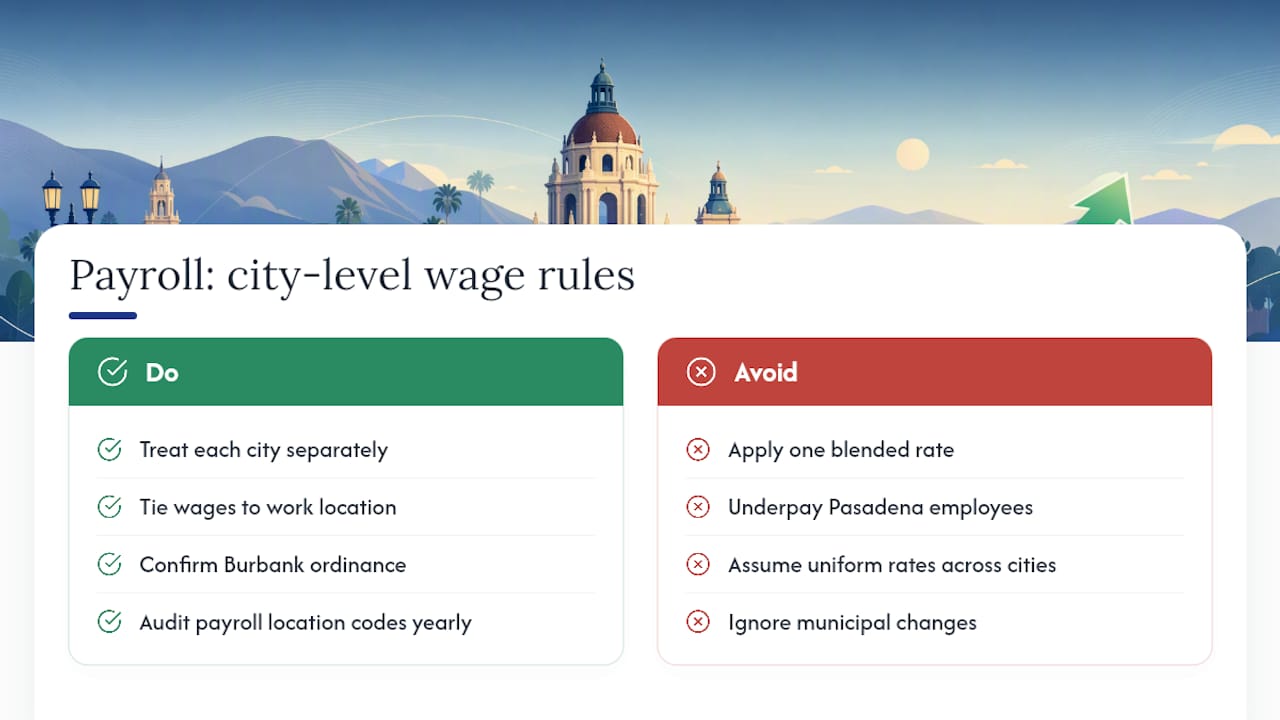
This is where multi-city employers most often stumble. It's tempting to apply one blended rate across all locations for simplicity, but that approach either overpays employees in lower-rate cities unnecessarily or, worse, underpays Pasadena employees and creates real liability. The safer approach is to treat each city as its own compliance zone within your payroll system, with wage rates tied to work location rather than company headquarters.
If you operate in Burbank as well, the same principle applies: confirm whether Burbank uses the state minimum wage or its own local ordinance before assuming uniform rates across your Greater Los Angeles locations. Businesses with employees split across Pasadena, Glendale, and Burbank should audit their payroll location codes at least once a year, since municipal wage ordinances can change independently of one another and often do.
What the 2026 Increase Means for Pasadena Businesses and Workers
For workers, an $18.57 hourly floor translates directly into more predictable income, particularly for part-time and split-shift employees who previously fell into gaps between city and state rate coverage. The two-hour coverage threshold specifically protects workers who might otherwise be paid a lower rate simply because their Pasadena hours were a small fraction of a longer multi-city shift.

For employers, the financial impact varies significantly by industry and staffing model. Retail and food service businesses with larger part-time workforces feel the increase most directly, since a higher share of their labor costs sits at or near minimum wage. Businesses with mostly salaried, above-minimum staff see comparatively little direct payroll impact, though they still carry the same posting and recordkeeping obligations as everyone else.
The practical risk isn't the wage increase itself. It's the administrative gap between the old rate and the new one if payroll systems aren't updated before the first July pay date. Employers who treat this as a payroll deadline, not a "sometime this summer" task, avoid the retroactive pay corrections and potential penalty exposure that come with late implementation. Businesses that already run Pasadena and Burbank payroll compliance through a coordinated system tend to absorb these annual changes with minimal disruption, while those relying on manual spreadsheets or infrequent payroll reviews face a higher error rate.
The Compliance Gap Most Employers Don't See Coming
Most advice about wage increases stops at "update the number in your payroll system." That's the easy part. The research behind this ordinance points to a different risk entirely: employers get tripped up by coverage edges, not the rate itself. The two-hour threshold, the fast-food carve-out, the split-shift worker crossing into Pasadena for one delivery, these are where penalties actually originate.
Conventional wage-increase guidance also underestimates how often California's overlapping city, state, and industry-specific rules create genuine ambiguity for a business owner without payroll expertise. You shouldn't need a law degree to run payroll correctly, but you do need a system built for location-based rate assignment.
If you take one thing from this, prioritize timekeeping accuracy overrate updates. A correct hourly figure attached to the wrong location code still produces a violation. Fix your location tracking first, then confirm your rates. That order of operations, more than any single payroll setting, determines whether July 1 is a non-event or an expensive one.
— Glendale Payroll Staff
Sources
- Pasadena’s Minimum Wage Rate Increases to $18.57 Effective July 1, 2026 - Office of the City Manager
- California Department of Industrial Relations — Minimum Wage FAQ