
Payroll audit preparation is the structured process of reviewing payroll records, tax filings, and employee classifications to confirm compliance before an IRS or state agency examination. For startups, this process is especially critical. Gaps in documentation, worker misclassification, or missed EFTPS deposits can trigger penalties that derail early-stage operations. This guide walks you through payroll audit preparation for startups step by step, covering prerequisites, a seven-step process, common pitfalls, and long-term best practices. Tools like Gusto, QuickBooks Payroll, and IRS Form 941 appear throughout because they are the systems most startup founders actually use.
What are the essential prerequisites for payroll audit preparation in startups?
Before you touch a single payroll record, define your audit scope. Defining audit scope upfront means identifying which pay periods you are reviewing, which systems are involved, which compliance areas you are testing, and who owns each task. Without that foundation, your preparation produces a pile of documents rather than a defensible audit trail.
Startups typically run payroll through platforms like Gusto, QuickBooks Payroll, or ADP Run. Each of these systems generates the core reports you need: wage summaries, tax liability registers, and employee change logs. Pull these reports before you do anything else. They become your baseline.

EFTPS setup deserves special attention. The IRS Electronic Federal Tax Payment System requires advance planning because the IRS PIN arrives by mail in 5–7 business days, and activation takes additional time. Experts recommend activating EFTPS at least 10 business days before your first deposit deadline. Assign one person to own EFTPS enrollment and PIN receipt tracking. Overlapping that responsibility with the person running payroll creates errors.
The table below shows the documents and tools every startup needs before beginning audit preparation.
| Document or Tool | Purpose |
|---|---|
| IRS Forms 941 (all quarters) | Confirm quarterly tax filings match deposits |
| EFTPS deposit history | Verify federal tax payment timing and amounts |
| Employee classification records | Support contractor vs. employee decisions |
| Payroll platform reports (Gusto, QuickBooks) | Baseline wage, tax, and headcount data |
| State payroll tax filings | Confirm multi-state compliance where applicable |
| Timekeeping records | Validate hours worked against pay issued |
Pro Tip: Assign audit preparation tasks to someone who does not process payroll day-to-day. Separation of duties catches errors that the payroll processor may overlook.
How to conduct step-by-step payroll audit preparation for startups
A structured approach turns audit preparation from a stressful scramble into a repeatable process. The seven-step audit sequence below covers every major compliance area a startup is likely to face.
Step 1: Define your audit timeframe and compliance areas. Choose the pay periods under review. Identify the specific areas you are testing: overtime calculations, federal and state tax withholdings, and worker classification. Document this scope in writing before you begin.
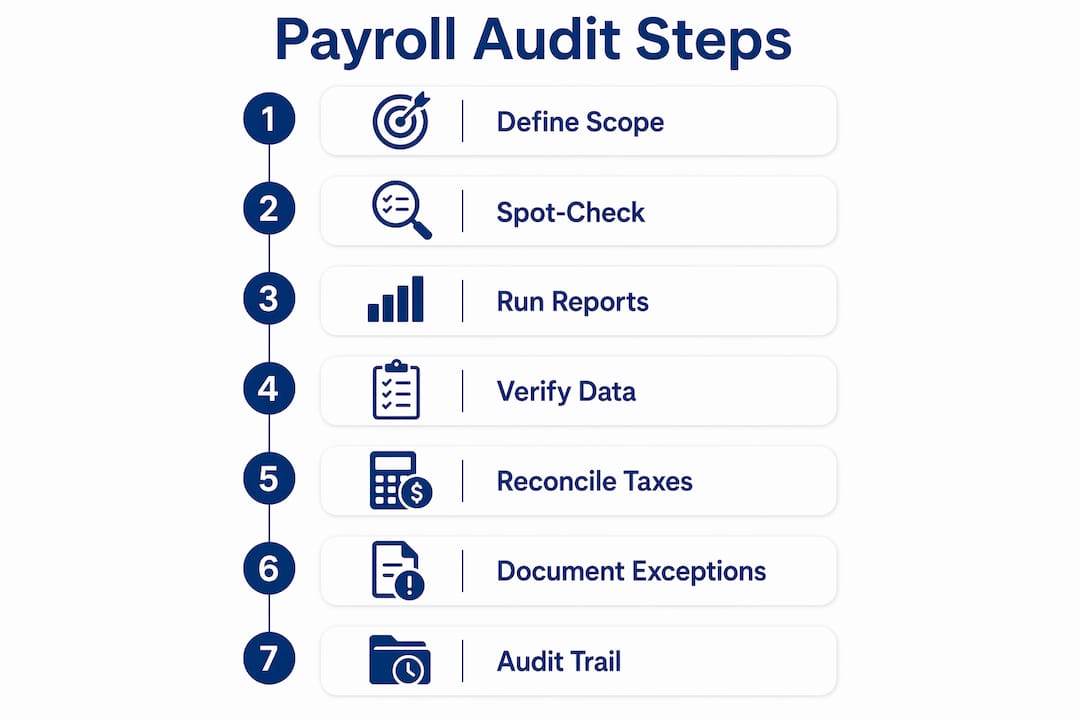
Step 2: Develop a spot-check strategy. You do not need to review every employee. Spot-checking 5%–10% of employees effectively tests pay accuracy and compliance without reviewing every record. Select a random sample across departments, pay types, and pay periods to get a representative picture.
Step 3: Run summary reports. Pull wage and tax summary reports from your payroll platform. These reports should show gross wages, federal and state withholdings, employer tax contributions, and benefit deductions for every employee in the sample.
Step 4: Verify active employees, pay rates, and hours. Cross-reference your payroll system against your HR records. Confirm that every person receiving a paycheck is an active employee. Compare pay rates against offer letters or employment agreements. Match hours paid against timekeeping records from systems like TSheets or Homebase.
Step 5: Reconcile tax payments and deposits. Compare your Forms 941 against your EFTPS deposit history. Confirm that state payroll tax filings match your payroll platform totals. Reconciling payroll accounts to bank accounts and documenting any differences builds a strong compliance case if an auditor asks questions.
Step 6: Identify and document atypical transactions. Flag any off-cycle payments, retroactive adjustments, or manual checks. These transactions attract auditor attention. Document the business reason for each one in writing.
Step 7: Maintain an organized audit trail. Store all supporting documents in a single location, whether that is a shared drive, a document management system, or a folder structure within your payroll platform. Label everything clearly by pay period and document type.
| Approach | Best For | Scope | Time Required |
|---|---|---|---|
| Spot-check audit | Routine internal review | 5%–10% of employees | Low |
| Full audit | IRS or state examination | All employees and periods | High |
Pro Tip: Run your first internal audit before you receive any IRS notice. Identifying errors on your own terms gives you time to correct them without penalty exposure.
What are the common payroll audit pitfalls startups must avoid?
Startups face a predictable set of audit problems. Knowing them in advance lets you fix them before an auditor does.
-
Worker misclassification. Classification errors between contractors and employees are one of the most common audit triggers and penalty sources. The IRS and California's EDD both scrutinize this area closely. Document your classification decisions using the IRS common law test or California's ABC test, and keep that documentation on file. For California-specific guidance, review the employee vs. contractor rules that apply to your workforce.
-
Incomplete deposit records. Missing or late EFTPS records escalate penalties quickly. Incomplete deposit documentation during an audit invitation often results in higher final assessments. Keep every EFTPS confirmation number and payment receipt organized by quarter.
-
Gaps in state registrations. Startups that hire remote workers often miss state payroll tax registration requirements. Each state where you have an employee requires its own registration, withholding account, and unemployment insurance filing.
-
Poor timekeeping records. Inaccurate or missing time records make it impossible to verify overtime calculations. Use a dedicated timekeeping system and retain records for at least the IRS-required period.
-
Inadequate response to IRS notices. This is the mistake that costs startups the most money. Responding to payroll tax notices without full documentation is a major error. It is better to request an extension than to submit an incomplete response.
"When you receive an IRS payroll tax notice, the worst thing you can do is respond quickly with incomplete information. Request an extension, gather complete documentation for the exact period in question, and respond once. A partial response invites follow-up scrutiny." — BPM, 2026 Payroll Tax Notice Guidance
For a detailed checklist covering California-specific audit requirements, the EDD audit preparation checklist covers the documentation California employers need most.
What best practices sustain payroll audit readiness long term?
One-time audit preparation is not enough. Startups that stay audit-ready treat compliance as an ongoing process, not a reaction to a notice.
-
Run quarterly mini audits. A brief internal review every quarter catches errors before they compound. Check your Forms 941 against EFTPS deposits, verify your active employee list, and confirm pay rates match current agreements.
-
Centralize payroll records with clear retention timelines. The IRS generally requires payroll tax records for a minimum of 4 years, with some forms requiring longer retention. Gaps in records increase audit risk. Use a single storage system and label files by year and document type.
-
Use payroll automation to reduce manual errors. Platforms like Gusto and QuickBooks Payroll automate tax calculations, generate Forms 941, and maintain deposit histories. Payroll automation removes the human error that creates most audit findings.
-
Assign clear ownership of tax filings and EFTPS management. One person should own federal deposit deadlines. A second person should review and confirm. This two-person check prevents missed deadlines.
-
Train staff on classification rules and audit processes. Your HR team should understand the difference between an employee and an independent contractor. Your finance team should know your state's payroll tax filing calendar.
-
Develop escalation protocols for IRS and state notices. Decide in advance who reviews a notice, who contacts your payroll advisor, and what the response timeline looks like. Having that protocol written down before a notice arrives removes panic from the process.
Pro Tip: Review your year-end payroll checklist every december. Year-end is when most classification and deposit errors surface, and catching them before january filings saves significant time.
Key takeaways
Startups that define audit scope, assign clear ownership, and run quarterly internal reviews avoid the documentation gaps that turn routine IRS inquiries into costly penalties.
| Point | Details |
|---|---|
| Define scope first | Identify pay periods, systems, and compliance areas before reviewing any records. |
| Spot-check strategically | Reviewing 5%–10% of employees tests compliance without a full audit workload. |
| Avoid worker misclassification | Document every contractor classification decision using the IRS or ABC test. |
| Respond to notices with full documentation | Request an extension rather than submit an incomplete IRS notice response. |
| Retain records for 4+ years | The IRS minimum is 4 years; some payroll forms require longer retention periods. |
What working with startups on payroll audits has taught me
The founders who struggle most with payroll audits are not the ones with the most complex payroll. They are the ones who treated payroll as a back-office task until a notice arrived. By then, records are scattered, EFTPS confirmations are missing, and worker classification decisions were never written down.
The mindset shift that makes the biggest difference is treating every payroll run as a document you may have to defend. That means saving EFTPS confirmations the day you make a deposit. It means writing a one-sentence note when you pay a contractor instead of an employee. It means reconciling your payroll bank account at the end of every quarter, not just at year-end.
Startups in California face an additional layer of complexity. The EDD conducts its own audits independently of the IRS, and California's ABC test for worker classification is stricter than the federal standard. A founder who passes an IRS review can still face EDD penalties for the same contractor relationships. That gap surprises almost every client I work with for the first time.
The practical advice I give every startup: do not wait for a notice to build your audit file. Spend two hours per quarter running a mini audit. Check your active employee list, confirm your deposits, and review any off-cycle payments. Two hours per quarter is far less expensive than the time and fees that come with responding to an IRS or EDD examination.
— Glendale
How Glendalepayroll supports startups with audit-ready payroll
Glendalepayroll works with startups across Glendale, Burbank, Pasadena, and Greater Los Angeles to build payroll processes that hold up under IRS and EDD scrutiny.
Every client engagement starts with a free comprehensive payroll audit to identify existing risks before they become penalties. Glendalepayroll's dedicated payroll professionals handle Forms 941 preparation, EFTPS deposit management, and state tax filings with accuracy built into every step. For startups that want practical, California-specific guidance, the payroll tips for small businesses page covers the compliance areas that matter most. If you are weighing whether to handle payroll in-house or bring in professional support, the outsource payroll guide lays out the decision clearly. Glendalepayroll's goal is straightforward: keep your payroll compliant so an audit is never a crisis.
FAQ
What is a payroll audit for startups?
A payroll audit is a structured review of payroll records, tax filings, and employee classifications to confirm compliance with IRS and state requirements. Startups use internal audits to catch errors before an external examination occurs.
How often should startups conduct internal payroll audits?
Quarterly internal audits are the standard best practice. Brief quarterly reviews catch deposit errors, classification issues, and timekeeping gaps before they accumulate into larger compliance problems.
What records does the IRS require startups to keep?
The IRS requires payroll tax records for a minimum of 4 years, with some forms requiring longer retention. Missing records increase audit risk and can escalate penalties.
What is the biggest payroll audit mistake startups make?
Worker misclassification is the most common audit trigger. Classification errors between contractors and employees generate significant IRS and state penalties, particularly in California where the ABC test applies.
What should a startup do after receiving an IRS payroll tax notice?
Gather complete documentation for the exact period cited before responding. Requesting an extension is better than submitting an incomplete response, which invites additional scrutiny and higher final assessments.