
When an employee raises a payroll dispute, your first move is not to investigate — it's to acknowledge. Send a written confirmation within 24 hours, assign one person to own the case, and pull the authoritative records before touching anything else in payroll. Speed matters because delayed wage corrections can trigger additional state penalties, and failing to respond promptly increases the risk of regulatory complaints and attorney involvement.
Your 24–72 hour checklist:
- Acknowledge the claim in writing to the employee; confirm you received it and will respond by a specific date
- Assign a case owner — one person in payroll or HR who is responsible from intake to closure
- Preserve evidence — pull the paystub, time records, approvals, offer letter, and any commission or expense documentation before any payroll run touches those records
- Set a response deadline — communicate a realistic resolution date (typically 3–5 business days for straightforward errors)
- Assess jurisdiction — if the employee works in California, the California Department of Industrial Relations enforces prompt payment rules with per-pay-period penalties; federal claims fall under the U.S. Department of Labor's Wage and Hour Division (WHD); IRS payroll tax implications apply when corrective payments affect withholding
State wage statutes are not forgiving on timing. California, for example, imposes waiting-time penalties when final wages are not paid promptly. Acting within 72 hours is not just good practice — it is often the difference between a corrected paystub and a formal wage claim.
Table of Contents
- What does the payroll dispute resolution process look like step by step?
- What are the legal risks and timelines you need to know?
- How should you communicate with the employee and document the dispute?
- How do you prevent payroll disputes from repeating?
- When should you involve agencies, mediators, or legal counsel?
- Key Takeaways
- The case for treating every dispute as a system signal
- Glendale Payroll handles the hard part for you
- Useful resources for wage claims and official guidance
What does the payroll dispute resolution process look like step by step?
A reliable payroll conflict resolution workflow moves through five stages: triage, diagnosis, correction decision, execution, and closure.
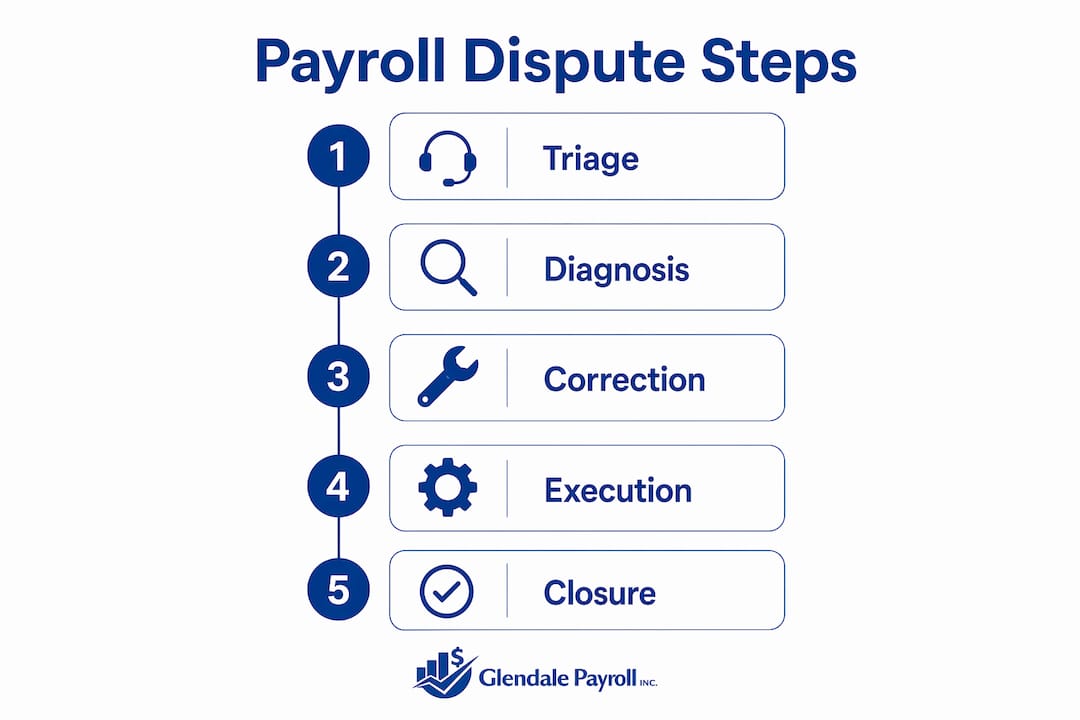
Triage and intake
Every complaint enters through one channel — a logged intake form or a designated HR/payroll email alias. This one-door approach prevents disputes from getting lost in a manager's inbox. Assign a priority level immediately:
- P0 — potential wage theft, final paycheck errors, or legal demand received
- P1 — underpayment affecting current pay period or overtime miscalculation
- P2 — administrative discrepancy (wrong deduction code, benefits adjustment) with no immediate financial harm
Diagnosis: what to pull and reconcile
When records are unclear, the law often favors the employee, so gather corroborating evidence: badge logs, computer timestamps, manager approvals, and commission contracts. Cross-reference the payroll register against the timekeeping system, HRIS data, and any expense or commission records. Document every source you checked and what it showed.

Correction decision
| Method | Best for | Key control step |
|---|---|---|
| On-cycle adjustment | Minor errors caught before payroll closes | Approver sign-off; update timekeeping notes |
| Off-cycle check | Verified underpayment after payroll has run | Dual approval; ledger tie-out before issuing |
| Reversal / repayment plan | Overpayment recovery | Written employee agreement; confirm state law allows deduction |
For overpayments, many states restrict wage deductions without employee consent, so a voluntary installment agreement is usually safer than a unilateral paycheck deduction.
Pro Tip: Always perform a ledger tie-out after any correction. Retain an evidence packet that records who requested the change, who approved it, effective dates, impacted pay runs, and before/after payroll outputs. Finance should be able to reconcile without chasing anyone.
Execution, approval, and closure
Two people must sign off on every correction: the resolver who calculated it and an approver (payroll manager or controller). Update the timekeeping system to reflect the corrected hours or amounts, issue a corrected or supplemental paystub, and log the final action in your exception register with the resolution date and outcome.
What are the legal risks and timelines you need to know?
The federal Fair Labor Standards Act (FLSA) sets the baseline: employers must pay all earned wages on the established payday. The U.S. Department of Labor's Wage and Hour Division investigates federal wage claims and can assess back wages plus liquidated damages equal to the unpaid amount — effectively doubling the cost of a delayed correction.
State rules add another layer:
- California — the Department of Industrial Relations enforces waiting-time penalties of up to 30 days of the employee's daily wage for late final paychecks; per-pay-period penalties apply for certain wage statement violations; the EDD monitors payroll tax compliance separately
- New York — the NYSDOL accepts wage complaints generally within three years of the work performed, and employees may also sue in court within six years
- Most states — have their own prompt payment statutes with varying penalty structures; check your state labor office for the specific deadline
Overpayment recovery is its own minefield. Federal law generally permits recoupment, but state rules often require written consent before any deduction. In California, deductions to recover overpayments are tightly regulated. A signed repayment agreement is the safest path in nearly every state.
Correcting a verified underpayment immediately — even with an off-cycle check — almost always reduces total exposure. Waiting for the next regular pay cycle when the error is already confirmed is a compliance risk, not a cost-saving measure.
How should you communicate with the employee and document the dispute?
Neutral, factual communication keeps the conversation professional and lowers the chance an employee seeks outside legal help. Acknowledging the error and communicating regularly — including what is being done and when it will be resolved — is one of the most effective ways to prevent escalation.
Sample acknowledgment message: "We received your payroll concern on [date] and have assigned it to [name] for review. We will provide a status update by [date]. Please reply with any supporting documents you have, such as paystubs or time records."
Documentation checklist — save everything in the case file:
- Original complaint (written or transcribed from verbal)
- Paystubs for the disputed period
- Time records, badge logs, or system timestamps
- Manager approvals and schedule records
- Correspondence with the employee (all channels)
- Tie-out notes showing before/after payroll figures
- Approval records for any off-cycle check or correction
- Signed repayment agreement (for overpayments)
- Final resolution memo with date and outcome
Contemporaneous records of the complaint, investigation steps, findings, and corrective payments are your best evidence of good faith if the matter reaches an auditor or court. Notify HR, payroll, and finance through secure internal channels — not group chats — to preserve confidentiality. A solid payroll records retention policy makes this process far less stressful when a dispute surfaces.
How do you prevent payroll disputes from repeating?
A single resolved dispute is a data point. Two of the same dispute in a quarter is a system problem. The fix is a prevention loop built into your standard operating procedure.
Minimum SOP elements:
- One-door intake (single email alias or form) so no complaint goes unlogged
- Priority tiers (P0/P1/P2) assigned at intake, not after investigation
- Diagnosis checklist covering payroll register, timekeeping, HRIS, and commission records
- Dual-approval gate before any correction is executed
- Evidence standard: case file must include before/after outputs and approver sign-off
- Closure step: root-cause tag added to the exception log
Run spot-check audits and trend analysis after each incident to detect systematic issues. Track exceptions monthly, identify the top one to three recurring root causes (late approvals, misconfigured pay codes, timekeeping gaps), and assign an owner to fix each one. Without this loop, the same errors recur and create permanent administrative overhead.
Pro Tip: Integrated payroll and timekeeping systems eliminate the manual data transfer step where most transcription errors originate. Employee self-service paystub access also reduces disputes by letting employees catch discrepancies before payday.
A standardized payroll procedure with documented approval gates cuts both the frequency of errors and the time it takes to resolve them when they do occur.
When should you involve agencies, mediators, or legal counsel?
Most payroll disputes resolve internally. Escalation becomes necessary when the internal process stalls or the exposure grows.
Escalate to government agencies when:
- The employee files a formal complaint with the DOL, California Department of Industrial Relations, or state labor office
- You identify a pattern affecting multiple employees (class exposure)
- A statutory deadline is approaching and the dispute is unresolved
- The employee presents an attorney demand letter
Use mediation when the facts are disputed but the amounts are modest and both parties want a faster resolution than litigation. The DOL's Wage and Hour Division and many state labor offices offer informal resolution conferences before a full investigation begins.
Retain legal counsel when the dispute involves potential willful wage violations, exempt-status classification questions, or any claim that could expand to a class or collective action. At that point, a disciplined, evidence-based approach — preserved case file, quantified exposure, documented settlement options — is what your attorney will need on day one.
Before escalating, confirm:
- The complete case file is preserved and accessible
- No unilateral deductions have been made without a lawful basis
- Tax treatment of any corrective payment has been reviewed with your payroll or tax advisor
- All correspondence has been saved in a secure, dated format
Key Takeaways
A prompt, documented response to every payroll dispute is the single most effective way to limit legal exposure and preserve employee trust.
| Point | Details |
|---|---|
| Acknowledge within 24 hours | Send written confirmation and assign one case owner before any investigation begins. |
| Correct verified underpayments immediately | Issue an off-cycle check when needed; waiting for the next cycle increases state penalty exposure. |
| Document every step | Save the complaint, time records, approvals, correspondence, and resolution memo in one case file. |
| Build a prevention loop | Tag root causes monthly and assign ownership so the same error does not repeat each cycle. |
| Glendale Payroll | Provides SOP-led remediation, off-cycle execution, and a free payroll audit to identify and fix recurring dispute triggers. |
The case for treating every dispute as a system signal
Most small business owners treat a payroll dispute as a one-off problem to close as quickly as possible. That instinct is understandable, but it misses the more important question: why did the error reach the employee in the first place?
The payroll error complaint process is not just a compliance exercise. It is diagnostic data. A dispute over overtime calculation usually means the timekeeping-to-payroll handoff has a gap. A dispute over a final paycheck almost always means the offboarding checklist skips a step. Fixing the individual case without tagging the root cause guarantees the same conversation happens again in three months with a different employee.
The employers who handle disputes best are not the ones with the fastest off-cycle check turnaround. They are the ones who treat each exception as an audit trigger, run the root-cause analysis, and close the loop with a documented SOP update. That is the difference between dispute management in payroll that costs you time every quarter and a system that gets quieter over time.
Glendale Payroll handles the hard part for you
Resolving a payroll dispute correctly — acknowledged, documented, corrected, and closed with a prevention plan — takes time most small business owners do not have. Glendale Payroll gives you dedicated payroll professionals (not a call center) who run the full remediation workflow: intake, audit, on-cycle or off-cycle correction, ledger tie-out, and a documented prevention loop so the same issue does not surface again.

Every new client starts with a free comprehensive payroll audit to identify existing risks before they become disputes or IRS penalties. Glendale Payroll handles federal and California state tax filings, W-2 preparation, EDD account compliance, and ongoing SOP implementation — all under a flat monthly fee with no long-term contract surprises. If you are in Glendale, Burbank, Pasadena, or anywhere in Greater Los Angeles, the team is ready to step in. Request your free payroll audit or review the full service offerings to get started.
Useful resources for wage claims and official guidance
| Resource | When to use it |
|---|---|
| U.S. Department of Labor — Wage and Hour Division | Federal wage claims, FLSA compliance questions, and back-wage investigations |
| California Department of Industrial Relations | California wage complaints, waiting-time penalties, and labor standards enforcement |
| IRS — Payroll Tax Guidance | Tax treatment of corrective payments, withholding adjustments, and employer tax obligations |
| Glendale Payroll — Essential Records Guide | Practical checklist of records to maintain for audits and dispute documentation |
| Glendale Payroll — California Compliance | State-specific compliance guidance for California employers |
For SOP templates and payroll process documentation, the Glendale Payroll blog provides step-by-step guidance built for small business operations.
This article provides general information about payroll dispute procedures and is not legal or tax advice. Confirm current rules with the relevant agency or a qualified professional for your specific situation.