
Payroll fraud is preventable, and the fix does not require expensive software. Start by separating who enters payroll data from who approves it, and verify every bank-detail change through a second channel before it processes. Run an access review and a pay-change audit for your current payroll cycle right now — before another paycheck goes out.
TL;DR:
- Large payroll increases without new hires or raises may indicate multiple fraud schemes and warrant immediate investigation.
- Segregating payroll duties, implementing role-based access, and verifying bank changes via phone are cost-effective fraud prevention methods.
- Routine exception reports, tip hotlines, and system audits are essential for early detection of payroll fraud activity.
- Suspected fraud cases require immediate access restriction, evidence preservation, and involvement of forensic or legal experts.
- Regular payroll audits, quarterly reviews, and surprise external checks build ongoing safeguards against payroll embezzlement.
Table of Contents
- What is payroll fraud and why does it matter?
- What are the most common payroll fraud schemes?
- How do you prevent payroll fraud with internal controls?
- How do you detect payroll fraud and respond when it's suspected?
- What should your payroll audit schedule look like?
- How does Glendale Payroll help prevent fraud for small businesses?
- What the data actually tells small business owners
- How to get started with Glendale Payroll's free payroll audit
- Sources
What is payroll fraud and why does it matter?
Payroll fraud is any scheme where an employee, employer, or outside actor manipulates the payroll system for illegitimate financial gain. It covers three distinct categories: employees who game the system from inside (ghost employees, inflated hours), employers who knowingly misclassify workers or skip tax withholding, and third parties who exploit weak verification to divert direct deposits.
The dollar figures are sobering. The Association of Certified Fraud Examiners found payroll schemes in its dataset carry a median loss near $50,000, and most run about 18 months before anyone catches them.
That gap between the fraud starting and when someone notices is where the real damage happens. It's not just the missing cash. Repeated payroll errors trigger compliance exposure with state and federal agencies, erode trust among employees who notice pay discrepancies, and in serious cases expose owners to legal liability for failing to catch embezzlement they should have controlled against.
What are the most common payroll fraud schemes?
Most payroll fraud falls into a handful of recognizable patterns. Knowing the pattern is half the battle. Once you know what to look for, the red flags tend to jump out during a routine review rather than staying buried for 18 months.
- Ghost employees. Someone stays on the payroll after leaving, or a fictitious worker gets added entirely. Check your headcount against your active employee list every pay period, and flag any duplicate bank account numbers or Social Security numbers across employee records.
- Timesheet fraud and buddy punching. One employee clocks in for another, or hours get padded. Watch for repeated manual edits to the same employee's timesheet and suspiciously round-number overtime entries week after week.
- Pay-rate manipulation. Someone adjusts a wage rate without proper sign-off. Any rate change missing a matching authorization document, or a change made outside the normal review window, deserves a second look.
- Expense reimbursement and overpayment schemes. Fake or inflated reimbursement requests slip through when receipts go missing or when the same employee's expense pattern suddenly shifts.
- Payroll diversion and phishing. A fraudster impersonates an employee or executive and requests a direct deposit change. Federal prosecutions document how quickly these schemes move once account takeover succeeds. A sudden bank-detail change request, or a payroll preview email you never asked for, is the tell.
- Misclassification and withholding embezzlement. Workers get labeled as contractors to dodge tax obligations, or withheld taxes never make it to the government. An unexplained gap between what should have been remitted and what actually was is usually the first sign.
Payroll costs rising while your workforce count stays flat is a red flag that spans several of these schemes at once, according to occupational fraud research. If your payroll total climbed 8% this quarter and you didn't hire anyone or hand out raises, that number is worth chasing down before you approve the next run.
How do you prevent payroll fraud with internal controls?
Prevention comes down to breaking single-person control over the payroll process. No one person should be able to add an employee, change a pay rate, and approve the payment without a second set of eyes somewhere in that chain.
- Separate the roles. Data entry, approval, and reconciliation should sit with different people. A small business without three full-time staff can simulate this with cross-checks: one person enters the payroll, another signs off before it runs, and the owner or an outside reviewer reconciles the bank transfers afterward. Cross-train backup staff too, so no single employee becomes an irreplaceable bottleneck who also happens to be the only person who could catch their own mistakes.
- Lock down access. Role-based permissions limit who can edit pay rates, banking details, or hours. Deactivate system access the same day someone leaves, not at the end of the pay period.
- Require two-channel verification for bank changes. If a request to change direct deposit details arrives by email, call the employee back on the phone number already on file, not the number listed in the email itself, and require a signed form or HR portal confirmation before the change goes live. This single habit closes the door on most payroll diversion attempts.
- Put pay changes in writing. Rate increases, bonuses, and new hires all need a documented, signed approval trail before they touch the next run. Clear payroll process documentation makes this a habit rather than a hope.
- Add technical safeguards. Multi-factor authentication, audit logs, and integrated timekeeping that feeds directly into payroll all reduce the room for manual tampering. Exception reports that flag unusual entries automatically catch what a busy manager might miss.
- Train staff and open a reporting channel. Organizations that run fraud training see roughly half the median loss of those that don't, according to ACFE's findings. Make it easy and anonymous for employees to flag something that looks off.
Pro Tip: Treat every bank-detail change request as suspicious by default, even when it looks like it came from someone you know. The phone call back to the number already on file takes two minutes and closes off the most common diversion tactic outright.
Segregation of duties, verification workflows, and quarterly access reviews together form the backbone that most fraud-prevention frameworks point to as essential, and none of them require a large budget to implement.
How do you detect payroll fraud and respond when it's suspected?
Detection depends on habits, not luck. Run exception reports every pay cycle that flag pay-rate changes, new bank details, and off-cycle payments automatically. Check for duplicate account numbers across employees. Monitor for logins to the payroll system at odd hours, and review the audit trail on any record that changed more than once in a short window.
Tips remain the most reliable early-warning system available. ACFE research consistently finds that tips, not audits or automated alerts, are the most common way fraud actually gets discovered. A formal, anonymous channel makes an employee far more likely to say something the moment they notice a coworker's paycheck looks wrong.
If you suspect fraud is already happening, move carefully:
- Do not alert the suspected employee before you've secured your evidence.
- Preserve system logs, timesheets, and approval records exactly as they are.
- Restrict that person's system access immediately, without announcing why.
- Assign a specific investigator, ideally someone outside the payroll chain of command.
- Bring in legal or forensic accounting help for anything beyond a simple documentation error.
- Notify the Department of Labor or relevant tax authority once your internal investigation confirms wrongdoing that requires it.
Acting on a hunch without evidence risks a wrongful accusation; sitting on solid evidence too long risks losing it.
What should your payroll audit schedule look like?
Fraud prevention only works as a program, not a one-time fix. Build a calendar around it.
- Every pay run: Preview payroll before it processes, reconcile headcount against active employees, and verify any off-cycle or manual payment individually.
- Quarterly: Review system access and permissions, sample-audit a batch of payroll records, and reconcile totals against bank statements and tax filings.
- Annually, or higher for higher-risk operations: Schedule a surprise spot check nobody saw coming, and bring in an external reviewer. Surprise audits measurably cut both loss size and detection time compared to scheduled ones alone.
Businesses without three full-time payroll staff can still achieve segregation of duties through cross-checks, a part-time CFO, or outsourced payroll support that builds verification into the process by default.
| Cadence | Task | Typical owner |
|---|---|---|
| Every pay run | Preview payroll, reconcile headcount, verify off-cycle payments | Payroll processor + manager sign-off |
| Quarterly | Access review, sample audit, bank/tax reconciliation | Owner or outsourced payroll partner |
| Annual | Surprise spot check, external review | Independent reviewer or CPA |
How does Glendale Payroll help prevent fraud for small businesses?
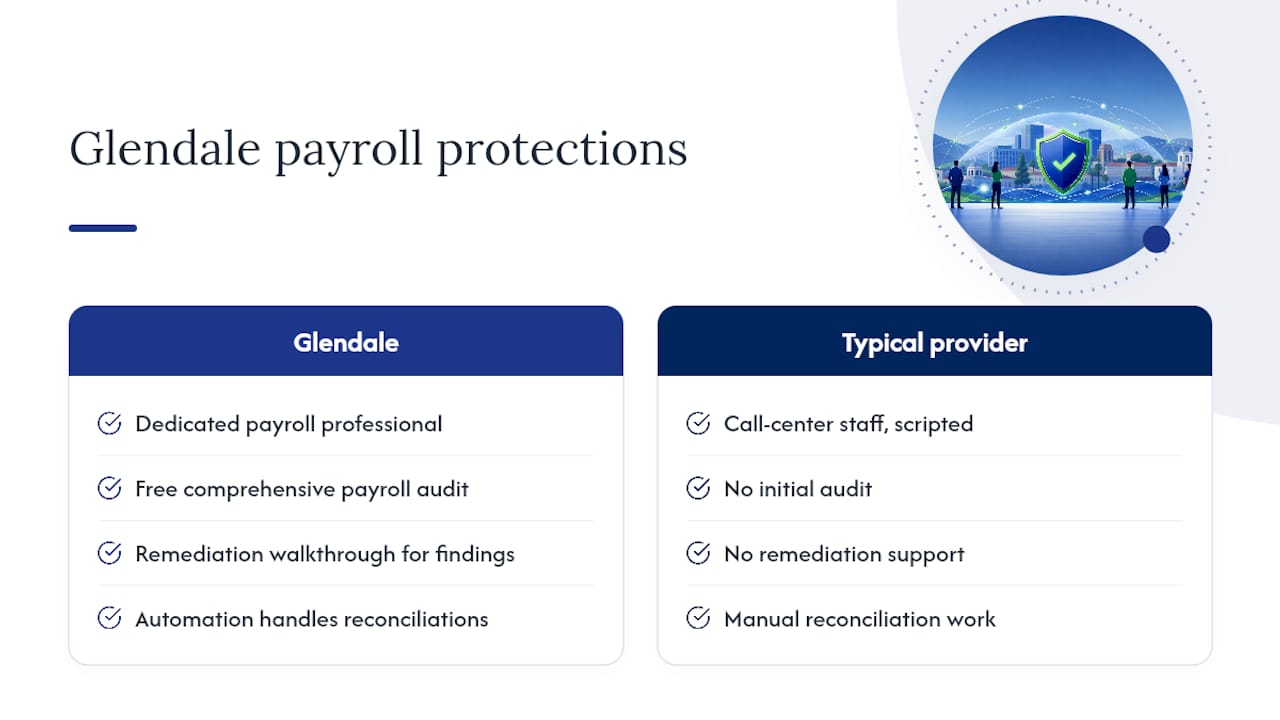
Glendale Payroll assigns dedicated payroll professionals to every client account, not call-center staff working from a script. That continuity means the same person reviewing your account this quarter caught the anomaly last quarter too.
Every new client starts with a free comprehensive payroll audit. It typically surfaces the same handful of issues: missing segregation between entry and approval, no documented process for bank-change requests, and gaps in access controls after an employee departs. Glendale Payroll walks clients through remediation on each finding, with automation handling the reconciliation work that used to eat a Friday afternoon. If you want a clear picture of where your payroll stands, request a free audit and start there.
What the data actually tells small business owners
The conventional advice on payroll fraud leans hard on technology: buy the platform with AI-driven anomaly detection, add the machine-learning layer, automate everything. That advice is not wrong, and adoption of AI-based fraud detection is genuinely accelerating. But for most small businesses, the highest-value fix sits somewhere far less glamorous: who is allowed to touch the payroll system, and whether a bank-change request gets a phone call before it gets a click of "approve."
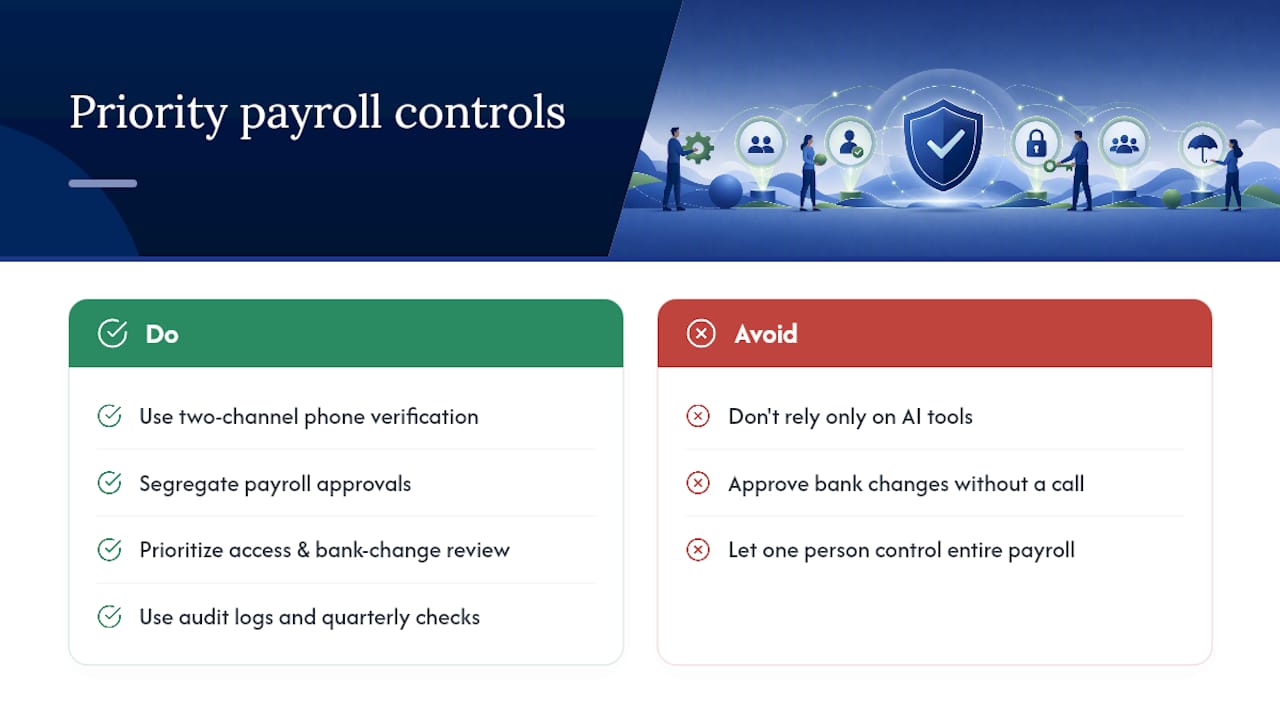
What gets underrated is the phone call itself. Two-channel verification costs nothing and takes two minutes, yet it's the single control most likely to stop the diversion schemes doing real damage right now. Segregation of duties is the other underrated lever. Owners often assume it requires headcount they don't have, when in practice it just requires structuring approvals so no one person controls the entire payroll cycle alone.
If you do one thing this month, make it the access and bank-change review. Everything else, the audit logs, the quarterly checks, the training, builds on that foundation.
— Glendale Payroll Staff
How to get started with Glendale Payroll's free payroll audit
Most payroll platforms sell you software and leave the verification workflows to you. Glendale Payroll takes a different position: dedicated payroll professionals handle your reconciliations, build verified bank-change workflows into the process, and manage your compliance filings directly, so the controls this article describes aren't something you have to bolt on yourself.
Every engagement starts with the same free comprehensive payroll audit mentioned above, built to catch the access gaps and missing approvals before they turn into a $50,000 problem. For business owners in Glendale, Burbank, Pasadena, and Greater Los Angeles, that audit doubles as a practical roadmap toward full federal and California compliance. If your current process leaves you unsure who can actually change a bank detail without a second signoff, that's the exact gap worth closing first. Review our payroll tips for California small businesses or reach out to schedule your free audit and get a specific, prioritized list of fixes for your payroll process.
Sources
- ACFE — Occupational Fraud: Report to the Nations (2024)
- AIA — Fighting fraud a shared responsibility
- U.S. Department of Labor