
Payroll internal controls setup is the process of establishing policies, procedures, and system configurations that protect payroll accuracy, prevent fraud, and keep your business compliant with IRS and state regulations. For small businesses in California, the stakes are especially high. A single undetected error, such as a ghost employee or a recurring overpayment, can compound into significant financial loss before anyone notices. This guide covers the core control measures, the prerequisites you need in place, a step-by-step implementation process, and how to maintain those controls through regular internal payroll audits.
What are the essential payroll internal control measures to implement?

Segregation of duties is the single most critical payroll control measure for any small business. Fraud becomes nearly impossible to detect without forensic audits when one person controls employee setup, payroll approval, and payment execution. Splitting those three functions across different people removes the opportunity for ghost employee fraud before it starts.
Beyond segregation of duties, a complete payroll internal controls setup includes the following layers:
- Role-based access control (RBAC): Limit each employee's system access to only the data their job requires. A payroll clerk should not see executive compensation. A manager approving timesheets should not have the ability to edit pay rates.
- Approval workflows for payroll changes: Every change to pay rates, deductions, direct deposit details, or employee records must go through a documented approval chain before it takes effect. Documented change authorization prevents unauthorized modifications and creates a clear paper trail.
- Audit trails with timestamps: Your payroll system should log every change with the user ID, timestamp, and reason for the change. Targeted audit trails on sensitive changes, such as bank detail updates and pay rate adjustments, are more effective than logging every routine transaction.
- Data validation rules: Configure your payroll software to flag entries that fall outside expected ranges, such as hours worked exceeding a set threshold or a pay rate change above a defined percentage, before the payroll run finalizes.
- Separate payroll bank account: A dedicated payroll account creates a clean audit trail and limits fraud risk by keeping payroll funds completely separate from your operating cash.
- Real-time exception reporting: Set up automated alerts for anomalies, such as duplicate Social Security numbers, new employees added without HR approval, or payments to inactive employees.
Pro Tip: Assign a named owner to each control point. If no one is personally responsible for reviewing exception reports, those reports will sit unread. Ownership turns a policy into a practice.
What do you need before setting up payroll internal controls?
Effective payroll controls depend on having the right systems and documentation in place before you configure a single workflow. Trying to build controls on top of a disorganized payroll process produces gaps that auditors and fraudsters both find quickly.
The table below outlines the core prerequisites for a sound payroll internal controls setup:
| Prerequisite | Why it matters |
|---|---|
| Centralized employee data management | Eliminates duplicate records and ensures all control rules apply to a single source of truth |
| Integrated HR, payroll, and finance systems | Prevents data from being re-entered manually, which introduces errors and bypasses controls |
| Documented payroll process workflows | Gives auditors and new staff a clear map of every control point and who owns it |
| Payroll software with access controls and audit logging | Makes RBAC, approval workflows, and audit trails technically enforceable rather than policy-only |
| Named control owners for each process stage | Ensures accountability and continuity when staff changes occur |
Integrated payroll solutions that connect HR, payroll, and accounting reduce the manual handoffs where errors and unauthorized changes most often occur. Without that integration, a pay rate change approved in your HR system may never update correctly in your payroll software.
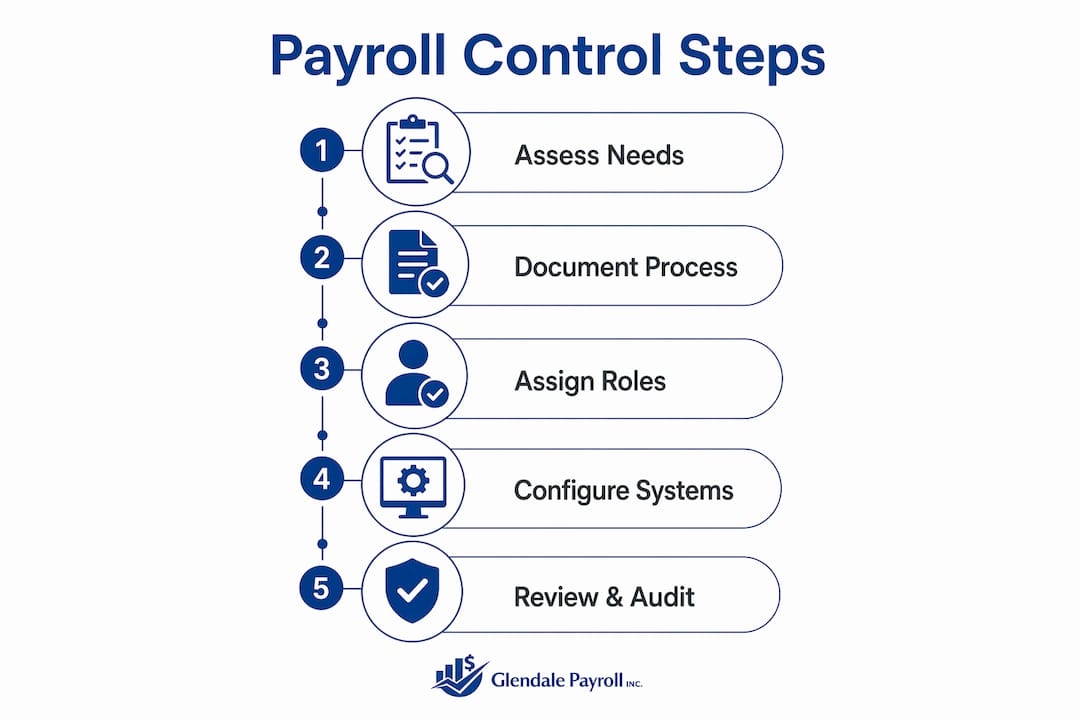
Payroll process documentation is equally non-negotiable. Payroll governance requires clear ownership and evidence of control at every stage of the payroll cycle to pass both internal and external audits. Documentation also protects you when staff turns over. A control that lives only in one employee's memory disappears the day they leave.
Pro Tip: Before you configure any software settings, draw a simple flowchart of your current payroll process from new hire setup through payment release. Every handoff point on that chart is a potential control gap.
How to set up payroll internal controls step by step
Implementation works best as a sequential process. Skipping steps, particularly the mapping and documentation phases, leads to controls that look complete on paper but fail in practice.
-
Map your payroll process end to end. List every task from new hire data entry through tax filing. Identify who currently performs each task and where the same person handles multiple steps that should be separated.
-
Define and implement segregation of duties. Assign employee setup, payroll approval, and payment release to three different people or roles. If your business is too small for three separate staff members, use a manager approval step as a compensating control for any combined roles.
-
Set up approval and authorization workflows. Configure your payroll software so that any change to employee records, pay rates, or bank details requires a second approver before saving. Approval workflows for payroll changes must be layered on top of segregation of duties, not treated as a substitute for it.
-
Configure access controls and data validation. Apply RBAC settings so each user can only view and edit data relevant to their role. Set validation rules that block or flag entries outside expected parameters before the payroll run processes.
-
Establish regular internal payroll audits and exception reporting. Schedule recurring audits and activate automated exception reports in your payroll system. Automated exception reporting flags anomalies for human review rather than requiring someone to manually check every transaction.
-
Develop a change authorization process with full documentation. Create a standard form or system workflow for every payroll change request. The form should capture the requester, the approver, the effective date, and the reason for the change. Store completed forms in your essential payroll records archive.
-
Conduct a final payroll review before releasing payments. A designated reviewer, separate from the person who processed payroll, should compare the current payroll run against the prior period and flag any unexpected variances before funds are released.
The following checks belong in every pre-payment review:
- Total gross payroll compared to the prior period
- New employees added since the last run
- Employees with changed bank account details
- Any pay rate changes effective this period
- Deduction totals compared to benefit enrollment records
Pro Tip: Run your first full payroll cycle under the new controls in parallel with your old process. Comparing the two outputs will surface configuration errors before they affect actual payments.
How do you audit and maintain payroll internal controls over time?
Controls degrade without regular review. Staff changes, software updates, and business growth all create new gaps in a framework that was solid at launch.
Small businesses should conduct internal payroll audits at minimum quarterly. Higher-risk operations, such as businesses with high employee turnover, multiple pay rates, or complex commission structures, benefit from weekly or biweekly reviews. Quarterly audits catch systemic errors. More frequent reviews catch individual transaction errors before they compound.
A complete internal payroll audit compares data across four sources: the payroll register, bank statements, the general ledger, and tax filings. Discrepancies between any two of those sources indicate either an error or an unauthorized change. Reconciling all four together gives you a complete picture of payroll accuracy and compliance.
The most productive audit focus areas for small businesses are:
- Employee classification: Confirm that workers classified as independent contractors meet the applicable legal test, such as California's ABC test, and that all W-2 employees are correctly categorized.
- Pay rates and hours: Compare current pay rates against approved rate records. Verify that hours paid match approved timesheets.
- Deductions: Reconcile benefit deductions against enrollment records and confirm that garnishments match court orders.
- Unusual transactions: Flag any payments to employees not on the active roster, any off-cycle payments without documented approval, and any round-dollar amounts that may indicate manual adjustments.
Payroll controls prevent silent errors like recurring overpayments that employees rarely report. Because employees almost never flag overpayments in their own favor, automated reconciliation between payroll and bank statements is the only reliable method to catch ongoing cost leakage early.
Document every audit finding and the corrective action taken. That documentation becomes your evidence of a functioning control framework when an external auditor or the IRS requests it. Review and update your control framework at least annually, or whenever your business adds a new pay type, location, or payroll system.
Pro Tip: Keep a running audit log that records the date, scope, findings, and resolution for every review. A single spreadsheet maintained consistently is more useful to an auditor than a polished report produced once a year.
Key Takeaways
A payroll internal controls setup built on segregation of duties, documented workflows, and regular audits is the most reliable defense against payroll fraud and compliance failures.
| Point | Details |
|---|---|
| Segregation of duties is foundational | Never allow one person to control employee setup, payroll approval, and payment release simultaneously. |
| Documentation enables continuity | Written workflows and control ownership records protect your business when staff changes occur. |
| Audit frequency must match risk level | Conduct audits at minimum quarterly; higher-risk operations need weekly or biweekly reviews. |
| Automation reduces manual control burden | Exception reporting and audit trails shift review from manual checking to targeted investigation. |
| Reconcile across four data sources | Compare payroll register, bank statements, general ledger, and tax filings to confirm full accuracy. |
What I've learned from watching payroll controls fail in practice
Most payroll fraud and error problems I see at Glendale Payroll do not start with bad intentions. They start with trust. A small business owner trusts a long-term employee with full payroll access because that employee has always been reliable. That trust is understandable. It is also a control gap that an auditor will flag immediately.
The uncomfortable reality is that segregation of duties protects your trusted employees as much as it protects you. When one person controls the entire payroll cycle, any error or discrepancy automatically points to them. Splitting responsibilities distributes both the work and the accountability, which is fairer to everyone involved.
The second pattern I see consistently is businesses that have controls on paper but not in practice. They have a policy requiring manager approval for pay rate changes, but the payroll software allows changes without a system-enforced approval step. Policy without system enforcement is not a control. It is a suggestion.
The fix is not complicated. Map your process, configure your software to enforce the rules you have written, assign named owners to each control point, and review your payroll process on a set schedule. Businesses that do those four things consistently pass audits and avoid the costly corrections that come from undetected errors.
— Glendale Payroll Staff
How Glendale Payroll supports your payroll control framework

Glendale Payroll works with small businesses across Glendale, Burbank, Pasadena, and Greater Los Angeles to build payroll control frameworks that hold up under IRS scrutiny and California EDD audits. Every client engagement starts with a free comprehensive payroll audit to identify existing gaps in access controls, approval workflows, and reconciliation practices. From there, Glendale Payroll's dedicated payroll professionals, not call center staff, help you configure the right controls for your business size and risk profile. Explore the California payroll compliance guide or review payroll tips for California businesses to see how structured controls translate into real compliance protection.
FAQ
What is a payroll internal controls setup?
Payroll internal controls setup is the process of implementing policies, system configurations, and approval workflows that protect payroll accuracy, prevent fraud, and maintain regulatory compliance. It includes segregation of duties, role-based access control, audit trails, and regular reconciliation procedures.
How often should a small business run an internal payroll audit?
Small businesses should conduct internal payroll audits at minimum quarterly. Operations with high employee turnover, complex pay structures, or elevated fraud risk benefit from weekly or biweekly reviews.
What does segregation of duties mean in payroll?
Segregation of duties means that the person who adds employee data cannot also approve payroll or release payments. Separating those three functions prevents any single individual from committing and concealing payroll fraud.
Why do payroll controls matter for California small businesses?
California imposes strict payroll compliance requirements, including the ABC test for worker classification, SDI contributions, and specific wage statement rules. Payroll controls reduce the risk of misclassification penalties, IRS assessments, and EDD audit findings.
What is the biggest payroll fraud risk for small businesses?
The biggest risk is allowing one person to control employee setup, payroll approval, and payment execution. That combination makes ghost employee fraud nearly impossible to detect without a forensic audit, according to payroll reconciliation best practices.