
Payroll process documentation is defined as a company's master blueprint that translates all payroll knowledge into written, auditable procedures covering every phase from data collection through tax filing and record retention. The industry standard term for this is a Standard Operating Procedure, or SOP, applied specifically to payroll. Payroll records must be retained for up to 7 years to satisfy IRS and Department of Labor audit standards. That single requirement alone makes written documentation non-negotiable for any small business. Without it, you cannot prove compliance, train new staff reliably, or defend your payroll practices during an audit.
What is payroll process documentation and why does it matter?
Payroll process documentation is the formal, written record of every task, rule, decision point, and control your business uses to run payroll accurately and on time. Think of it as the difference between knowledge locked in one person's head and knowledge your entire organization can access, verify, and act on. When your payroll administrator leaves, that undocumented knowledge walks out the door with them.
The importance of payroll documentation goes beyond convenience. Federal agencies including the IRS and the Department of Labor require businesses to maintain accurate payroll records. Documented procedures create an audit trail that proves your business followed the correct steps at the right times. Without this trail, a routine compliance inspection can become a costly dispute.

Payroll documentation also drives consistency. When every pay run follows the same written steps, errors from guesswork or memory drop significantly. Your essential payroll records become easier to maintain because the process for creating them is already defined.
What are the essential components of payroll process documentation?
Comprehensive payroll documentation covers six core areas. Each one addresses a different failure point that causes payroll errors or compliance gaps.
- Payroll policies vs. procedures. Policies define high-level rules such as a bi-weekly pay schedule, while procedures specify exact operational steps such as importing time data every Monday at 9:00 AM. Confusing the two is one of the most common documentation failures.
- Process inventory. This is a complete list of every payroll task, from collecting time cards to submitting tax deposits. A full inventory prevents critical steps from being omitted.
- Role definitions. Assign tasks to job titles, not personal names. Using roles like Payroll Specialist and Finance Manager keeps your documentation valid through staff changes without requiring constant rewrites.
- Timing markers. Document pay frequency, time card approval cutoffs, funding deadlines, and tax filing dates. Timely markers like pay frequency and tax deadlines are critical to preventing late payments and IRS penalties. Your payroll date management practices belong in writing here.
- Checks and controls. Document your Separation of Duties policy explicitly. The person entering payroll data should never be the same person who approves pay release. This single control reduces fraud risk substantially.
- Records retention schedule. State clearly which records are kept, where they are stored, and for how long. Seven years is the standard for most federal payroll records.
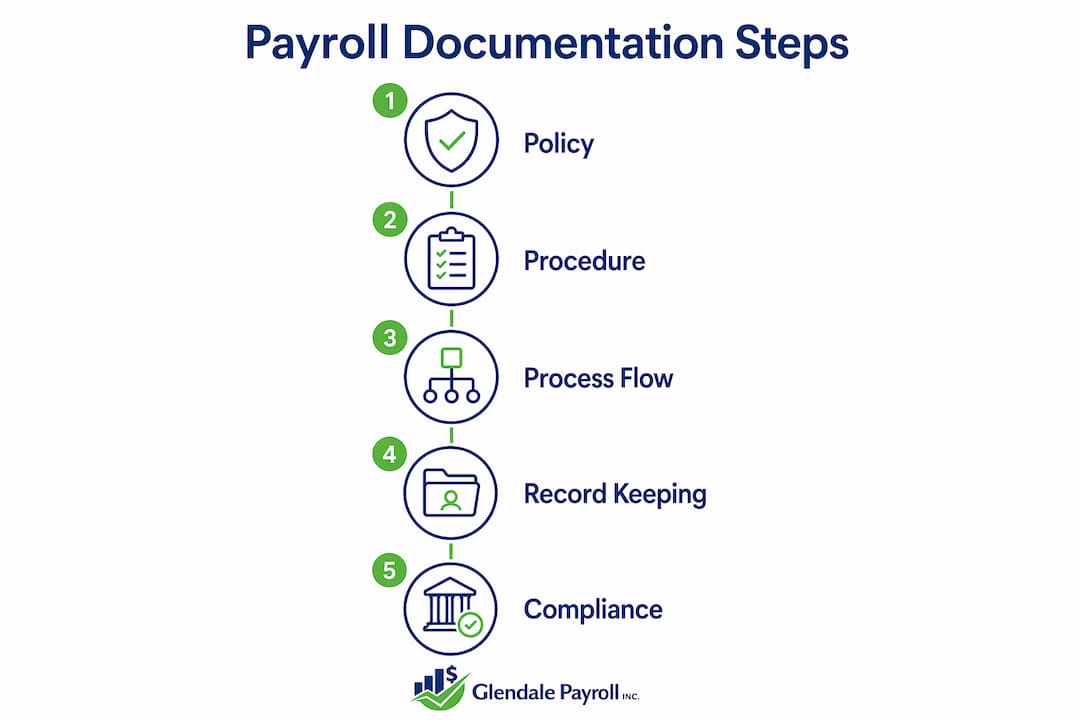
A well-organized payroll manual groups these elements into three sections: policy, procedure and process flow, and records and forms. This structure balances high-level rules with detailed workflows and supporting documents, making it useful for both daily staff reference and auditor review.
Pro Tip: Never write your payroll SOP from memory alone. Pull your actual payroll system reports and tax filing confirmations first, then document what you observe happening, not what you think should happen.
How do you create effective payroll process documentation?
Building solid payroll documentation follows a five-step approach. Each step builds on the previous one, so skipping ahead creates gaps.
- Complete a full process inventory first. Completing a process inventory before writing documentation prevents omitting critical payroll steps. List every task across pre-payroll, payroll processing, and post-payroll phases before writing a single procedure.
- Choose the right format for each procedure. Written checklists work well for sequential tasks. Flowcharts and swim lane diagrams visually clarify responsibilities and sequence, making complex multi-department processes easier to follow and audit. Swim lane diagrams are especially useful when HR, Payroll, and Finance each own different steps.
- Assign roles, not names. Write "Payroll Specialist reviews time data" rather than "John reviews time data." This one practice prevents your documentation from becoming outdated every time someone changes jobs.
- Test the documentation with your payroll team. Have the people who actually run payroll follow the written steps and flag anything unclear or missing. This testing step catches gaps that the writer never notices because they already know the process.
- Schedule regular reviews. Maintaining documentation as a living document updated regularly avoids costly errors and compliance risks. Review your SOP whenever your payroll software changes, tax rates update, or your workforce structure shifts.
Pro Tip: Set a calendar reminder every january to review your payroll SOP against any new federal or California state regulation changes. A 30-minute annual review prevents months of compliance headaches.
What common pitfalls should small businesses avoid?
Small businesses make predictable mistakes when building payroll documentation. Knowing them in advance saves significant time and money.
- Treating policies and procedures as the same thing. A policy states what your business does. A procedure states exactly how it gets done. Mixing them produces documents that are too vague to follow and too specific to enforce consistently.
- Using employee names instead of role titles. When the named employee leaves, the document becomes inaccurate immediately. Every reference to a person's name is a future maintenance problem.
- Omitting exception handling. Failure to document exception handling causes recurring payroll errors. Off-cycle payments, payroll corrections, and retroactive adjustments all need their own written procedures. These edge cases are exactly where mistakes happen most often.
- Treating documentation as a one-time project. A payroll SOP written in 2022 and never updated is a liability, not an asset. Regulations change, software updates, and staff turns over. Static documentation creates false confidence.
- Skipping Separation of Duties. Many small businesses assign all payroll tasks to one person for convenience. Without documented role separation, you have no internal control against errors or fraud. This gap is one of the first things an auditor looks for.
How does payroll documentation support compliance and internal control?
Payroll documentation is the primary evidence you present during a regulatory audit or IRS inquiry. It proves that your business followed defined procedures, applied the correct tax rates, and retained records as required. Without written procedures, you are relying on verbal explanations, which carry no legal weight.
The table below shows how specific documentation elements map to compliance and control outcomes.
| Documentation element | Compliance or control benefit |
|---|---|
| Written pay policies | Demonstrates consistent application of pay rules to all employees |
| Tax filing deadline markers | Reduces risk of late deposits and IRS penalties |
| Separation of Duties assignment | Prevents a single employee from committing and concealing payroll fraud |
| Records retention schedule | Satisfies IRS 7-year retention rule and Department of Labor standards |
| Exception handling procedures | Reduces recurring errors on off-cycle and corrected payroll runs |
Payroll documentation clarifies Separation of Duties by specifying that data entry and payroll approval belong to different roles. That clarity reduces fraud risk and gives auditors a clear picture of your internal controls. Proper audit preparation starts with having these written controls in place before an auditor ever requests them.
Documentation also supports staff training and knowledge transfer. When a new Payroll Specialist joins your team, a complete SOP cuts their onboarding time and reduces the chance of errors during the transition. Role-based documentation remains usable through staff changes, supporting business continuity without requiring repeated rewrites.
What I have learned from years of payroll documentation work
The most common mistake I see small business owners make is confusing having a payroll system with having payroll documentation. Your software processes the numbers. Your documentation governs the decisions behind those numbers. Those are two completely different things, and conflating them leaves serious gaps.
The businesses that handle audits most confidently are not necessarily the ones with the most sophisticated payroll software. They are the ones whose written procedures match what their team actually does. That alignment takes deliberate effort. It requires sitting down with your payroll team, walking through each step, and writing down what you observe, not what you assume.
I have also seen documentation fail because it was written by one person and never tested by anyone else. The writer already knows the process, so they skip steps they consider obvious. The reader does not have that context. Testing your SOP with a new employee or a colleague unfamiliar with payroll reveals those invisible gaps immediately.
One more thing worth stating directly: role-based documentation is not just a best practice. It is the difference between a document that lasts three years and one that needs rewriting every time someone changes jobs. Assign tasks to titles. Your future self will appreciate it.
— Glendale Payroll Staff
How Glendale Payroll helps small businesses get documentation right
Building complete, compliant payroll documentation takes time and expertise that most small business owners do not have on hand. Glendale Payroll works with businesses across Glendale, Burbank, Pasadena, and Greater Los Angeles to build payroll processes that meet federal and California state standards from the start.

Every engagement begins with a free comprehensive payroll audit that identifies gaps in your current procedures, records retention practices, and internal controls. From there, Glendale Payroll's dedicated payroll professionals, not call center staff, work directly with your team to close those gaps. For practical guidance you can apply right now, the California payroll tips resource covers compliance requirements and documentation practices specific to California employers.
Key Takeaways
Payroll process documentation is the written SOP that governs every payroll task, control, and deadline, and it is the primary evidence of compliance during any regulatory audit.
| Point | Details |
|---|---|
| Documentation is a compliance asset | Written payroll procedures create an audit trail that satisfies IRS and Department of Labor standards. |
| Policies and procedures are different | Policies state the rules; procedures state the exact steps. Mixing them produces documents too vague to follow. |
| Use roles, not names | Assigning tasks to job titles keeps documentation valid through staff changes without constant rewrites. |
| Exception handling must be written | Off-cycle payments and payroll corrections need their own procedures to prevent recurring errors. |
| Treat it as a living document | Review and update your payroll SOP whenever regulations, software, or staffing changes occur. |
FAQ
What is payroll process documentation?
Payroll process documentation is a written Standard Operating Procedure that records every task, rule, role, and deadline involved in running payroll. It serves as both an operational guide for staff and an audit trail for regulators.
How long must payroll records be retained?
Payroll records must be retained for up to 7 years to satisfy IRS and Department of Labor requirements. This applies to wage records, tax filings, and supporting documentation.
What is the difference between a payroll policy and a payroll procedure?
A payroll policy defines a high-level rule, such as a bi-weekly pay schedule, while a procedure specifies the exact operational steps to execute that rule. Confusing the two is one of the most common payroll documentation failures.
Why should documentation use role titles instead of employee names?
Using role titles like Payroll Specialist instead of personal names keeps procedures accurate through staff turnover. Name-based documentation becomes outdated the moment that employee changes roles or leaves the company.
What is Separation of Duties in payroll documentation?
Separation of Duties means the employee who enters payroll data is never the same person who approves pay release. Documenting this control explicitly reduces fraud risk and satisfies internal audit requirements.
Recommended
- Essential Payroll Records to Maintain for Small Businesses | Glendale Payroll Inc.
- Employee Self-Service Payroll Setup: A 2026 Guide | Glendale Payroll Inc.
- How Payroll Automation Saves Small Businesses Time and Money | Glendale Payroll Inc.
- Payroll Tips for California Small Businesses | Glendale Payroll Inc.