
A payroll process review is a systematic evaluation of your business's payroll procedures to verify accuracy, confirm regulatory compliance, and identify gaps before they become costly problems. Also called a payroll process assessment or payroll audit, this practice is the standard method recommended by the IRS and the Department of Labor for maintaining clean payroll records. Small businesses that skip regular reviews face IRS penalties, employee grievances, and legal exposure. The good news is that a structured review does not require auditing every single payroll record. Done correctly, it gives you a clear picture of where your process stands and what needs to change.
What is a payroll process review and why does it matter?
A payroll process review is a scheduled, structured examination of every stage in your payroll cycle, from data entry and timekeeping to tax filings and final disbursements. The core purpose is threefold: catch errors before they compound, confirm compliance with federal and state regulations, and identify process weaknesses that create risk. Regular audits reduce the risk of undetected errors and legal penalties that accumulate silently over time.
The industry term most professionals use is a payroll audit, though "payroll process review" and "payroll process assessment" are widely used interchangeably in small business contexts. Both refer to the same structured evaluation. The distinction worth knowing is that a payroll audit can be triggered externally by the IRS or the California Employment Development Department (EDD), while a payroll process review is one you initiate proactively.
For small businesses in California, the stakes are especially high. California's labor code imposes strict requirements around overtime calculations, paid sick leave accrual, and wage statement accuracy. A missed requirement does not just create a fine. It can trigger a class action or a full EDD audit. Treating your payroll review as a routine business discipline, not a crisis response, is the most effective way to stay protected.
What are the steps involved in a payroll process review?
Industry-standard payroll reviews involve 5–7 core steps: scope definition, data collection, report analysis, spot-checks, reconciliation, findings documentation, and corrective action planning. Each step has a specific objective, and skipping any one of them creates blind spots.

The table below outlines each step and its purpose:
| Step | Objective |
|---|---|
| Define scope and timeframe | Set the pay periods, employee groups, and compliance areas under review |
| Collect payroll data | Pull payroll registers, timekeeping records, and general ledger entries |
| Analyze reports | Compare gross pay, deductions, and tax withholdings against expected values |
| Spot-check employee samples | Verify pay accuracy for a targeted sample without auditing every record |
| Reconcile against source data | Match payroll output to timekeeping systems and general ledger accounts |
| Document findings | Record discrepancies, root causes, and recommended corrections |
| Plan corrective actions | Assign owners, deadlines, and verification steps for each finding |
Spot-checking targeted employee samples allows you to verify pay accuracy and compliance without reviewing every single payroll record. This sampling approach balances thoroughness with the practical resource limits most small businesses face.
One control that significantly reduces error and fraud risk is separating payroll processing from review. The person who runs payroll should not be the same person who reviews it. This segregation of duties is a foundational internal control recommended by auditors and the IRS alike. For small teams where one person handles both, consider having your accountant or an outside payroll firm conduct the review.
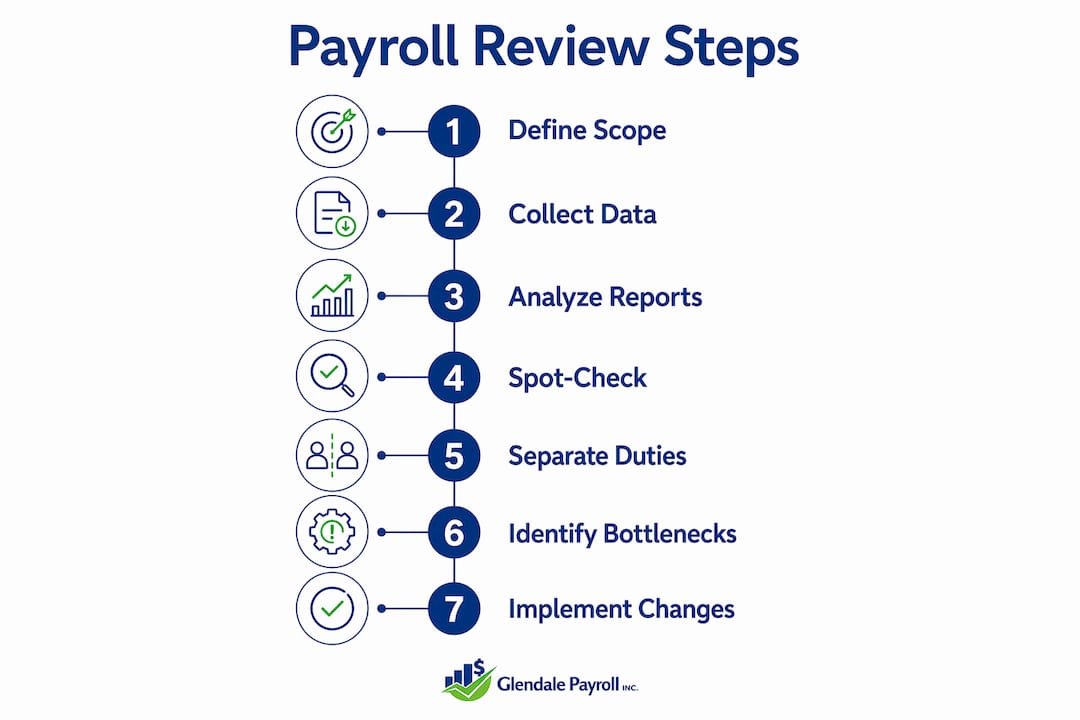
A thorough review also requires understanding the entire payroll cycle and its dependencies. Bottlenecks often hide at the handoff points between systems, not inside any single system.
What common errors do payroll reviews help identify?
Most payroll errors do not come from fraud. Many payroll errors stem from inadequate communication and unclear responsibilities between HR, payroll administrators, and timekeepers. That distinction matters because it means the fix is usually a process change, not a personnel change.
Common errors and risk categories that payroll reviews surface include:
- Worker misclassification: Employees labeled as independent contractors to avoid payroll taxes, which violates the IRS common law test and California's ABC test
- Inaccurate overtime calculations: Failing to include bonuses or commissions in the regular rate of pay before calculating overtime, a frequent California Labor Code violation
- Stale employee records: Terminated employees still active in the system, or outdated W-4 withholding elections that cause under-withholding
- Broken system handoffs: Timekeeping data that does not sync correctly with payroll software, creating pay discrepancies
- Missed statutory filings: Statutory filings, deductions, and off-cycle payments that were not reconciled against actual payroll runs, resulting in tax deposit shortfalls
- Access concentration: A single employee controlling payroll entry, approval, and disbursement with no oversight
Most critical issues arise from process breakdowns, not financial theft. A broken handoff between your HR system and your payroll platform can silently produce incorrect paychecks for months before anyone notices. By the time an employee raises a grievance or the IRS flags a discrepancy, the liability has already grown.
Pro Tip: Build a simple payroll audit checklist that covers employee status verification, deduction accuracy, and tax deposit reconciliation. Review it every pay period, not just annually. Catching a $200 error in week two costs far less than correcting six months of compounded mistakes.
How often should small businesses conduct payroll reviews?
Businesses that review payroll only after issues arise consistently miss compliance gaps that a scheduled review would have caught. Annual reviews are the recommended minimum, but quarterly reviews are better for businesses experiencing growth, high turnover, or frequent pay structure changes.
Scheduled reviews outperform ad hoc reviews for one clear reason: they create a baseline. When you review payroll on a fixed schedule, you can compare results period over period and spot trends. An ad hoc review triggered by a complaint gives you a snapshot of one problem. A scheduled review gives you a pattern.
"Reviewing your payroll process before implementing new software is not optional. Automating a flawed process does not fix it. It accelerates it."
Process reviews should precede automation to produce accurate results. Many small businesses invest in payroll software expecting it to solve existing problems, only to find that the software faithfully replicates every error from the manual process it replaced. A pre-implementation review maps your current process, identifies what is broken, and gives you a clean foundation before the new system goes live.
Tax law changes are another trigger for an unscheduled review. California's 2026 payroll tax updates affect SDI rates, UI Tax Rate Schedules, and minimum wage thresholds. Any change to the tax environment is a valid reason to verify that your payroll setup reflects the new rules.
Pro Tip: Schedule your payroll review for the same month each year, ideally in january or february after W-2s are filed. You already have the annual data in front of you, and any discrepancies from the prior year are fresh and easy to trace.
What steps can small businesses take to improve payroll after a review?
Review findings are only useful if they drive change. The improvement phase is where most small businesses stall, usually because findings are documented but never assigned to a specific owner with a deadline.
Use this numbered process to turn review findings into durable improvements:
- Document your payroll procedures in writing. Every step, every system, every approval. If your process only exists in one person's head, you have a single point of failure. Identifying single points of failure is a core objective of any payroll resilience review.
- Assign clear role ownership. Define who enters data, who approves it, and who reviews the output. Overlap creates confusion. Gaps create errors.
- Cross-train backup personnel. Operational risk rises sharply when payroll access and knowledge are concentrated in one individual. Train at least one backup who can run payroll independently if your primary person is unavailable.
- Set up exception-first reporting. Configure your payroll system to flag anomalies automatically: hours above a threshold, pay rates that changed without an approval record, or deductions that differ from the prior period. Reviewing exceptions takes minutes. Reviewing everything takes hours.
- Test your contingency plan. Document what happens if your payroll system goes down the day before payday. A written plan that has never been tested is not a plan. Run a tabletop exercise at least once a year.
- Schedule your next review before you close this one. Payroll process improvement is a cycle, not a project. The year-end payroll checklist for California employers is a practical starting point for building that cycle into your calendar.
Regular payroll reviews catch hidden errors before they escalate into costly legal or reputational issues. They also improve the employee experience, because employees who are paid accurately and on time trust their employer more. That trust has real retention value.
Key Takeaways
A payroll process review is the most cost-effective tool a small business has for preventing IRS penalties, employee grievances, and compliance failures before they escalate.
| Point | Details |
|---|---|
| Define the review scope first | Set the pay periods, employee groups, and compliance areas before collecting any data. |
| Use sampling, not full audits | Spot-checking targeted employee samples verifies accuracy without exhausting your resources. |
| Separate processing from review | The person who runs payroll should never be the same person who reviews it. |
| Review before automating | Automating a flawed process accelerates errors rather than eliminating them. |
| Build in backup and documentation | Written procedures and cross-trained staff prevent single points of failure from halting payroll. |
What most payroll reviews miss, and why it matters
Most small business owners approach a payroll review looking for fraud. That is the wrong starting point. In my experience working with businesses across Glendale, Burbank, and Pasadena, the vast majority of payroll problems trace back to process gaps, not bad actors. An HR coordinator who forgets to update a termination date. A timekeeping system that rounds hours differently than the payroll platform expects. A deduction that was set up correctly three years ago but never updated when the benefit plan changed.
The reviews that actually improve payroll operations are the ones that map the entire process, not just the numbers. When you document every handoff point between HR, timekeeping, and payroll, you see where information gets lost or delayed. That documentation also has a secondary benefit: it makes cross-training possible. You cannot train a backup if the process only exists in someone's memory.
One more thing that rarely gets discussed: regular reviews improve employee morale. Payroll errors erode trust faster than almost any other workplace issue. When employees know their pay is accurate and consistent, they stop worrying about it. That peace of mind is worth more than the hours you spend on the review itself. Build the review into your calendar the same way you build in your tax filings. It is not optional. It is part of running a business correctly.
— Glendale Payroll Staff
How Glendale Payroll supports your payroll process evaluation
Payroll compliance in California is not a set-it-and-forget-it task. Rates change, classifications shift, and the EDD conducts audits with little warning. Glendale Payroll works with small businesses across Greater Los Angeles to identify compliance gaps, correct payroll errors, and build processes that hold up under scrutiny.

Glendale Payroll's team of dedicated payroll professionals, not call center staff, reviews your payroll setup and delivers findings you can act on immediately. The firm offers a free comprehensive payroll audit for new clients, covering federal and state compliance, deduction accuracy, and filing reconciliation. If you are preparing for an EDD review, the EDD audit preparation checklist is a practical first step. For ongoing California-specific guidance, the payroll tips for small businesses resource covers the compliance areas that matter most to employers in this state.
FAQ
What is the difference between a payroll audit and a payroll process review?
A payroll audit and a payroll process review refer to the same structured evaluation of your payroll procedures. The term "audit" is also used for externally triggered reviews by the IRS or EDD, while a "process review" typically refers to an internal, proactive assessment.
How long does a payroll process review take?
The time depends on your business size and the scope of the review. A small business with fewer than 20 employees can typically complete a focused payroll process assessment in one to three business days using a structured payroll audit checklist.
What documents do I need for a payroll review?
You need payroll registers, timekeeping records, general ledger entries, tax deposit confirmations, and employee status records. Statutory filings and deduction schedules should also be on hand to verify alignment with actual payroll runs.
How often should a small business conduct a payroll review?
Annual reviews are the recommended minimum. Quarterly reviews are better for businesses with high turnover, recent software changes, or significant growth, since these conditions introduce new error risks between annual cycles.
Can I conduct a payroll review myself?
You can conduct an internal review using a structured payroll audit checklist, but the person reviewing should not be the same person who processes payroll. For the most reliable results, an outside payroll professional or CPA should conduct or verify the review findings.