
A payroll tax deposit schedule is the IRS rule that determines when you must deposit withheld federal payroll taxes with the U.S. Treasury. The IRS assigns every employer to one of two main deposit schedules: monthly or semiweekly. Your assignment is based on your total reported tax liability during a specific historical period called the lookback period, not on how often you run payroll. Missing a deposit deadline triggers escalating penalties from 2% up to 15% of the unpaid amount, and personal liability is possible even if a third party handles your payroll.
How the IRS lookback period determines your deposit schedule
The lookback period is the foundation of the entire deposit scheduling system. The IRS defines it as the 12-month window running from july 1 of the second preceding year through june 30 of the prior year. For 2026, that means the IRS looks at your tax liability from july 1, 2024 through june 30, 2025.
Your total reported liability during that window places you in one of two categories. Employers who reported $50,000 or less become monthly depositors. Employers who reported more than $50,000 become semiweekly depositors. That single threshold drives every deposit deadline you face for the entire calendar year.

The lookback rules differ slightly depending on which form you file. Form 941 filers use the 12-month lookback window described above. Form 944 filers, who file annually, look at their total tax liability for the prior calendar year instead. The IRS publishes your assigned schedule in your annual notice, but you can also calculate it yourself using your prior returns.
Pro Tip: Your payroll frequency, whether weekly, biweekly, or semimonthly, has no effect on your deposit schedule. The IRS deposit schedule is determined entirely by your lookback period liability, not by how often you pay employees.
| Lookback period | Liability threshold | Resulting deposit schedule |
|---|---|---|
| July 1, 2024 – June 30, 2025 | $50,000 or less | Monthly depositor for 2026 |
| July 1, 2024 – June 30, 2025 | More than $50,000 | Semiweekly depositor for 2026 |
| Prior calendar year (Form 944) | $50,000 or less | Monthly depositor |
| Prior calendar year (Form 944) | More than $50,000 | Semiweekly depositor |
What are the exact deadlines for monthly and semiweekly depositors?
Monthly and semiweekly schedules carry very different deadlines, and confusing the two is one of the most common compliance errors small business owners make.
Monthly depositor deadlines
Monthly depositors must deposit taxes by the 15th of the month following the month in which wages were paid. If you paid wages in january, your deposit is due by february 15. If the 15th falls on a weekend or a federal holiday, the deadline shifts to the next business day. Business days exclude weekends and legal holidays observed in the District of Columbia.
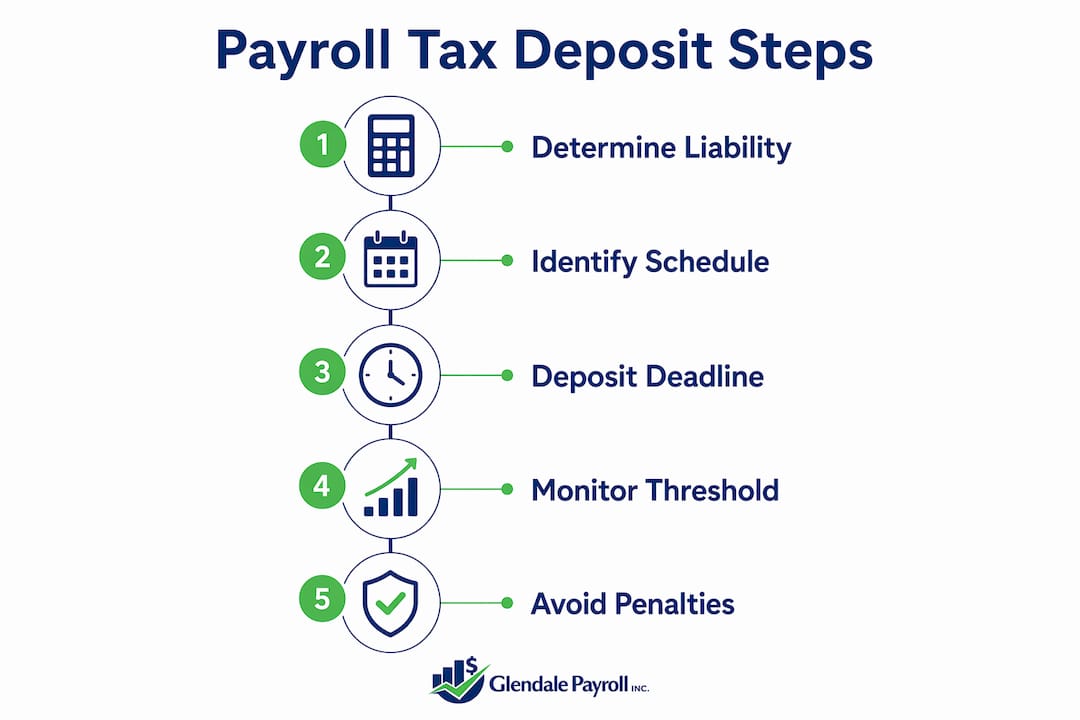
Semiweekly depositor deadlines
Semiweekly depositors follow a two-track deadline system tied to the day of the week wages are paid. The IRS semiweekly rules work as follows:
- Wednesday through Friday paydays: deposit is due by the following Wednesday.
- Saturday through Tuesday paydays: deposit is due by the following Friday.
- Weekend and D.C. legal holidays extend the deadline to the next business day.
- Semiweekly depositors always have at least three business days after the payday to make the deposit.
A practical example: if you pay wages on a thursday, your deposit is due the following wednesday. If you pay on a monday, your deposit is due that same friday.
| Deposit schedule | Payday falls on | Deposit due by |
|---|---|---|
| Monthly | Any day in the month | 15th of the following month |
| Semiweekly | Wednesday, Thursday, or Friday | Following Wednesday |
| Semiweekly | Saturday, Sunday, Monday, or Tuesday | Following Friday |
Pro Tip: Mark every deposit deadline on a shared calendar at the start of each quarter. Semiweekly deadlines shift with your payroll calendar, so a payday that moves by one day can change your deposit due date by an entire week.
What is the $100,000 next-day deposit rule?
The $100,000 next-day deposit rule is the most frequently overlooked provision in the entire deposit system. It applies to both monthly and semiweekly depositors, and it triggers immediately with no grace period.
If your accumulated tax liability reaches $100,000 on any single day, you must deposit the full amount by the next business day. For a monthly depositor, this rule has an additional consequence. Once you hit $100,000 in a single day, you automatically become a semiweekly depositor for the remainder of that calendar year and for the entire following calendar year.
This mid-year reclassification catches many small business owners off guard. A company that has operated as a monthly depositor for years can become a semiweekly depositor overnight simply because of a large bonus payroll or a catch-up payment. The IRS does not send a notice before this happens. You are responsible for recognizing the trigger and adjusting your deposit schedule immediately.
FUTA tax deposits: a separate schedule entirely
Federal Unemployment Tax Act (FUTA) deposits follow a completely different schedule from the FICA and federal income tax deposits covered above. FUTA deposits must not be mixed with income or FICA tax deposits, and the timing rules are distinct.
FUTA liability accumulates quarterly. You are required to deposit when your accumulated FUTA liability exceeds $500 in a quarter. The key deadlines are:
- Q1 (january through march): deposit due april 30
- Q2 (april through june): deposit due july 31
- Q3 (july through september): deposit due october 31
- Q4 (october through december): deposit due january 31 of the following year
If your total FUTA liability for the year is $500 or less, you do not make quarterly deposits. You pay the full amount with your annual Form 940 by january 31. FUTA deposits are also made electronically, just like employment tax deposits, but they are reported on a separate form and tracked on a separate schedule.
Common compliance pitfalls and how to avoid them
The most damaging compliance errors are not caused by ignorance of the rules. They are caused by operational gaps that let deadlines slip through unnoticed.
Mistaking payroll frequency for deposit schedule
IRS deposit schedules are administrative categories that have nothing to do with how often you run payroll. A business running biweekly payroll is not automatically a semiweekly depositor. Confusing these two concepts is the single most common source of missed deposits and resulting penalties.
Relying on third-party payroll providers without monitoring
All federal payroll tax deposits must be made electronically, primarily through the Electronic Federal Tax Payment System (EFTPS). Many business owners assume their payroll provider handles everything. The IRS holds you, the employer, liable for missed deposits even when a third party is responsible. You should log into EFTPS regularly to confirm that deposits are posting correctly.
Letting deposit deadlines fall on holidays without a backup plan
When a deposit deadline falls on a weekend or a federal holiday, the deadline moves to the next business day. This is not automatic relief. You still need to initiate the payment in time for it to process. EFTPS payments initiated after 8:00 PM Eastern time are processed the following business day, which can cause a missed deadline if you wait until the last moment.
Here are the most effective practices for staying compliant:
- Confirm your deposit schedule at the start of each year by reviewing your IRS notice or calculating your lookback period liability from your prior Form 941 filings.
- Set up EFTPS alerts so you receive confirmation every time a deposit posts successfully.
- Monitor for the $100,000 threshold on every payroll run, especially during bonus seasons or large catch-up payments.
- Keep a payroll tax calendar that maps every payday to its corresponding deposit due date for the full year.
- Review your year-end payroll deadlines each december to catch any schedule changes before the new year begins.
Pro Tip: Outsourcing payroll does not transfer your IRS liability. Always verify that deposits are posting in EFTPS, regardless of who initiates them.
Penalties for late deposits start at 2% for amounts 1–5 days late and escalate through multiple tiers up to 15% for deposits more than 10 days late or after the IRS issues a notice. Beyond corporate penalties, the IRS can assess the Trust Fund Recovery Penalty against individual officers or owners, making them personally liable for unpaid payroll taxes.
Key Takeaways
Your deposit schedule is set by your IRS lookback period liability, and missing a single deadline can trigger penalties that escalate automatically with no warning.
| Point | Details |
|---|---|
| Lookback period sets your schedule | The IRS assigns monthly or semiweekly status based on tax liability from the prior 12-month lookback window. |
| Monthly deadline is the 15th | Monthly depositors must pay by the 15th of the following month, or the next business day if it falls on a weekend or holiday. |
| Semiweekly deadlines follow payday | Wed–Fri paydays require a deposit by the next Wednesday; Sat–Tue paydays require a deposit by the next Friday. |
| $100,000 rule triggers immediately | Accumulating $100,000 in liability on a single day requires next-business-day deposit and converts monthly depositors to semiweekly status. |
| FUTA follows a separate quarterly schedule | FUTA deposits are due when quarterly liability exceeds $500, with deadlines on the last day of the month after each quarter ends. |
What I've learned from watching businesses get this wrong
After working with small businesses across Glendale, Burbank, Pasadena, and Greater Los Angeles, the pattern is consistent. Business owners who get hit with deposit penalties almost never misread the rules. They simply did not know the rules existed in the first place.
The most common misconception I see is the belief that running biweekly payroll makes you a semiweekly depositor. It does not. Your payroll frequency and your deposit schedule are completely separate systems. A business with weekly payroll can still be a monthly depositor if its lookback period liability stayed under $50,000.
The second issue is overconfidence in third-party payroll services. Outsourcing payroll is a sound decision for most small businesses, but it does not transfer IRS liability. I have seen business owners receive penalty notices for deposits their payroll provider missed, and the IRS had no interest in who was at fault internally. The employer pays.
The fix is straightforward. Build deposit deadline tracking into your regular payroll workflow. Check EFTPS after every payroll run. Know your lookback period number before january 1 each year. These are not complex tasks. They are habits that prevent expensive surprises.
Glendale Payroll keeps your deposits on schedule
Managing deposit deadlines, tracking lookback periods, and monitoring the $100,000 threshold requires consistent attention throughout the year. Glendale Payroll handles all of it for small businesses across Greater Los Angeles.

Glendale Payroll's dedicated payroll professionals, not call center staff, manage your deposit schedule, file electronically through EFTPS, and flag compliance risks before they become penalties. Every client starts with a free payroll audit to identify gaps in their current process. For California businesses in Glendale, Burbank, and Pasadena, local compliance expertise matters. Visit Glendale Payroll's services page to learn how we protect your business from IRS penalties, or review our California payroll compliance guide for state-specific deposit requirements.
FAQ
What is a payroll tax deposit schedule?
A payroll tax deposit schedule is the IRS rule that determines when employers must deposit withheld federal taxes. The IRS assigns employers to either a monthly or semiweekly schedule based on their lookback period tax liability.
How does the IRS determine my deposit schedule?
The IRS reviews your total reported tax liability during the lookback period, which runs from july 1 of the second preceding year through june 30 of the prior year. Liability of $50,000 or less makes you a monthly depositor; more than $50,000 makes you a semiweekly depositor.
What happens if I miss a payroll tax deposit deadline?
Late deposit penalties start at 2% for deposits 1–5 days late and escalate up to 15% depending on how long the deposit remains unpaid. The IRS can also assess personal liability against business owners through the Trust Fund Recovery Penalty.
Does my payroll frequency affect my deposit schedule?
No. Your payroll frequency, whether weekly, biweekly, or monthly, does not determine your IRS deposit schedule. The schedule is based solely on your lookback period tax liability.
When are FUTA tax deposits due?
FUTA deposits are due on the last day of the month following each quarter when accumulated liability exceeds $500. For example, first-quarter FUTA liability is due by april 30.
Recommended
- Payroll Tips for California Small Businesses | Glendale Payroll Inc.
- Essential Payroll Records to Maintain for Small Businesses | Glendale Payroll Inc.
- Payroll Date Management: A 2026 Guide for Small Businesses | Glendale Payroll Inc.
- Ways to Automate Payroll Processing for Small Businesses | Glendale Payroll Inc.