
Payroll tax planning is defined as the strategic process of organizing business finances to minimize payroll-related tax liabilities while maintaining full compliance with federal, state, and local regulations. For small business owners, this is not optional financial housekeeping. Payroll taxes represent one of the largest recurring costs you face, covering FICA contributions, unemployment taxes, and withholding obligations that add up fast. Effective planning can include reclassifying your entity status and implementing pre-tax benefit plans like Section 125 Cafeteria Plans. Getting this right from the start protects your cash flow and keeps the IRS off your back.
What is payroll tax planning and what taxes does it cover?
Payroll tax planning starts with understanding exactly which taxes you owe and who pays them. Employers pay 6.2% for Social Security up to the annual wage base limit, plus 1.45% for Medicare on all wages. Employees match those rates through withholding. On top of FICA, you also owe Federal Unemployment Tax Act (FUTA) and State Unemployment Tax Act (SUTA) taxes, which fund unemployment insurance programs. These are employer-only obligations. Employees do not share them.

The table below breaks down the core payroll tax types, their rates, and who bears the cost.
| Tax | Rate | Paid By |
|---|---|---|
| Social Security (FICA) | 6.2% employer + 6.2% employee | Both |
| Medicare (FICA) | 1.45% employer + 1.45% employee | Both |
| Additional Medicare Tax | 0.9% on wages over $200,000 | Employee only |
| FUTA | 6.0% on first $7,000 (credit reduces effective rate) | Employer only |
| SUTA | Varies by state and experience rating | Employer only |
Understanding payroll tax implications at this level gives you a clear picture of your actual cost per employee. Most small business owners underestimate total employer costs because they focus only on gross wages. The combined employer-side FICA burden alone adds roughly 7.65% to every dollar of wages paid.
How can small businesses reduce payroll tax liabilities legally?
Reducing your payroll tax burden is legal, practical, and well within IRS guidelines when done correctly. The strategies below are the most effective options available to small business owners in 2026.
-
Elect S-Corp status. Reclassifying as an S-Corp reduces payroll tax exposure because owners pay FICA only on a reasonable salary. Remaining profits pass through as distributions, which are exempt from payroll tax. The IRS scrutinizes S-Corp salaries closely, so the salary you set must reflect what the market pays for your role.
-
Implement a Section 125 Cafeteria Plan. Section 125 Cafeteria Plans allow employees to pay health insurance premiums and dependent care costs with pre-tax dollars. This reduces taxable wages, which directly lowers the payroll tax base for both you and your employees.
-
Set up an Accountable Plan. An Accountable Plan converts employee reimbursements for business expenses into non-taxable payments. Without this plan, stipends for home office use or tools count as taxable wages. With it, those same payments are excluded from payroll tax calculations entirely.
-
Offer tax-advantaged benefits. HSAs, FSAs, and retirement plans lower taxable income for both employer and employee. These benefits reduce the wage base on which payroll taxes are calculated, creating savings on both sides of the ledger.
-
Apply the R&D tax credit against payroll taxes. Qualified small business startups with less than $5 million in gross receipts can apply up to $500,000 of the R&D tax credit under Internal Revenue Code Section 41 against the employer portion of Social Security taxes. This is one of the most underused payroll tax reduction tools available to early-stage companies.
Pro Tip: Many business owners overlook tax-free fringe benefits as a compensation method. Benefits like employer-paid transit passes, on-site meals, and educational assistance reduce your payroll tax base without increasing cash wages.
What are key compliance practices in payroll tax management?
Effective payroll tax management requires more than good strategy. Compliance is the foundation everything else rests on. One filing error or misclassification can trigger penalties that wipe out months of careful planning.
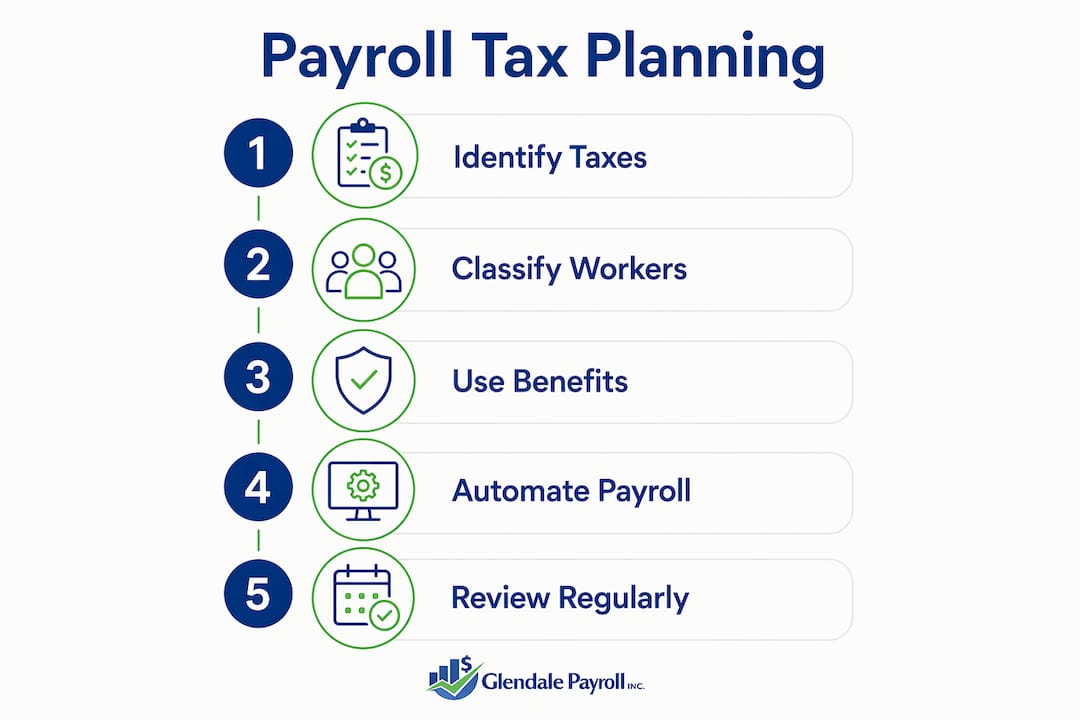
Worker classification is the most common compliance failure. Misclassifying employees as independent contractors to avoid payroll taxes can trigger back taxes, penalties, and IRS audits. The IRS uses behavioral, financial, and relationship factors to determine worker status. If your "1099 contractor" works set hours, uses your equipment, and works exclusively for you, the IRS will likely reclassify that person as a W-2 employee. California's ABC test applies an even stricter standard for state purposes. You can review the employee vs. contractor rules that apply in California before making any classification decisions.
Deposit schedules and record keeping are equally non-negotiable. Employers must deposit payroll taxes on the correct schedule and file required forms accurately to avoid penalties. The IRS assigns you either a monthly or semi-weekly deposit schedule based on your lookback period. Missing a deposit date, even by one day, triggers a penalty that starts at 2% and scales up to 15% depending on how late the deposit is.
Key compliance practices every small business owner should follow:
- Classify all workers correctly before the first paycheck is issued.
- Deposit payroll taxes on your assigned IRS schedule without exception.
- File Form 941 quarterly and reconcile it against your deposit records.
- Issue W-2 forms to employees and 1099-NEC forms to qualifying contractors by january 31 each year.
- Keep payroll records for at least four years, including tax forms, deposit confirmations, and wage calculations.
- Maintain a separate bank account for payroll tax withholdings so those funds are never mixed with operating cash.
That last point deserves emphasis. Treating withheld payroll taxes as available cash flow is one of the most common causes of IRS penalties for small businesses. Those funds belong to the government the moment you withhold them.
What tools and resources support payroll tax planning?
The right tools reduce errors and keep your filings on track. Small business owners have several practical options, from IRS forms to professional services.
Key IRS forms you need to know:
- Form 941: Quarterly employer tax return reporting wages, tips, and payroll taxes withheld.
- Form W-2: Annual wage and tax statement issued to each employee.
- Form 6765: Used to calculate the R&D tax credit.
- Form 8974: Used to apply the R&D credit against employer payroll taxes.
Payroll automation reduces the risk of manual errors in tax calculations, deposit scheduling, and form preparation. Payroll automation saves small businesses time and reduces the likelihood of costly filing mistakes. Automated systems calculate withholding in real time, flag deposit deadlines, and generate year-end forms without manual data entry.
Professional payroll services go further than software alone. A dedicated payroll professional reviews your setup, catches classification issues before they become audits, and stays current on state-level changes. For California employers, this matters especially. California has its own SDI (State Disability Insurance) withholding requirements, UI Tax Rate Schedules, and EDD reporting obligations that differ from federal rules. Staying current on 2026 California payroll tax updates is a practical necessity, not a bonus.
Minor errors in payroll tax calculations or filings can lead to costly IRS penalties, which is why periodic professional reviews and audits add measurable value. A free payroll audit from a qualified firm can surface risks you did not know existed.
Key Takeaways
Payroll tax planning requires accurate worker classification, proactive use of pre-tax benefits, and strict deposit compliance to reduce costs and avoid IRS penalties.
| Point | Details |
|---|---|
| Know your tax rates | Employers owe 6.2% Social Security, 1.45% Medicare, plus FUTA and SUTA on top of wages. |
| Use pre-tax benefits | Section 125 Cafeteria Plans and HSAs reduce the taxable wage base for both employer and employee. |
| Consider S-Corp election | S-Corp status limits FICA to a reasonable salary, but the IRS will audit salaries set too low. |
| Classify workers correctly | Misclassifying employees as contractors triggers back taxes, penalties, and audits. |
| Separate payroll tax funds | Keep withheld taxes in a dedicated account to avoid IRS penalties and cash flow problems. |
The payroll tax mistakes I see most often
After working with small businesses across Glendale, Burbank, Pasadena, and Greater Los Angeles, the pattern is consistent. Business owners who struggle with payroll taxes are not cutting corners intentionally. They simply start running payroll before they understand the full cost structure, and they never go back to fix the foundation.
The S-Corp election is the most misunderstood strategy I encounter. Owners elect S-Corp status, set a low salary to minimize FICA, and assume the IRS will not notice. The IRS notices. Auditors compare your salary to industry benchmarks, and if yours falls short, they reclassify distributions as wages and assess back taxes plus penalties. The strategy works, but only when the salary is genuinely defensible.
The second mistake is treating fringe benefits as an afterthought. A well-structured Section 125 Cafeteria Plan, combined with HSA contributions and an Accountable Plan, can reduce your payroll tax base meaningfully without cutting employee compensation. Most business owners I speak with have never implemented any of these, even though the setup cost is modest compared to the annual savings.
My honest recommendation: plan your payroll tax structure before you hire your first employee, not after you receive your first IRS notice. Retroactive fixes are expensive. Proactive planning is not.
— Glendale Payroll Staff
How Glendale Payroll supports your tax planning needs
Glendale Payroll works with small business owners across Greater Los Angeles to build payroll processes that hold up under IRS scrutiny. The team consists of dedicated payroll professionals, not call center staff, so you get expert guidance on classification, deposit schedules, and California-specific requirements like SDI and EDD reporting.

Every new client starts with a free comprehensive payroll audit to identify existing risks before they become penalties. From there, Glendale Payroll handles federal and state filings, deposit scheduling, and year-end form preparation. If you want practical payroll tips for California or need a full-service compliance partner, Glendale Payroll is built for exactly that. You can also review the full range of payroll compliance services to find the right fit for your business.
FAQ
What is payroll tax planning in simple terms?
Payroll tax planning is the process of legally organizing your business finances to reduce the payroll taxes you owe while staying fully compliant with IRS, state, and local rules. It includes strategies like S-Corp elections, pre-tax benefit plans, and proper worker classification.
What payroll taxes does an employer pay?
Employers pay 6.2% for Social Security, 1.45% for Medicare, and FUTA at 6.0% on the first $7,000 of each employee's wages, plus state unemployment taxes at rates that vary by state and experience rating.
How does an S-Corp election reduce payroll taxes?
An S-Corp election limits FICA taxes to the owner's reasonable salary. Profits above that salary pass through as distributions, which are not subject to payroll tax. The IRS audits S-Corp salaries to confirm they reflect fair market compensation.
What happens if I misclassify an employee as a contractor?
Misclassifying an employee as an independent contractor can trigger back taxes, IRS penalties, and a formal audit. California applies the ABC test, which makes it harder to classify workers as contractors than federal standards alone.
Can a startup use the R&D tax credit to offset payroll taxes?
Yes. Qualified small business startups with less than $5 million in gross receipts can apply up to $500,000 of the R&D tax credit under IRC Section 41 against the employer portion of Social Security taxes, providing a direct reduction in payroll tax owed.