
Verify every employee's name and Social Security number, reconcile your payroll totals against your quarterly filings, run your final payroll of the year, then prepare and distribute W-2s and 1099s before you file with the agencies. That sequence is the entire job, condensed into one sentence. The details are where employers get into trouble.
The deadline that matters most is January 31: employers must furnish W-2s to employees and file W-2s and 1099-NEC forms with the Social Security Administration and IRS by that date, for both recipient copies and agency copies. When January 31 lands on a weekend or federal holiday, the deadline rolls to the next business day, but don't count on that grace period unless you've confirmed the calendar for the specific year.
Here's the printable version to tape to your monitor:
- Confirm employee names, SSNs, and addresses against Social Security records.
- Reconcile YTD payroll totals to your four quarters of Form 941.
- Run your final payroll and lock year-to-date figures.
- Prepare, distribute, and file W-2s, W-3, and 1099-NEC by January 31.
- Update tax tables and wage bases for the new year before your first January payroll.
Pro Tip: Your payroll software calculates based on the data you enter. It doesn't audit whether an employee's SSN matches Social Security's records or whether that contractor should really be a W-2 employee. That verification is on you.
Key Takeaways
Year-end payroll accuracy depends on verifying employee data, reconciling every quarter against your annual totals, and filing W-2s and 1099-NEC by January 31 without exception.
| Point | Details |
|---|---|
| January 31 is the anchor deadline | W-2s and 1099-NEC must be furnished to recipients and filed with agencies by this date, or the next business day if it falls on a weekend. |
| Classification checks come first | Employers, not payroll providers, are responsible for correctly classifying workers and verifying SSNs. |
| Reconcile before you file | Match your payroll register to your W-3 and to the sum of all four quarterly Form 941 filings. |
| Watch the 1099-MISC threshold | Payments made in 2026 raise the 1099-MISC reporting threshold to $2,000, changing which vendors need a form. |
| Get a second set of eyes | Glendale Payroll offers a free payroll audit to catch classification errors, missing fringe benefits, and reconciliation gaps before filing. |
This article is general information, not a substitute for advice from a qualified financial advisor. Consult a qualified financial professional about your own circumstances before acting on anything here.
Table of Contents
- Before Your Last Payroll: Verification and Setup Tasks
- How to Run the Final Payroll of the Year
- Reconciling Payroll Before the First Payroll of the New Year
- Which Year-End Forms Do You File, and When?
- How Do You Reconcile Payroll and Prepare for an Audit?
- How Long Should You Keep Payroll Records?
- What Are the Most Common Year-End Payroll Mistakes?
- Why Employers Still Own Year-End Accuracy
- Let Glendale Payroll Handle Your Year-End Filing
- Sources
Before Your Last Payroll: Verification and Setup Tasks
Everything on this list works better in October than in late December, because most of it depends on someone else responding. Employees need to confirm their addresses. Contractors need to send you a completed W-9. Banks need lead time to process bonus runs. Start here.

Run these reports before you touch the final payroll
| Report | What it catches |
|---|---|
| Employee detail report | Name/SSN mismatches, missing addresses, incomplete W-4 data |
| Payroll summary | Year-to-date wage totals by employee and department |
| Tax liability report | Federal, state, and local tax deposits owed vs. paid |
| Contractor payment report | Contractors approaching or exceeding 1099 thresholds |
Verify employee and contractor data
| Field | Why it matters |
|---|---|
| Legal name and SSN | Mismatches trigger IRS notices and delay processing |
| Mailing address | Required for W-2/1099 furnishing, even if delivered electronically |
| W-4 and state withholding forms | Confirms current-year elections are still accurate |
| Signed W-9 (contractors) | Required before you can issue a 1099-NEC |
Worker classification deserves its own line item, not an afterthought. The IRS holds employers responsible for correctly classifying workers as employees or independent contractors, and misclassification penalties compound quickly once multiple tax years are involved. If someone has been treated as a 1099 contractor all year, but controls, schedule, and tools suggest otherwise, document your reasoning now. Glendale Payroll's guide on employee classification types walks through the factors the IRS actually weighs.
Fringe benefits and taxable items to catch before year-end
| Item | Action needed |
|---|---|
| Gift cards, prizes, and awards | Must be added to taxable wages, not excluded as gifts |
| Personal use of company vehicle | Calculate and include the taxable value in Box 1 |
| S-corp owner health premiums | Must be reported in shareholder-employee wages |
| Employer-paid life insurance over $50,000 | Excess coverage value is taxable income |
Bank cutoffs for bonus runs
| Task | Timing consideration |
|---|---|
| Bonus payroll approval | Submit at least one full processing cycle before the pay date |
| ACH funding confirmation | Verify your bank's cutoff time for same-day vs. next-day ACH |
| Off-cycle run scheduling | Coordinate with your payroll provider to avoid conflicting with the regular run |
Once your reports are clean, your data is verified, and your bonus timing is locked, you're ready for the final run.
Pro Tip: Anything requiring a third-party response, a signed W-9, an address confirmation, an EIN verification, moves at other people's pace, not yours. Start those requests in October and you'll spend December fixing exceptions instead of chasing signatures.
How to Run the Final Payroll of the Year
Bonuses and off-cycle adjustments tied to the current tax year should run on a separate payroll before your final regular run, not folded into it. Mixing them makes it harder to isolate errors and complicates any correction you might need later.
Follow this sequence for the last payroll:
- Post any final fringe benefit adjustments (vehicle use, gift cards, imputed income).
- Confirm pre-tax deduction totals haven't exceeded annual limits, especially for FSAs and commuter benefits.
- Apply the final employer retirement match calculation for the year.
- Lock the pay period once all adjustments are entered.
- Process the run and generate the payroll register.
Confirm your bank's ACH cutoff before you submit. A run that misses same-day ACH funding by even an hour can push a deposit into January, which creates a mismatch between when wages were earned and when they were reported. Glendale Payroll's guide to payroll date management breaks down how funding cutoffs interact with pay period timing.
- Confirm the payroll register total matches your expected year-to-date figure before finalizing.
- Run a year-end preview in your payroll software in early December, not the week of your last check.
- Flag any employee whose year-to-date totals look off compared to their regular pay pattern.
Pro Tip: A December preview run costs you fifteen minutes. A January correction costs you a W-2c, an amended 941, and a much longer phone call with an unhappy employee.
Reconciling Payroll Before the First Payroll of the New Year
The gap between your last payroll of the year and your first payroll of the new one is where reconciliation happens, and it's the single most-skipped phase in year-end processing. Skipping it here means discovering the error in April, attached to a penalty notice.
Run these comparisons before you file anything:
- Compare payroll register totals to your Q4 Form 941 figures for wages, Social Security wages, and Medicare wages.
- Add all four quarters of Form 941 and confirm the sum matches your W-3 total.
- Verify EFTPS deposit records against your tax liability report for federal deposits.
- Cross-check state withholding deposits against your state agency portal.
- Confirm annual FUTA calculations reconcile against Form 940 before filing.
If you find a gap, don't wait to sort it out. A missing deposit or an underreported wage figure needs correction before you submit your annual returns, not after.
Once reconciliation is clean, turn to system setup for January:
- Update federal and state withholding tables for the new tax year using the latest IRS inflation adjustments.
- Update the Social Security wage base in your system using current SSA figures.
- Adjust for any state minimum wage increases affecting hourly employees.
- Confirm California's EDD year-end notification requirements are met, including any required employee notices.
- Update your payroll calendar for the new year's pay dates and processing deadlines.
- Confirm new benefit contribution limits (401(k), HSA, FSA) are loaded correctly.
If an error surfaces after filing, document it immediately. A wage correction typically means filing Form W-2c alongside an amended 941x, and both need to reference the original filing accurately.
Pro Tip: Reconciling quarterly, not just at year-end, catches small discrepancies while they're still small. An employer who checks payroll against bank statements every quarter rarely faces a January surprise.
Which Year-End Forms Do You File, and When?
Different forms go to different recipients on different timelines, and mixing them up is one of the easier mistakes to make under deadline pressure.
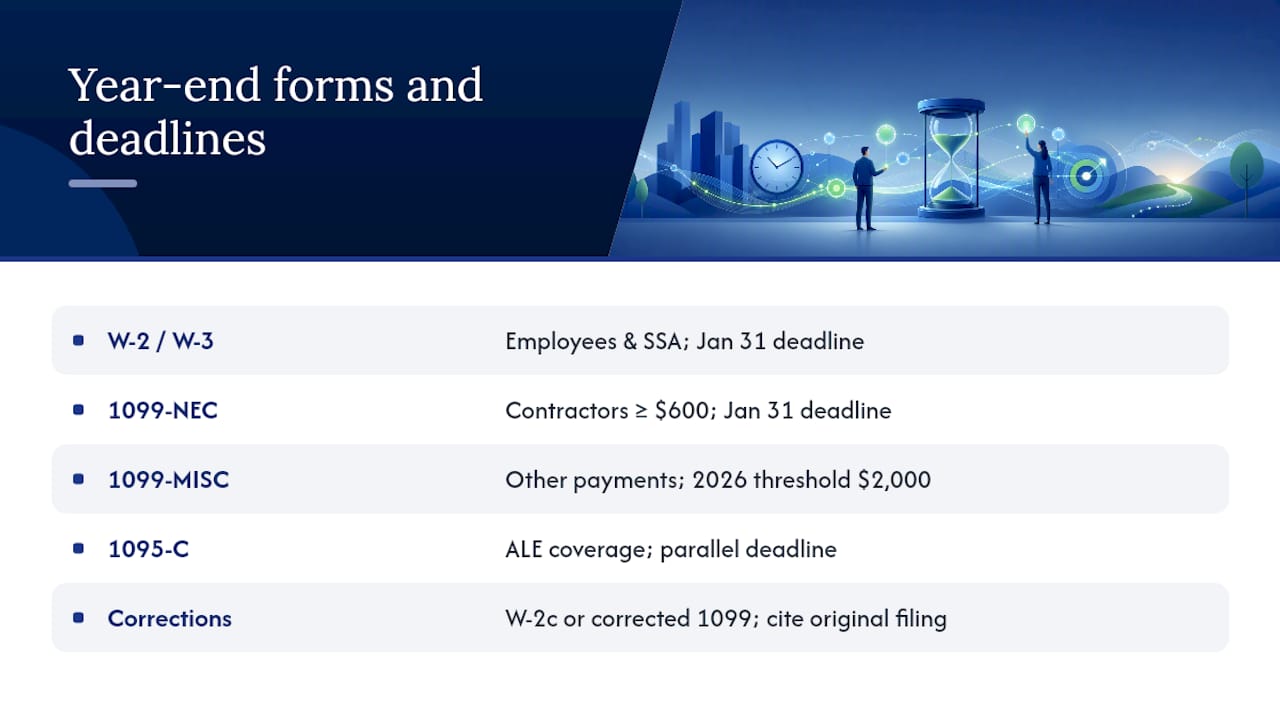
W-2 and W-3 forms go to employees and the Social Security Administration, covering all wages, tips, and withholding for the year. Form 1099-NEC covers contractors paid $600 or more for services. Both W-2s and 1099-NEC forms share the same January 31 deadline for furnishing to recipients and filing with the agency, with no split date and no automatic extension between the two copies.
Form 1099-MISC covers other payments, like rents or attorney settlements, and the reporting threshold for payments made in 2026 increases to $2,000, up from the prior threshold. That change means some vendors who required a 1099-MISC last year may fall under the new threshold this year, so recheck your vendor payment totals before assuming last year's list still applies.
You can furnish W-2s electronically if the employee has affirmatively consented to electronic delivery; otherwise, paper copies must go out by mail. If your business offers health coverage as an Applicable Large Employer, Form 1095-C reporting carries its own furnishing deadline that runs parallel to this list, so don't let it slip through because it's not on the W-2/1099 radar.
Corrections happen. A wrong wage amount on a filed W-2 means filing a W-2c; an error on a 1099 means filing a corrected 1099 with the box marked "corrected." Both corrections should reference the original filing so the agency can match them. For contractors, a service like Tax Form Hero can handle e-filing corrections if you're managing forms outside a full-service payroll provider.
A significant portion of small businesses report struggling to keep up with changing federal filing thresholds year over year, according to the same guidance the IRS issued on the 2026 threshold changes, which is exactly why the $2,000 1099-MISC shift matters more than it looks at first glance.
How Do You Reconcile Payroll and Prepare for an Audit?
Reconciliation isn't a single step, it's a chain: payroll register to W-3, W-3 to the sum of four quarterly 941s, and each 941 broken out box by box against wages, Social Security wages, Medicare wages, and federal income tax withheld.
- Total your payroll register for the full year by employee.
- Confirm that total matches Box 1 wages on your W-3.
- Add Form 941 wage figures from all four quarters and compare the sum to your W-3.
- Check Social Security and Medicare wage boxes separately, since pre-tax deductions can create legitimate differences from Box 1.
- Investigate any variance immediately rather than assuming it will resolve itself.
Watch for these recurring triggers:
- Mismatched employee SSNs between payroll records and Social Security's database.
- Wages reported above or below the correct Social Security wage base.
- Fringe benefits left out of taxable wages entirely.
- A missed or late deposit period that doesn't show up until reconciliation.
Keep an audit-ready file: payroll registers, bank deposit confirmations, journal entries, signed wage authorizations, and every W-4 and W-9 on hand.
Payroll platforms calculate based on the data you supply. They do not independently verify that a Social Security number is correct or that a fringe benefit was properly taxed. That verification step belongs to the employer, every year, regardless of who processes the payroll.
— Glendale Payroll Staff
How Long Should You Keep Payroll Records?
Different records carry different retention clocks, and guessing wrong in either direction wastes storage or, worse, leaves you without proof when an agency asks.
- Keep W-2s, 1099s, and payroll registers for at least four years from the filing date.
- Retain employment tax returns (941, 940) for a minimum of four years.
- Hold W-4s and I-9s for as long as employment continues, plus several years after separation.
- Store bank reconciliations and third-party benefit statements alongside the payroll year they cover.
- Keep signed W-9s on file for the duration of the contractor relationship plus the retention window above.
Store both digital and physical backups. An agency notice rarely arrives with much lead time, and being able to pull the right file in minutes rather than days changes how that conversation goes.
What Are the Most Common Year-End Payroll Mistakes?
Most year-end penalties trace back to the same handful of errors, repeated by different employers every year:
- Issuing W-2s or 1099-NEC forms late or with incorrect data.
- Failing to collect a signed W-9 before paying a contractor.
- Leaving taxable fringe benefits out of reported wages.
- Misclassifying an employee as a contractor without documented reasoning.
- Filing quarterly 941s that don't reconcile to the final W-3.
Print this five-line version and hand it to whoever touches payroll in your office. It won't replace the full checklist above, but it catches the mistakes that cause the most damage.
Pro Tip: Set two internal checkpoints, one in mid-October and one in mid-November, specifically to review this list. Waiting until December to notice a missing W-9 turns a five-minute email into a scramble against a January 31 deadline.
Why Employers Still Own Year-End Accuracy
A payroll provider processes what you give it. It doesn't know that a contractor's role quietly shifted into employee territory, or that a bonus check missed a taxable fringe benefit. That verification work sits with the employer, and no service fully removes it.
Glendale Payroll's approach starts with a free payroll audit precisely because most compliance gaps hide in data nobody double-checked. If you want a second set of eyes before you file, that's the conversation worth having now.
— Glendale Payroll Staff
Let Glendale Payroll Handle Your Year-End Filing
Running this checklist alone, on top of everything else December demands, is where most small businesses lose an afternoon they didn't have. Glendale Payroll handles the parts that carry the most risk: W-2 preparation and distribution, federal and California state filing, quarterly-to-annual reconciliation, and the compliance audit that catches misclassified workers or unreported fringe benefits before the IRS does.
What separates Glendale Payroll from a generic filing service is who answers when you call. You get a dedicated payroll professional who knows your account, not a rotating call center queue reading from a script. For California employers specifically, that matters, given how often state withholding rules and EDD notification requirements shift year to year.
If you want that free audit before you file, visit Glendale Payroll's California compliance guide to see what it covers, or browse payroll tips for California small businesses for guidance specific to your situation. Glendale Payroll serves employers throughout Glendale, Burbank, Pasadena, and Greater Los Angeles. Request your audit before your next payroll run, not after a notice arrives.