
Yes, California allows piece-rate pay, but employers must separately compensate and itemize rest and recovery periods and other nonproductive time under Labor Code §226.2. You can simplify that duty by adopting a hybrid hourly-plus-piece model that pays at least the applicable minimum wage for all hours worked, which qualifies for the statute's safe harbor and eases wage-statement itemization.
TL;DR:
- Paying nonproductive time at least the higher of the applicable minimum wage or the employee's average rate is required for all piece-rate workers, including rest and recovery periods.
- Employers using a hybrid hourly-plus-piece model that pays at least the local minimum wage can simplify wage-statement itemization and qualify for the safe harbor under §226.2.
- Accurate measurement or reasonable estimation of nonproductive time is critical, with the burden on tracking or consistently estimating waiting, setup, meetings, and travel time.
- Overtime must be calculated based on the total weekly earnings divided by total hours worked, not just productive hours, and added on top of rest and nonproductive pay.
- Proper documentation, including detailed wage statements and retention of time and production records, helps avoid costly errors and penalties during audits or claims.
Table of Contents
- What California Labor Code §226.2 Requires for Piece-Rate Pay
- How to Calculate Piece-Rate Pay: Average Hourly Rate, Rest Periods, and Overtime
- Pay Stub Requirements and Recordkeeping for Piece-Rate Employees
- Hybrid Safe Harbor vs. Pure Piece-Rate: Which Model Fits Your Business
- Compliance Checklist: Avoiding the Most Common Piece-Rate Mistakes
- How Glendale Payroll Handles Piece-Rate Compliance for You
- Who Counts as a Piece-Rate Worker in California
- Industries Where Piece-Rate Pay Is Most Common in California
- Next Steps: Getting Your Piece-Rate Payroll Audit-Ready
- Primary Sources for California Piece-Rate Compliance
- Sources
What California Labor Code §226.2 Requires for Piece-Rate Pay
Piece-rate pay has been legal in California for decades, but AB 1513 changed the compliance math in 2016 by writing specific protections for piece-rate workers directly into Labor Code §226.2. The statute exists because piece-rate formulas, by design, don't account for time spent not producing. A garment worker waiting for fabric, a landscaper driving between job sites, a technician sitting through a mandatory safety meeting: none of that generates piece units, yet all of it is compensable time under California law.
The core requirement is straightforward to state and harder to execute. You must pay piece-rate employees separately for:
- Rest and recovery periods, at whichever is higher: the applicable minimum wage or an average hourly rate you calculate for that workweek.
- Other nonproductive time, at no less than the applicable minimum wage.
"Applicable minimum wage" is not a single number. It means the highest wage floor that applies to that employee, factoring in state minimum wage, any local municipal minimum wage ordinance, and industry-specific wage orders. An employer in Los Angeles with a citywide minimum wage above the state rate must use the local figure when it exceeds the state minimum, not the other way around. Get this wrong and every downstream rest-period calculation is wrong too.
Measuring nonproductive time is where most employers stumble. The DIR's AB 1513 guidance allows two approaches: track actual nonproductive minutes through timekeeping records, or use a reasonable estimate based on the nature of the work, applied consistently across similar employees or roles. A reasonable estimate isn't a guess pulled from thin air. It has to reflect real observation of how the work actually flows: how long equipment setup takes, how often a crew waits on materials, how much travel time separates job sites.
HR practice guidance from HRCalifornia notes that nonproductive time is broader than most employers assume. It can include waiting for work assignments, equipment inspections, staff meetings, cleaning duties, and travel between job locations. If your piece-rate workers do any of these things and you're not tracking or estimating that time separately, you likely have exposure right now.
The penalty structure gives you room to correct mistakes made in good faith. Under §226.2, if you make a good-faith error in estimating nonproductive time but still provide the wage-statement information required and pay the compensation owed, you're shielded from certain statutory civil penalties tied to that error. That protection disappears the moment the error looks willful or the correction never happens. Speed matters here: catching a miscalculation and fixing it before an employee files a claim or the DIR opens an inquiry is the difference between a payroll adjustment and a liability event.
None of this is optional guidance you can implement loosely and hope holds up. The wage-statement itemization tied to these requirements is a separate legal obligation from the underlying pay calculation, meaning you can owe money correctly and still face penalties for how you documented it.
How to Calculate Piece-Rate Pay: Average Hourly Rate, Rest Periods, and Overtime
The math behind piece-rate compliance isn't complicated once you see it worked through, but it does require discipline about what counts and what doesn't.
The average hourly rate formula divides total compensation earned in the workweek (excluding rest and recovery pay itself, and excluding any overtime premium) by the total hours worked in that workweek (excluding rest and recovery period time). This average hourly rate is then compared against the applicable minimum wage, and whichever figure is higher becomes the rate you must pay for every rest and recovery period that week, according to DIR's AB 1513 FAQs.
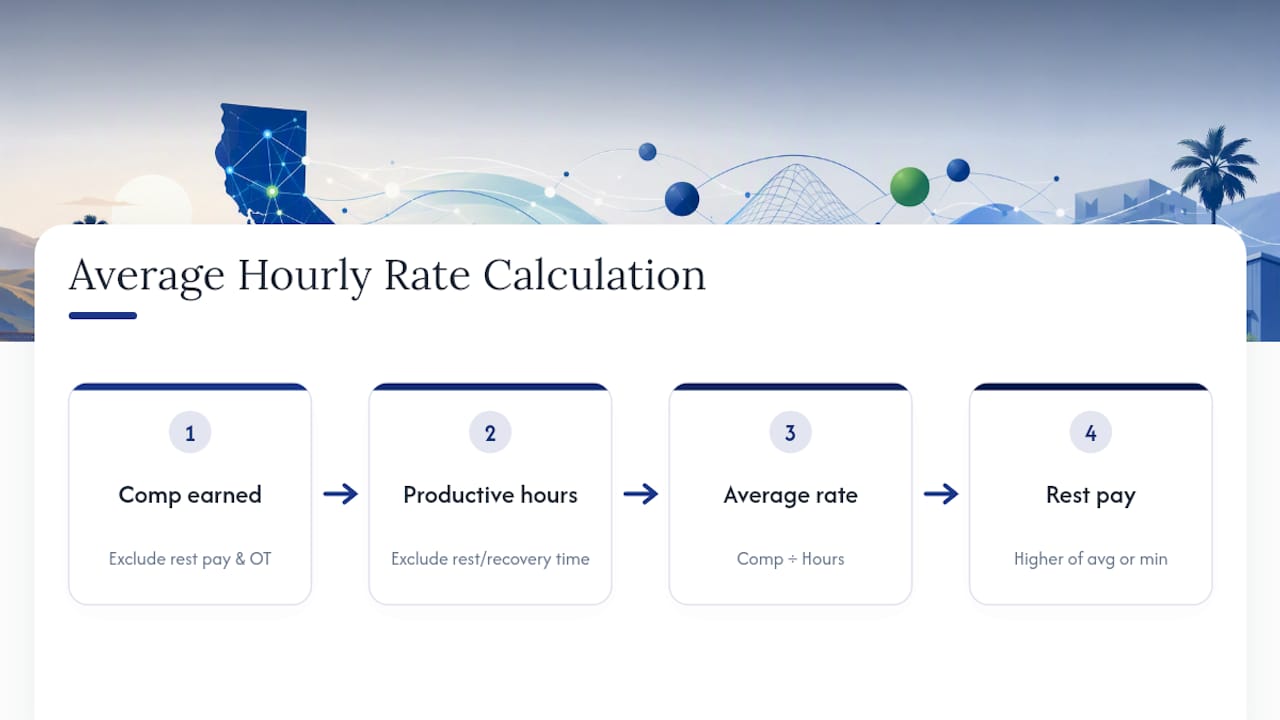
That exclusion rule trips people up constantly. You cannot pad the average hourly rate by including the rest-period pay you're trying to calculate, and you cannot let overtime premiums inflate the base number. The formula only looks at straight piece-rate and hourly earnings against the hours actually spent producing.
Worked Example 1: Pure Piece-Rate Employee, Slow Production Week
Imagine a seamstress paid strictly by the piece who earned $410 in piece-rate wages across a 38-hour workweek, of which 2 hours were rest periods. Her productive hours worked were 36 (38 total minus the 2 rest hours).
Average hourly rate = $410 ÷ 36 hours = $11.39/hour.
If the applicable minimum wage that week is $16.50, the employer must pay the higher figure for those 2 rest hours: $16.50/hour, not the $11.39 average. Total rest and recovery pay owed: $33.00. That amount must appear as a separate line on her wage statement, itemized by hours, rate, and gross wages, distinct from her piece-rate earnings.
Worked Example 2: Hybrid Safe-Harbor Model
Now consider a warehouse picker paid $18/hour for all hours worked, plus a per-unit bonus for units picked above a baseline threshold. In a 40-hour week, she earns her $720 base hourly pay plus a $95 productivity bonus for exceeding quota.
Because her hourly rate ($18) already meets or exceeds the applicable minimum wage for every hour she worked, including rest breaks and any nonproductive time, this plan satisfies the §226.2(a)(7) safe harbor. There's no separate rest-period calculation required, because rest time is already paid at $18/hour as part of her regular hourly wage. Her wage statement doesn't need the separate nonproductive-time itemization that a pure piece-rate employee's statement requires.
| Scenario | Pay Structure | Rest/Recovery Treatment | Wage-Statement Itemization |
|---|---|---|---|
| Pure piece-rate | Paid per unit only | Separate calculation: higher of avg. hourly rate or min. wage | Full itemization required (units, rate, hours, rate, gross wages) |
| Hybrid safe harbor | Hourly (at/above min. wage) + piece bonus | Already covered by hourly base pay | Simplified; nonproductive-time itemization not required |
Overtime for piece-rate workers follows its own logic. Their regular rate of pay for overtime purposes is calculated by dividing total piece-rate earnings for the week by total hours worked (not just productive hours), then paying 1.5 times that regular rate for hours over 8 in a day or 40 in a week. Rest and recovery pay and any nonproductive-time pay are added on top of, not blended into, that overtime calculation.
The gap between these two examples illustrates exactly why the Ninth Circuit's ruling in Williams v. J.B. Hunt matters so much to California employers weighing which model to run.
Pay Stub Requirements and Recordkeeping for Piece-Rate Employees
Getting the math right means nothing if your wage statements don't reflect it. California pay-stub rules for piece-rate employees are more detailed than standard hourly pay stubs, and the itemization requirement carries its own independent liability.
Here's exactly what a compliant piece-rate wage statement must show, unless you qualify for the hybrid safe harbor:
- Total piece units earned during the pay period and the applicable piece rate for each unit type.
- Total hours of compensable rest and recovery periods, the rate of pay applied to those hours, and the gross wages paid for that time.
- Total hours of other nonproductive time, the rate of pay applied (no less than applicable minimum wage), and the gross wages paid.
- All other standard wage-statement items required under Labor Code §226, including regular hourly rate, overtime hours and rate, and applicable deductions.
If your pay structure meets the §226.2(a)(7) safe harbor because you pay at least the applicable minimum wage for all hours worked, items 2 and 3 collapse into your standard hourly line items, according to HRCalifornia's guidance on piece-rate pay.
Pro Tip: If you run semi-monthly payroll, don't assume you can true up rest-period pay whenever it's convenient. The workweek, not the pay period, is the unit that governs the average hourly rate calculation. When a workweek splits across two pay periods, you need to compute the average based on that full workweek and correct any shortfall by the next regular payday.
Retention matters as much as calculation. Keep timecards or production logs showing actual hours worked, piece counts by unit and date, written nonproductive-time estimates and the methodology behind them, your written piece-rate compensation policy, and any signed employee acknowledgments of that policy. California generally expects payroll records to be retained for at least three years, and a DLSE inquiry or wage claim can reach back further than most employers expect, so err toward keeping records longer rather than shorter.
If your payroll system still calculates piece-rate pay in a spreadsheet separate from your timekeeping software, you're accumulating risk with every pay cycle. Systems that automatically pull piece counts, tag rest and recovery time, and populate the required wage-statement fields eliminate the manual transcription errors that show up first in a DLSE audit.
Hybrid Safe Harbor vs. Pure Piece-Rate: Which Model Fits Your Business
The §226.2(a)(7) safe harbor rewards a specific structural choice: paying an hourly rate at or above the applicable minimum wage for every hour an employee works, then layering piece-rate or activity-based incentives on top. Meet that threshold and your itemization burden drops immediately, because rest, recovery, and nonproductive time are already covered by the hourly floor.
Fail to meet it, and you're running the full pure piece-rate compliance regime: separate average hourly rate calculations every workweek, separate nonproductive-time estimates, and full itemization on every wage statement.
Reasons to move toward the hybrid model:
- Wage statements get simpler, with fewer required line items and less room for itemization errors.
- Litigation exposure drops meaningfully, since the Ninth Circuit's Williams v. J.B. Hunt ruling reinforced that a properly structured hybrid plan satisfies the safe harbor.
- Payroll math becomes far less workweek-dependent, since you're not recalculating an average hourly rate every pay period.
- Employees get pay certainty on their hourly floor while still chasing production bonuses, which tends to reduce wage-dispute friction.
Reasons some employers keep a pure piece-rate structure:
- Production incentives stay sharper when pay is tied entirely to output, particularly in industries where nonproductive time is minimal and easy to measure.
- Some employers with mature, well-documented estimation methodologies already have low audit risk and see limited upside in restructuring.
The decision usually comes down to four questions. How much nonproductive time does your workforce actually generate, and how variable is it week to week? Can your payroll system handle the workweek-based average hourly rate calculation without manual intervention? How likely is your industry to draw a DLSE audit or a wage-and-hour class claim? And are you prepared to communicate a pay-structure change to a workforce that may be used to pure piece-rate incentives? Answer those honestly and the right model usually becomes obvious.
Compliance Checklist: Avoiding the Most Common Piece-Rate Mistakes
Most piece-rate wage claims trace back to a small handful of repeated errors, and nearly all of them are preventable with a payroll process that catches problems before the pay stub goes out.
The mistakes that show up again and again:
- Folding rest-break pay into an inflated piece rate instead of itemizing it separately. DIR treats this as a distinct compensable category, not something you can average away.
- Wage statements that omit required fields, even when the underlying pay calculation is correct.
- Nonproductive time that never gets identified or paid, particularly travel time, equipment setup, and mandatory meetings.
- Overtime calculated on the piece rate alone rather than the full regular rate including all hours worked.
What auditors and plaintiffs' attorneys look for first: inconsistent wage-statement formatting from one pay period to the next, missing itemization fields, gaps between timecard records and reported hours, and any employee complaint history involving pay discrepancies. A single inconsistent pay stub rarely triggers an audit on its own, but a pattern of them is exactly what a DLSE investigator or class-action attorney is trained to spot.
If you find a problem, the sequence matters. Run a full payroll audit covering the affected period, compute the retroactive pay owed using the correct average hourly rate or minimum wage floor, reissue corrected wage statements where required, and update your written piece-rate policy so the same error doesn't repeat next quarter.
Before your next payroll run, work through this shortlist:
- Confirm every piece-rate employee's wage statement itemizes rest/recovery hours, rate, and gross wages separately from piece earnings.
- Verify your average hourly rate calculation excludes rest/recovery pay and overtime premiums.
- Confirm nonproductive time is being tracked or reasonably estimated, not ignored.
- Check that your applicable minimum wage figure reflects the correct local ordinance, not just the state rate.
- Review whether a hybrid hourly-plus-piece structure would reduce your itemization burden and legal exposure.
How Glendale Payroll Handles Piece-Rate Compliance for You
Piece-rate math isn't the kind of thing you want to be reverse-engineering during a DLSE inquiry. Glendale Payroll builds compliant piece-rate processing directly into ongoing payroll service, so the calculations, itemization, and documentation are handled correctly the first time, every pay period.
That work includes:
- Payroll processing that computes average hourly rates, rest and recovery pay, and nonproductive-time compensation automatically from your piece-count and timekeeping data.
- Compliant wage-statement generation that itemizes every required field for piece-rate employees, or simplifies correctly when your structure qualifies for the §226.2 safe harbor.
- A free comprehensive payroll audit that identifies piece-rate calculation errors, missing itemization, or nonproductive-time gaps before they become wage claims.
- Corrected wage statements and retroactive pay calculations when a prior period needs fixing.
- Federal and California state payroll tax filing, EDD account setup, and year-end W-2 preparation, so piece-rate compliance sits inside a fully managed payroll operation rather than a separate manual project.
Unlike payroll providers that route your account to a call-center queue, Glendale Payroll assigns dedicated payroll professionals who understand California's piece-rate rules specifically, not just general payroll processing. For employers in Glendale, Burbank, Pasadena, and Greater Los Angeles running piece-rate crews in manufacturing, agriculture, garment work, or logistics, that local, specialized attention is what catches a nonproductive-time gap before it becomes a class claim.
Who Counts as a Piece-Rate Worker in California
California defines piece-rate compensation as pay calculated based on units produced, tasks completed, or similar output-based measures rather than hours worked. If your employees earn per garment sewn, per tree pruned, per part assembled, per delivery completed, or per patient chart processed, they're piece-rate workers under Labor Code §226.2, regardless of what you call the arrangement internally.
The classification applies whether piece-rate pay is the employee's entire compensation or just one component alongside an hourly base. That second scenario is exactly what the hybrid safe-harbor model relies on: paying an hourly floor plus a piece-based bonus does not remove the employee from piece-rate coverage; it just changes which compliance path applies.
One distinction matters here: independent contractors paid by the job are not covered by §226.2, because the statute governs employees. But California's ABC test for worker classification sets a high bar for contractor status, and misclassifying a piece-rate employee as a contractor to avoid rest-period and nonproductive-time obligations creates a second, often larger, legal exposure on top of any piece-rate violation.
If your workforce includes any employee whose pay fluctuates with output, count, or completed task volume, rather than a fixed hourly or salary rate, assume §226.2 applies until you've confirmed otherwise. The statute doesn't require a formal "piece-rate" label on the pay structure itself. It looks at how compensation is actually calculated.
Industries Where Piece-Rate Pay Is Most Common in California
Piece-rate structures cluster in industries where output is countable and quality-consistent, which is exactly why California legislators focused AB 1513 there in the first place.
Agriculture is probably the state's most piece-rate-intensive sector, with harvest crews paid per box, bin, or pound picked. Field work involves substantial nonproductive time by nature: travel between rows, equipment breakdowns, weather delays, which makes §226.2 compliance especially demanding for agricultural employers.
Manufacturing and garment production run heavily on per-unit pay, particularly in Los Angeles's apparel manufacturing base, where sewing operators are frequently paid per completed piece. Setup time, machine maintenance, and quality-control holds all count as nonproductive time here.
Trucking and logistics became a national compliance flashpoint after Williams v. J.B. Hunt, where drivers were paid activity-based rates for mileage or delivery completion. Waiting time at loading docks is a classic nonproductive-time category in this sector.
Auto repair and service technicians are often paid "flat rate" or "book time" per repair job, a piece-rate variant that triggers the same rest-period and nonproductive-time obligations as any other per-unit structure.
Landscaping, home healthcare (per-visit pay), and warehouse fulfillment (per-pick or per-pallet incentive pay) round out the industries where Glendale Payroll sees piece-rate structures most often among California small business clients.
Next Steps: Getting Your Piece-Rate Payroll Audit-Ready
You don't need to solve every calculation above by yourself before your next payroll run. Start with a free comprehensive payroll audit from Glendale Payroll, where a dedicated payroll professional reviews your current piece-rate structure, wage statements, and nonproductive-time practices against §226.2 requirements, and flags gaps before they become claims.
To get the most out of that audit, gather your last three months of timecards, piece-count records, and any written policy describing how you calculate nonproductive time. If you're unsure whether your current pay structure would qualify for the hybrid safe harbor, that's precisely the kind of question the audit is built to answer. For employers who want a broader view of state obligations beyond piece-rate specifics, the California payroll compliance guide covers the full picture of what small businesses in Glendale, Burbank, Pasadena, and Greater Los Angeles need to track.
One caveat worth stating plainly: Glendale Payroll handles the calculations, wage-statement itemization, and ongoing compliance reporting, but disputed legal interpretations of ambiguous facts, such as whether a specific task counts as nonproductive time in a gray-area scenario, should go through your employment attorney. Payroll accuracy and legal strategy are two different disciplines, and treating them as one is how employers end up under-covered on both.
Ready to see where your current piece-rate payroll stands? Request your audit and get a specific, written breakdown of what needs fixing before your next pay period closes.
Primary Sources for California Piece-Rate Compliance
The guidance above draws on primary statutory text and enforcement authority you should bookmark directly, rather than relying solely on secondary summaries:
- California Labor Code §226.2 — the statutory text governing rest/recovery pay, nonproductive time, and the safe-harbor provision.
- DIR's AB 1513 FAQs and fact sheet — official calculation guidance and worked examples from the state agency that enforces piece-rate rules.
- HRCalifornia / CalChamber guidance on piece-rate pay — practitioner-level detail on wage-statement itemization and common employer traps.
- Williams v. J.B. Hunt Transport, Inc., Ninth Circuit (2025) — the appellate ruling confirming how a hybrid hourly-plus-bonus plan satisfies the §226.2(a)(7) safe harbor.
Why Conservative Compliance Beats Clever Compliance
Every enforcement trend in this area points the same direction: wage-statement transparency and itemization accuracy, not just correct underlying pay, are what triggers penalties. The Williams v. J.B. Hunt ruling didn't loosen employer obligations. It confirmed a narrow, specific path to reduced itemization, one that only works if your hourly floor genuinely covers every hour worked, not just most of them.
That's why the conservative move, in our view, beats the clever one. Employers who try to thread the needle on borderline nonproductive-time estimates or partial hourly floors tend to end up defending those judgment calls in a DLSE inquiry, not benefiting from them. Migrating to a hybrid safe-harbor model where your operations allow it, or investing in payroll automation that itemizes correctly every single pay period, closes the gap between what the law technically permits and what actually survives an audit.
You don't have to build that system yourself. Partnering with a payroll specialist who already understands California's piece-rate framework removes the guesswork from a compliance area where guessing is exactly what gets employers into trouble.
— Glendale Payroll Staff
This article is general information, not a substitute for advice from a qualified lawyer. Consult a qualified legal professional about your own circumstances before acting on anything here.
Sources
- Piece-Rate Compensation - Labor Code §226.2 (AB 1513) — DIR FAQs
- California Labor Code §226.2
- Piece rate pay — HRCalifornia / CalChamber
- Williams v. J.B. Hunt Transport, Inc. — Ninth Circuit opinion summary (2025)