
Recruitment process outsourcing (RPO) is a business model where an employer transfers ownership of all or part of its hiring function to a specialist partner that designs, manages, and is held accountable for the results of that process. According to the RPO Association (RPOA), RPO differs from traditional staffing in one critical way: the provider assumes responsibility for outcomes, not just candidate volume. Organizations that benefit most are those facing sustained high-volume hiring, a gap in internal talent acquisition (TA) capability, or a need to scale recruiting without adding permanent headcount.
If your organization fits that profile, here is what you can expect from a well-structured RPO engagement:
- Faster time-to-fill: Embedded teams with domain knowledge move faster than reactive in-house searches.
- Lower cost-per-hire: Consolidated sourcing, technology, and process ownership reduce per-hire spend.
- Predictable pipeline: A governed delivery model gives you visibility into candidate flow weeks ahead of open roles.
Table of Contents
- What is recruitment process outsourcing, and how does it differ from staffing and BPO?
- How does the RPO recruitment lifecycle work from intake to onboarding?
- How do RPO providers charge, and what pricing should you expect?
- Is RPO the right fit for your organization?
- How do you evaluate and select the right RPO provider?
- What should you expect in the first 30, 60, and 90 days of an RPO engagement?
- What KPIs and reporting should you require from your RPO partner?
- How are AI and automation changing what RPO providers offer?
- Legal and compliance considerations every employer must address in RPO
- Key Takeaways
- Why payroll-TA alignment matters more than most RPO guides acknowledge
- Useful sources and further reading
What is recruitment process outsourcing, and how does it differ from staffing and BPO?
RPO is not a staffing agency, a retained search firm, a managed service provider (MSP), or a business process outsourcing (BPO) arrangement. Buyers frequently conflate these categories, which leads to mismatched contracts and unmet expectations. The defining characteristic of RPO is process ownership: the provider takes responsibility for the design, management, and measurable results of recruiting, not just the delivery of candidates.
TechTarget's explainer on RPO draws a clean line between RPO and contingency staffing: a staffing agency fills a role transactionally and moves on; an RPO partner builds and runs the hiring engine.
| Dimension | RPO | Staffing Agency | Retained Search | MSP | BPO |
|---|---|---|---|---|---|
| Scope | Full or partial recruitment lifecycle | Single-role fill | Senior/executive search | Contingent workforce management | Broad back-office processes |
| Accountability | Outcomes (quality, retention, time-to-fill) | Candidate delivery | Candidate delivery | Vendor management | Process execution |
| Duration | Long-term or project-based | Transactional | Per-engagement | Ongoing | Ongoing |
| Measured outcomes | Time-to-fill, cost-per-hire, quality-of-hire | Fill rate | Placement rate | Spend under management | SLA compliance |
| Best when | High-volume or strategic hiring at scale | Urgent single fills | C-suite or niche roles | Large contingent workforce | Non-recruitment back-office |
When to choose each alternative: Use a staffing agency for a single urgent fill. Use retained search for a CFO or VP-level hire. Use an MSP when your contingent workforce spend exceeds what your procurement team can manage. Use BPO for finance or IT processes unrelated to talent acquisition. Choose RPO when you need a repeatable, accountable hiring engine.
How does the RPO recruitment lifecycle work from intake to onboarding?
A well-governed RPO engagement follows a defined lifecycle with clear handoffs and governance checkpoints. The table below maps each stage to its owner and typical timeline.
| Stage | Key Activities | Primary Owner | Typical Timeline |
|---|---|---|---|
| Intake & role definition | Job brief, competency mapping, sourcing strategy | RPO program manager + client hiring manager | Days 1–3 per role |
| Sourcing | Job posting, Boolean search, outreach, talent community | RPO sourcing team | — |
| Screening & assessment | Resume review, phone screens, structured interviews | RPO recruiter | — |
| Selection & offers | Hiring manager interviews, debrief, offer generation | Client (final decision) + RPO (logistics) | — |
| Onboarding support | Pre-boarding, document collection, Day 1 coordination | RPO + client HR/payroll | — |
| First-90-day follow-up | Retention check-ins, early attrition flags | RPO program manager | — |
Governance structure: Every RPO engagement needs a program sponsor on the client side with authority to resolve escalations, a dedicated RPO program manager who owns delivery, and a steering committee that meets at least monthly. Weekly pipeline reviews keep hiring managers informed; quarterly strategic reviews assess market conditions and adjust sourcing strategy.
Implementation timeline callouts: A scoped project RPO (single function or location) can launch in two to four weeks. A full-lifecycle enterprise RPO typically requires eight to twelve weeks for discovery, technology integration, and recruiter onboarding before the first hires close.
How do RPO providers charge, and what pricing should you expect?
Pricing structures in RPO vary more than most buyers realize, and the wrong model can create misaligned incentives. The RPOA's overview of RPO pricing identifies fixed monthly fees, pay-per-hire, and hybrid true-up models as the most common structures.
| Pricing Model | How It Works | Best For | Risk Transfer |
|---|---|---|---|
| Fixed monthly (FTE-based) | Flat fee per dedicated recruiter per month | Predictable, sustained hiring volume | Client bears volume risk |
| Pay-per-hire | Fee triggered at each successful hire | Variable or project-based hiring | Provider bears some delivery risk |
| Hybrid/blended (true-up) | Base monthly fee + per-hire adjustment | Mixed volume with seasonal peaks | Shared |
| Gainshare/outcome-based | Fee tied to measurable savings vs. baseline | Mature programs with established benchmarks | Provider bears outcome risk |
Fixed monthly fees give you budget predictability but mean you pay the same whether hiring is slow or fast. Pay-per-hire aligns the provider's incentive to fill roles, but can create pressure to close candidates quickly rather than carefully. Gainshare models are attractive in theory but require a clean baseline cost-per-hire figure before the contract starts, which many organizations do not have.
Pro Tip: Negotiate minimum volume commitments and termination clauses before signing. A contract with no minimum volume floor can leave the provider under-resourced on your account; a contract with no exit clause locks you in if performance deteriorates. Require SLA remedies (fee credits or cure periods) to be spelled out in the agreement, not left to future negotiation.
Is RPO the right fit for your organization?
Not every organization benefits from RPO. The decision depends on hiring volume, internal capability, and appetite for vendor accountability. Use this checklist to assess fit before engaging providers.
| Decision Factor | RPO-Favorable Signal | Caution Signal |
|---|---|---|
| Hiring volume | sustained high-volume hiring | Fewer than 20 hires per year, sporadic |
| Role criticality | Roles are strategic or hard-to-fill | Roles are easily filled through job boards |
| Internal TA capability | Gaps in sourcing, technology, or bandwidth | Strong, fully staffed TA team |
| Budget flexibility | Can commit to a monthly or per-hire fee structure | Headcount budget only, no services budget |
| Vendor accountability appetite | Willing to share data and hold vendor to SLAs | Prefer to keep recruitment fully internal |
| Technology readiness | ATS and HRIS are in place and accessible | No ATS or fragmented HR systems |
Red flags to watch for in vendor conversations:
- Vague SLA language ("we aim to fill roles quickly") with no measurable targets or remedies.
- No demonstrated integration capability with your ATS (Workday, Greenhouse, iCIMS, or similar).
- High recruiter turnover on the vendor's delivery team, which destroys the institutional knowledge that makes RPO valuable.
- Inability to produce sample reporting dashboards or explain their data sourcing methodology.
- Unclear data privacy practices, especially regarding candidate data storage and GDPR/CCPA compliance.
If you see two or more of these signals, treat them as disqualifying unless the provider addresses them with specifics.
How do you evaluate and select the right RPO provider?
Selecting an RPO provider is a procurement decision with long-term operational consequences. The evaluation should cover delivery capability, technology, compliance, and cultural fit.
Evaluation criteria to prioritize:
- Vertical and role specialization relevant to your industry and job families.
- Delivery model flexibility (can they support embedded, virtual, or blended arrangements?).
- Data and analytics capability, including real-time dashboards and retention tracking.
- ATS/HRIS integration experience with your specific platforms.
- References from clients of comparable size and hiring volume.
- Recruiter retention rate on the provider's own delivery teams.
Questions to ask during vendor interviews:
- What is your sourcing methodology for passive candidates in our industry?
- What is the average tenure of recruiters on your client delivery teams?
- How long does it take your team to reach full productivity on a new account?
- Which KPIs do you report on, at what cadence, and in what format?
- How do you handle data security and candidate privacy under CCPA and applicable federal law?
- Who owns the candidate data and the talent community at contract end?
- What is your process when a hire leaves within 90 days?
- Can you provide two client references with similar hiring volume and role complexity?
Contract terms you must require:
- SLA definitions with measurable targets (time-to-fill in calendar days, offer acceptance rate as a percentage) and explicit remedies (fee credits, cure periods, termination rights).
- Data ownership clause confirming that candidate data, talent community contacts, and sourcing records belong to the client at contract end.
- Transition and knowledge transfer timeline: a minimum 60-day handover period with documented process guides.
- Termination terms: notice period, payment obligations on open requisitions, and data return timeline.
- Confidentiality and compliance warranties covering applicable labor law, data privacy, and equal employment opportunity requirements.
The Insight Global RPO overview notes that contract terms around SLA definitions and data ownership are among the factors that most directly shape vendor behavior after the contract is signed.
What should you expect in the first 30, 60, and 90 days of an RPO engagement?
Implementation is where most RPO engagements succeed or fail. Setting clear milestones and governance expectations before Day 1 prevents the ambiguity that causes early friction.
| Phase | Milestone | Owner | Success Indicator |
|---|---|---|---|
| Days 1–30 (Discovery) | Process mapping, tech integration, recruiter onboarding, intake templates built | RPO program manager + client HR | ATS access confirmed; intake process documented |
| Days 31–60 (Pilot fills) | First requisitions sourced and screened; weekly reporting cadence live | RPO delivery team | First candidates submitted; dashboard operational |
| Days 61–90 (Optimization) | First hires closed; KPI baseline established; hiring-manager feedback collected | RPO + client steering committee | Time-to-fill and cost-per-hire data available for review |
Governance checklist for the first 90 days:
- Steering committee with executive sponsor on both sides, meeting monthly.
- Weekly pipeline review with hiring managers (30 minutes, standing agenda).
- Communications plan for internal stakeholders explaining the RPO model and their role in it.
- Hiring manager enablement session covering how to use the new intake process and interview framework.
- Change management plan addressing recruiter role changes if internal TA staff are affected.
Pro Tip: Clean your ATS data before the RPO team arrives. Duplicate requisitions, stale candidate records, and inconsistent job titles slow the discovery phase by weeks and distort the baseline metrics the provider needs to set meaningful SLAs.
What KPIs and reporting should you require from your RPO partner?
Insight Global and Korn Ferry both emphasize that modern RPO value goes beyond fill rates. Buyers should require weekly performance dashboards, retention tracking, and market intelligence, not just candidate volume reports.
| KPI | Definition | Reporting Cadence |
|---|---|---|
| Time-to-fill | Calendar days from requisition open to offer accepted | Weekly |
| Time-to-offer | Days from first screen to offer extended | Weekly |
| Cost-per-hire | Total RPO fees + sourcing costs divided by hires | Monthly |
| Quality-of-hire | First-90-day retention rate for RPO-placed hires | Quarterly |
| Offer acceptance rate | Offers extended vs. offers accepted | Weekly |
| Diversity metrics | Representation in candidate slates by role and level | Monthly |
| Hiring-manager satisfaction | Post-hire survey score | Quarterly |
Reporting cadence guidance: Daily sourcing metrics (applications, outreach responses, pipeline depth) belong in a live dashboard the delivery team monitors internally. Weekly reports to hiring managers should cover active pipeline, submissions, and upcoming interviews. Monthly executive summaries should include cost-per-hire trends, market intelligence, and SLA compliance. Quarterly strategic reviews should address quality-of-hire data, diversity progress, and any contract adjustments.
Validate vendor data by cross-referencing RPO-reported time-to-fill against your ATS timestamps at least quarterly. Discrepancies in how the provider counts "days" (business vs. calendar, from open vs. from first submission) are common and material.
How are AI and automation changing what RPO providers offer?
AI and automation are now standard components of enterprise RPO delivery, though the depth of implementation varies significantly by provider. Korn Ferry's RPO capabilities page describes tech-enabled RPO value as including dashboards, analytics, AI-driven sourcing, and predictive pipeline modeling.
Common AI applications in RPO delivery:
- Sourcing automation: AI tools scan LinkedIn, GitHub, and talent databases to identify passive candidates matching defined criteria, reducing manual Boolean search time.
- Candidate rediscovery: Algorithms resurface qualified candidates from prior applications who were not hired but remain a fit for new openings.
- Interview scheduling automation: AI scheduling tools (such as GoodTime or Calendly integrations) eliminate the back-and-forth that extends time-to-offer.
- Assessment automation: Structured video interviews with AI scoring on competency indicators, used for high-volume screening.
- Predictive analytics: Pipeline models that forecast time-to-fill based on historical data and current sourcing activity.
Buyer questions for evaluating AI use:
- Can you explain how your AI scoring model works, and what data it was trained on?
- How do you test for and mitigate bias in automated screening or assessment tools?
- What happens when the AI model produces a result the recruiter disagrees with?
- How does your automation integrate with our ATS without creating duplicate records?
- What SLAs apply to automation-driven outcomes (e.g., if the scheduling tool fails)?
Risks to address contractually: Candidate experience can deteriorate when automation replaces human touchpoints at the wrong stages. Opaque scoring models create legal exposure under equal employment opportunity law. Candidate data processed by AI tools must comply with CCPA for California employers and applicable federal privacy standards. Require the provider to disclose which tools process candidate data and under what data processing agreements.
Legal and compliance considerations every employer must address in RPO
RPO engagements involve the transfer of sensitive candidate data, the use of third-party tools in hiring decisions, and the management of employment-related communications. Each of these creates legal exposure that must be addressed in the contract and in ongoing governance.
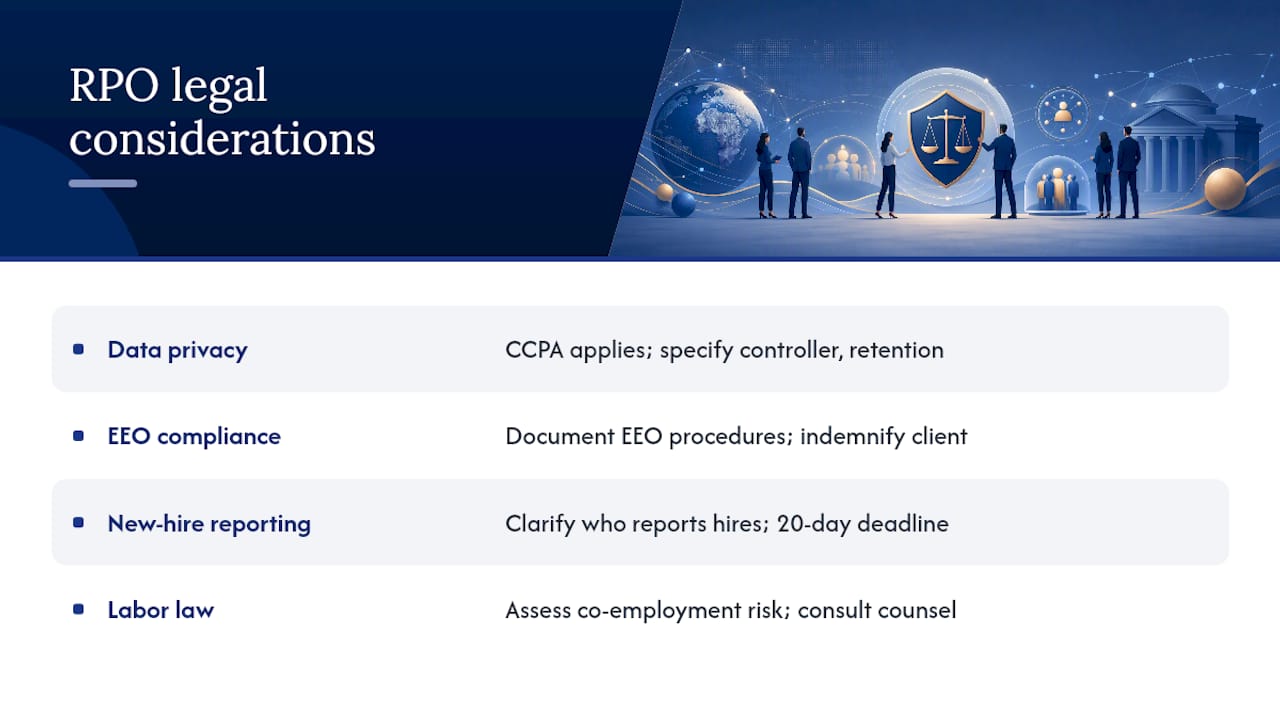
Data privacy: Candidate data collected during RPO-managed recruiting is subject to the California Consumer Privacy Act (CCPA) for California employers, as well as applicable federal privacy standards. Your contract must specify who is the data controller, where candidate data is stored, how long it is retained, and what happens to it at contract end. If the RPO uses AI assessment tools, those tools may trigger additional disclosure obligations under emerging state AI-in-hiring laws.
Equal employment opportunity (EEO) compliance: The RPO provider acts as an agent of the employer in the hiring process. Discriminatory screening practices, whether human or algorithmic, expose the employer to liability under Title VII of the Civil Rights Act, the Age Discrimination in Employment Act (ADEA), and the Americans with Disabilities Act (ADA). Require the provider to document their EEO compliance procedures and to indemnify the client for screening practices that violate federal or state law.
New-hire reporting: Federal law requires employers to report new hires to the state directory within 20 days of hire. In California, that obligation runs through the California EDD. When an RPO manages onboarding, the contract must clarify who is responsible for triggering new-hire reporting and how that data flows to the employer's payroll system. A gap here creates compliance risk that is entirely avoidable with a clear data handoff protocol.
Labor law and co-employment: In some RPO structures, particularly those using embedded recruiters, questions of co-employment can arise. Consult employment counsel before finalizing an RPO contract to confirm that the engagement structure does not create unintended employer-employee relationships with the provider's staff.
This article provides general information about RPO legal considerations and is not legal advice. Confirm current requirements with qualified employment counsel and the relevant regulatory agencies for your jurisdiction.
Key Takeaways
Recruitment process outsourcing delivers the most value when the provider assumes genuine accountability for outcomes, the engagement model matches your hiring volume and internal capability, and contract terms enforce measurable SLAs with clear remedies.
| Point | Details |
|---|---|
| RPO transfers process ownership | The provider is accountable for design, management, and results, not just candidate delivery. |
| Match the model to your scale | Full-lifecycle, modular, project, and on-demand RPO each suit different hiring volumes and organizational maturity levels. |
| Pilot before committing | A 60–90 day project RPO with defined success criteria reduces risk before an enterprise-wide commitment. |
| Require SLAs with remedies | Time-to-fill targets, cost-per-hire definitions, and fee credits for missed SLAs must be written into the contract. |
| Align payroll and TA handoffs | New-hire reporting, EDD registration, and first-pay coordination must be mapped before the RPO goes live. |
Why payroll-TA alignment matters more than most RPO guides acknowledge
Most RPO guides stop at the offer letter. The operational reality for HR and business leaders is that the moment a candidate accepts an offer, a second clock starts: payroll setup, new-hire reporting, and compliance obligations that have nothing to do with recruiting and everything to do with whether that person gets paid correctly on Day 1.
When an RPO partner manages onboarding, the data handoff from the TA function to payroll is a genuine risk point. Candidate records collected during recruiting (legal name, address, Social Security number, start date, compensation) must transfer cleanly into your HRIS and payroll system. If that handoff is manual, delayed, or incomplete, you face late new-hire reporting, incorrect first-pay calculations, and potential California EDD compliance issues. These are not hypothetical risks; they are the predictable result of treating the RPO engagement as ending at the offer stage.
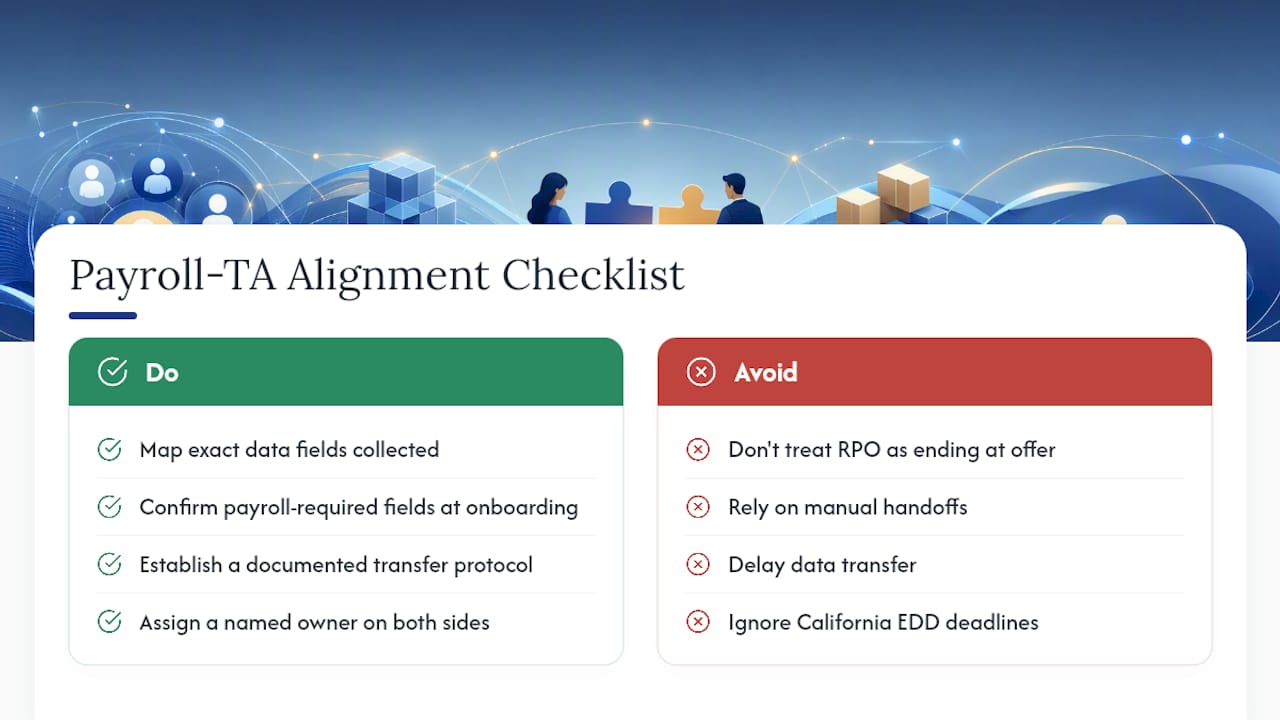
The practical fix is straightforward: before your RPO goes live, map the exact data fields the provider will collect, confirm which fields your payroll system requires at onboarding, and establish a documented transfer protocol with a named owner on both sides. If your organization is scaling hiring in California, payroll compliance requirements add another layer: EDD employer account setup, SDI enrollment, and new-hire reporting to the California New Employee Registry all have statutory deadlines that begin running from the hire date, not the start date.
Glendale Payroll supports employers in Glendale, Burbank, Pasadena, and Greater Los Angeles through exactly this transition, handling payroll setup, EDD account registration, new-hire reporting, and ongoing compliance so that the hiring ramp your RPO partner delivers does not create a payroll backlog. If you are planning an RPO engagement and need payroll-side support, Glendale Payroll's services are built for this coordination.
Useful sources and further reading
The sources below provide authoritative definitions, buyer guides, and operational benchmarks for organizations evaluating RPO.
-
RPO Association (RPOA) — What Is Recruitment Process Outsourcing?: The industry association's authoritative definition of RPO, engagement types, and pricing models. The starting point for any buyer new to the category.
-
TechTarget — What Is Recruitment Process Outsourcing (RPO)?: A clear, practical explainer covering how RPO differs from staffing, common benefits, and drawbacks. Useful for building an internal business case.
-
Korn Ferry — Recruitment Process Outsourcing: Describes tech-enabled RPO delivery, including AI, analytics dashboards, and measurable outcomes. Useful for evaluating provider technology claims.
-
KellyOCG — Recruitment Process Outsourcing: Covers engagement model selection, pilot recommendations, and how to align RPO model to organizational scale and goals.
-
Hudson RPO — What Is Recruitment Process Outsourcing?: Operational description of embedded delivery teams, time-to-hire reduction, and the long-term partnership model. Strong on delivery mechanics.
-
Insight Global — Recruitment Process Outsourcing: Practical descriptions of delivery team design, weekly reporting cadence, and high-volume program management.
-
Robert Walters — Recruitment Process Outsourcing: Covers modular, project, and full RPO with emphasis on scalability, technology integration, and cost efficiency. Useful for benchmarking service scope.
-
Glendale Payroll — Payroll Services: For employers in Greater Los Angeles managing a hiring ramp, Glendale Payroll provides payroll processing, EDD setup, new-hire reporting, and California compliance support to align with your RPO partner's onboarding handoff.