
Direct deposit automation turns payroll ACH into an auditable, electronic deposit engine that increases deposit capture, cuts processing cost, and measurably improves customer experience. More than 93% of U.S. workers are paid by direct deposit, making it the dominant payroll payment method and the anchor for primary banking relationships. The role of direct deposit automation is to make that capture systematic, not accidental.
The core functional elements:
- ACH orchestration: Automated file creation, validation, and submission via NACHA-compliant rails
- Onboarding verification: Pre-note testing, micro-deposits, or real-time account validation before first credit
- Routing rules: Logic that directs split deposits, handles return codes, and flags exceptions without manual intervention
- Reconciliation automation: Automated matching of remittance data to payroll records and ledger entries
The rest of this guide covers how the mechanics work, which benefits matter most to your KPIs, how to choose an integration pattern, what compliance controls you cannot skip, and how to build a credible ROI case for your leadership team.
Table of Contents
- How direct deposit automation works in the U.S.
- Primary benefits for banks and fintech: what automation actually delivers
- Integration and delivery patterns: which approach fits your situation
- U.S. compliance, privacy, and fraud-risk controls you cannot skip
- Operational impact and the KPIs to track after you go live
- ROI, cost drivers, and what a payroll audit reveals
- Key Takeaways
- What practitioners get wrong about direct deposit automation
- Glendale Payroll's audit and pilot services for direct deposit automation
- Authoritative references and further reading
How direct deposit automation works in the U.S.
At its core, automation replaces manual file preparation and paper check issuance with electronic orchestration through the ACH network. Understanding the data flow is the prerequisite for every implementation decision that follows.

The standard payment flow
A payroll system generates a payment file. That file moves to a payment orchestration layer or payroll vendor, which formats it as a NACHA-compliant ACH batch. The originating depository financial institution (ODFI) submits the batch to an ACH operator, either the Federal Reserve's FedACH or The Clearing House's EPN. The receiving depository financial institution (RDFI) posts the credit to the employee's account. ACH is the core electronic network for payroll direct deposit; funds typically post on payday morning unless same-day ACH or bank-specific posting policies alter that timing.
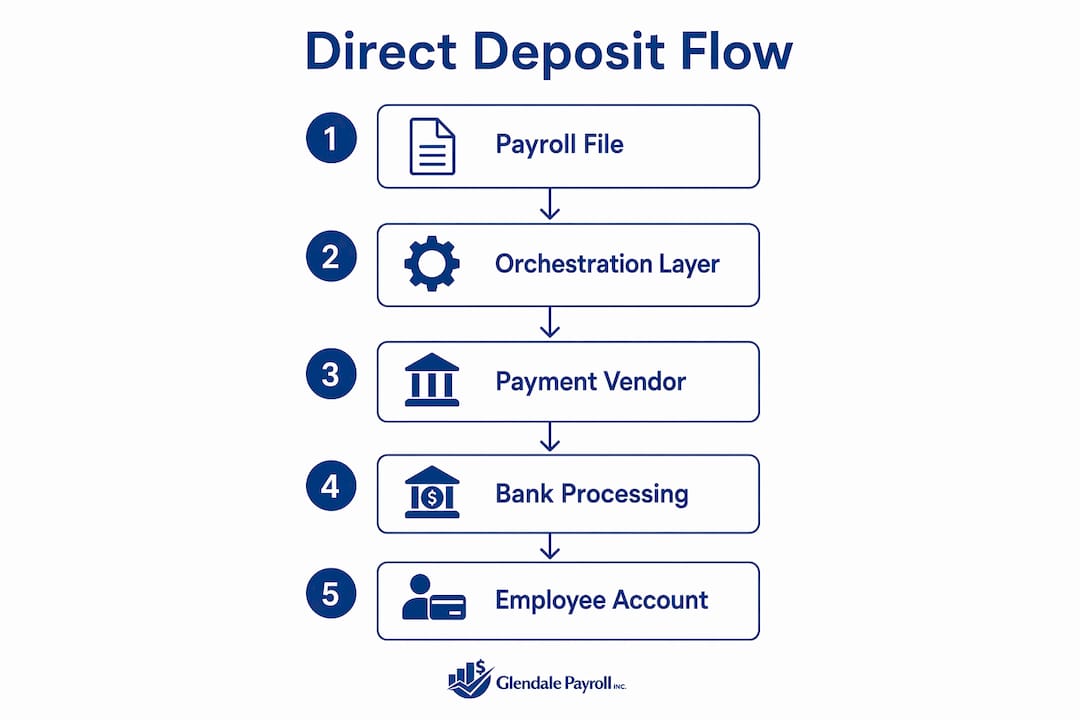
File-based ACH vs. API-driven connectivity
File-based workflows batch payroll records into a NACHA-formatted flat file, transmit it on a schedule, and rely on return files for exception feedback. This approach is mature, widely supported, and predictable. API-driven payroll connectivity, by contrast, sends individual payment instructions in near real time, receives immediate validation responses, and integrates directly with payroll platforms. API connectivity reduces the lag between payroll approval and payment initiation, and it cuts the human-error rate during account setup compared to manual form entry.
Same-Day ACH and early-pay features
Some U.S. financial institutions credit automated direct deposits up to two business days earlier than the scheduled payday when they post ACH credits on receipt. Same-Day ACH, governed by NACHA rules, allows same-business-day settlement for eligible credits submitted before the applicable cutoff windows. For banks and fintech, offering same-day ACH payroll is a product differentiator that directly affects deposit timing and customer satisfaction.

Onboarding verification patterns
Most direct deposit changes take effect within 1–2 pay cycles; some employers issue a final paper check during the first cycle while the pre-note clears. The three common verification methods are:
- Pre-note ($0 test transaction): Sent one cycle before the first live credit to confirm routing and account numbers are valid
- Micro-deposits: Two small credits (typically under $1.00 each) that the employee confirms, providing active verification
- Real-time account validation: API-based services that verify account ownership and status instantly at enrollment, reducing the 1–2 cycle delay
Glossary:
- ACH: Automated Clearing House, the electronic network for U.S. bank-to-bank transfers
- NACHA: The organization that governs ACH rules and operating standards
- Same-Day ACH: An ACH service that settles credits within the same business day, subject to cutoff windows
- API connectivity: Direct software-to-software integration between a payroll platform and a payment or banking system
Primary benefits for banks and fintech: what automation actually delivers
The highest-value outcome of automating direct deposit is deposit capture tied to the primary banking relationship. Recurring payroll credits are the single strongest predictor of a customer's lifetime value and product cross-sell potential. Every other benefit flows from that anchor.
Industry data point: Direct deposit remains the dominant payroll delivery method in the U.S., positioning it as the central mechanism for deposit-capture strategies at banks and fintech alike.
Customer experience and product benefits
- Early-pay access: Posting ACH credits on receipt rather than on settlement date gives customers funds up to two business days early, a feature that drives account opening and reduces churn
- Split deposits: Allowing employees to route portions of each paycheck to checking and savings simultaneously drives savings-rate adoption without requiring a separate customer action
- Predictable payment timing: Automated scheduling eliminates the variability customers experience with paper checks, supporting bill-pay confidence and reducing overdraft events
Commercial and financial benefits
Automation eliminates expenses tied to paper checks, postage, and manual reconciliation while reducing fraud and check forgery risk. For banks, the commercial case is straightforward: a customer whose payroll deposits land in your institution is far more likely to open a second product, maintain a higher average daily balance, and remain a customer for longer. Automated direct deposit is the mechanism that makes that relationship sticky. You can explore the direct deposit advantages in detail, including how automation reduces cost and risk for both employer and institution.
Operational benefits
- Reconciliation time: Automated matching of ACH return codes and remittance data to payroll records cuts the manual reconciliation cycle from hours to minutes in mature implementations
- Exception handling: Automated routing rules triage return codes (R02, R03, R04, etc.) and trigger the appropriate resolution workflow without staff intervention on routine cases
- Fraud reduction: Eliminating paper checks removes check forgery as a fraud vector; automated account verification at onboarding reduces misdirected deposits
Integration and delivery patterns: which approach fits your situation
The right implementation path depends on your scale, existing infrastructure, time-to-value requirements, and tolerance for ongoing maintenance. Three patterns dominate U.S. deployments.
The three core patterns
Payment orchestration layers centralize settlement, routing, and reconciliation for enterprises and fintechs, improving visibility and reducing manual exceptions. That architecture maps to Pattern A below.
| Pattern | Description | Pros | Cons | Best for |
|---|---|---|---|---|
| A. Payment orchestration platform | A middleware layer receives payroll instructions from ERPs/payroll systems and routes them to ACH rails, returning remittance for reconciliation | Centralized control, multi-rail support, real-time visibility | Higher upfront integration effort, ongoing platform cost | Mid-to-large fintechs, multi-ERP environments |
| B. Payroll-vendor native integration | Direct connection to a payroll platform's built-in ACH submission and reporting tools | Faster time-to-market, lower dev overhead | Limited control over routing logic, vendor dependency | Smaller banks, single-payroll-system employers |
| C. In-house ACH file automation | Internal systems generate NACHA-formatted files, submit via ODFI, and process return files | Full control, no third-party dependency | High maintenance burden, requires deep ACH expertise | Large banks with existing ACH infrastructure |
For practical examples of how automated payout workflows operate across different business models, the automated payout patterns documented in brokered payment environments illustrate common orchestration decisions that translate directly to payroll contexts.
Decision checklist before you commit
- Data quality: Are employee account numbers and routing numbers validated at source, or will you inherit dirty data?
- Volume: What is your projected daily transaction count, and does your ODFI relationship support that volume under Same-Day ACH cutoffs?
- Return file processing: Do you have automated logic to handle NACHA return codes, or will exceptions queue for manual review?
- Testing environment: Does your chosen pattern offer a sandbox or pre-production environment for end-to-end test cases?
- Payroll software integration: Review payroll software integration patterns and fraud-reduction controls before finalizing your architecture
Integration tips:
- Use OAuth 2.0 or equivalent token-based authentication for all API connections
- Run a minimum of 50 end-to-end test transactions covering normal credits, returns, and prenote flows before production cutover
- Map every data field from your payroll system to the NACHA file specification before writing a single line of integration code
- Document exception-handling workflows before go-live, not after the first return file arrives
U.S. compliance, privacy, and fraud-risk controls you cannot skip
Speed is the primary promise of automation. Compliance is the constraint that keeps that speed from becoming liability. Automating direct deposit without the right controls in place creates regulatory exposure and fraud risk that can outweigh the operational savings.
Compliance checklist
- Depositor authorization: Obtain written or electronic authorization from each employee before initiating any ACH credit. NACHA rules require valid authorization; retain records for a minimum of two years after the last transaction
- NACHA file rules: Confirm your ACH files conform to current NACHA operating rules, including correct SEC codes (PPD for consumer payroll, CCD for corporate accounts), proper company IDs, and accurate effective entry dates
- Pre-note and return windows: Allow the full pre-note period (typically one banking day before the effective date) and monitor return windows. Standard ACH returns must be processed within two banking days; unauthorized returns have a 60-calendar-day window
- Federal Reserve holiday schedule: ACH does not settle on Federal Reserve holidays. Build holiday logic into your scheduling engine or you will miss payroll dates
- Record retention: Maintain ACH authorization records, file transmission logs, and return code histories per NACHA requirements and applicable state law
- KYC/AML checks: Verify account ownership at onboarding. Automated direct deposit does not exempt you from Bank Secrecy Act obligations; transaction monitoring must cover payroll credit flows for anomalous patterns
Technical security controls
- Encrypt account numbers and routing data at rest (AES-256 minimum) and in transit (TLS 1.2 or higher)
- Enforce role-based access controls on payroll admin functions; no single user should be able to approve and submit an ACH file without a second authorization
- Require multi-factor authentication for all payroll system logins with ACH submission rights
- Implement transaction monitoring rules that flag sudden changes in routing numbers, unusually large credits, or high-frequency account updates
Fraud scenarios and recovery realities
Change-of-account fraud, where a bad actor substitutes a fraudulent routing number during an account update, is the most common payroll ACH fraud vector. Social engineering attacks targeting HR or payroll staff are the typical entry point. Tight verification at the point of account change, including re-verification of the new account via micro-deposit or real-time validation, is the primary control.
Once an ACH file is submitted, re-routing an incorrectly deposited credit becomes a complex, multi-day bank-to-bank investigation. Same-day escalation on discovery is not optional; it is the only way to preserve recovery options.
Pro Tip: NACHA's website (nacha.org) publishes the current operating rules, holiday schedules, and return code definitions at no cost. Bookmark the ACH return code reference and the Federal Reserve holiday calendar and review both before every major system change.
Operational impact and the KPIs to track after you go live
Automation changes what your operations team does, not just how fast they do it. Staff shift from manual file preparation and check reconciliation to exception triage, analytics review, and process governance. That shift is a feature, but only if you measure it.
Primary KPIs to monitor
- Primary-bank share: Percentage of active customers with payroll direct deposit landing at your institution
- Deposit growth rate: Month-over-month change in average daily balances attributable to payroll credits
- Exception rate: Number of ACH returns per 1,000 transactions; a declining rate signals improving data quality at onboarding
- Average time to resolution (TTR): Mean time from return code receipt to account correction and re-credit
- Cost per deposit: Total processing cost (platform fees, FTE hours, return handling) divided by total deposit transactions
- Reconciliation time per cycle: Clock time from payroll approval to fully reconciled ledger entry
Operational benchmark: Banking automation applied to payment flows and compliance checks consistently reduces manual processing time across account setup, payment orchestration, and reconciliation functions. Organizations that automate reconciliation in multi-ERP environments report that machine learning matching of remittance data to payroll records can dramatically reduce the reconciliation effort that previously concentrated in accounting ledger integration.
Phase-based timeline and measurement
| Phase | Typical Duration | What to measure |
|---|---|---|
| Discovery and data audit | 1–2 pay cycles | Data quality score, exception rate baseline, current cost per deposit |
| Pilot (limited volume) | 1–2 pay cycles | Exception rate vs. baseline, TTR, reconciliation time per cycle |
| Production rollout | — | Primary-bank share growth, deposit growth rate, cost per deposit trend |
Reviewing payroll process documentation before the discovery phase gives your team a structured framework for mapping current-state workflows and identifying where exceptions concentrate.
ROI, cost drivers, and what a payroll audit reveals
The business case for automating direct deposit rests on two cost lines: the direct cost of paper-based payment methods and the hidden labor cost of manual reconciliation and exception handling.
Cost comparison framework
| Cost line | Paper check (per transaction) | Automated ACH (per transaction) |
|---|---|---|
| Check printing and stock | under $1.00 | $0 |
| Postage and handling | under $1.00 | $0 |
| Return/stop-payment handling | — | $1–$3 per return code |
Ranges are illustrative industry estimates; your actual figures depend on volume, FTE cost, and platform pricing. A payroll audit establishes your real baseline.
The time and cost savings from payroll automation compound quickly at scale. A 500-employee employer processing bi-weekly payroll can eliminate hundreds of check-printing and postage transactions per year, with reconciliation labor savings that often exceed the platform cost within the first year.
What a Glendale Payroll audit surfaces
Glendale Payroll conducts a free comprehensive payroll audit that maps your current direct deposit flows, identifies data quality gaps, flags NACHA compliance exposures, and quantifies the reconciliation labor your team currently absorbs. The audit output is a prioritized action list with estimated cost and time savings attached to each item. For businesses in Greater Los Angeles, including Glendale, Burbank, and Pasadena, the audit also covers California-specific payroll obligations that interact with your ACH timing and authorization requirements.
The audit is the fastest way to establish a real cost-per-deposit baseline and build a credible ROI case for leadership before committing to a full implementation.
Key Takeaways
Direct deposit automation reduces per-transaction cost, improves primary-bank deposit capture, and shifts operations staff from manual reconciliation to exception governance, but only when data quality, NACHA compliance, and verification controls are built in from the start.
| Point | Details |
|---|---|
| Deposit capture is the primary ROI driver | Recurring payroll credits anchor the primary banking relationship and drive lifetime customer value. |
| Choose your integration pattern deliberately | API connectivity reduces human error at onboarding; file-based ACH suits mature, high-volume environments with existing infrastructure. |
| Compliance controls are non-negotiable | NACHA authorization, return-window management, and change-of-account verification must be in place before go-live. |
| Measure exception rate and cost per deposit first | These two KPIs establish your baseline and prove ROI after automation is live. |
| Glendale Payroll offers a free audit | The audit maps current flows, identifies compliance gaps, and quantifies reconciliation labor savings before you commit to implementation. |
What practitioners get wrong about direct deposit automation
The conventional wisdom treats direct deposit automation as a technology project. It is not. It is a data governance project with a technology layer on top. The institutions that struggle with implementation almost always share the same root cause: they automated a broken process instead of fixing the process first.
The most common pitfalls are predictable once you know what to look for. Dirty account data at onboarding, meaning unvalidated routing numbers and account numbers collected via paper forms, generates a return rate that no orchestration layer can fix. Insufficient testing, specifically skipping end-to-end return-file scenarios, leaves teams unprepared for the first production exception. Underestimating exception workflows is the most expensive mistake: organizations often staff for the happy path and discover that return handling, re-credit authorization, and employee communication consume more FTE hours than the original manual process did.
Authorization capture deserves more attention than most implementations give it. A missing or defective authorization record is not just a NACHA compliance gap; it is the primary defense against unauthorized-return claims. Build authorization capture into the enrollment UX, not as an afterthought.
On future trends: real-time payment rails, specifically the RTP network and FedNow, will eventually challenge ACH's dominance for payroll. For most banks and fintechs, that transition is 3–5 years away from being operationally mainstream for payroll use cases. AI-driven anomaly detection for change-of-account fraud is available today and worth evaluating now, particularly for institutions with high employee turnover in their employer client base. Adopt real-time rails when your volume and customer demand justify the integration cost; adopt AI fraud detection as soon as your transaction monitoring vendor supports it.
The mindset shift that separates successful implementations from troubled ones is moving from "we control the file" to "we govern the rules." Automation works when the rules are right. Your job is to write good rules, test them thoroughly, and monitor the exceptions that reveal where the rules need refinement.
Glendale Payroll's audit and pilot services for direct deposit automation
Compliance gaps and reconciliation inefficiencies rarely announce themselves. They accumulate quietly until a missed payroll, an IRS notice, or a NACHA return-rate warning makes them visible. Glendale Payroll's free payroll audit is designed to surface those gaps before they become penalties.

The audit covers your current direct deposit flows, authorization records, ACH file compliance, and reconciliation workflows. You receive a prioritized findings report with specific remediation steps and estimated savings. For businesses across Glendale, Burbank, Pasadena, and Greater Los Angeles, the audit also addresses California payroll obligations that affect ACH timing and employee authorization requirements. Glendale Payroll employs dedicated payroll professionals, not call center staff, so every finding comes with expert context, not a generic checklist.
Request your free audit at Glendale Payroll's payroll tips and services page or review the full services overview to see how managed implementation assistance fits your situation.
This article is general information, not legal or compliance advice. Confirm current NACHA rules, Federal Reserve holiday schedules, and California payroll requirements with your operations team, legal counsel, or a qualified payroll professional for your specific situation.
Authoritative references and further reading
The sources below support the claims in this article and provide the regulatory and technical depth to guide your implementation planning.
Regulatory and standards bodies:
- NACHA — ACH operating rules, return codes, and Same-Day ACH guidance (regulatory; primary source for all ACH rule questions)
- U.S. Senate Banking Committee — testimony on deposit practices and early-pay programs (regulatory context; early-pay settlement timing)
Practical how-to and industry guides:
- Investopedia — Direct deposit explained: ACH, NACHA, and timing (how-it-works reference)
- IBM — Banking automation: RPA, APIs, and payment orchestration (enterprise automation patterns)
- Stripe — Automated payment systems and orchestration layers (architecture reference)
- First Card — Direct deposit setup, verification timing, and pre-note patterns (onboarding mechanics)
- Business Management Daily — Early direct deposit and ACH recovery realities (fraud and recovery risk)
Cost and ROI references:
- Emagia — Direct deposit vs. check: costs, risks, and enterprise impact (cost-comparison framework)
- Branch — Direct deposit adoption statistics (APA usage data)
Glendale Payroll resources:
- Direct deposit benefits for employers
- Payroll automation benefits and time savings
- Same-Day ACH payroll explained
Validate specific regulatory deadlines, return-window requirements, and Federal Reserve holiday schedules directly with NACHA and your ODFI before each implementation phase. Rules update periodically and your operations and legal teams should confirm current requirements for your specific ACH agreement.