
Payroll compliance is the foundation every startup's growth depends on. Get it right, and you protect your cash, your credibility, and your team. Get it wrong, and the IRS can hold you personally liable for unpaid trust fund taxes, investors will flag your records during due diligence, and penalties can quietly compound for months before anyone notices. The role of payroll compliance in startup growth is not a back-office detail. It is a direct input into your burn rate, your fundraising readiness, and your ability to hire and retain people with confidence.
Here is what compliance protects you from, at a glance:
- IRS penalties and interest on late or missed tax deposits
- Trust Fund Recovery Penalty under IRC §6672, which reaches your personal assets
- Worker misclassification audits that create back-tax liabilities and disrupt M&A or funding rounds
- Investor friction when payroll records do not reconcile cleanly during due diligence
- Employee trust erosion when payroll errors affect paychecks or benefits
What payroll compliance actually covers for your startup
Payroll compliance means meeting every legal obligation tied to paying your employees: withholding the right taxes, depositing them on the correct schedule, filing accurate returns, and keeping records that hold up under audit. For a startup, that scope is wider than most founders expect.
The core components include:
- Federal income tax withholding from each employee's paycheck, reported on Form 941 quarterly
- FICA taxes: Social Security (6.2% employer match, up to the annual wage base) and Medicare (1.45% employer match, no cap)
- FUTA: Federal Unemployment Tax Act contributions, paid by the employer on the first $7,000 of each employee's wages
- SUTA: State unemployment tax, with rates and wage bases that vary by state
- State and local income tax withholding in every jurisdiction where you have employees
- Worker classification: correctly distinguishing employees from independent contractors under IRS guidelines
- Recordkeeping: timesheets, pay-rate authorizations, payroll run reports, and W-2s that create a clean audit trail
Worker classification deserves specific attention. The IRS uses Form SS-8 to evaluate whether a worker is truly an independent contractor or a misclassified employee. The distinction is not about what you call the arrangement. It is about behavioral control, financial control, and the nature of the relationship.
Why payroll compliance matters specifically for startups
Startups carry compliance risk that established companies do not. Limited cash flow means a single penalty notice can disrupt operations. A lean finance team means errors go undetected longer. And rapid hiring, often across multiple states, multiplies the number of obligations you are managing simultaneously.

For a Series A SaaS startup with 30 employees averaging $150,000 in salary, the employer payroll tax burden typically amounts to $360,000–$450,000 annually at 8–10% of gross payroll. That figure belongs in your financial model as a clearly broken-out line, not buried in a general expenses bucket.
The personal liability dimension is what founders underestimate most. Under IRC §6672, the IRS can assess the Trust Fund Recovery Penalty against any "responsible person" who willfully fails to remit withheld employee taxes. That includes the CEO, CFO, or anyone with check-signing authority. A company bankruptcy does not extinguish this liability. The IRS collects from the individual.
Compliance also connects directly to your credibility with investors. Investors scrutinize payroll records for evidence of financial control quality. Messy payroll raises broader questions about reporting discipline and management maturity. Clean records will not win a round by themselves, but sloppy ones can create friction at exactly the wrong moment.
Common payroll compliance mistakes and how to avoid them
Most payroll problems at startups trace back to a small set of recurring errors. Recognizing them early is the fastest way to stay out of trouble.
- Misclassifying employees as independent contractors. Many founders believe contractor status reduces payroll tax obligations. The IRS actively audits this, and misclassification triggers back taxes, penalties, and a complicated diligence conversation during fundraising. Review classifications before onboarding, not after a problem surfaces.
- Missing deposit schedule changes. The IRS assigns deposit schedules based on your payroll tax liability, and that schedule can shift from monthly to semiweekly as your team grows. Founders frequently fail to notify their payroll provider of these changes, and penalties accrue silently for months.
- Failing to register in new states. Hiring one employee in a new state creates withholding, unemployment, and workers' compensation obligations in that state. Many startups discover this late, after retroactive registration and cleanup become necessary.
- Poor payroll software configuration. Automated payroll tools only work correctly if set up accurately. Errors in the initial configuration replicate efficiently and silently until an audit or IRS notice surfaces them.
- Not updating employee work locations. When a remote employee moves to a new state, the company must notify its payroll provider. Delays of six months or more between a move and the provider's awareness are common, with retroactive withholding cleanup as the consequence.
Pro Tip: Keep a payroll tax calendar that tracks federal and state deposit due dates, quarterly Form 941 deadlines, and annual Form 940 filings. Assign one person to own it and review it monthly.
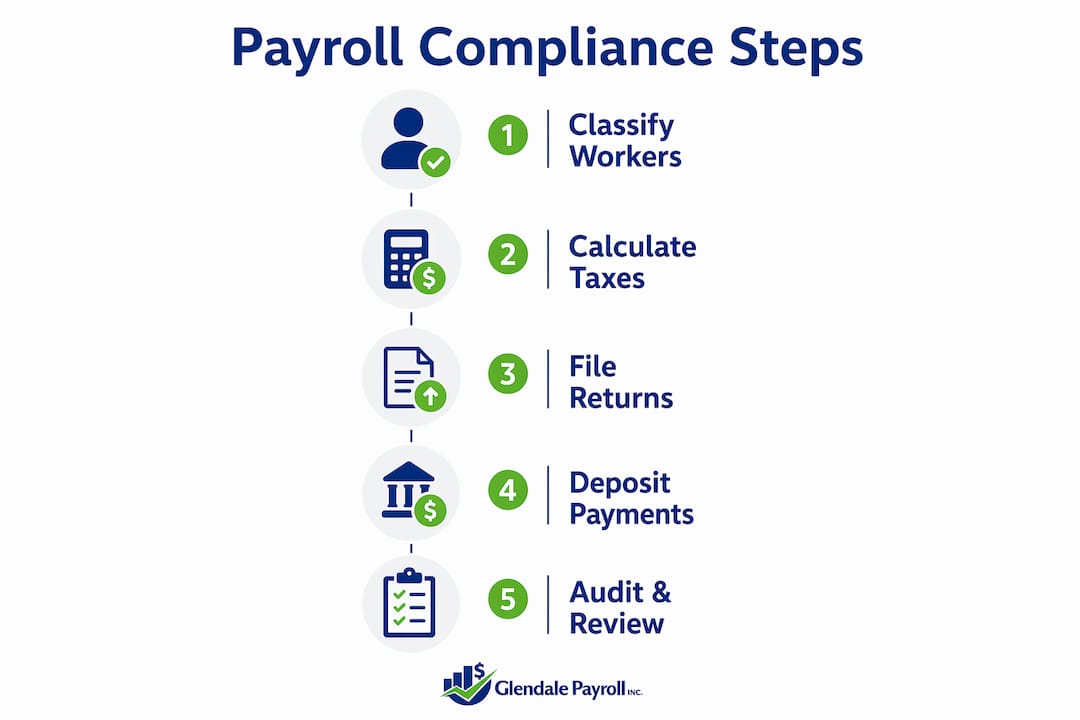
How startups can maintain payroll compliance successfully
Building a compliant payroll process is less about perfection and more about consistent, documented habits. The following practices form a reliable foundation.
- Automate deposits and filings. Use payroll software that integrates federal and state deposit schedules, files Form 941 quarterly, and issues W-2s at year-end. Automation removes the human error that manual spreadsheets introduce. Explore integrated payroll solutions that connect payroll with your accounting system for cleaner reporting.
- Reconcile payroll monthly. Monthly reconciliation of your payroll register to tax deposits and your general ledger catches configuration errors before they compound. This is the single most common root cause of late IRS notices, and a 30-minute monthly review prevents it.
- Separate withheld taxes immediately. Transfer withheld employee taxes to a dedicated bank account as soon as payroll runs. This prevents the funds from being used for operating expenses and creates a transparent record for any audit.
- Establish internal controls. Separate the person who inputs payroll data from the person who approves bank transactions. This separation of duties is a basic control that reduces both error and fraud risk.
- Track new-state registrations to completion. When you hire in a new state, your payroll provider initiates registration, but the state drives the timeline. Some states issue an employer ID within days; others take 6–8 weeks. Track each registration actively. Review payroll best practices to build a checklist that covers every new-hire trigger.
- Confirm your deposit schedule annually. Each October or November, when the IRS announces the following year's deposit schedule, confirm with your provider that the correct schedule is loaded. A growing startup can cross from monthly to semiweekly deposits without realizing it.
Expert insights on payroll tax trust funds and worker classification risks
The IRS treats withheld payroll taxes as trust funds. Federal income tax withheld from employees, the employee portion of Social Security, and the employee portion of Medicare are legally not the company's money. They are held in trust for remittance to the government. Failure to remit is treated as a serious breach, not a bookkeeping error.
The Trust Fund Recovery Penalty under IRC §6672 is a 100% penalty assessed personally against responsible persons. The IRS does not require proof of intent to steal. Willful failure to remit, which includes choosing to pay other creditors while knowing taxes are due, is sufficient. This is the only form of personal liability most founders carry directly from payroll operations.
Key risk pattern: A startup under cash pressure directs its payroll provider to delay tax remittance. The provider complies. The IRS eventually catches up. The founder owes the underlying tax personally, even after a company bankruptcy that eliminates all other obligations.
Worker misclassification carries a parallel risk. Many early-stage founders wrongly believe classifying workers as contractors reduces payroll taxes. The IRS actively audits this through Form SS-8 and data analytics that flag businesses paying contractors instead of employees. When misclassification is found, the company owes back payroll taxes, penalties, and interest. During a fundraising round or acquisition, a large contractor population that should have been on payroll creates a diligence problem that is expensive and time-consuming to resolve.
How payroll compliance affects investor relations and funding
Investors do not lead due diligence with payroll questions, but they notice when the records are inconsistent. Payroll data touches burn rate, headcount, department-level cost allocation, and benefits accruals. When those numbers do not reconcile cleanly across systems, it raises questions about the reliability of your financial reporting overall.
Alight's 2024 Company Payroll Complexity Report found that 53% of surveyed companies had incurred payroll penalties in the prior five years due to non-compliance. For a startup already managing tight runway, that is an avoidable expense that shows up directly on the board slide. Clean payroll records, by contrast, signal operational maturity and give investors confidence that your financial model reflects reality.
The data room request during a Series A or B typically includes payroll records, employee census data, tax filings, and compensation details. Founders who have maintained monthly reconciliations and accurate state registrations move through that process quickly. Those who have not face a cleanup project at the worst possible time.
Tools and software solutions for payroll compliance in startups
Payroll software handles the operational mechanics of compliance: calculating withholdings, depositing taxes on the correct schedule, filing quarterly and annual returns, and issuing W-2s and 1099s. The key distinction is that these tools execute against the configuration you provide. They do not validate that the configuration is correct.
When evaluating payroll tools for your startup, prioritize platforms that:
- Automate federal and state tax deposits on the correct schedule
- File Form 941 quarterly and Form 940 annually without manual intervention
- Support multi-state withholding as your team grows
- Process IRS and state notices with a defined intake and response workflow
- Integrate with your accounting system for clean general ledger mapping
Beyond the software itself, consider whether your setup needs a payroll audit to verify that existing configurations are accurate before errors compound further. Many startups inherit payroll setups from a prior administrator and assume they are correct without ever validating them.
For startups with employees in multiple states, a professional employer organization (PEO) or a dedicated payroll compliance firm adds a layer of oversight that software alone cannot provide. The new hire onboarding process is also a critical control point: accurate employee data entered at onboarding prevents the downstream errors that trigger notices and penalties.

Legal consequences of non-compliance specific to startups
The legal exposure from payroll non-compliance scales with the severity and duration of the problem. Late deposits trigger penalties of 2–15% of the unpaid tax under IRS failure-to-deposit rules. Failing to file Form 941 adds a penalty of up to 25% of the tax due, with interest accruing on any unpaid balance.
Beyond civil penalties, willful failure to pay employment taxes can lead to criminal prosecution in egregious cases. For most startups, the practical risk is civil liability and business disruption, but the threshold for "willful" is lower than founders expect. Choosing to pay vendors or rent while knowing payroll taxes are overdue meets the standard.
State-level consequences add another layer. Each state has its own withholding returns, unemployment filings, and deposit schedules. Missing state obligations creates duplicate liabilities that run parallel to federal penalties. Multi-state startups that have not registered in every state where payroll nexus exists face retroactive registration, back filings, and penalties across multiple jurisdictions simultaneously.
Worker misclassification compounds all of this. Back payroll taxes, unpaid overtime exposure under the Fair Labor Standards Act, benefits liability, and worker claims can arrive together when the IRS or a state labor agency reclassifies a contractor population. The employee vs. contractor distinction is not a gray area the IRS tolerates indefinitely.
Scaling payroll compliance as your startup grows
Payroll compliance gets harder as you grow, not easier. The first inflection point is usually hiring in a second state. The second is crossing the threshold that changes your IRS deposit schedule from monthly to semiweekly. The third is adding commission plans, bonuses, or equity events that create off-cycle payroll obligations.
Each stage requires a deliberate review of your compliance setup, not an assumption that existing systems will adapt automatically. Build these checkpoints into your operational calendar:
- At each new-state hire: Register for withholding and unemployment before the first payroll runs in that state.
- At each headcount milestone: Confirm your deposit schedule with your payroll provider and verify it matches the most recent IRS notice.
- At each equity or bonus event: Coordinate with your payroll and tax advisors before the payroll runs, not after. Large bonus or equity-vesting payrolls can trigger the $100,000 next-day deposit rule, requiring a federal tax deposit by the next banking day.
- Monthly, without exception: Reconcile payroll tax liabilities to deposits and to your general ledger. Assign a clear owner. Keep a payroll tax calendar that tracks every required federal and state account.
The startups that handle scaling well are the ones that treat payroll compliance as a finance function, not an HR task. When payroll, accounting, and headcount planning operate from the same data, the board reporting is cleaner, the diligence process is faster, and the risk of a surprise IRS notice drops considerably.
Work with Glendale Payroll before a problem compounds
Payroll compliance problems rarely announce themselves early. They accumulate quietly until a notice arrives, a deposit is flagged, or an investor's diligence team asks a question you cannot answer cleanly. Glendale Payroll works with startups and growing businesses across Greater Los Angeles, including Glendale, Burbank, and Pasadena, to build compliant payroll processes from the ground up.
Unlike firms that route your account through a call center, Glendale Payroll assigns dedicated payroll professionals who know your setup, your state obligations, and your growth stage. The process starts with a free comprehensive payroll audit to identify existing risks before they become penalties.
If your payroll is running on inertia and you are not certain every state account, deposit schedule, and worker classification is correct, now is the right time to find out. Review Glendale Payroll's California compliance services or explore the full payroll services overview to see how the firm supports startups at every stage of growth.
Key Takeaways
Payroll compliance directly protects startup growth by preventing IRS penalties, personal founder liability, and investor friction that can derail fundraising at critical moments.
| Point | Details |
|---|---|
| Trust fund liability is personal | Under IRC §6672, founders can be held personally liable for unpaid withheld payroll taxes, even after company bankruptcy. |
| Employer tax burden is material | For a 30-employee SaaS startup, employer payroll taxes can total $360,000–$450,000 annually at 8–10% of gross payroll. |
| Misclassification triggers audits | The IRS uses Form SS-8 to detect contractor misclassification, creating back-tax liabilities that complicate fundraising and M&A. |
| 53% of companies incur penalties | Alight's 2024 report found that 53% of surveyed companies had incurred payroll penalties in the prior five years due to non-compliance. |
| Monthly reconciliation prevents most issues | Reconciling payroll tax liabilities to deposits and the general ledger each month catches configuration errors before they compound into IRS notices. |
Recommended
- Payroll Audit Preparation for Startups: 2026 Guide | Glendale Payroll Inc.
- Startup Payroll Tax Obligations Explained for Founders | Glendale Payroll Inc.
- Payroll Process Review: A Guide for Small Business | Glendale Payroll Inc.
- Payroll Process Documentation: A Guide for Small Business | Glendale Payroll Inc.