
If you provide services for your S corporation, you must pay yourself a reasonable W-2 wage on a regular payroll cadence. That salary is subject to FICA taxes; profit distributions are not. If you have not started payroll yet, do it now and document why you chose the number you did.
TL;DR:
- You must pay yourself a reasonable W-2 salary based on your actual duties, hours, and market standards, not solely on profit percentages.
- Regular payroll runs, documentation of your compensation rationale, and benchmarking reports are essential to defend your salary during an audit.
- The IRS assesses reasonable pay using factors like job responsibilities, industry wages, and comparisons to non-owner employees, not fixed formulas.
- Failing to establish or document a proper salary, especially when taking large distributions with little or no wages, increases audit risk of reclassification and penalties.
- Implementing ongoing payroll processes with professional guidance and maintaining detailed records significantly reduces the chance of IRS challenges.
Table of Contents
- Quick Checklist: Immediate Setup and Payroll Actions to Comply Today
- How Does the IRS Decide What Counts as Reasonable Compensation?
- Payroll Operations and Filings: How to Run Payroll for an S Corp Owner
- Documenting and Defending Your Salary Choice: What to Keep in the Audit File
- Practical Calculation Methods and Worked Examples for a Defensible Salary
- Tax Consequences and Interactions to Model
- Common Mistakes and Red Flags That Trigger IRS Reclassification
- Glendale Payroll: How a Local Payroll Specialist Implements Defensible Salaries
- What Owners Get Wrong About S Corp Payroll Salary
- Get a Free Payroll Audit From Glendale Payroll
- Sources
- FAQ
Quick Checklist: Immediate Setup and Payroll Actions to Comply Today
If your S corp is not running payroll yet, or you suspect it has been underpaying you, work through this sequence this week rather than waiting for a tax deadline to force the issue.
- Register your EIN and enroll in EFTPS so you can deposit federal payroll taxes electronically.
- Open state payroll tax accounts, including a California EDD employer account if you operate in California.
- Pick a payroll cadence (biweekly or semimonthly are the most common and easiest to defend).
- Set up with a payroll provider or accounting system that handles withholding, deposits, and filings automatically.
- Withhold and remit federal income tax, employee FICA, and employer FICA on every payroll run.
- File Form 941 quarterly and Form 940 annually, and issue W-2s by January 31.
- Document your compensation policy in writing, including the benchmark data you used to set the number.
If cash flow is tight this quarter, do not skip payroll altogether. Set a defensible baseline salary you can actually afford, write down the reasoning, and note your plan for raising it as revenue improves. A documented, modest salary beats an undocumented zero every time an examiner looks at your return.
How Does the IRS Decide What Counts as Reasonable Compensation?
There is no fixed percentage, no safe harbor, and no simple formula the IRS will bless in advance. S corporation compensation and medical insurance issues guidance from the IRS confirms that reasonable compensation is a facts-and-circumstances determination tied to what you actually do for the company and what comparable workers earn for similar work.
Examiners and courts have converged on a consistent set of factors when they evaluate an owner's pay:
- Training and experience relevant to the role
- Duties and responsibilities actually performed
- Time and effort devoted to the business
- Comparable salaries paid by similar businesses for similar positions
- The source of the company's gross receipts (services versus capital or non-owner labor)
- History of dividends or distributions paid in prior years
- Compensation paid to non-owner employees for comparable work
- Any written compensation agreements in place
- Whether pay was set using a defensible formula or benchmark
Case law reinforces the stakes. Advisors frequently cite the Watson line of cases, where courts sided with the IRS after an accountant took a token salary while distributions ran into six figures. Audit examiners commonly reconstruct wages by comparing an owner's pay to the highest-paid non-owner employee and cross-checking against industry wage surveys. If your bookkeeper earns $55,000 and you, working full-time as the company's only salesperson and operator, pay yourself $20,000 while pulling $150,000 in distributions, that ratio is exactly the pattern examiners are trained to flag.
The practical translation: look at what a non-owner would need to be paid to do your job, then look at how your pay compares to whoever on your payroll earns the most. Those two comparisons carry more weight in an audit than any percentage rule you might read on a forum.
Payroll Operations and Filings: How to Run Payroll for an S Corp Owner
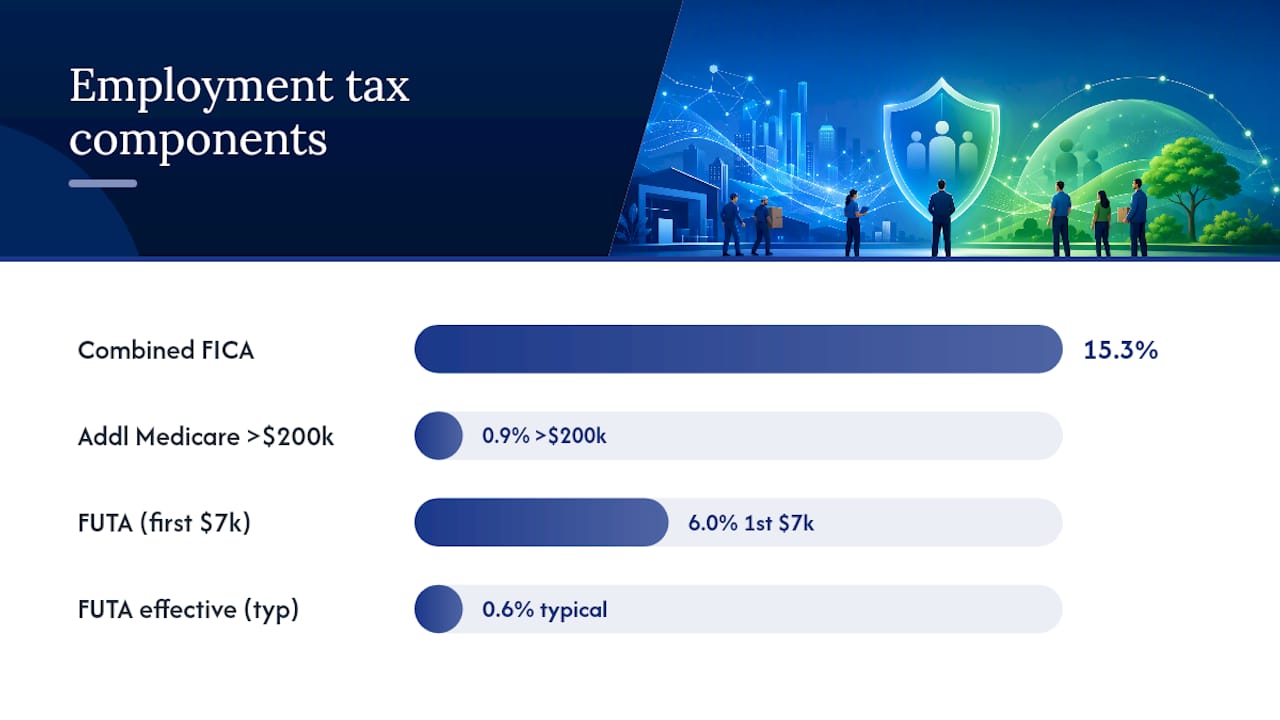
Running payroll correctly is mechanical once it is set up, but the mechanics matter. Every payroll run withholds federal income tax based on the employee's W-4, plus employee-side FICA (6.2% Social Security and 1.45% Medicare), while the company separately owes a matching employer-side FICA contribution. Combined, FICA runs 15.3% of wages once you count both sides. Federal unemployment tax (FUTA) applies at 6.0% on the first $7,000 of wages, though most employers pay an effective rate of 0.6% after the standard state credit.
Your filing calendar has four fixed points:
- Form 941, filed quarterly, reporting wages, withholding, and both sides of FICA for that quarter.
- Form 940, filed annually, reconciling FUTA liability.
- W-2 and W-3, issued to you and filed with the Social Security Administration by January 31.
- Form 1120-S with Schedule K-1, reporting the corporation's income and your distributions, filed separately from payroll but reconciled against your W-2 wages when you or your accountant prepares the return.
Deposits happen through EFTPS on either a monthly or semiweekly schedule, determined by your prior lookback-period tax liability. If you operate in California, add EDD registration for state income tax withholding, SDI, and state unemployment insurance to that list.
Timing matters more than owners expect. Compensation is taxed under a constructive-receipt standard, meaning income is taxable when it becomes available to you, not just when you cash the check. That is why a single lump-sum "salary" paid in December, with no payroll runs before it, looks like a backfilled fix rather than genuine wages. Regular cadence, run through the year, is what makes the wage number credible.
Documenting and Defending Your Salary Choice: What to Keep in the Audit File
A defensible salary that lives only in your head is worth nothing to an examiner. What protects you is a paper trail built while you set the number, not one assembled after a notice arrives.
Keep these items in one file, physical or digital, updated whenever your pay changes:
- Payroll registers showing every pay date, gross wages, and withholding
- EFTPS deposit confirmations matched to each payroll run
- Filed copies of Forms 941, 940, and W-2/W-3
- Board minutes or a written resolution adopting your compensation policy
- A job description outlining your actual duties and hours
- Time logs or a reasonable estimate of hours devoted to the business
- Benchmark reports (industry surveys, BLS occupational wage data) with the source cited
Build this file when payroll starts or the moment your pay changes, not retroactively. Advisors who specialize in reasonable compensation consistently note that a compensation policy adopted before or at the time pay is set carries far more weight than one drafted after the fact, because contemporaneous records are much harder for an examiner to dismiss as after-the-fact rationalization.
Pro Tip: Save your benchmarking source, not just the number it produced. "$78,000, based on BLS median wage for my occupation code plus a 10% adjustment for my added management duties" survives an audit; "$78,000, because that felt right" does not.

Practical Calculation Methods and Worked Examples for a Defensible Salary
Three methods hold up consistently when tax professionals defend a client's salary figure.
- Hours times market rate. Estimate your hours devoted to the business, then multiply by the market hourly rate for someone doing that work. A consultant working 25 hours a week at a market rate of $60 per hour: 25 × 52 × $60 = $78,000.
- Market benchmark adjusted for role. Pull a base figure from BLS wage tables or an industry survey for your occupation, then adjust up or down for your specific duties, hours, and management responsibilities.
- Comparison to the highest-paid employee. If your top non-owner employee earns $65,000 doing work less senior than yours, your salary should generally sit at or above that figure, adjusted for the added scope of your role.
Seasonal or partial-year businesses should prorate rather than skip. If you only operated eight months this year, calculate the annualized market rate, then pay 8/12 of that figure through payroll during the months the business actually operated, and document the proration logic in your compensation file.
Tax Consequences and Interactions to Model
The salary number you choose ripples through more of your tax return than payroll tax alone, which is why chasing the lowest defensible wage is often the wrong optimization.
Combined FICA runs 15.3% of wages up to the Social Security wage base, split between employee and employer sides, with an Additional Medicare Tax of 0.9% kicking in on wages above $200,000 for single filers. FUTA adds 6.0% on the first $7,000 of wages, typically reduced to an effective 0.6% once the state credit applies.
But W-2 wages also drive two benefits owners routinely underweight. Your retirement plan contribution limits, particularly for a solo 401(k) or SEP-IRA, are calculated as a percentage of W-2 compensation, so a salary set too low can quietly cap how much you can shelter for retirement. And under Section 199A, the Qualified Business Income deduction phases in wage-based limitations for higher earners, meaning your W-2 wages can actually increase your allowable QBI deduction rather than only shrinking it through payroll tax.
California employers add state income tax withholding, SDI, and state unemployment insurance on top of federal obligations, all calculated against the same wage base. Run the full picture, retirement contribution room, QBI limitation, and total employment cost, before deciding a lower salary saves you money. Often it does not.
Common Mistakes and Red Flags That Trigger IRS Reclassification
Four patterns show up again and again in reclassification cases, and every one of them is preventable.
- Zero or token salary paired with large distributions. This is the single most common trigger and the easiest for an examiner to spot on a Schedule K-1.
- Irregular payroll, especially a single year-end "catch-up" payment with no regular runs before it.
- No contemporaneous documentation tying the salary figure to duties, hours, or market data.
- Reliance on arbitrary percentage rules (like paying yourself a flat 30% or 60% of profit) with no benchmarking behind the number.
If you recognize any of these patterns in your own business, correct payroll going forward with professional guidance rather than trying to unwind prior years yourself, adopt a written compensation policy immediately, and build your audit file before any notice arrives, not after.
Glendale Payroll: How a Local Payroll Specialist Implements Defensible Salaries
Setting the right number is half the job. Running it correctly, every pay period, is the other half, and it is where most owners lose the thread. Glendale Payroll assigns each client a dedicated payroll professional, not a call center queue, so the person reviewing your compensation file actually knows your business.
A free comprehensive payroll audit is where Glendale Payroll starts with every new client, identifying gaps before the IRS or California's EDD does. From there, the work includes:
- Sourcing and documenting market benchmarks for your role
- Building the deposit and filing evidence trail (941s, W-2s, EFTPS receipts)
- Drafting a written compensation policy template you can adopt
- Managing California-specific compliance, including EDD registration and SDI
Engage sooner rather than later if you suspect past underpayment, operate payroll across multiple states, are adjusting compensation mid-year, or simply want an audit-ready file before you ever need one.
What Owners Get Wrong About S Corp Payroll Salary
The conventional advice circulating online, pay yourself around 60% of profit and call it a day, is the exact kind of arbitrary formula that invites scrutiny. The research behind this article points to a different priority: the number matters less than the paper trail supporting it.
Where most owners go wrong is treating documentation as an afterthought, something to assemble if a notice ever shows up. By then it is too late; contemporaneous records are what carry weight, and records built after the fact read as exactly what they are. The single highest-leverage move is not finding the "perfect" salary number. It is running payroll on a regular cadence from day one and writing down your reasoning while you set it, not months or years later.
If you take one thing from this guide, take this: consistency and documentation beat precision. A well-documented $70,000 salary beats an undocumented $85,000 every time an examiner opens the file.
— Glendale Payroll Staff
Get a Free Payroll Audit From Glendale Payroll
Glendale Payroll is built for exactly the problem this article covers: turning a reasonable-compensation decision into a properly run, fully documented payroll process. Instead of guessing at your salary number and hoping it holds up, a dedicated payroll professional reviews your situation, sources the benchmarks, and keeps your deposits, filings, and W-2s on schedule so the audit file builds itself as you go.

Every new client engagement starts with a free comprehensive payroll audit that flags gaps in your current setup, whether that means an irregular pay schedule, missing California EDD registration, or a salary that has no benchmark behind it. From there, the service provider handles onboarding, EDD account setup, ongoing federal and California payroll tax filing, and year-end W-2 preparation for small businesses in the region.
Visit the payroll tips resource for California small businesses to see practical guidance, or request your free payroll audit today to get your S corp salary and payroll process on solid, defensible footing.
Sources
- S corporation compensation and medical insurance issues — IRS
- Advising S‑Corporation clients on reasonable compensation — The Tax Adviser (2024)
This article is general information, not a substitute for advice from a qualified financial advisor. Consult a qualified financial professional about your own circumstances before acting on anything here.
FAQ
What Is a Reasonable Salary for an S Corp Owner?
There is no fixed number or percentage. A reasonable salary reflects what a non-owner would be paid for your duties, hours, and experience, benchmarked against market data such as BLS wage tables.
How Does Payroll Work With an S Corp?
You run regular payroll for yourself as an employee, withholding federal income tax and FICA, filing Form 941 quarterly and Form 940 annually, and issuing yourself a W-2 by January 31, while profit distributions flow through separately on Schedule K-1.
Is the 70/30 Salary-to-Distribution Split a Real IRS Rule?
No. The 70/30 split (or any fixed ratio) is not an IRS rule or safe harbor; the IRS evaluates reasonable compensation based on facts and circumstances like duties, hours, and comparable pay, not a preset formula.
What Happens if I Pay Myself Zero Salary but Take Distributions?
The IRS can reclassify those distributions as wages, assessing back payroll taxes, penalties, and interest, since officers who perform more than minor services are generally required to be treated as employees.