
Same-day ACH payroll is defined as an accelerated payment method that settles employee pay on the same business day the file is submitted, using the existing ACH Network under Nacha rules. The industry term for this capability is "Same-Day ACH," a formal enhancement Nacha introduced to the standard ACH framework. Unlike traditional ACH payroll, which takes one to three business days to settle, same-day ACH compresses that timeline into a single business day. Nacha sets a $1,000,000 per-transaction limit for same-day ACH entries, making it practical for most small business payroll runs. If your business has ever missed a pay run or needed to correct payroll on short notice, same-day ACH payroll is the tool that closes that gap without resorting to costly wire transfers.
What is same-day ACH payroll and how does it work?
Same-day ACH payroll runs on the same infrastructure as standard ACH but uses multiple intra-day settlement windows to accelerate processing. No new routing numbers or payment rails are required. The network simply processes batches more frequently throughout the day.
The payment flow follows a clear sequence:
- File submission. Your business, acting through an Originating Depository Financial Institution (ODFI), submits a payroll file before one of the daily cutoff windows.
- Cutoff windows. Same-day ACH batches are processed at approximately 10:30 AM, 2:45 PM, and 4:45 PM ET. Missing a window means your file moves to the next available slot.
- ACH Operator clearing. The file routes through an ACH Operator, either the Federal Reserve or The Clearing House, which sorts and forwards transactions to the receiving banks.
- RDFI posting. The Receiving Depository Financial Institution (RDFI) posts funds to employee accounts. Settlement occurs on the same business day for files submitted before the applicable cutoff.
- Funds availability. Employees can access their pay the same day, rather than waiting until the next business day or later.
The batch nature of same-day ACH is a critical distinction. Same-day ACH is not instant payment. It processes in scheduled windows tied to banking hours, not in real time. That distinction matters when you are managing employee expectations or correcting a payroll error under time pressure.
Pro Tip: Submit your payroll file before the 10:30 AM ET cutoff to maximize the chance of same-day settlement and give your bank time to flag any issues before the day closes.

What are the costs, benefits, and limitations of same-day ACH payroll?
Same-day ACH payroll carries a higher per-transaction fee than standard ACH, though it remains lower in cost than wire transfers. Fees typically range from a few cents to low dollar amounts per transaction, depending on your bank or payroll provider. For a small business running payroll for 20 employees, the added cost is manageable. For a business running hundreds of transactions weekly, the fees accumulate and deserve attention in your budget.
Benefits of same-day ACH payroll:
- Faster funds availability. Employees receive pay the same day, reducing financial stress and improving satisfaction.
- No new infrastructure. Same-day ACH uses existing bank accounts and routing numbers, so setup is minimal.
- Avoids wire transfer costs. For urgent payroll needs, same-day ACH is significantly cheaper than a wire while still delivering same-day results.
- Supports direct deposit benefits for employees without requiring paper checks or cash handling.
- Flexibility for off-cycle runs. You can correct a missed payroll or issue a termination check on the same day without waiting for the next standard ACH cycle.
Limitations to understand before you commit:
- Tighter cash flow demands. Cleared funds must be available almost immediately upon file submission. Standard ACH allows some float; same-day ACH does not.
- Limited error correction time. Errors are harder to correct once a same-day ACH file is submitted. The accelerated timeline leaves little room to pull back a transaction before it settles.
- Higher per-transaction cost. Routine use of same-day ACH for every payroll run adds up. The cost is justified for exceptions, not necessarily for every cycle.
- Banking hours dependency. Same-day ACH only works within defined processing windows on business days. It does not operate on weekends or federal holidays.
Pro Tip: Reserve same-day ACH for payroll exceptions, such as a missed pay run, a termination payment, or a correction. Running all routine payroll through same-day ACH increases costs without a proportional benefit for most small businesses.
How does same-day ACH compare with standard ACH and wire transfers?
The three primary payment options for payroll each serve a different purpose. Understanding where each fits helps you choose the right tool for each situation.
| Feature | Standard ACH | Same-Day ACH | Wire Transfer |
|---|---|---|---|
| Settlement time | 1–3 business days | Same business day | Same day (often within hours) |
| Per-transaction cost | Lowest | Moderate | Highest |
| Transaction limit | No standard cap | $1,000,000 per entry | Varies by bank |
| Reversibility | Possible within window | Very limited | Generally not reversible |
| Best use case | Routine payroll | Urgent or off-cycle payroll | Large or international payments |
| Infrastructure change | None | None | Separate process required |
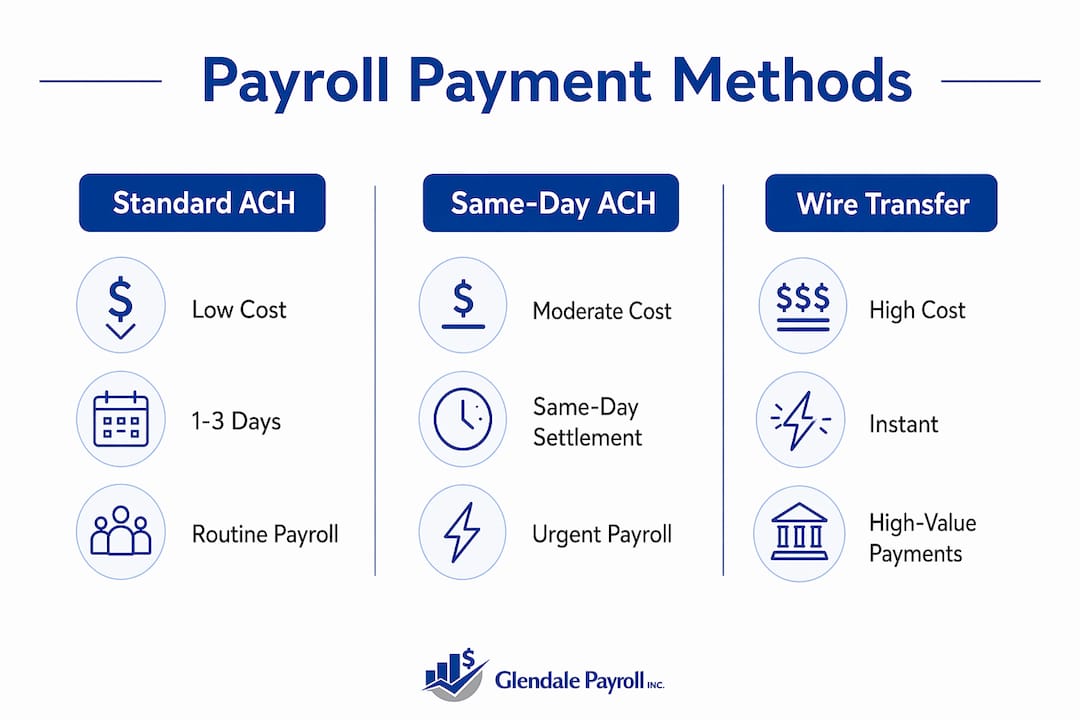
Standard ACH remains the best choice for routine, recurring payroll. It is the lowest-cost option and gives your team time to catch and correct errors before funds settle. ACH credits settle within one banking day for most transactions, and Nacha estimates about 80% of ACH payments settle within one day or less. That statistic shows standard ACH is already fast for most use cases.
Same-day ACH fills the gap between standard ACH and wire transfers. It delivers same-day settlement at a fraction of wire transfer costs, without requiring a separate banking process. Wire transfers remain the right choice for very large, time-critical, or international payments where same-day ACH limits or reversibility constraints are a concern.
For small businesses in California, payroll date management is especially important given state-specific pay frequency and timing requirements. Same-day ACH gives you a reliable tool when a payroll deadline falls on a day when standard ACH timing is too slow.
What steps should small businesses take to implement same-day ACH payroll?
Implementing same-day ACH payroll requires operational adjustments before you submit your first file. The accelerated timeline removes the buffer that standard ACH provides, so preparation is not optional.
- Confirm your bank or payroll provider supports same-day ACH. Not every financial institution offers same-day ACH origination. Verify this capability before you plan around it.
- Verify employee bank account details rigorously. Routing and account data must be accurate before submission. A return on a same-day ACH transaction delays the employee's pay and creates a correction process with no easy same-day fix.
- Ensure cleared funds are in your account before submission. Same-day ACH requires near-immediate fund availability. Review your account balance and confirm funds are cleared, not just pending, before you submit the file.
- Know your submission cutoffs. Build your internal payroll workflow around the 10:30 AM ET cutoff as your primary target. If you miss it, the 2:45 PM ET window is your fallback. Missing both means next-day settlement at best.
- Set up a pre-submission validation checkpoint. Review employee names, account numbers, and payment amounts before every same-day ACH submission. Return rate monitoring is critical because returns post-settlement can delay payroll corrections unexpectedly.
- Document your same-day ACH policy. Define internally which payroll situations trigger same-day ACH use. This prevents overuse and keeps costs predictable.
Following payroll best practices becomes even more critical when you are working within the compressed timeline of same-day ACH. Errors that are minor inconveniences in a standard ACH cycle can become costly disruptions when there is no time to correct them before settlement.
Key Takeaways
Same-day ACH payroll is the most cost-effective tool for urgent payroll needs, but it requires tighter cash flow management and greater data accuracy than standard ACH.
| Point | Details |
|---|---|
| Defined settlement timeline | Same-day ACH settles on the same business day, subject to Nacha cutoff windows and banking hours. |
| Transaction limit applies | Nacha caps same-day ACH entries at $1,000,000 per transaction, covering most small business payroll needs. |
| Higher cost than standard ACH | Per-transaction fees are greater than standard ACH but lower than wire transfers, making it cost-effective for exceptions. |
| Cash flow must be ready | Cleared funds must be available at submission time; same-day ACH does not allow the float that standard ACH permits. |
| Best for off-cycle payroll | Industry guidance recommends using same-day ACH for missed pay runs, corrections, and termination payments rather than routine cycles. |
What we have seen working with same-day ACH payroll in practice
Same-day ACH is genuinely useful. It solves a real problem. But the businesses that get the most value from it are the ones that treat it as a precision tool, not a default setting.
The most common mistake we see is businesses switching all payroll to same-day ACH after one successful urgent run. The cost difference feels small per transaction, but it adds up across a full year of payroll cycles. More importantly, the compressed timeline removes the error-correction buffer that protects you in a standard ACH run. When something goes wrong in a same-day ACH submission, you are dealing with it after settlement, not before.
The future of same-day ACH is worth watching. Nacha continues to expand the network's capabilities, and real-time payment rails like the RTP network and FedNow are growing in adoption. Those systems process payments individually and instantly, unlike the batch windows of same-day ACH. For now, same-day ACH remains the practical middle ground for most small businesses: faster than standard ACH, cheaper than wires, and available through most existing banking relationships.
The businesses that use same-day ACH well have one thing in common. They plan for it. They know their cutoff times, they verify their data before submission, and they keep their cash flow tight. If you build those habits, same-day ACH becomes a reliable safety net rather than a source of stress.
— Glendale Payroll Staff
How Glendale Payroll supports faster, accurate payroll for small businesses
Glendale Payroll works with small businesses across Glendale, Burbank, Pasadena, and Greater Los Angeles to manage payroll accurately and on time, including situations where accelerated processing is needed.

When a missed pay run or off-cycle payment puts you under time pressure, having a payroll partner who understands ACH timing, submission cutoffs, and cash flow requirements makes a measurable difference. Glendale Payroll's dedicated payroll professionals handle the details so you are not scrambling to meet a 10:30 AM ET cutoff on your own. For California small businesses managing state-specific pay timing rules alongside federal ACH requirements, the California payroll tips from Glendale Payroll provide practical guidance tailored to your situation. Contact Glendale Payroll to discuss your payroll processing needs and find out how to keep your team paid accurately and on time.
FAQ
What is the transaction limit for same-day ACH payroll?
Nacha sets the per-transaction limit for same-day ACH at $1,000,000 per entry. This limit covers the payroll needs of most small and mid-sized businesses.
Is same-day ACH payroll the same as instant payment?
Same-day ACH is not instant payment. It processes in scheduled batch windows throughout the business day, with cutoffs at approximately 10:30 AM, 2:45 PM, and 4:45 PM ET.
How much does same-day ACH payroll cost compared to standard ACH?
Same-day ACH carries a higher per-transaction fee than standard ACH, typically ranging from a few cents to low dollar amounts per transaction, but it costs significantly less than a wire transfer.
Can errors be corrected after a same-day ACH payroll file is submitted?
Error correction is very limited once a same-day ACH file is submitted. The accelerated timeline means transactions often settle before a correction can be processed, making pre-submission data validation critical.
When should a small business use same-day ACH payroll?
Same-day ACH payroll is best suited for urgent or off-cycle situations, such as a missed pay run, a termination payment, or a payroll correction. Routine payroll typically runs more cost-effectively through standard ACH.
Recommended
- How Payroll Automation Saves Small Businesses Time and Money | Glendale Payroll Inc.
- Payroll Tips for California Small Businesses | Glendale Payroll Inc.
- Payroll Process Documentation: A Guide for Small Business | Glendale Payroll Inc.
- Why Direct Deposit Benefits Your Employees and Your Business | Glendale Payroll Inc.