The 2026 California SDI employee contribution rate is 1.3%; it applies to all wages with no taxable wage limit. This single rate funds both State Disability Insurance and Paid Family Leave benefits. The maximum weekly benefit rises to $1,765 for claims beginning in 2026. Confirm every figure against the EDD's official contribution rate page before you finalize your first payroll run of the year.
TL;DR:
- The 2026 SDI contribution rate is 1.3% on all wages, with no taxable wage limit, applying equally to high earners and lower-income employees.
- Employers must verify their payroll systems have removed any wage cap fields and perform test runs to ensure correct 1.3% withholding across the entire wage base.
- Accurate payroll reporting and timely filing of quarterly forms are essential, as wage data directly impacts claim processing and claim speed.
- The maximum weekly benefit for 2026 remains $1,765, with the annual maximum payout totaling $91,780 for continuous claims.
- Employers are encouraged to conduct a payroll audit before the deadline to prevent misconfigurations and avoid potential penalties.
Table of Contents
- Understanding the 2026 SDI Rate and What It Funds
- How to Calculate SDI Withholding With No Wage Cap
- Employer Responsibilities: Withholding, Filing, and Deadlines
- Voluntary Plans and the 2026 VP Assessment Rate
- Who Qualifies for SDI Benefits in 2026
- What SDI Actually Covers: Disability and Paid Family Leave
- What's Changing Beyond the Rate in 2026
- How Employees File and Receive SDI Payments
- What the 1.3% Rate Really Means for Small Employers
- Get a Free Payroll Audit Before Your Next Filing Deadline
- Sources
- FAQ
Understanding the 2026 SDI Rate and What It Funds
That's the employee contribution rate for State Disability Insurance in 2026, and it's withheld from gross wages, not net pay. The rate covers two distinct programs under one deduction line: short-term Disability Insurance (DI) and Paid Family Leave (PFL). Employees don't see these as separate line items on their pay stubs, but the combined fund pays out both types of claims.
Quick Fact: The 2026 SDI rate is 1.3%, unchanged in structure from 2024 and 2025, but it still applies with no cap on taxable wages, meaning higher earners contribute proportionally more than they did before Senate Bill 951 took effect.
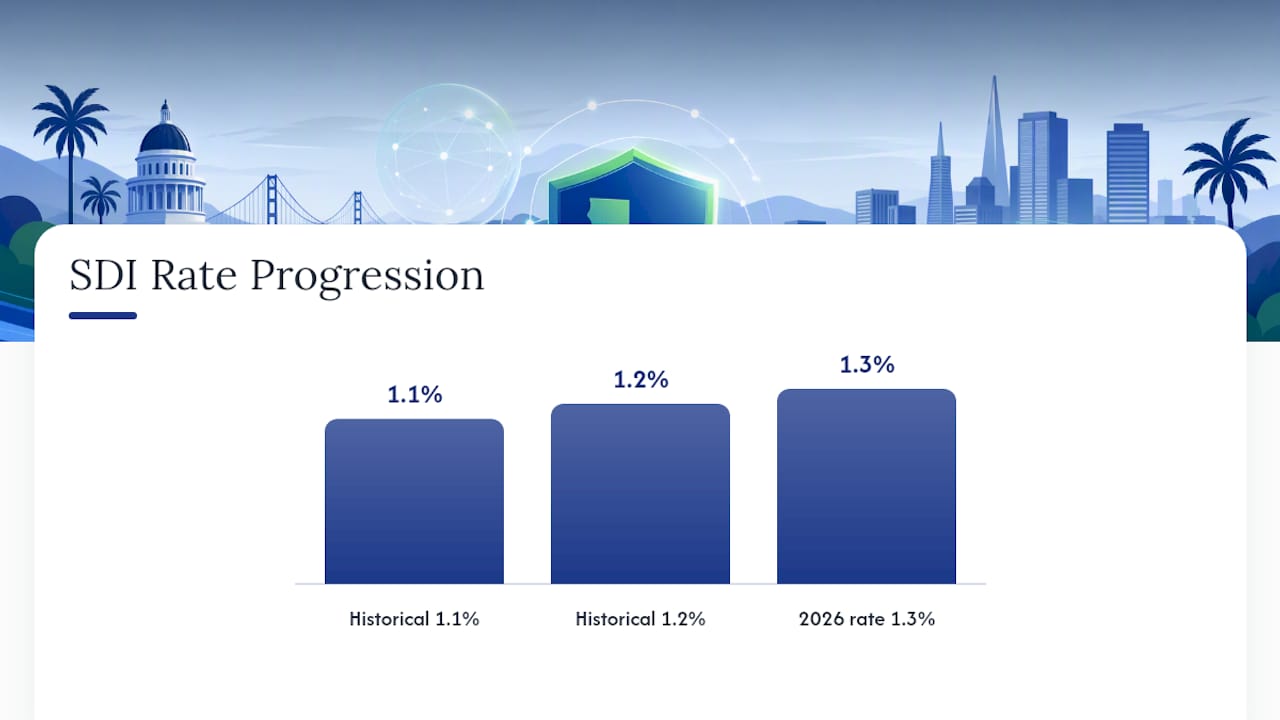
The rate is not static year over year. EDD sets it annually based on the Disability Insurance fund's solvency, and the agency's own fund forecast documents show the progression from 1.1% to 1.2% to the current 1.3%, driven largely by claim volume and fund balance projections. A few things stay consistent regardless of the year-to-year shift:
- The rate applies uniformly to every employee, regardless of job title, income bracket, or industry.
- There is no employer-paid match for SDI. Unlike Social Security or UI tax, this deduction comes entirely from employee wages.
- The maximum weekly benefit for 2026 claims is $1,765, which annualizes to a maximum benefit of $91,780 for a full 52-week claim period.
- EDD publishes updated rate and benefit figures each fall for the following calendar year, so payroll teams should check for updates before December.
Because the rate funds both DI and PFL from a single pool, any employee questions about "why is my SDI deduction bigger than last year" usually trace back to the removal of the wage ceiling, not a rate hike itself.
How to Calculate SDI Withholding With No Wage Cap
Since January 1, 2024, there's no ceiling on wages subject to SDI. Every dollar an employee earns in gross wages is taxed at 1.3%, no matter how high their salary climbs. That single change, mandated by Senate Bill 951, is the biggest structural shift to hit this program in years, and it's the reason high-earning employees now see steadily growing SDI deductions instead of a rate that flattens out once they cross an old wage threshold.
Running the math is straightforward once you drop the cap from your calculation logic. Multiply gross wages for the pay period by 0.013. EDD's own taxable wage guidance walks through this exact method with worked quarterly examples, and the same logic scales down to a single pay period.
A few things to check before you trust your first 2026 payroll run:
- Confirm your payroll software has removed any legacy wage ceiling field for SDI. Older configurations sometimes retain a capped-wage logic from pre 2024 tax tables.
- Run a test payroll for at least one high-earning employee to confirm the software applies 1.3% across the full wage amount, not just a capped portion.
- Reconcile one full pay period manually against the EDD calculation examples to catch rounding or configuration errors early.
Employer Responsibilities: Withholding, Filing, and Deadlines
Withholding the right amount is only half the job. You're also responsible for remitting those funds to EDD on schedule and reporting wages accurately through the correct forms. Missing either step turns a simple rate update into a compliance problem.
Here's the sequence most California employers follow each quarter:
- Withhold 1.3% from every paycheck based on gross wages, with no exceptions for high earners.
- Deposit withheld amounts according to your assigned deposit schedule, which EDD determines based on your total tax liability. Larger employers deposit more frequently than smaller ones.
- File Form DE 9 (Quarterly Contribution Return and Report of Wages) and DE 9C (Quarterly Contribution Return and Report of Wages, Continuation) by the last day of the month following the close of each quarter.
- Reference DE 44, the California Employer's Guide, for the full breakdown of program rules, definitions, and rate history if a question comes up mid-year.
- Reconcile total withholdings against total deposits at quarter close, and again at year end, to confirm the numbers match before W-2 preparation begins.
The most common mistake payroll teams make isn't the rate itself. It's a configuration lag, where a payroll system still applies an old wage cap for part of the year before someone catches it. That discrepancy usually surfaces during quarterly reconciliation, and by then, you may owe back withholding or need to issue corrected pay stubs.
Pro Tip: Reconcile SDI withholding against gross wages every single pay period, not just at quarter end. A five-minute spot check on your first three payrolls of the year catches configuration errors before they compound into a much bigger correction later.
Confirming your deposit schedule and due dates directly with EDD, rather than relying on last year's calendar, protects you from delinquent-filing penalties that are entirely avoidable.
Voluntary Plans and the 2026 VP Assessment Rate
Some employers opt out of the State Plan entirely and run a Voluntary Plan (VP) instead, offering equal or better benefits through a private plan while covering DI and PFL obligations independently. VPs require EDD approval and follow separate reporting rules from standard State Plan withholding.
For 2026, the VP assessment rate is 0.00182, equal to 14% of the 1.3% State Plan rate, as confirmed in EDD's Voluntary Plan general release letter. A few distinctions matter here:
- VP employers still pay an assessment to EDD, just at a fraction of the standard rate, since the state continues to administer certain oversight functions.
- VP status doesn't exempt you from filing entirely. You maintain separate documentation and approval paperwork tied to your VP status.
- If you're not already running a Voluntary Plan, this section is informational only. Most small and mid-sized California employers remain on the State Plan by default.
Who Qualifies for SDI Benefits in 2026
Eligibility hasn't shifted dramatically for 2026, but it's worth restating clearly because employee questions on this topic spike every January. To qualify for a disability or paid family leave claim, an employee generally needs to have earned enough wages in a base period to meet EDD's minimum earnings threshold, and they need to have had SDI contributions withheld from those wages.
Beyond the earnings requirement, a few conditions apply across both DI and PFL claims:
- The employee must be unable to perform their regular or customary work due to a qualifying disability, or need time off to care for a seriously ill family member or bond with a new child, depending on the claim type.
- A licensed health care provider generally must certify the medical necessity for DI claims.
- The employee must file a claim within the standard filing window EDD specifies, since late filing can delay or jeopardize benefit payments.
- Self-employed individuals and certain independent contractors may qualify only if they've elected into Disability Insurance Elective Coverage, since standard SDI withholding doesn't apply to true independent contractor income.
For payroll teams, the practical takeaway is that eligibility determination sits with EDD, not the employer. Your role is limited to accurate wage reporting and withholding, since that wage history is exactly what EDD uses to verify a claimant's base period earnings. If an employee asks whether they qualify, the honest answer is to direct them to EDD's eligibility tools rather than guess based on tenure or job title alone.
What SDI Actually Covers: Disability and Paid Family Leave
SDI isn't a single benefit. It's an umbrella covering two related but distinct programs, and confusing them is one of the more common employee misunderstandings you'll field as a payroll professional.
Disability Insurance (DI) provides partial wage replacement when an employee can't work due to a non-work-related illness, injury, or pregnancy. This is short-term coverage, generally lasting as long as the medical condition prevents work, up to a defined maximum benefit period.
Paid Family Leave (PFL) provides partial wage replacement when an employee takes time off to care for a seriously ill family member, bond with a new child, or in some cases, assist a family member called to active military duty. PFL doesn't require the employee to be sick themselves. It's specifically designed for caregiving and family-formation situations.
Both programs draw from the same 1.3% contribution and share the same maximum weekly benefit structure for 2026, topping out at $1,765 per week. The distinction matters mainly for claim purposes, since PFL and DI have different qualifying conditions and different documentation requirements. An employee bonding with a newborn files a very different claim than one recovering from surgery, even though both draw from the identical payroll deduction.
What's Changing Beyond the Rate in 2026
The headline number gets the attention, but a few structural details around SDI continue evolving heading into 2026, and payroll professionals should track them separately from the rate itself.
The removal of the taxable wage ceiling, effective January 1, 2024, remains the most consequential change still working through payroll systems. Some employers only fully corrected their configurations in 2025, and 2026 is realistically the first full year where most systems should be running clean. If your organization hasn't done a full audit of how your software calculates SDI across the entire wage base, this is the year to close that gap.
Benefit duration and qualifying condition definitions haven't seen the same dramatic overhaul as the wage cap did, but EDD periodically updates guidance around what counts as a qualifying family relationship for PFL claims and how base period calculations work for employees with irregular income. These updates typically show up in revised editions of DE 44 rather than as standalone press releases, so checking the current edition each year matters more than relying on last year's guide.
The broader trend worth watching is fund solvency. EDD's own forecasting documents track the Disability Insurance fund balance and signal whether future rate adjustments are likely.
How Employees File and Receive SDI Payments
The claims process runs entirely through EDD, not through the employer's payroll system, though your wage reporting accuracy directly affects how smoothly a claim gets processed.
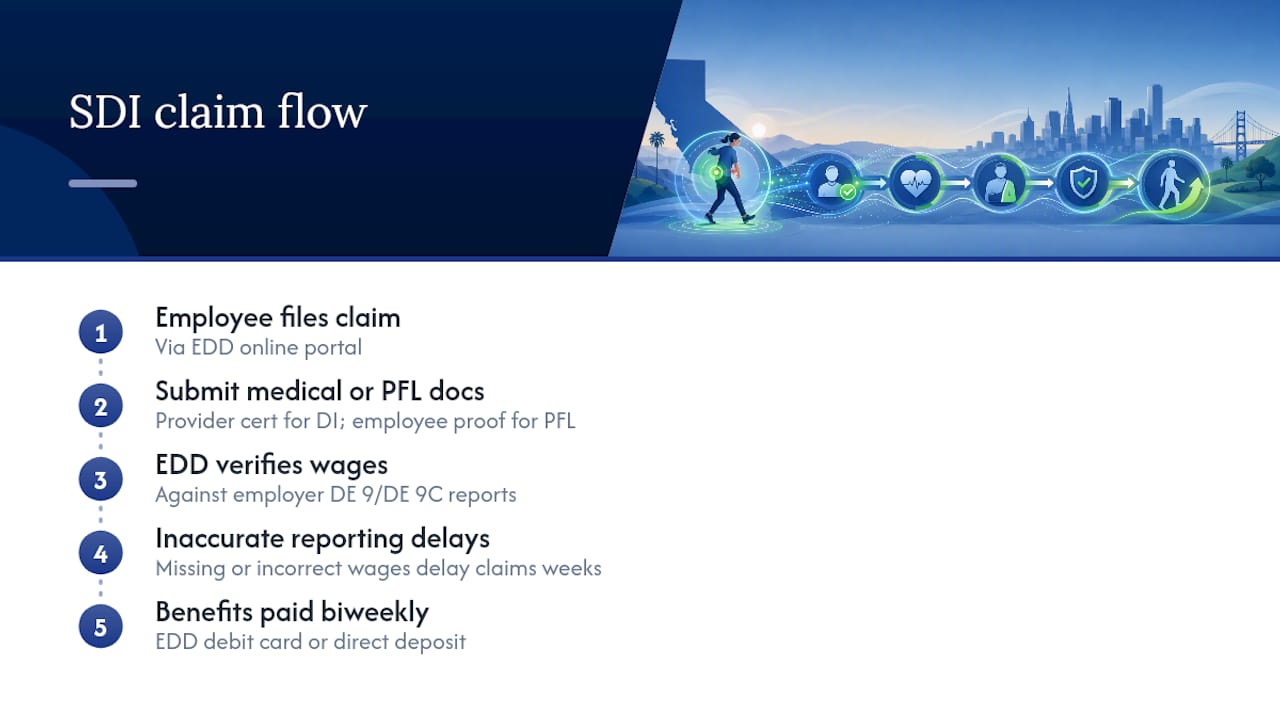
An employee begins by filing a claim through EDD's online SDI portal, typically within a defined window after their disability begins or their family leave starts. For Disability Insurance claims, a licensed health care provider needs to submit a medical certification confirming the employee can't perform their regular work. For Paid Family Leave claims, the employee documents the qualifying family circumstance instead, such as a new child or a family member's serious health condition.
Once EDD receives a complete claim, the agency verifies the employee's base period wages against the earnings your business reported through quarterly DE 9 and DE 9C filings. This is the direct link between your payroll reporting accuracy and how fast an employee's claim moves. Missing or incorrect wage data on your end can delay a legitimate claim by weeks.
Approved benefits get paid on a biweekly basis, typically loaded onto an EDD debit card or through direct deposit, depending on the claimant's preference. There's also a standard non-payable waiting period for most new DI claims before benefits begin, though PFL claims generally don't carry that same waiting period. Employers aren't involved in disbursing these payments. Your responsibility ends at accurate wage reporting and, when applicable, confirming employment dates if EDD requests verification during the claims review.
What the 1.3% Rate Really Means for Small Employers
The rate itself is simple. The operational fallout from the no-wage-cap rule is where small employers actually get tripped up, especially those still running payroll software configured under pre 2024 assumptions.
Our priority list for any California employer this year: test your payroll system with a high-wage sample run, reconcile your first quarter closely, and get ahead of employee questions about bigger-than-expected deductions before they turn into a wave of confused emails. A short internal memo explaining the wage cap removal saves your HR team hours of one-off explanations. If you want a second set of eyes on your setup, our audit preparation checklist is a solid starting point.
— Glendale Payroll Staff
Get a Free Payroll Audit Before Your Next Filing Deadline
Updating a tax table sounds simple until it's your business absorbing an EDD penalty for a misconfigured SDI deduction six months later. Glendale Payroll handles the parts of this transition that trip up in-house teams most: rate updates, EDD account setup, quarterly DE 9/DE 9C filing, and full reconciliation, so nothing slips through between now and year end.

Our team offers a free payroll audit for California businesses to check your current SDI configuration, deposit schedule, and filing history for gaps before they turn into penalties. Every account is managed by a payroll professional, ensuring questions about your specific setup get answered by someone familiar with your account. If you're ready to confirm your 2026 SDI withholding is configured correctly, start with our California payroll compliance guide or request your free audit through our services page today.
FAQ
What is the maximum weekly SDI benefit amount for 2026?
The maximum weekly benefit amount for Disability Insurance and Paid Family Leave claims in 2026 is $1,765, which annualizes to a maximum of $91,780 for a full year of benefits.
Does CASDI tax have a wage limit?
No. Effective January 1, 2024, California removed the SDI taxable wage limit, so the 1.3% rate applies to all gross wages an employee earns during the year, with no cap.
How much does California pay for disability benefits?
Benefit amounts are based on a percentage of the employee's prior earnings, up to the 2026 maximum weekly benefit of $1,765, and payments are issued biweekly by EDD once a claim is approved.
How do I know if my payroll system is calculating SDI correctly for 2026?
A free payroll audit from Glendale Payroll can verify your configuration if you're unsure.