
SDI (technically Disability Insurance, or DI) pays you when you can't work because of your own illness, injury, or pregnancy. PFL pays you when you take time off to care for a seriously ill family member, bond with a new child, or assist a family member called to active military duty. Both draw from the same SDI payroll deduction on your paystub, so the difference comes down to whose health condition triggered your time off. If you're still unsure which applies, the comparison below breaks down eligibility, dollar amounts, and filing steps for each.
TL;DR:
- The highest-earning quarter determines the benefit amount, with lower-wage earners receiving up to 90% of their wages, and higher earners closer to 70%.
- Disability insurance covers your own illness or injury for up to 52 weeks, while Paid Family Leave offers up to 8 weeks for caregiving or bonding purposes.
- Accurate payroll records, including last-day worked and CASDI withholding, are essential for preventing claim delays and ensure proper eligibility verification.
- Filing deadlines are strict: PFL claims need to be filed within 41 days of leave start, and proper documentation is crucial for fast approval.
- Regular payroll audits and proper record-keeping help prevent issues that cause delays in SDI and PFL benefit payments.
Table of Contents
- SDI vs PFL California: A Quick Side-by-Side Comparison
- Who Qualifies for SDI and Who Qualifies for PFL?
- How Much Do SDI and PFL Actually Pay, and for How Long?
- How Do You File an SDI or PFL Claim in California?
- What Should Employers Do to Coordinate SDI and PFL Smoothly?
- Why Payroll Accuracy Determines How Smooth SDI/PFL Claims Go
- Managed Payroll That Keeps Your SDI and PFL Records Claim-Ready
- Where to Verify Current SDI and PFL Numbers
- Sources
- FAQ
SDI vs PFL California: A Quick Side-by-Side Comparison
The fastest way to separate these two programs is to look at who the leave is for. DI is about you. PFL is about someone else in your life who needs you.
| Factor | DI (SDI) | PFL |
|---|---|---|
| Who it covers | Your own non-work-related illness, injury, or pregnancy | Caregiving, bonding with a new child, or military family assist |
| Who files | The employee | The employee |
| Maximum duration | Up to 52 weeks | Up to 8 weeks |
| Benefit calculation | Highest quarter in base period, 70–90% replacement | Same base-period method, same 70–90% bands |
| Funding source | SDI payroll withholding | Same SDI withholding |
| Documentation | Medical certification from a treating physician | Relationship proof (bonding) or care recipient's medical certification (caregiving) |
Pro Tip: Check your paystub for a line labeled "CASDI." That deduction, not a separate line item, is what funds both programs. If you don't see it, ask your payroll provider before you assume you're covered.
Every dollar of that deduction matters more than most employees realize. The SDI withholding rate sits at 1.3% for 2026, and there's no taxable wage limit as of January 1, 2024, meaning higher earners keep contributing on their full wages rather than hitting a cap. If your leave is about your own body, file DI. If it's about someone else's, file PFL. Some employees end up filing both, in sequence, around the same birth or medical event.
Who Qualifies for SDI and Who Qualifies for PFL?
Both programs share a baseline rule: you need at least $300 in wages during your base period, with SDI withheld from those wages. The base period is a specific 12-month span tied to when you file, not necessarily your most recent paycheck, and it can include wages from a prior employer if you switched jobs recently.
Beyond that shared threshold, the two programs split sharply.
- DI eligibility requires that you're unable to do your regular work for at least eight consecutive days due to a non-work-related illness, injury, or pregnancy, and a licensed medical provider must certify the disability.
- PFL eligibility covers caring for a seriously ill parent, spouse, registered domestic partner, child, grandparent, grandchild, or sibling, bonding with a new child within the first year, or assisting a family member on active military duty.
- Edge cases worth knowing: school employees face different base-period rules tied to the academic calendar, and independent contractors generally aren't covered unless they elected into Disability Insurance Elective Coverage.
If your CASDI wages look thin because you changed jobs mid year, don't assume you're ineligible. Wages from a prior employer still count toward your base period.
How Much Do SDI and PFL Actually Pay, and for How Long?
The EDD calculates your weekly benefit amount using your highest-earning quarter within the base period, not an average across the whole year.
- Lower-wage earners generally receive replacement rates closer to 90% of their highest-quarter wages.
- Higher earners typically land closer to 70%, since the 70–90% band scales down as income rises.
- Duration is where DI and PFL diverge most: DI can run up to 52 weeks, while PFL caps at 8 weeks per claim.
The SDI withholding rate funding both benefits is 1.3% in 2026, with no wage cap. That single deduction line is doing double duty, financing both the long-term DI safety net and the short-term PFL benefit.
For the actual dollar figures, don't rely on secondhand estimates. The EDD publishes exact weekly benefit amounts in dollar increments through DE 2589, which is the authoritative place to check current maximum WBAs before you or an employee makes a leave decision.
How Do You File an SDI or PFL Claim in California?
Timing matters more than most employees expect. Filing late or filing the wrong claim type is the single most common reason payments get delayed.
- Confirm your last day worked and gather recent pay stubs showing your CASDI withholding history.
- File through SDI Online, accessible via your myEDD account, rather than mailing a paper form when possible.
- Submit within the deadline window. PFL claims generally need to be filed within 41 days of the start of your leave; DI claims have their own filing windows tied to your disability onset date.
- Attach the correct documentation. DI needs a physician's medical certification. PFL bonding claims need proof of the relationship, like a birth certificate or adoption paperwork, while PFL caregiving claims need the care recipient's medical certification.
- Respond quickly if EDD contacts your employer. The agency may verify wage and separation details, and medical information stays confidential throughout that exchange.
Pro Tip: Missing documentation, not eligibility, causes most delays. Treat bonding and caregiving claims as different paperwork packages from day one instead of assuming one certification covers both.
What Should Employers Do to Coordinate SDI and PFL Smoothly?
Your payroll records are the backbone of every claim your employees file. When EDD reaches out to verify wages or last day worked, incomplete or miscoded records slow everything down for the employee, not just for you.
- Confirm and document each employee's last day worked the moment a leave request comes in.
- Preserve accurate wage history and CASDI withholding records, especially for employees who moved between departments, changed pay rates, or switched from hourly to salaried status mid year.
- Respond to EDD verification requests within the requested timeframe, since delays on the employer side directly delay employee payments.
- Coordinate SDI/PFL timing with Pregnancy Disability Leave, CFRA, and FMLA obligations so leave categories don't get miscoded against each other.
Pro Tip: A misclassified pay period or a missed CASDI deduction on even one paycheck can trigger an EDD inquiry months later. A periodic payroll process review catches these before they become claim disputes. Keeping payroll cadence consistent also helps employees track their own CASDI contributions accurately across biweekly or weekly pay cycles.
Why Payroll Accuracy Determines How Smooth SDI/PFL Claims Go
Most SDI and PFL friction we see traces back to payroll records, not to the employee's actual eligibility. When CASDI withholding gets miscoded, or when a last-day-worked date doesn't match what EDD has on file, a legitimate claim stalls for weeks while the agency sorts out the discrepancy.
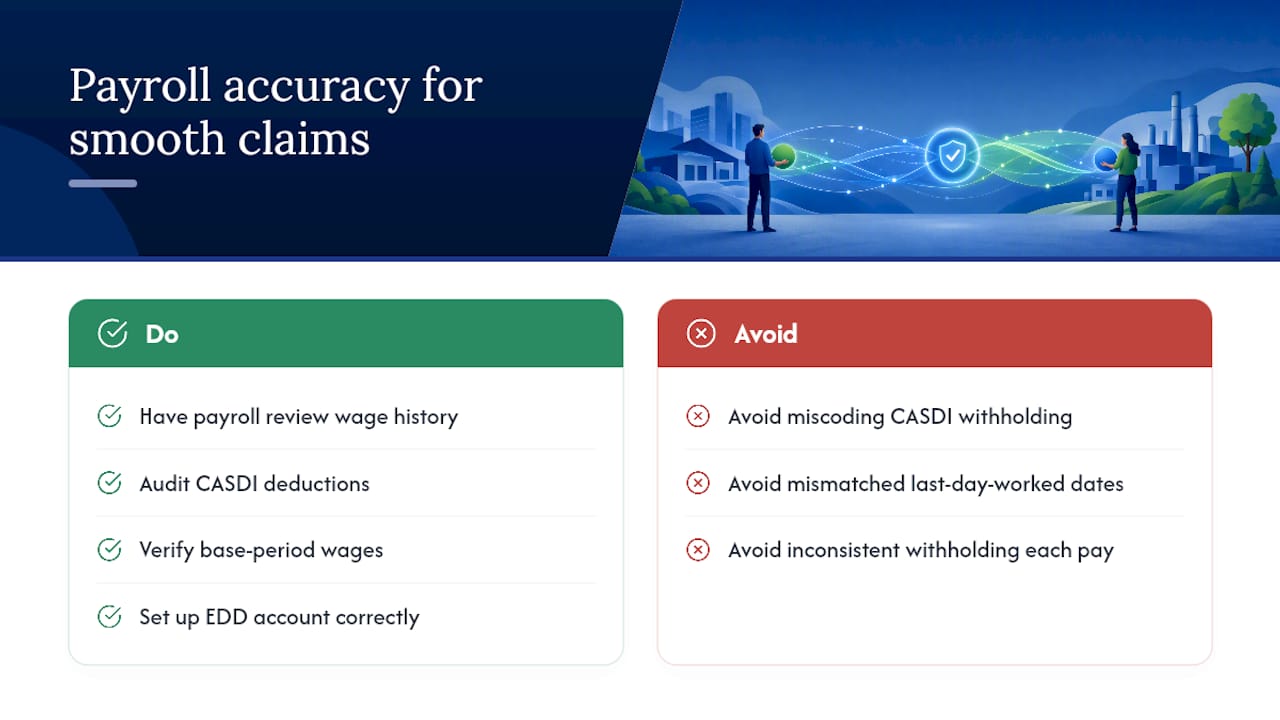
Dedicated payroll professionals catch these errors before they reach EDD, because they're reviewing wage history and withholding line by line rather than processing claims by volume. A thorough payroll audit specifically checks CASDI deduction accuracy, base-period wage reporting, and whether prior employer wages carried over correctly, which is exactly the data EDD cross-checks against every DI and PFL claim.
Getting EDD employer account setup right from the start, and keeping withholding consistent every pay period, does more to prevent claim delays than any employee-facing advice ever will.
— Glendale Payroll Staff
Managed Payroll That Keeps Your SDI and PFL Records Claim-Ready
Glendale Payroll is the alternative to guessing whether your CASDI withholding and wage records will hold up when EDD comes calling. Instead of a call center reading from a script, you get dedicated payroll professionals who catch miscoded withholding and incomplete wage history before an employee's claim ever gets flagged.
Every new client engagement starts with a free comprehensive payroll audit, checking your CASDI deductions, EDD account setup, and wage reporting for gaps that create claim friction down the road. From there, Glendale Payroll's services cover payroll processing, tax filing, direct deposit, W-2 preparation, new hire reporting, and EDD account setup, all built around 100% compliance with federal and California state payroll regulations.
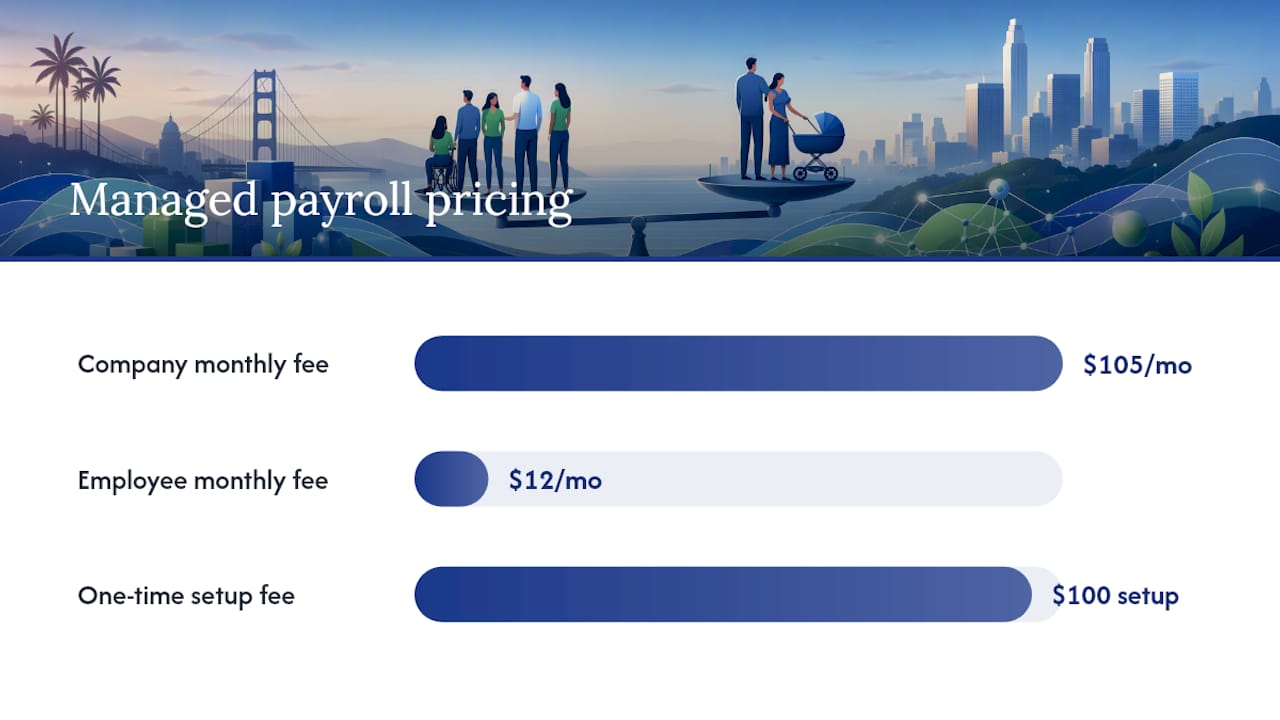
Monthly service runs $105 per month per company plus $12 per employee, with a one-time $100 setup fee for onboarding and EDD account registration. If you want your payroll records claim-ready before your next SDI or PFL request lands on your desk, consider requesting a payroll audit.
Where to Verify Current SDI and PFL Numbers
Always confirm figures directly through official EDD resources before making leave decisions:
- EDD Disability Insurance and PFL overview
- California Employer's Guide (DE 44) for withholding and reporting rules
- DE 2589 weekly benefit tables for current maximum weekly benefit amounts
- SDI Online through myEDD for filing claims directly
Sources
- Am I eligible for DI benefits? (EDD)
- Am I eligible for PFL benefits? (EDD)
- Calculating PFL benefit payment amounts (EDD)
- California Employer's Guide (DE 44)
FAQ
What Are the Downsides of Paid Family Leave?
PFL caps out at eight weeks per claim, far shorter than DI's 52-week maximum. It doesn't guarantee job protection on its own. You typically need to pair a PFL claim with CFRA or FMLA leave to secure job reinstatement rights while you're out.
When Should You Switch From SDI to PFL?
You switch when the reason for your leave changes, not because one program pays better. If your own medical disability ends and you then need time to bond with a newborn or care for a family member, that's a new PFL claim, not a continuation of your DI claim.
How Much Does PFL Pay in California?
PFL replaces roughly 70–90% of your highest-quarter wages during your base period, with lower earners generally receiving the higher percentage. Exact dollar amounts are published in DE 2589, which you should check directly since caps adjust periodically.
Is FMLA or PFL Better for Taking Time Off?
They're not competing options. FMLA and its California counterpart, CFRA, protect your job while you're away; PFL replaces a portion of your lost wages during that same time. Most employees taking bonding or caregiving leave in California use both together rather than choosing one over the other.
Does Glendale Payroll Help With SDI or PFL Compliance?
Glendale Payroll doesn't process employee benefit claims, but its payroll processing, EDD account setup, and compliance audit services keep the wage records and CASDI withholding history that DI and PFL claims depend on accurate and audit-ready.