
For 2026, California's SDI withholding rate is 1.3%, and since January 1, 2024, all wages are subject to SDI with no annual cap. You must withhold this amount from every employee's wages, every pay period, regardless of how much they earn, and remit it to the EDD on schedule.
TL;DR:
- The SDI withholding rate will rise to 1.3% for 2026, with all wages, including bonuses and overtime, now subject to withholding without any cap.
- The rate change is driven by updates to the DI Fund forecast, and payroll systems must review tax tables annually to stay compliant.
- Employers are solely responsible for withholding, depositing, and accurately reporting SDI contributions, which are not matched by the employer.
- Mistakes often stem from outdated software assumptions about wage caps, highlighting the need for regular reconciliation and verification.
- Late deposits or filing errors can lead to penalties, interest, and even personal liability for responsible individuals, emphasizing the importance of ongoing compliance.
Table of Contents
- What the SDI rate and scope mean for California withholding
- Who pays SDI, and how do exemptions and voluntary plans work?
- How do you calculate SDI withholding for 2026?
- Filing and deposit rules employers can't skip
- Common SDI payroll mistakes and how to fix them
- How to explain SDI withholding to your employees
- What happens if you don't comply with SDI withholding rules?
- Why specialist oversight catches SDI errors before they become penalties
- Get SDI withholding right with managed payroll support
- Where to verify SDI rates and requirements directly
- Sources
What the SDI rate and scope mean for California withholding
The 1.3% rate isn't picked at random each year. The California Employment Development Department sets it using a statutory formula under California Unemployment Insurance Code Section 984, which weighs the Disability Insurance Fund's balance against projected claims for both DI and Paid Family Leave benefits. When the fund looks tight, the rate ticks up. When it's healthy, the rate can hold steady or drop. That's exactly what happened between 2025 and 2026, when the rate moved from 1.2% to 1.3%.
The bigger structural shift happened earlier. Senate Bill 951 eliminated the SDI taxable wage limit effective January 1, 2024. Before that, SDI withholding stopped once an employee's wages crossed an annual ceiling (it sat above $153,000 in the last year it applied). Now there's no ceiling at all.
For payroll teams, that means two things going forward:
- Every dollar of wages is subject to SDI withholding, including bonuses, commissions, and overtime, no matter how high total compensation climbs for the year.
- Expect the rate itself to shift annually as the DI Fund forecast updates, so your tax tables need a yearly review, not a one-time fix.
Who pays SDI, and how do exemptions and voluntary plans work?
SDI is an employee-paid tax. You withhold it from wages and remit it to the EDD. Unlike some payroll taxes, employers don't contribute a matching share, though the administrative burden of accurate withholding and reporting falls squarely on the employer.
A few categories work differently:
- Household employers and agricultural employers follow separate registration and reporting timelines, though the SDI rate itself doesn't change based on industry.
- Elective coverage exists for certain business owners, partners, and self-employed individuals who aren't otherwise required to carry SDI but choose to opt in for benefit eligibility.
- Voluntary Plan (VP) employers, who run a state-approved private disability plan instead of SDI, still owe an assessment tied directly to the state rate. That assessment sits at 14% of the state SDI contribution rate, which works out to roughly 0.00182 for 2026. When the state rate moves, your VP assessment moves with it, so a rate bump you didn't notice can quietly throw off your VP budgeting.
How do you calculate SDI withholding for 2026?
The math itself is simple. What trips up payroll teams is the assumption that a wage cap still exists somewhere in the calculation.
- Identify gross wages for the pay period, including regular pay, overtime, bonuses, and commissions.
- Multiply by 1.3% (0.013). There's no wage ceiling to check against, and no point in the year where withholding stops.
- Withhold that amount from the employee's pay and record it separately from federal and other state withholdings.
Here's how that plays out in practice:
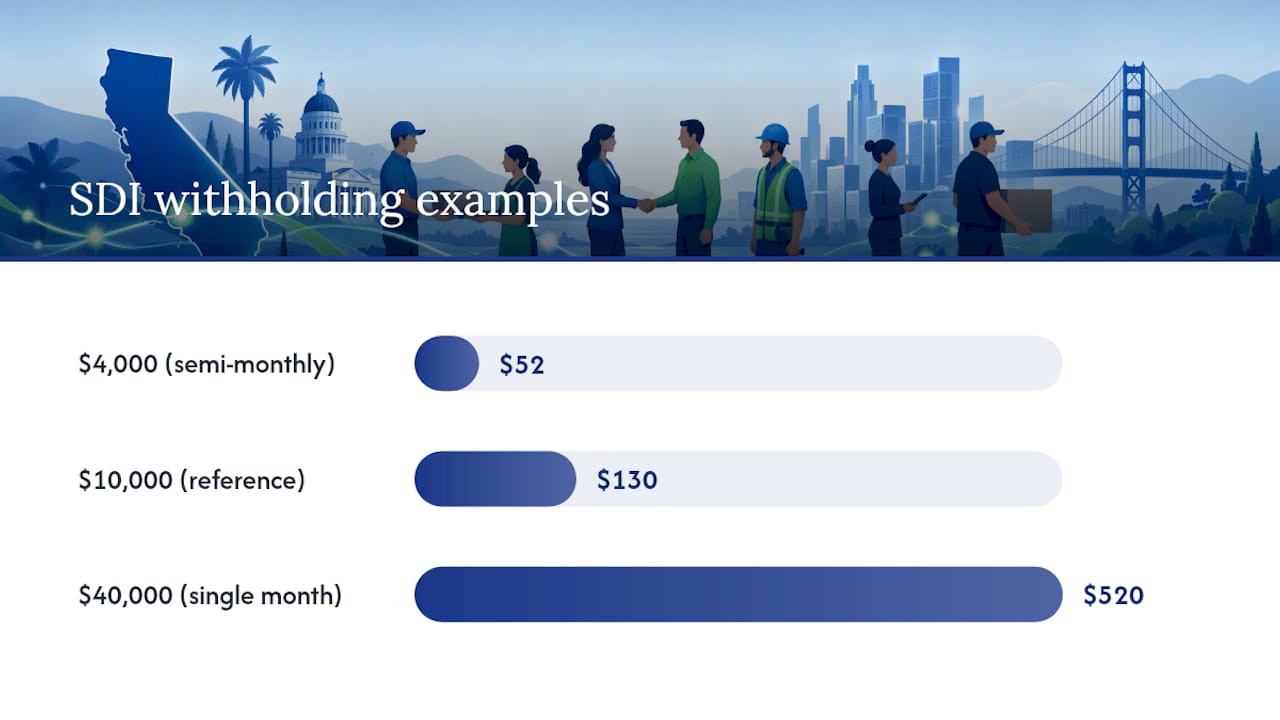
An hourly employee earning $4,000 in gross wages for a semi-monthly pay period owes $52.00 in SDI withholding ($4,000 × 0.013). A salaried executive earning $40,000 in a single month, once bonuses and equity payouts are included, owes $520.00 in SDI withholding on that check alone, with no cap reducing the figure later in the year the way older systems might assume.
Quick reference: at 1.3%, every $10,000 in gross wages generates $130.00 in SDI withholding, uncapped, for the full 2026 tax year.
Legacy formulas that reference the old ceiling will under-withhold high earners without throwing an error, which is exactly the kind of mistake that surfaces months later during reconciliation.
Filing and deposit rules employers can't skip
Withholding correctly is only half the job. Getting SDI dollars to the EDD on the right schedule, and reporting them accurately, is where a lot of otherwise careful employers slip.
SDI contributions get deposited alongside other California payroll taxes using DE 88, and your deposit schedule generally mirrors the frequency the EDD assigns based on your total tax liability, similar in structure to federal deposit timing rules. Separately, you report wage and withholding detail quarterly through DE 9 and DE 9C, and those totals need to reconcile against what you've already deposited via DE 88. A mismatch between the two is one of the fastest ways to trigger EDD scrutiny.
Key filing requirements for 2026:
- Employers with 10 or more employees, and effectively almost all employers, must file and pay electronically through e-Services for Business; paper filing is no longer a practical fallback.
- The EDD uses SIDES for electronic unemployment and disability claim notices, so make sure your registered account is monitored, not just your mailing address.
- Late DE 88 deposits or late DE 9/DE 9C filings both carry penalties, and interest accrues on unpaid amounts separately from the penalty itself.
Pro Tip: Set a recurring calendar reminder tied to your assigned deposit schedule, not the calendar quarter. Many employers default to quarterly deposit habits and miss a monthly or semi-weekly DE 88 obligation the EDD assigned them based on prior liability.
Common SDI payroll mistakes and how to fix them
Most SDI withholding errors trace back to outdated assumptions built into payroll software years ago. Here's a short remediation checklist Glendale Payroll walks through with every new client:
- Confirm your tax tables reflect 1.3% for 2026 with zero taxable wage ceiling anywhere in the configuration.
- Purge references to the old wage cap from any spreadsheet formulas, gross-up calculators, or custom payroll scripts still running old logic.
- Run a sample payroll for your highest earner and manually verify the SDI line against a 1.3% calculation with no cap.
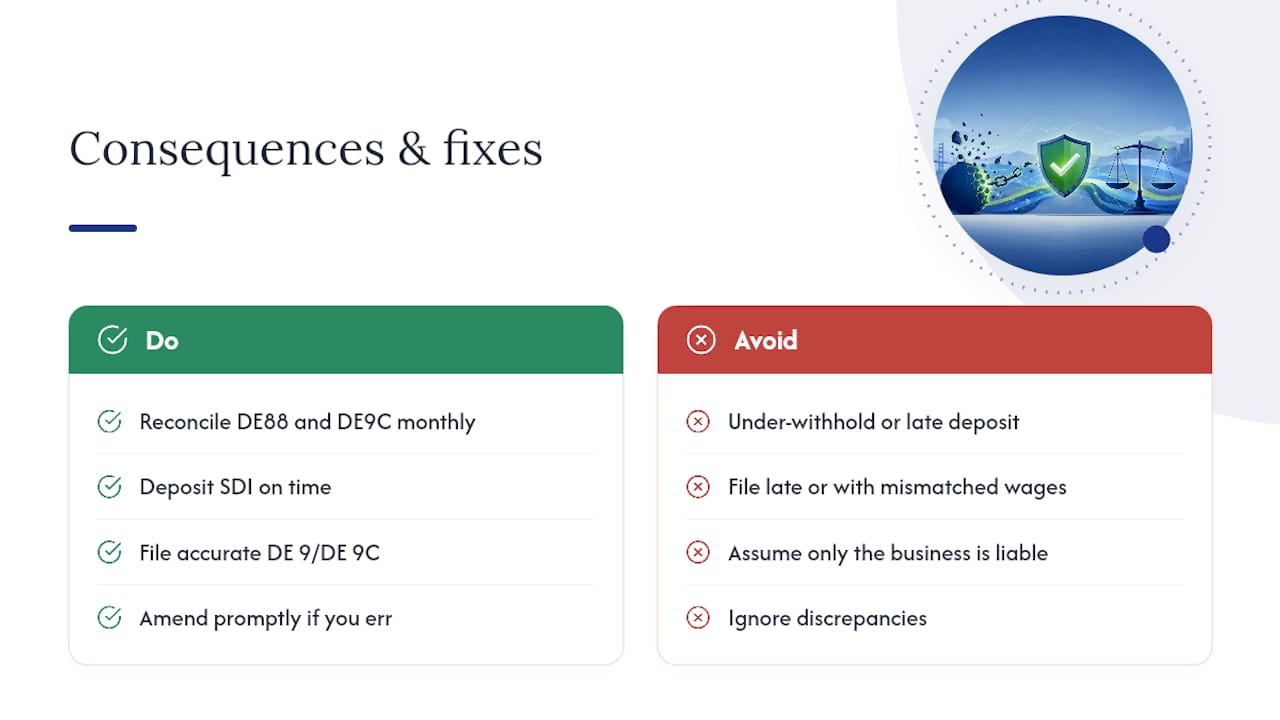
- Reconcile DE 88 deposits against DE 9/DE 9C filings monthly instead of waiting for quarter-end, so discrepancies surface while they're still small.
Gross-up math is the most common failure point, since it requires the correct rate built into the formula from the start rather than applied after the fact. Payroll teams that don't update gross-up coefficients each year risk under-reporting wages, which then distorts year-end W-2 figures and creates a bigger cleanup job in January than a five-minute table update would have in advance.
Pro Tip: Schedule your SDI table review for the same week every December. Rate changes typically post in the fall, giving you a predictable window to update before the first payroll of the new year.
How to explain SDI withholding to your employees
Employees notice when a new withholding line appears or an existing one grows, and a short, accurate explanation heads off most questions before they land in HR's inbox.
A simple script works: "SDI is a state payroll tax that funds California's Disability Insurance and Paid Family Leave programs. If you're ever unable to work due to illness, injury, pregnancy, or need time off to care for a family member, this is the fund that pays those benefits."
A few practical reminders:
- Post the required Notice to Employees (DE 1857A) that the EDD sends after you register your business, along with your UI/DI/PFL rate notice, somewhere employees can actually see it.
- Point employees to the EDD's disability and PFL benefit pages directly rather than trying to summarize benefit eligibility yourself.
- Keep a short internal FAQ handy for HR so the same three or four questions don't require a fresh answer every time.
What happens if you don't comply with SDI withholding rules?
The EDD doesn't treat SDI withholding errors as a minor bookkeeping issue. Under-withholding, late deposits, and inaccurate DE 9/DE 9C filings all carry direct financial consequences, and the exposure compounds the longer an error goes uncorrected.
Late DE 88 deposits accrue penalties on top of the interest that builds on the unpaid balance itself. Filing DE 9 or DE 9C late, or filing with wage detail that doesn't match your actual deposits, can also trigger penalties, and repeated discrepancies raise your odds of an EDD audit. Once an audit starts, it typically doesn't stay narrowly focused on SDI. Examiners routinely expand the review into unemployment insurance, employment training tax, and personal income tax withholding, since all four sit on the same DE 9/DE 9C filing.
There's a personal liability angle too. Responsible individuals within a business, not just the business entity itself, can be held personally accountable for unpaid withholding taxes in certain circumstances, which is a sharper consequence than many small business owners expect from what looks like a routine payroll tax.
Correcting an SDI withholding error after the fact generally means filing an amended DE 9C for the affected quarter, adjusting the employee's wage and withholding record, and paying any shortfall plus accrued interest. The earlier you catch the discrepancy, the smaller that cleanup tends to be, which is exactly why monthly reconciliation between DE 88 and DE 9C matters more than most employers assume until they're the ones filing an amendment.
Why specialist oversight catches SDI errors before they become penalties
Most SDI withholding failures aren't from ignorance. They come from payroll software running on last year's assumptions, unchecked. Glendale Payroll builds its process around a free audit specifically to catch that gap: outdated gross-up formulas, unreconciled DE 88 deposits, tax tables that still reference a wage ceiling that hasn't existed since 2024. A dedicated payroll professional reviewing your account catches what an automated system trained on last year's rules won't.
— Glendale Payroll Staff
Get SDI withholding right with managed payroll support
Running SDI withholding correctly means updating tax tables every year, reconciling DE 88 deposits against DE 9/DE 9C filings every quarter, and catching gross-up errors before they hit a W-2. That's a lot of recurring precision for a business owner already running the rest of the operation.

Glendale Payroll handles that precision as a dedicated service, not a side task squeezed into someone's week. The team manages EDD account setup, keeps tax tables current with every rate change, reconciles quarterly filings against deposits, and flags discrepancies before they turn into penalties. Every new client starts with a free payroll audit that reviews your current SDI calculations, deposit history, and filing accuracy, so you know exactly where the risk sits before committing to anything. If you're a small business in Glendale, Burbank, Pasadena, or the Greater Los Angeles area, review the California payroll compliance guide and schedule your free audit to see where your current setup stands.
Where to verify SDI rates and requirements directly
- EDD Contribution Rates and Withholding Schedules for the current SDI rate
- DE 44 California Employer's Guide for filing and deposit rules
- DE 3395 Tax Rates and Wage Limits for wage valuation tables
Check the EDD's rate page each fall, since annual updates typically post before the new tax year begins.
Sources
- Contribution Rates, Withholding Schedules, and Meals and Lodging Values — EDD
- 2025 California Employer's Guide (DE 44) — EDD