
Seasonal workforce payroll management is the process of handling compensation, tax withholding, and compliance for temporary employees hired during peak demand periods. For small to mid-sized businesses, this process carries real legal weight. The Fair Labor Standards Act (FLSA) applies to most seasonal workers, and labor protections extend to temporary staff just as they do to year-round employees. Getting this wrong means wage disputes, IRS penalties, and state agency audits. Getting it right means a productive season and a clean compliance record.
What legal and compliance requirements apply to seasonal workforce payroll management?
Seasonal employees are generally entitled to at least the federal minimum wage of $7.25 per hour and overtime pay at 1.5 times their regular rate for any hours over 40 in a workweek. That rule holds regardless of whether you hire someone for six weeks or six months. A narrow exemption exists for seasonal recreational businesses that operate fewer than seven months per year and meet specific revenue thresholds, but most small businesses do not qualify.
Workers' compensation insurance is another non-negotiable. Most states require coverage for seasonal employees regardless of their part-time or temporary status. Exceptions are rare and usually limited to specific agricultural or domestic work categories. If a seasonal worker gets injured on the job and you lack coverage, you face both the medical liability and state penalties.

State-level complexity adds another layer. Paid sick leave laws and state unemployment insurance often apply once a worker crosses a minimum hours threshold. Paid leave mandates can trigger unexpectedly for seasonal employees because compressed work schedules push workers past state thresholds faster than employers anticipate. California, for example, requires paid sick leave accrual for employees who work 30 or more days within a year.
Key compliance obligations to track for every seasonal hire:
- Federal minimum wage and overtime under the FLSA
- Workers' compensation insurance as required by your state
- State unemployment insurance (UI) contributions once work thresholds are met
- Paid sick leave accrual under applicable state or local law
- Multi-state payroll tax registration if workers perform duties across state lines
- Final paycheck timing governed by state law at offboarding
Multi-state payroll tax obligations require separate registration, withholding, and reporting for every state where your seasonal employees physically work. A landscaping company that sends crews into neighboring states, or a resort that recruits workers from out of state, faces this complexity directly.
How should you classify seasonal workers to avoid penalties?
Misclassifying a seasonal worker as an independent contractor instead of an employee is one of the most expensive payroll mistakes a small business can make. Repeated misclassification over multiple seasons compounds unpaid payroll taxes, unemployment contributions, and overtime liabilities. The IRS and state labor agencies treat this pattern as willful noncompliance, which triggers enforcement action.
The IRS uses a behavioral, financial, and type-of-relationship test to determine worker status. California applies the stricter ABC test, which presumes a worker is an employee unless the hiring business proves all three conditions: the worker is free from control, performs work outside the usual course of business, and is customarily engaged in an independently established trade. Most seasonal workers fail at least one of these conditions.
Common misclassification risks for seasonal staff:
- Paying workers a flat rate per project without tracking hours
- Allowing workers to set their own schedules while still directing their tasks
- Assuming that short-term or part-time status automatically means contractor status
- Failing to issue W-2 forms because the work felt "informal"
- Not reviewing classification status when rehiring the same workers each season
Pro Tip: Review the classification of every returning seasonal worker before rehiring. A worker who was correctly classified as a contractor in a prior season may qualify as an employee this season if your level of control over their work has increased.
Misclassification in seasonal agriculture and construction carries particular risk. Tripled tax liabilities and unemployment contribution gaps are documented outcomes in these industries when employers misclassify workers across multiple seasons. Annual classification reviews, documented in writing, are your best defense.
How do you execute seasonal payroll accurately, step by step?
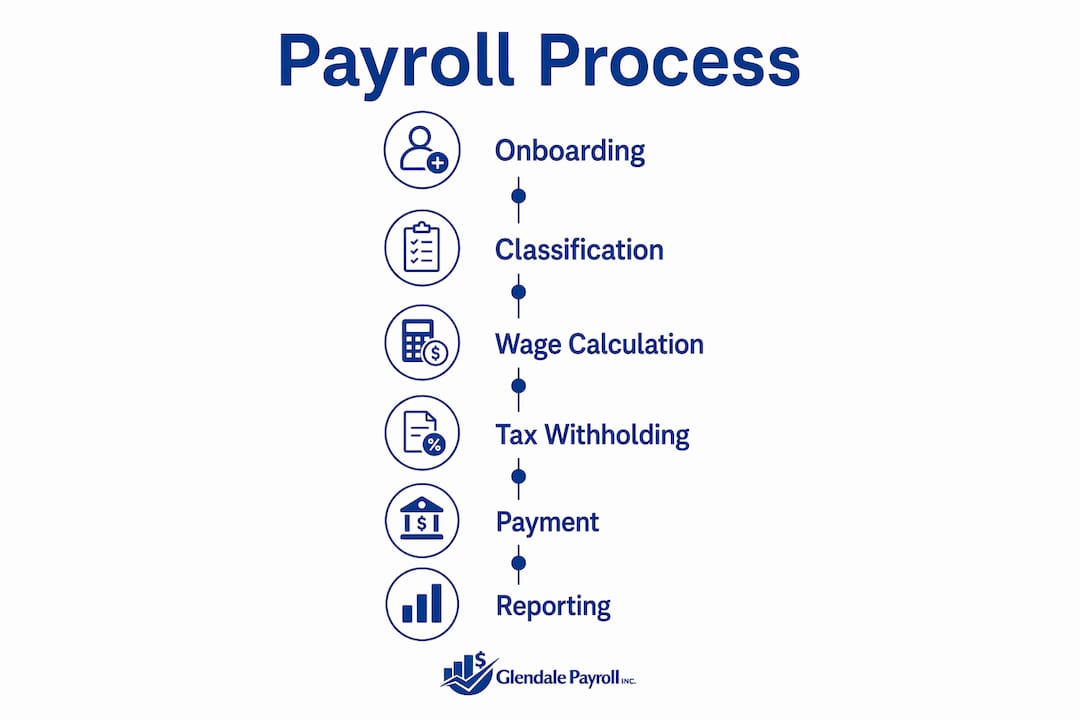
A repeatable payroll process is the difference between a smooth busy season and a compliance crisis. The steps below apply whether you are managing payroll for seasonal hires in retail, hospitality, agriculture, or construction.
-
Standardize onboarding and data collection. Collect a completed W-4, I-9, and direct deposit authorization from every seasonal hire before their first day. Missing documentation creates tax withholding errors that are difficult to correct retroactively.
-
Record hours accurately from day one. Use a time-tracking system that captures clock-in and clock-out data with timestamps. Manual timesheets create disputes and make overtime calculations error-prone.
-
Calculate wages including overtime and state-specific rules. Apply the FLSA overtime threshold of 40 hours per workweek. Some states, including California, require daily overtime after 8 hours worked in a single day. Check your state's rules before the season starts.
-
File payroll taxes on schedule. Deposit federal payroll taxes according to your IRS deposit schedule, either semiweekly or monthly depending on your tax liability. Missing a deposit deadline triggers penalties that compound quickly.
-
Use the Form 941 seasonal employer designation. If you have quarters with no payroll activity, check the seasonal employer box on Form 941. This notifies the IRS that no filing is required for that quarter and prevents unnecessary audit inquiries about missing returns.
-
Manage offboarding and final paychecks carefully. State laws govern final pay deadlines and accrued PTO payouts. California requires final wages to be paid on the last day of work for terminated employees. Missing this deadline triggers waiting time penalties of up to 30 days of the employee's daily wage.
Pro Tip: Build a seasonal payroll calendar before your peak period begins. Map every pay date, tax deposit deadline, and state filing due date onto a single document. Review it weekly during the busy season.
| Payroll step | Key action | Common error to avoid |
|---|---|---|
| Onboarding | Collect W-4, I-9, direct deposit | Missing forms before first paycheck |
| Time tracking | Use digital time records | Manual timesheets with gaps |
| Wage calculation | Apply FLSA and state overtime rules | Ignoring daily overtime in California |
| Tax deposits | Follow IRS deposit schedule | Late deposits triggering penalties |
| Form 941 | Mark seasonal employer box | Filing blank returns unnecessarily |
| Offboarding | Issue final pay per state deadline | Late final paychecks in California |
Timely payroll directly affects staff retention during peak seasons. Delayed payments cause turnover at exactly the moment you need full staffing. Managing cash flow to cover payroll on schedule is as important as the payroll process itself.
What technology features matter for seasonal payroll tools?
Integrated payroll and HR software reduces errors and handles the complexity of managing temporary employee payroll at scale. Software automation handles tax filings, wage calculations, scheduling, and multi-state compliance in ways that manual processes cannot match during a compressed busy season.
When evaluating payroll solutions for temp workers, prioritize these features:
- Multi-state tax compliance. The system should automatically calculate and remit withholding for every state where your workers perform duties.
- Overtime rule configuration. Look for tools that let you set both federal and state-specific overtime thresholds, including daily overtime rules.
- Onboarding document collection. Digital W-4 and I-9 collection reduces paperwork errors and keeps records audit-ready.
- Time and attendance integration. Direct integration between scheduling, time tracking, and payroll eliminates manual data entry errors.
- Audit trail and reporting. Every pay run should generate a record that shows hours, rates, deductions, and tax withholdings by employee.
Entry-level payroll tools handle basic wage calculations and federal tax filings well. They often fall short on multi-state compliance and state-specific overtime rules. Enterprise platforms cover these gaps but carry costs that exceed most small business budgets. The right fit for most seasonal employers is a mid-tier platform with multi-state capability and direct integration with your time-tracking system. Glendale Payroll's integrated payroll solutions are built specifically for businesses that need compliance coverage without the overhead of an enterprise system.
What I've learned from years of seasonal payroll work
Seasonal payroll is not a simplified version of regular payroll. It is regular payroll compressed into a shorter window with more moving parts and less margin for error.
The biggest mistake I see small business owners make is treating seasonal payroll as a one-time event rather than a repeatable system. Every season, the same errors appear: missing W-4s, miscalculated overtime, late final paychecks. These are not random. They happen because the employer did not build a documented process before the season started.
The off-season is when the real work happens. A payroll audit conducted in january or february, before hiring begins, surfaces classification issues, outdated tax rates, and missing documentation from the prior season. That audit is far cheaper than an IRS notice in july. Glendale Payroll's payroll best practices guide covers exactly this kind of pre-season review in practical terms.
Timely, accurate pay also builds something that no compliance checklist can manufacture: trust. Seasonal workers talk to each other. A business known for paying correctly and on time attracts better candidates the following season. A business known for payroll errors does not get a second chance with the same talent pool.
— Glendale Payroll Staff
How Glendale Payroll supports your seasonal hiring season
Managing payroll for a seasonal workforce requires more than software. It requires compliance expertise applied to your specific situation, including your state's overtime rules, your industry's classification risks, and your payroll schedule.

Glendale Payroll serves businesses across Glendale, Burbank, Pasadena, and Greater Los Angeles with dedicated payroll professionals who handle seasonal staff compensation, multi-state tax filings, and compliance reviews. Every new client receives a free payroll audit to identify risks before they become penalties. For California-specific guidance on seasonal payroll compliance, Glendale Payroll's resource library covers the rules that matter most for small and mid-sized employers. To review the full range of services, visit glendalepayroll.com/services.
Key takeaways
Effective seasonal workforce payroll management requires documented processes, correct worker classification, and state-specific compliance applied before the first hire of the season.
| Point | Details |
|---|---|
| Classification comes first | Verify employee vs. contractor status for every seasonal hire before work begins. |
| FLSA and state rules both apply | Apply federal overtime at 40 hours per week and check your state for daily overtime rules. |
| Form 941 seasonal designation | Mark the seasonal employer box on Form 941 to prevent IRS inquiries during off-season quarters. |
| Final pay deadlines are strict | Issue final paychecks by the state deadline; California requires same-day payment for terminated employees. |
| Off-season audits prevent penalties | Conduct a payroll review before each hiring season to catch classification and documentation errors early. |
FAQ
What is seasonal workforce payroll management?
Seasonal workforce payroll management is the process of calculating wages, withholding taxes, and maintaining compliance for temporary employees hired during peak business periods. It applies the same federal and state labor laws as regular payroll, often with added complexity from multi-state obligations and compressed timelines.
Are seasonal employees entitled to overtime pay?
Yes. Seasonal employees are entitled to overtime pay at 1.5 times their regular rate for hours over 40 in a workweek under the FLSA. Some states, including California, also require daily overtime after 8 hours in a single workday.
What happens if I misclassify a seasonal worker as a contractor?
Misclassification triggers liability for unpaid payroll taxes, unemployment contributions, and overtime wages going back to the start of the working relationship. The IRS and state agencies treat repeated misclassification as willful noncompliance, which increases penalties.
Do I need to register for payroll taxes in multiple states for seasonal workers?
Yes, if your seasonal employees perform work in more than one state. Each state where work is performed requires separate registration, withholding, and tax reporting regardless of where your business is headquartered.
What is the Form 941 seasonal employer designation?
The seasonal employer designation is a checkbox on IRS Form 941 that notifies the IRS you do not need to file for quarters in which no wages were paid. Marking this box prevents the IRS from flagging your account for missing returns during your off-season.
Recommended
- Payroll Date Management: A 2026 Guide for Small Businesses | Glendale Payroll Inc.
- How Payroll Automation Saves Small Businesses Time and Money | Glendale Payroll Inc.
- Benefits of Integrated Payroll Solutions for Small Businesses | Glendale Payroll Inc.
- Payroll Tips for California Small Businesses | Glendale Payroll Inc.