
The moment you pay an employee more than $100 in a calendar quarter, you become a "subject employer" under California law, and you have 15 days to register with the EDD. Registering gets you an Employer Payroll Tax Account Number, which you then use to enroll in e-Services for Business. From there, you configure withholding for state income tax and disability insurance, set your deposit schedule, and you're legally ready to run payroll.
TL;DR:
- Employers are required to register with the EDD within 15 days if they pay more than $100 in wages in a calendar quarter, regardless of employee number.
- Registration involves selecting the correct form based on business type and providing key identification details, with online processing being the fastest option.
- Payroll deposits and quarterly reports must be filed electronically using forms DE 88 and DE 9/DE 9C, with deadlines aligned to federal deposit schedules and quarterly calendar dates.
- Starting January 1, 2024, SDI withholding applies to all wages without an upper limit, which affects higher-earning employees.
- A payroll provider can simplify setup and ongoing compliance by handling registration, filings, and audits, especially for multi-employee businesses or those with past missed deadlines.
Table of Contents
- How Do You Register as a California Employer?
- How Do You Enroll in e-Services for Business?
- Which Payroll Taxes Do You Actually Owe?
- What Are the Deposit and Filing Deadlines?
- What Should You Check Before Your First Payroll Run?
- How Does a Payroll Provider Handle This Setup for You?
- Common Setup Mistakes We See in Practice
- Get Your California Payroll Taxes Set Up Right the First Time
- Sources
- FAQ
How Do You Register as a California Employer?
You trigger the registration requirement the moment you pay wages over $100 in a calendar quarter, whether that's one employee or ten. The California Employer's Guide (DE 44) spells this out clearly, and it comes with a hard deadline: 15 days from that first paycheck to get registered.
The EDD uses a family of DE 1 forms depending on your business type, so pick the right one before you start:
- DE 1 for standard commercial employers
- DE 1AG for agricultural employers
- DE 1HW for household employers (nannies, in-home caregivers)
- DE 1NP for nonprofit and public entity employers
- DE 1P for employers of household workers who elect coverage
Before you sit down to fill out whichever form applies, gather your Federal Employer Identification Number (FEIN), your business address, the name and Social Security number of your responsible party, your North American Industry Classification System (NAICS) code, and the exact date you started or plan to start paying wages. Missing any one of these will bounce your application back and eat into your 15-day window.
You can register online through e-Services for Business, which is generally the faster route, or mail a paper DE 1 to the EDD. Online registration typically processes faster than mail, so if you're already close to your deadline, skip the mailbox. Founders juggling their first hire alongside a dozen other launch tasks should treat this step as non-negotiable. For a broader rundown of what new employers owe beyond just registration, startup payroll tax obligations covers the full picture.
How Do You Enroll in e-Services for Business?
Once your registration is submitted, e-Services for Business becomes your control center for everything payroll tax related in California. The EDD built this portal so employers can register, file, and pay entirely online instead of mailing paper forms and waiting on postal delays.
Enrollment follows a predictable sequence:
- Go to the e-Services for Business homepage and select "Enroll."
- Choose your role. Most small business owners select "Employer," while accountants or bookkeepers managing multiple clients select "Representative."
- Set up your security questions and verify your email address to activate the account.
- Once inside, add your new employer account and request your Employer Payroll Tax Account Number if you haven't received it yet.
From that dashboard, you'll handle four recurring tasks: making DE 88 payroll tax deposits, filing your DE 9 and DE 9C quarterly reports, submitting DE 34 new-hire reports, and reviewing any notices the EDD sends your account. You can also authorize a third-party representative, like a bookkeeper or payroll provider, to act on your behalf without handing over your login.
For payments, you'll choose between standard e-Services transactions, Express Pay for a one-time payment without full enrollment, or Electronic Funds Transfer (EFT) if you're moving larger sums regularly. EDD's payment options page breaks down which method fits which situation.
Pro Tip: Enroll in e-Services before your first payroll run, not after. Employers who wait until deposit deadlines are looming often get stuck behind processing delays that a few days of lead time would have avoided.
Which Payroll Taxes Do You Actually Owe?
California employers deal with four distinct payroll taxes, and mixing up who pays which one is one of the most common setup errors.
- Unemployment Insurance (UI): paid entirely by you, the employer, based on a rate the EDD assigns each year.
- Employment Training Tax (ETT): also employer-paid, funding job training programs, and typically a small fraction of a percent.
- State Disability Insurance (SDI), which funds Paid Family Leave (PFL): withheld from employee wages, not paid by you directly.
- Personal Income Tax (PIT): withheld from employee wages based on their DE 4 withholding certificate.
Current UI and ETT rates are specific to your business and appear in your EDD account once you register, so check e-Services rather than relying on a generic number. One change worth flagging for anyone setting up payroll now: Senate Bill 951 removed the SDI taxable wage limit starting January 1, 2024. Before that law, SDI withholding stopped once an employee's wages crossed a certain threshold in the year. That cap no longer exists, which means higher earners now have SDI withheld on every dollar they make, not just the first chunk.
If you're running payroll software or working with a provider, this is the setting most likely to be outdated on an older template. Confirm your system withholds SDI on full wages, not a capped amount, before your first pay run. PIT and SDI deposit timing generally follows the same schedule the IRS assigns you for federal deposits, so whatever deposit frequency you land on federally tends to carry over to your state deposits too.
What Are the Deposit and Filing Deadlines?
Two forms drive the ongoing compliance cycle once you're registered: DE 88 for deposits and DE 9/DE 9C for quarterly reporting. DE 88 is how you actually send money to the EDD for UI, ETT, SDI, and PIT withholding, and your deposit frequency (monthly, semiweekly, or next-day) depends on how much you withhold, mirroring federal deposit rules.
Quarterly reporting works on a fixed calendar regardless of your deposit frequency:
- Q1 (January to March) reports due by April 30
- Q2 (April to June) reports due by July 31
- Q3 (July to September) reports due by October 31
- Q4 (October to December) reports due by January 31
Your DE 9 summarizes total wages and taxes for the quarter, while your DE 9C itemizes wages per employee. Reconcile the two before filing so your totals match, since mismatches are a common trigger for EDD follow-up notices.
New hires need separate attention. You must file a DE 34 new-hire report within 20 calendar days of an employee's start date, and if you use independent contractors, a DE 542 covers that reporting separately. For a deeper look at how deposit frequency gets assigned and what triggers a schedule change, see how payroll tax deposit schedules work. Every one of these filings and deposits must go through electronic channels; California's e-file and e-pay mandate doesn't leave paper as a real option for most employers anymore.
What Should You Check Before Your First Payroll Run?
Before you cut that first check, confirm each new hire's worker classification (employee versus independent contractor) and collect a completed federal Form W-4 and state DE 4 from every employee. You'll need this information anyway to file your DE 34 within the 20-day window.
Set your pay schedule and configure your payroll system to withhold PIT and SDI correctly, factoring in the SDI wage limit removal covered above. Separately, calculate your UI and ETT contributions as the employer, since these don't come out of employee pay.
A few more items round out the checklist:
- Post required workplace notices covering unemployment insurance, disability insurance, and paid family leave where employees can see them.
- Generate paystubs that meet California's itemized wage statement requirements.
- Keep payroll records for the legally required retention period, since EDD audits can reach back several years.
Pro Tip: Run a dry payroll calculation a few days before your actual pay date. Catching a misconfigured withholding setting on a test run costs you nothing; catching it after money has already moved means correcting a filing. A quick internal payroll process review before go-live catches most of these issues early. For contractor-specific new-hire questions, this compliance guide on new hire reporting walks through edge cases in more depth.
How Does a Payroll Provider Handle This Setup for You?
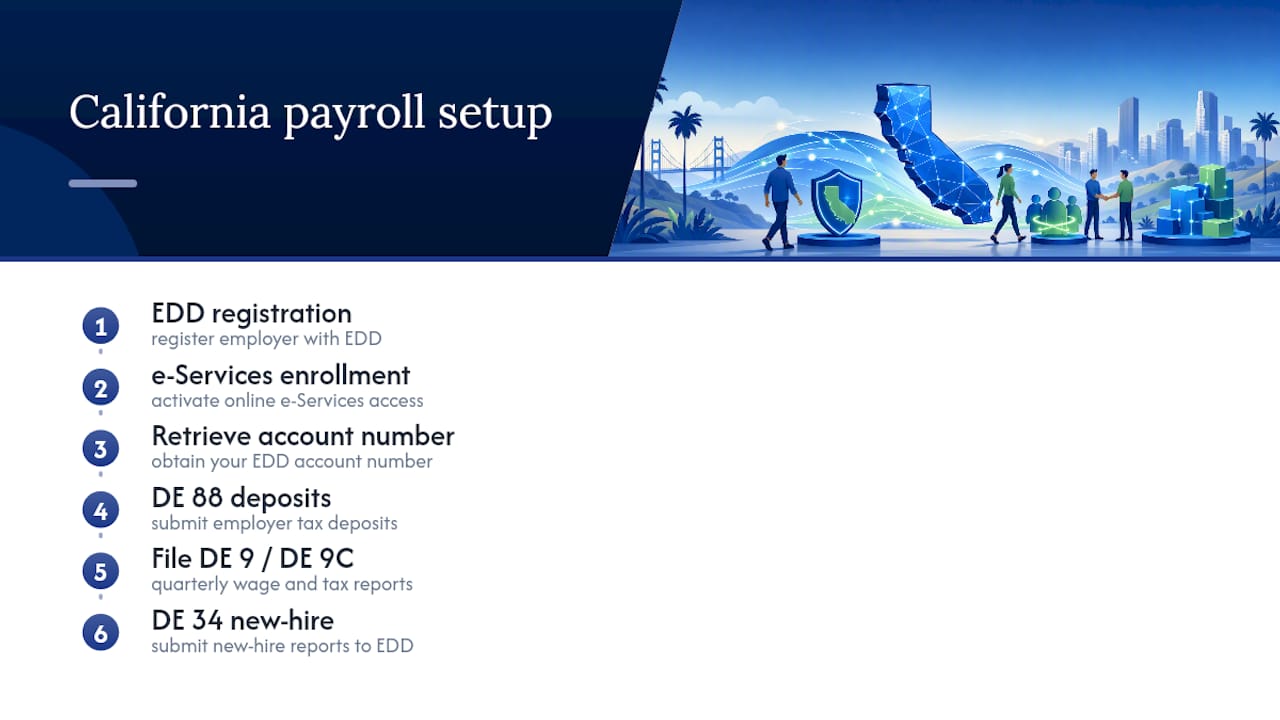
A payroll provider familiar with California can take on the entire registration and filing sequence: EDD registration, e-Services enrollment, retrieving your account number, submitting DE 88 deposits, filing DE 9/DE 9C reports, and handling DE 34 new-hire submissions on your behalf.
A payroll provider's model centered on dedicated payroll professionals rather than a call center, paired with a comprehensive payroll audit that flags risks before they become penalties. That combination matters most for employers in Glendale, Burbank, Pasadena, and across Greater Los Angeles who don't have the bandwidth to track every EDD deadline manually.
Outsourcing tends to make the most sense once you have more than a handful of employees or you've already missed a deadline once. You'll still need to supply basic documents (your FEIN, employee W-4/DE 4 forms, and pay rate information), but the provider handles the filings and deposit timing. When evaluating any provider, ask directly how they handle SDI wage-limit updates, what their deposit-error track record looks like, and whether you get a dedicated contact or a rotating queue.
Common Setup Mistakes We See in Practice
Late EDD registration tops the list, usually because a founder didn't realize the $100 quarterly threshold applied to their situation. Misclassifying a worker as a contractor when they meet employee criteria runs a close second, and skipping the DE 34 new-hire report entirely is more common than you'd expect.
A proactive audit catches most of these before the EDD does. Across Glendale, Burbank, and Pasadena, the pattern repeats: small operational gaps compound quietly until a notice arrives.
— Glendale Payroll Staff
Get Your California Payroll Taxes Set Up Right the First Time
A payroll provider can handle the parts of this checklist that eat up the most time for a first-time employer: EDD registration, e-Services enrollment, and ongoing DE 88 deposits and DE 9/DE 9C filings, backed by a comprehensive payroll audit that flags misconfigured withholding before it turns into a penalty notice.

Setup starts with a one-time fee of $100 to handle your EDD account registration, followed by $105 per month per company plus $12 per month per employee for ongoing payroll processing, tax filing, and direct deposit. Most employers can be running their first compliant payroll within days of handing over their FEIN, employee tax forms, and pay schedule. Review the full service breakdown to see exactly which setup tasks are included, then request your free payroll audit to find out where your current setup stands before your next filing deadline hits.
FAQ
What Payroll Taxes Are Mandatory for California Employers?
California employers must pay Unemployment Insurance (UI) and Employment Training Tax (ETT) directly, and withhold State Disability Insurance (SDI/PFL) and Personal Income Tax (PIT) from employee wages. All four are managed through your EDD payroll tax account once you register.
How Do Payroll Taxes Work in California?
You register with the EDD, receive an Employer Payroll Tax Account Number, then use e-Services for Business to make DE 88 deposits and file quarterly DE 9/DE 9C reports. Deposit frequency generally mirrors your assigned federal deposit schedule.
Do You Need to Register to File Payroll Taxes?
Yes. You must register with the EDD within 15 days of paying wages over $100 in a calendar quarter, and you cannot file returns or deposits without the Employer Payroll Tax Account Number that registration produces.
Can You Do Your Own California Payroll Taxes?
Yes, many small employers handle registration, withholding, and filing themselves through e-Services for Business. It requires tracking deadlines closely, though, and providers like Glendale Payroll exist specifically for employers who'd rather hand off deposits, quarterly filings, and new-hire reporting to dedicated payroll professionals.