
Under California law, employers who require split shifts for non-exempt employees must generally pay a one-hour split shift premium at the applicable minimum wage, unless an exemption applies. That premium is offset dollar-for-dollar by any wages the employee earns above minimum wage on that shift, so many higher-paid employees end up owed nothing extra even when their schedule technically qualifies.
Here's what determines your exposure:
- The trigger: an employer-required, unpaid gap in the workday that isn't a meal or rest period.
- The amount: one hour of pay at the state or applicable local minimum wage, whichever is higher.
- The offset: earnings above minimum wage reduce or eliminate the premium owed.
Pro Tip: Before you assume a schedule qualifies, check both IWC Wage Orders Section 4(C) and the DIR's split shift guidance directly. Payroll software rarely flags this correctly on its own.
Key Takeaways
California's split shift premium equals one hour at the applicable minimum wage, minus any earnings above minimum wage, and must appear as its own line on every wage statement.
| Point | Details |
|---|---|
| Premium trigger | An employer-required, unpaid gap in the workday, not a meal or rest break, on the same workday. |
| Standard amount | One hour of pay at the higher of state or local minimum wage, per IWC Wage Order 4(C). |
| Offset rule | Earnings above minimum wage reduce the premium dollar-for-dollar, sometimes to zero. |
| Common failure point | Wrong minimum wage selection or missing itemization on pay stubs, both common audit findings. |
| Compliance next step | Glendale Payroll's free payroll audit checks wage mapping, paystub formatting, and timekeeping for split-shift exposure. |
Table of Contents
- What Counts as a Split Shift Under California Wage Orders?
- Who Qualifies for the Premium, and Who's Exempt?
- How Do You Calculate the Split Shift Premium?
- How Do You Show the Premium on Pay Stubs and Records?
- What Mistakes Trigger DLSE Claims and Penalties?
- What Should Employers Do Right Now?
- Why California's Split Shift Rule Trips Up Even Careful Employers
- Get a Free Payroll Audit for Split-Shift Compliance
- Where to Verify These Split Shift Rules Yourself
- Frequently Asked Questions About Split Shift Premiums
- Sources
What Counts as a Split Shift Under California Wage Orders?
The Industrial Welfare Commission defines a split shift as a workday interrupted by a non-paid, non-working period the employer establishes, one that is not a bona fide meal or rest break. Think of a restaurant server working the lunch rush, going home for four unpaid hours, then returning for dinner service. Both work periods must fall on the same calendar workday for the rule to apply, according to DIR guidance.
This differs sharply from:
- A bona fide meal period (typically 30 minutes to an hour, taken during a single continuous shift).
- An overnight shift that runs past midnight without a true break in duties.
- A schedule the employee requested, rather than one management imposed.
That last distinction matters more than most employers realize. The legal test hinges on who benefits from the interruption and who required it. If the gap exists because the business only has customer demand at two separate windows, that's employer-driven. If an employee asks for a midday break to handle personal matters, that's a different situation entirely, and it can change whether the premium is owed.
Who Qualifies for the Premium, and Who's Exempt?
Non-exempt hourly employees are covered by the split shift rule. Exempt salaried employees, meaning those meeting the executive, administrative, or professional exemption tests, are not entitled to the premium regardless of their schedule.
Beyond that baseline, California carves out several specific exemptions under the IWC Wage Order Section 4(C):
- Employees who reside at the place of employment (live-in caregivers, resident managers).
- Apprentices indentured under the state Division of Apprenticeship Standards.
- Schedules governed by a valid collective bargaining agreement that meets statutory conditions.
- Voluntary splits initiated by the employee rather than required by the employer.
That voluntary-split exemption is where employers most often get burned in an audit, because "voluntary" needs to be provable, not just assumed.
Pro Tip: Get employee-requested split shifts in writing every time. A simple signed note or an email trail showing the employee asked for the schedule change protects you if the Labor Commissioner ever questions the arrangement.
How Do You Calculate the Split Shift Premium?
The math is more straightforward than most payroll teams expect once you have the formula. According to the calculation method payroll compliance guides use:
- Calculate the floor: (hours worked × applicable minimum wage) + (1 × applicable minimum wage).
- Compare to actual pay: subtract what the employee actually earned that day from the floor.
- Pay the difference, if positive: if actual pay meets or exceeds the floor, no premium is owed.
Here's how that plays out in three realistic scenarios, assuming a hypothetical $17 hourly minimum wage for illustration:
Example A: A minimum-wage worker. An employee works 6 hours total across a split shift at exactly minimum wage. The floor is (6 × $17) + (1 × $17) = $119. Actual pay is $102 (6 hours × $17). The premium owed is $17, a full hour at minimum wage.
Example B: Slightly above minimum wage. The same 6-hour split shift, but the employee earns $19/hour. Actual pay is $114. The floor is still $119. The premium owed is only $5, the gap between actual pay and the floor, not a full hour.
Example C: A higher-paid worker. A 6-hour split shift at $25/hour produces actual pay of $150, which already exceeds the $119 floor. No premium is owed at all, consistent with the offset rule courts have applied in appellate decisions.
Always plug in the highest applicable minimum wage, whether that's the state rate, a city ordinance, or an industry-specific supplement. Los Angeles, Pasadena, and other Southern California municipalities frequently set local minimums above the state floor, and using the wrong number is one of the most common payroll errors we see.
How Do You Show the Premium on Pay Stubs and Records?
Getting the math right is only half the job. California also requires you to document it correctly.
- Itemize the premium separately on the wage statement. Labor Code Section 226 guidance treats this as its own line item, not something folded into regular wages, and lumping it in creates a distinct wage-statement violation even if the total dollar amount is correct.
- Keep detailed time records showing start and end times for each work period, meal and rest breaks, and the length of the split interval itself, as required under IWC recordkeeping rules.
- Map pay by work location if you operate across multiple cities, since local minimum wage ordinances vary and the premium must reflect wherever the work actually occurred.
- Exclude the premium from hours-worked calculations. It's compensation, not time worked, so it doesn't factor into overtime math, per HRCalifornia's guidance.
Pro Tip: If you run locations in Glendale, Burbank, and Pasadena with different local wage ordinances, build a simple lookup table into your payroll system so each location automatically pulls the correct minimum wage before calculating any premium.
What Mistakes Trigger DLSE Claims and Penalties?
Payroll compliance audits repeatedly turn up the same handful of errors, and they tend to compound over time rather than stay isolated.
- Using the wrong minimum wage, typically the state rate when a higher local ordinance applies.
- Folding the premium into regular wages instead of listing it separately on the pay stub.
- Counting the premium as hours worked, which distorts overtime calculations.
- Skipping itemization entirely, creating a standalone Labor Code Section 226 violation independent of the underpayment itself.
Employees can file a claim with the Labor Commissioner's office (DLSE) or pursue a private lawsuit, and remedies can include back pay, interest, and civil penalties. Because wage claims often reach back multiple years, a schedule that quietly shortchanged workers by a few dollars a day can snowball into a five-figure liability once you multiply it across a workforce and a statute of limitations period.
What Should Employers Do Right Now?
Fixing split-shift exposure doesn't require an overhaul, just a focused review.
- Run a scheduling cost estimate before adopting any split shift, factoring in the premium at your highest applicable minimum wage.
- Configure payroll to map by work location, so the system applies the correct minimum wage automatically rather than relying on manual entry.
- Add a dedicated "Split Shift Premium" line to wage statements and verify your timekeeping captures every interruption.
- Bring in a payroll process review if your team isn't confident the current setup catches these cases.
Pro Tip: Run this checklist quarterly, not just once. Local minimum wage increases happen on a rolling basis across California cities, and a rate that was correct in January can be outdated by summer.
Why California's Split Shift Rule Trips Up Even Careful Employers
The split shift premium looks simple on paper and gets misapplied constantly in practice, mostly because the offset rule creates a false sense of safety. Employers see that higher-paid staff rarely trigger a payout and assume the whole rule is low-risk. That assumption ignores turnover, seasonal minimum-wage staff, and the local wage patchwork across Los Angeles County, where a business with locations in Glendale and Burbank might owe different premiums for functionally identical shifts.
Glendale Payroll built its compliance process around exactly this kind of gap. Our dedicated payroll professionals map minimum wage by work location, correct paystub itemization, and rebuild timekeeping records so they hold up under a DLSE inquiry. A free comprehensive payroll audit typically surfaces these issues before they become claims, not after.

Get a Free Payroll Audit for Split-Shift Compliance
If you've read this far and started mentally auditing your own schedules, that instinct is worth acting on. A missed split shift premium rarely shows up as a single complaint. It surfaces as a pattern across pay periods, and by the time an employee or the Labor Commissioner notices, the liability has already compounded.

Glendale Payroll runs a free comprehensive payroll audit that checks exactly the exposure points covered here: correct minimum wage mapping by work location, proper split shift premium itemization on wage statements, and timekeeping records that hold up if the DLSE ever asks questions. Unlike a call center operation, you work with a dedicated payroll professional who understands California's local wage patchwork across Glendale, Burbank, Pasadena, and the broader Los Angeles area. Our California payroll compliance services cover processing, tax filing, and ongoing compliance support so split-shift errors don't resurface every time a city raises its minimum wage. Request your free audit today and find out whether your current schedules are creating liability you don't know about yet.
Where to Verify These Split Shift Rules Yourself
For the underlying legal text, start with the DIR's split shift guidance and IWC Wage Order Article 4, which govern the premium and its exemptions directly. For broader context on shift-based pay structures, Salary Atlas's overview of shift differential pay explains how split-shift rules fit within premium pay practices generally. Glendale Payroll's payroll tips resource covers additional California-specific compliance steps.
Frequently Asked Questions About Split Shift Premiums
Does every split shift automatically require a premium payment? No. The premium only applies when the employer requires the split and the employee's total daily pay falls below the minimum-wage floor for hours worked plus one hour. Voluntary, employee-requested splits and several statutory exemptions can eliminate the obligation.
Which minimum wage applies if my business operates in multiple California cities? Use the highest applicable rate for the location where the work occurred, whether that's the state minimum wage or a city ordinance in places like Pasadena or Los Angeles. Multi-location employers should maintain documentation showing which rate applied at each site.
Does the split shift premium count toward overtime calculations? No. The premium is compensation for the inconvenience of the split, not hours worked, so it stays separate from your overtime calculations under California overtime rules.
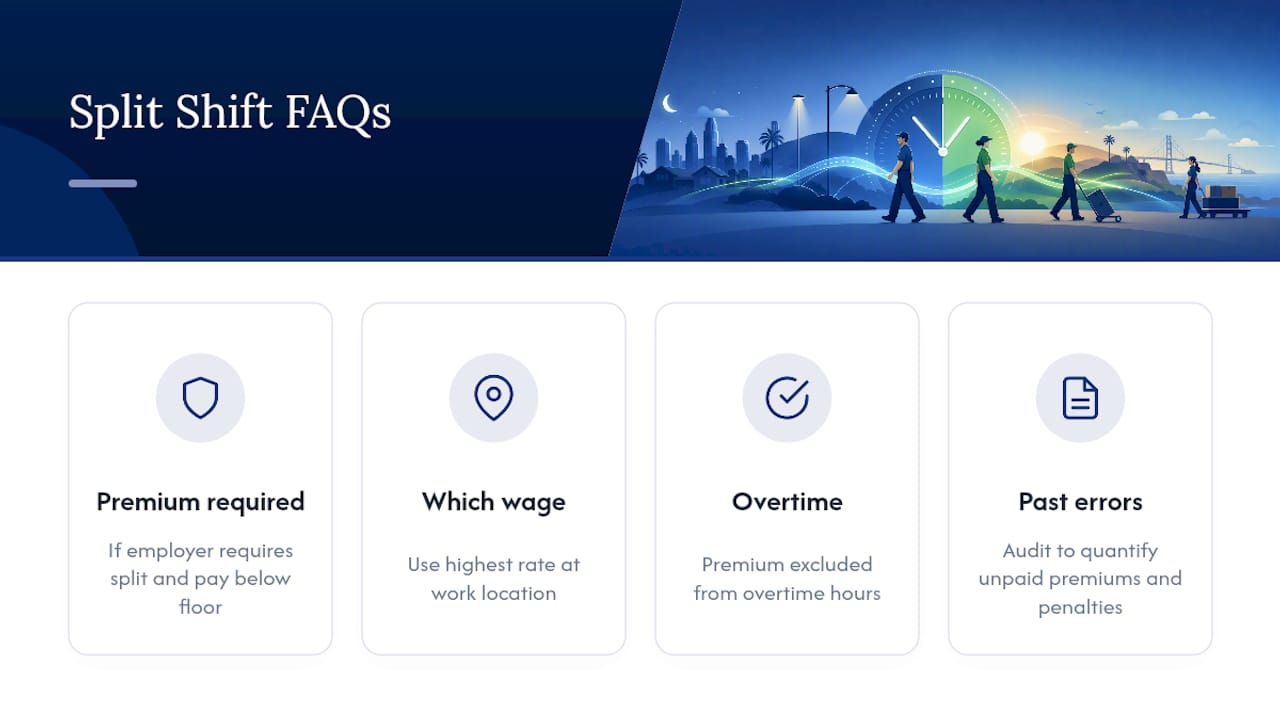
What happens if I've been miscalculating the premium for years? Because wage claims can reach back multiple years, unpaid premiums can accumulate into a significant liability, alongside potential penalties for wage-statement itemization errors. A payroll compliance audit is the fastest way to quantify and fix past exposure.