
Startup payroll tax obligations are defined as the federal and state tax duties every employer must fulfill the moment they hire their first employee. These obligations include withholding federal income tax, Social Security, and Medicare taxes from employee wages, plus paying matching employer contributions and unemployment taxes. The IRS and state tax agencies set strict deposit schedules and filing deadlines. Missing them triggers escalating penalties and, in serious cases, personal liability for founders. Understanding your employer tax obligations from day one is not optional. It is a core financial control that protects both your business and your personal assets.
What are the types of employer payroll tax obligations for startups?
Payroll taxes fall into two categories: taxes you withhold from employees and taxes you pay as the employer. Both are mandatory, and both are tracked separately by the IRS.
Here is a breakdown of each major tax type:
- Federal income tax withholding. The amount withheld depends on each employee's W-4 form and the IRS withholding tables. Employees control this figure through their filing status and allowances.
- Social Security tax. Employers withhold 6.2% from employee wages and match that amount dollar for dollar. This tax applies up to the annual Social Security wage base, which the IRS adjusts each year.
- Medicare tax. FICA taxes total 7.65%, composed of 6.2% Social Security and 1.45% Medicare, with employers matching the full amount. For employees earning above $200,000, an additional 0.9% Medicare tax is withheld from the employee only. The employer does not match this additional amount.
- Federal Unemployment Tax Act (FUTA). This is an employer-only tax. The effective rate after the standard state credit is 0.6%, applied to the first $7,000 of each employee's wages per year.
- State income tax withholding. Most states require withholding based on their own tables and forms. California, for example, uses the DE-4 form and has its own withholding schedules.
- State unemployment insurance (UI). Every state charges employers a UI tax rate based on their claims history. New employers typically receive a standard rate until their experience rating is established.
The critical distinction here is that Social Security and Medicare taxes have two components: the employee share you withhold and the employer share you owe separately. Missing either component creates a tax deficiency.
How does the IRS determine payroll tax deposit schedules?

The IRS assigns deposit frequency based on your total tax liability during a defined look-back period, typically the 12 months ending june 30 of the prior year. New employers with no look-back history default to the monthly deposit schedule.
The two standard schedules work as follows:
- Monthly depositors must deposit all payroll taxes accumulated in a calendar month by the 15th of the following month.
- Semi-weekly depositors must deposit taxes for payroll paid on Wednesday, Thursday, or Friday by the following Wednesday. Payroll paid Saturday through Tuesday is due by the following Friday.
- Next-day rule. Tax liabilities exceeding $100,000 on any single day trigger a next-business-day deposit requirement, regardless of your normal schedule. This rule catches many fast-growing startups off guard.
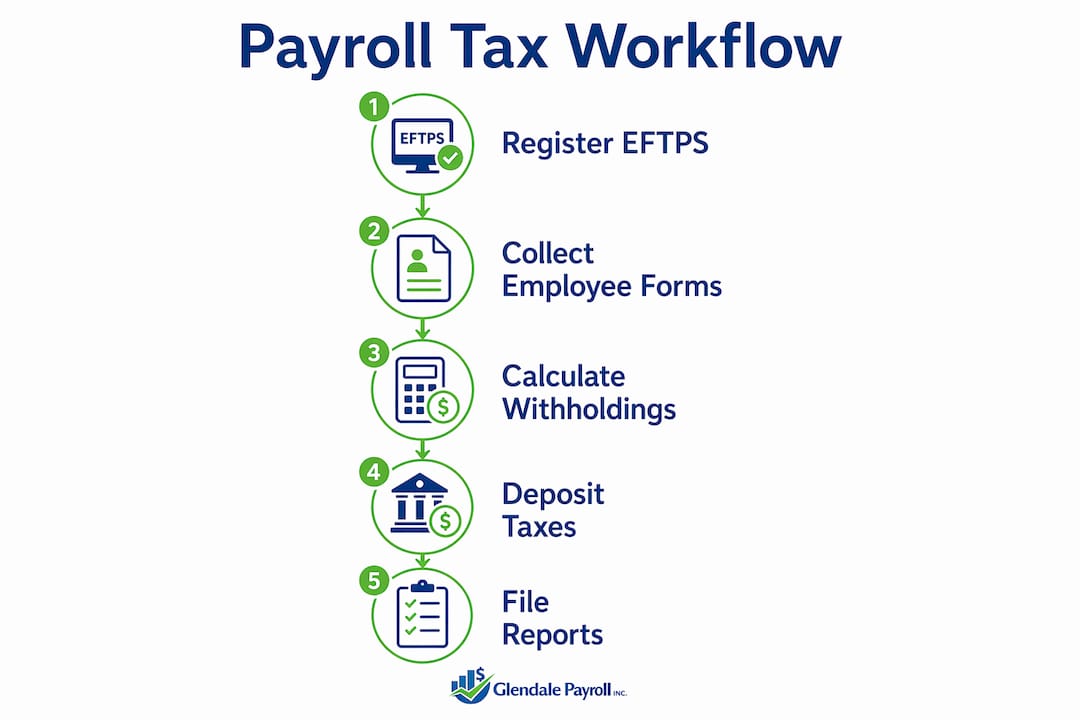
- Quarterly filing with Form 941. Employers file Form 941 every quarter to report total wages paid, taxes withheld, and employer contributions. This form reconciles what you deposited against what you owed.
- Electronic deposits only. Federal tax deposits must be made electronically through the Electronic Federal Tax Payment System (EFTPS). Paper checks are not accepted for payroll tax deposits.
- State deposit schedules. States set their own deposit frequencies, which may differ from federal rules. California, for instance, requires deposits based on payroll frequency and total withholding amounts.
Pro Tip: Set up your EFTPS account before your first payroll run. The IRS requires a 5-business-day enrollment window, and missing that window can delay your first deposit.
What are common payroll tax mistakes startups make?
Payroll tax errors are the fastest way to turn a cash-flow problem into a legal crisis. The IRS treats withheld payroll taxes as government funds held in trust, not as company money.
The most damaging mistakes include:
- Late or missed deposits. Penalties start at 2% for deposits 1–5 days late and climb to 15% if unpaid 10 days after an IRS demand notice. A $10,000 late deposit can cost $1,500 in penalties alone, before interest.
- Using withheld taxes as operating capital. Startups frequently treat payroll tax deposits as optional during cash-flow crunches. The IRS does not accept this reasoning. Those funds belong to the government the moment you withhold them.
- Misclassifying workers as independent contractors. Calling an employee a contractor eliminates your withholding obligation on paper, but the IRS applies the ABC test and similar standards to determine true classification. Misclassification results in back taxes, interest, and penalties for every affected pay period.
- Outdated tax tables. The IRS updates withholding tables annually. Using prior-year tables produces incorrect withholding amounts, which creates a deficiency you must correct at year-end.
- Failing to file W-2s and 1099s on time. The IRS charges per-form penalties for late information returns. Those fines compound quickly across a full employee roster.
Withheld payroll taxes are not your company's money. The IRS treats them as government funds from the moment they leave your employee's paycheck. Spending them on operations is one of the most common and costly startup tax mistakes in 2026.
The most severe consequence is the Trust Fund Recovery Penalty (TFRP). The IRS can hold responsible persons personally liable for 100% of unpaid trust fund taxes. This penalty applies to any individual with authority over company finances, including founders, CFOs, and bookkeepers. Business bankruptcy does not eliminate TFRP liability. The IRS pursues responsible persons individually, which means your personal bank accounts and assets are at risk.
Pro Tip: Treat payroll tax funds as untouchable from the moment payroll runs. Open a separate bank account specifically for tax withholdings if cash-flow discipline is a challenge at your startup.
Payroll automation reduces the risk of these errors significantly by calculating withholdings, scheduling deposits, and filing forms without manual intervention.
How can startups manage payroll tax obligations effectively?
Compliance does not require a large finance team. It requires the right systems and consistent habits from your first payroll run.
Build your compliance calendar first. Map every federal and state deposit deadline, Form 941 due date, and annual filing deadline (W-2s are due to employees by january 31). A missed deadline is almost always a process failure, not a knowledge failure.
Use payroll software that updates automatically. Payroll software that automatically updates tax rates and automates deposit scheduling eliminates the most common calculation errors. Look for platforms that handle both federal and state filings in a single workflow.
Onboard employees correctly from day one. Collect a completed W-4 and your state's equivalent withholding form before the first paycheck. Incomplete or missing forms force you to withhold at the default single rate, which may not match the employee's actual tax situation.
Here is a practical compliance checklist for new employers:
| Task | Timing |
|---|---|
| Register for EFTPS | Before first payroll run |
| Collect W-4 from each employee | At hire, before first paycheck |
| Confirm deposit schedule with IRS | After first payroll quarter |
| File Form 941 | By the last day of the month after each quarter ends |
| Distribute W-2s to employees | By january 31 each year |
| Review state UI rate annually | Each january, when state sends rate notice |
Separate withheld taxes from operating funds. This single habit prevents the most common and most expensive startup payroll mistake. Transfer withheld amounts to a dedicated account on every pay date.
Review California payroll tax updates regularly if your startup operates in California. The state updates SDI rates, UI tax schedules, and minimum wage thresholds on its own timeline, independent of federal changes.
Consider working with a professional payroll service if your team grows beyond five employees or if you operate across multiple states. The administrative complexity multiplies quickly, and the cost of professional help is almost always less than a single IRS penalty notice.
Key Takeaways
Startup payroll tax compliance requires accurate withholding, timely deposits, and correct filings from the first payroll run, with personal liability as the ultimate consequence of failure.
| Point | Details |
|---|---|
| Two-part tax obligation | Startups must withhold employee taxes and pay separate employer contributions for every payroll. |
| Deposit schedule matters | The IRS assigns monthly or semi-weekly schedules; liabilities over $100,000 require next-day deposits. |
| Penalties escalate fast | Late deposits trigger penalties from 2% to 15%, compounding quickly on unpaid balances. |
| Personal liability is real | The Trust Fund Recovery Penalty holds responsible persons liable for 100% of unpaid withheld taxes. |
| Automation reduces risk | Payroll software that auto-updates tax rates and schedules deposits prevents the most common errors. |
What I've learned from watching startups get payroll wrong
Payroll tax compliance is the area where I see founders make their most expensive assumptions. The most common one is that withheld taxes are a short-term loan the business can repay before the IRS notices. That assumption is wrong, and the IRS is not patient about it.
The founders who stay out of trouble share one habit: they treat payroll taxes as a fixed operating cost, not a variable one. They fund a separate account on every pay date and never touch it for operations. That discipline alone prevents the majority of enforcement actions I see startups face.
The second mistake is waiting until the first penalty notice to build a compliance process. By then, the damage is done and the IRS is watching. Building your payroll compliance process before your first hire costs almost nothing. Rebuilding it after an audit costs significantly more, in both money and time.
Professional payroll services are not a luxury for startups. They are a risk management tool. The cost of outsourcing payroll is predictable. The cost of a Trust Fund Recovery Penalty is not.
— Glendale Payroll Staff
How Glendale Payroll helps startups stay compliant
Payroll tax compliance is one of the highest-risk areas for any new business, and it is exactly where Glendale Payroll specializes.
Glendale Payroll provides dedicated payroll professionals, not call center staff, to handle your calculations, withholdings, deposits, and quarterly filings. Every client receives compliance guidance aligned with both federal IRS rules and California-specific requirements, including SDI, UI, and state income tax withholding. Glendale Payroll also offers a free payroll audit to identify existing risks before they become penalties. Founders in Glendale, Burbank, Pasadena, and Greater Los Angeles rely on Glendale Payroll to keep their businesses protected. Read the payroll tips for small businesses or review the full services overview to see how Glendale Payroll can reduce your compliance risk from day one.
FAQ
What payroll taxes does a startup employer owe?
Startups owe federal income tax withholding, Social Security (6.2% employee and employer each), Medicare (1.45% each), FUTA, and applicable state taxes. Employers must both withhold the employee share and pay a separate employer contribution.
When must startups deposit payroll taxes with the IRS?
The IRS assigns either a monthly or semi-weekly deposit schedule based on your prior tax liability. Liabilities exceeding $100,000 on any single day require a next-business-day deposit.
What is the Trust Fund Recovery Penalty?
The Trust Fund Recovery Penalty holds individual responsible persons personally liable for 100% of unpaid withheld payroll taxes. It applies even if the business closes or files for bankruptcy.
What happens if a startup misses a payroll tax deposit?
Late deposit penalties start at 2% for deposits 1–5 days late and increase to 15% for amounts unpaid 10 days after an IRS demand. Interest accrues on top of the penalty.
How can startups avoid payroll tax mistakes in 2026?
Use payroll software that auto-updates tax rates and automates deposit scheduling. Collect accurate W-4 forms at hire, maintain a compliance calendar, and keep withheld tax funds in a dedicated account separate from operating capital.