
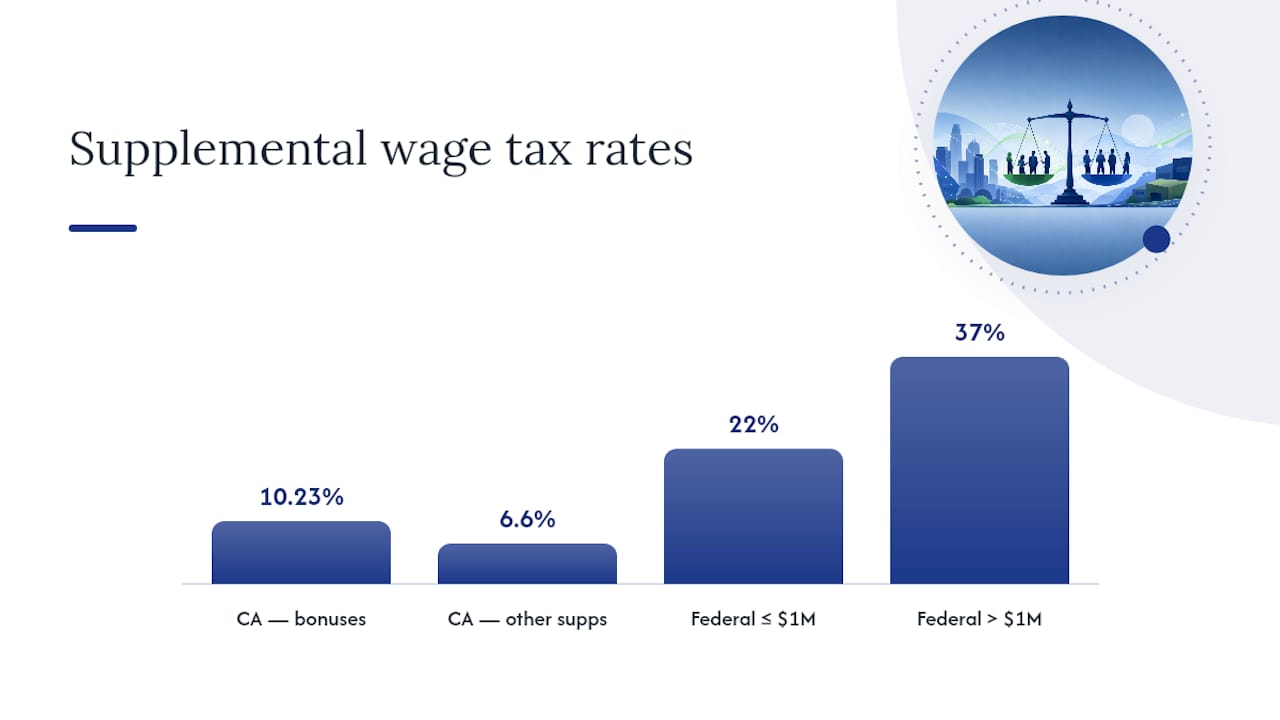
California employers withhold supplemental wages at a flat 10.23% for bonuses and stock options, or 6.6% for other supplemental pay, when using the flat-rate method. The federal rate sits at 22% up to $1 million and 37% above that. But the California Employment Development Department requires aggregation, taxing the combined total at ordinary rates, whenever supplemental wages are paid together with regular wages in the same check.
TL;DR:
- California's flat-rate withholding of 10.23% applies only to bonuses and stock options paid separately from regular wages, while 6.6% covers other supplemental wages outside the payroll run.
- When supplemental wages are paid alongside regular wages in the same check, employers must use the aggregate method, calculating total withholding based on the employee's DE 4 allowances, which can significantly alter tax amounts.
- Aggregation is only required if the supplemental pay is issued at the same time as regular wages, such as in lump-sum payments or combined paycheck disbursements; if paid separately, the flat-rate method applies.
- Failing to correctly choose between flat-rate and aggregate methods may lead to overwithholding or underwithholding, with errors often resulting in EDD assessments or employee disputes.
- Payroll taxes beyond income withholding, including SDI, Social Security, and Medicare, apply to all supplemental wages, with SDI being a common but often overlooked line item.
Table of Contents
- What Is the Supplemental Wage Tax Rate in California?
- Percentage Method vs. Aggregate Method: Which One Applies?
- When Must You Combine Supplemental and Regular Wages?
- How to Calculate Withholding on a Bonus: Two Worked Examples
- Payroll Taxes Beyond the Flat Rate
- Which EDD and IRS Forms Do You Actually Need?
- Common Mistakes and a Pre-Pay Compliance Checklist
- Why Small Withholding Errors Become Big Problems
- Get Your Supplemental Wage Withholding Reviewed Before It Costs You
- Where to Verify These Rates and Rules
- Sources
- FAQ
What Is the Supplemental Wage Tax Rate in California?
Payroll teams need a quick way to confirm which rate applies before they run a check, and California's rules split cleanly into two buckets.
- 10.23% applies to bonuses and stock options paid separately from regular wages.
- 6.6% applies to other supplemental wages, including overtime paid separately, commissions, and severance, when paid outside the regular payroll run.
- 22% is the federal flat rate on supplemental wages up to $1 million in a calendar year; anything above that threshold jumps to 37%, per IRS Publication 15.
These figures come directly from the EDD's DE 231PS information sheet, the authoritative source for California's flat-rate methodology. When layering state and federal withholding together, a $10,000 bonus paid separately is subject to withholding based on 10.23% California and 22% federal flat rates, before FICA or California State Disability Insurance are applied.
Pro Tip: SDI is not optional and it has no wage cap. Every dollar of supplemental pay gets hit with the current SDI rate, which is a common line item employers forget to include when they estimate a bonus payout for an employee.
Percentage Method vs. Aggregate Method: Which One Applies?
California gives employers two paths for withholding on supplemental wages, and the path is dictated by timing, not preference.
- Percentage (flat-rate) method. Use this only when the supplemental payment is issued separately from a regular paycheck. Apply 10.23% or 6.6% directly to the supplemental amount, with no adjustment for the employee's withholding allowances.
- Aggregate method. The EDD's DE 231PS guidance requires this method whenever supplemental wages are paid at the same time as regular wages. You combine the two amounts, calculate withholding on the total using the employee's DE 4 allowances, then back out what regular withholding would have been to isolate the supplemental portion.
- Check the DE 4 before you aggregate. The DE 44 employer guide notes that allowances materially shift the computed tax under the aggregate method. An outdated DE 4 on file means your aggregate withholding is wrong even if your math is flawless.
The choice isn't a formality. Pick the wrong method and you either overwithhold, generating employee complaints, or underwithhold, generating a liability that surfaces at year-end.
When Must You Combine Supplemental and Regular Wages?
The EDD's rule is narrower than most employers assume: aggregation only kicks in when the supplemental payment is paid at the same time as regular wages, not simply earned in the same pay period.
Situations that typically require aggregation:
- A bonus added directly to an employee's regular biweekly paycheck rather than issued as a separate check.
- Vacation pay paid out alongside a final or regular paycheck, which the DE 231PS guidance treats as supplemental once combined with other wages.
- A lump-sum back-pay settlement disbursed together with the employee's current wages.
Pro Tip: Before you run any payroll with a bonus or extra payment, ask one question: is this check separate from the employee's regular wages? If yes, the flat rate applies. If no, aggregate. That single question resolves most misclassification errors before they happen.
Misapplying the flat rate when aggregation was required is one of the more common triggers for an EDD payroll assessment, since it understates withholding on wages that should have been taxed at the employee's marginal rate.
How to Calculate Withholding on a Bonus: Two Worked Examples
Example A: A $5,000 bonus paid as a separate check.
- Federal withholding: $5,000 × 22% = $1,100.
- California withholding: $5,000 × 10.23% = $511.50.
- Social Security: $5,000 × 6.2% = $310. Medicare: $5,000 × 1.45% = $72.50.
- California SDI: $5,000 × the current SDI rate, withheld with no annual wage cap, per state payroll tax guidance.
- Net bonus after these deductions lands meaningfully below the $5,000 gross, often surprising employees who expected the full amount.
Example B: A $2,000 bonus added to a $3,000 regular paycheck.
- Combine the wages: $5,000 total for the pay period.
- Compute withholding on the full $5,000 using the wage-bracket or exact-calculation method from DE 44, applying the employee's DE 4 allowances.
- Subtract what withholding would have been on the $3,000 regular wages alone.
- The difference is the supplemental withholding amount attributable to the bonus.
For bonus payments that push an employee's cumulative supplemental wages past $1 million in a calendar year, federal withholding on the excess jumps to 37%. RSU vesting events raise a similar wrinkle: employers commonly apply the federal flat rate for sell-to-cover withholding, but flat withholding often under- or over-withholds relative to the employee's actual year-end liability.
Payroll Taxes Beyond the Flat Rate
Supplemental wages don't escape the standard payroll tax stack just because they're taxed at a flat rate for income tax purposes.
- Social Security withholds 6.2% up to the annual wage base, and once an employee crosses that threshold for the year, this stops.
- Medicare withholds 1.45% with no cap, plus an additional 0.9% on wages above the federal threshold for high earners.
- California SDI applies to every dollar of supplemental wages with no wage cap, an easy line item to miss when a payroll clerk is focused solely on the income tax rate.
Omitting SDI from a bonus calculation is one of the most frequent errors payroll teams make, since it doesn't show up until the discrepancy surfaces on a W-2 or an audit.
Which EDD and IRS Forms Do You Actually Need?
Every employer handling supplemental wages should keep four documents within reach.
- DE 231PS, the EDD's supplemental wage information sheet, spells out the flat rates and the aggregation rule.
- DE 44, the California Employer's Guide, walks through Method A wage-bracket tables and Method B exact calculations for withholding.
- DE 4 captures each employee's withholding allowances, and DE 9C reports quarterly wages and withholding to the EDD.
- IRS Publication 15 and Publication 15-T govern federal withholding methods and deposit schedules.
Missing a deposit deadline or filing an inaccurate DE 9C can trigger penalties independent of whether your withholding math was correct, so recordkeeping matters as much as calculation.
Common Mistakes and a Pre-Pay Compliance Checklist
The single most common error we see is applying 10.23% to every supplemental payment, when that rate is reserved for bonuses and stock options.
Run this checklist before processing any bonus or supplemental payment:
- Confirm whether the payment is being issued separately or combined with regular wages.
- Verify the employee's current DE 4 is on file if aggregation applies.
- Confirm your payroll system has the correct rate tagged for the payment type.
- Check that SDI and FICA are applied to the full supplemental amount.
Glendale Payroll built its free payroll audit around exactly these failure points, reviewing how a business currently classifies and withholds supplemental wages before an EDD notice forces the conversation.
Why Small Withholding Errors Become Big Problems
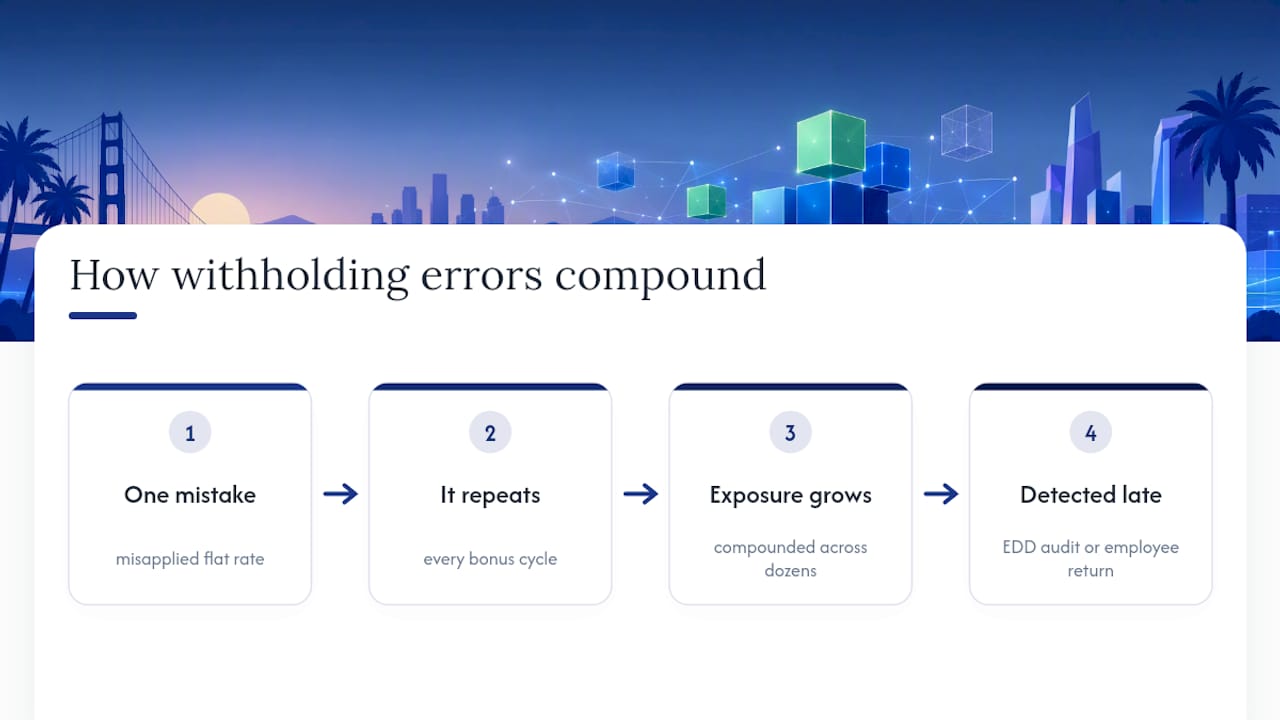
A misapplied flat rate rarely stays a one-time mistake. It usually repeats across every bonus cycle until an EDD audit or an employee's tax return flags the pattern, and by then the exposure has compounded across dozens of payments.
A free payroll audit is a low-friction way to find out whether your current setup already has this exposure.
— Glendale Payroll Staff
Get Your Supplemental Wage Withholding Reviewed Before It Costs You
Dedicated payroll professionals can assist businesses during bonus seasons or RSU vesting events when withholding decisions are critical.

Every new engagement starts with a free comprehensive payroll audit, so you find out where your supplemental wage withholding stands before the EDD does. From there, Glendale Payroll handles payroll processing, tax filing, direct deposit, W-2 preparation, new hire reporting, and EDD account setup, aiming for full compliance with federal and California state regulations on every run. Pricing runs $105 per month per company plus $12 per employee per month, with a one-time $100 setup fee to get your EDD account and onboarding squared away. If you're a small business owner in Glendale, Burbank, Pasadena, or the greater Los Angeles area handling your first big bonus payout, start with the free payroll audit and get a straight answer on whether your supplemental wage withholding is right.
Where to Verify These Rates and Rules
- EDD DE 231PS: flat rates and the aggregation rule.
- EDD DE 44 employer guide: withholding calculation methods.
- EDD rates and withholding page: current SDI and rate updates.
- IRS Publication 15: federal supplemental withholding rules.
- For broader tax obligations, see this California small business tax guide.
Sources
- Information Sheet: Personal Income Tax Withholding - Supplemental Wage Payments, Moving Expense Reimbursement — WARN Act Payments (DE 231PS)
- 2024 California Employer's Guide: DE 44
- Publication 15 (Circular E), Employer's Tax Guide
- EDD — Payroll taxes: rates and withholding
- Bonus Tax in California (2026) — Supplemental Withholding Rate | PaycheckGrid
FAQ
How Are Supplemental Wages Taxed in California?
When paid together with regular wages, the EDD requires aggregation, taxing the combined amount using the employee's DE 4 allowances instead.
Are Bonuses Taxed at 50% in California?
A bonus paid separately faces 22% federal withholding plus 10.23% California withholding, per IRS Publication 15 and the EDD's DE 231PS.
What Is the California Supplemental Tax Rate for 2026?
The rate stays at 10.23% for bonuses and stock options and 6.6% for other supplemental wages, unchanged under the EDD's current guidance.
Are Bonuses Still Taxed at 40%?
The actual amount an employee owes at year-end depends on their total income and tax bracket, which flat withholding rates don't always match.
Does Glendale Payroll Handle Supplemental Wage Withholding?
Yes. Glendale Payroll's payroll processing and tax filing services apply the correct flat or aggregate method to bonuses, commissions, and other supplemental pay, and every new client starts with a free payroll audit to catch existing withholding errors.