
Payroll is defined as the system a business uses to calculate, record, and distribute employee compensation while withholding taxes and meeting regulatory obligations. The role of payroll in business extends far beyond writing checks. It sits at the intersection of financial management, legal compliance, and employee trust. Payroll typically comprises 40%–60% of operating expenses, making it the largest recurring cash outflow most businesses face. The IRS, the California Employment Development Department (EDD), and the Department of Labor all impose direct penalties when payroll obligations are missed. Getting payroll right is not optional. It is a baseline requirement for staying in business.
How does payroll integrate with HR and accounting?
Payroll sits at the crossroads of two departments, and misalignment between them causes most payroll errors. Segregation of duties between HR and Finance is the primary control that prevents both mistakes and fraud. Each department has a distinct role, and understanding that division protects your business.
HR owns data integrity. That means managing employee classifications, pay rates, benefit deductions, new hire onboarding, and termination records. When HR fails to update a pay rate or misclassifies a worker, the error flows directly into every paycheck until someone catches it.

Finance owns execution. That means processing payroll runs, remitting tax deposits to the IRS and state agencies, reconciling payroll accounts against the general ledger, and producing the financial reports your accountant needs. Finance cannot do its job accurately if HR has not provided clean data.
The role of HR in payroll is therefore upstream. HR sets the inputs. Finance processes the outputs. When both departments operate from a single integrated system of record, errors drop sharply and tax reconciliation becomes far less painful.
Common breakdowns between HR and Finance include:
- Delayed termination notices that result in payments to former employees
- Incorrect worker classification that triggers IRS reclassification audits
- Missing benefit deduction updates that create under-withholding
- Unreconciled general ledger entries that distort financial statements
Pro Tip: Set a hard cutoff date for HR data changes before each payroll run. Any update submitted after that date processes in the following cycle. This single rule eliminates most last-minute errors.
What is payroll's impact on business cash flow?
Payroll often accounts for 40%–60% of a business's total operating expenses, which means it is the single largest drain on your cash reserves every pay period. That scale demands planning, not reaction. Businesses that treat payroll as a fixed, predictable obligation build cash reserves accordingly. Those that treat it as a variable expense often find themselves short at the worst possible moment.
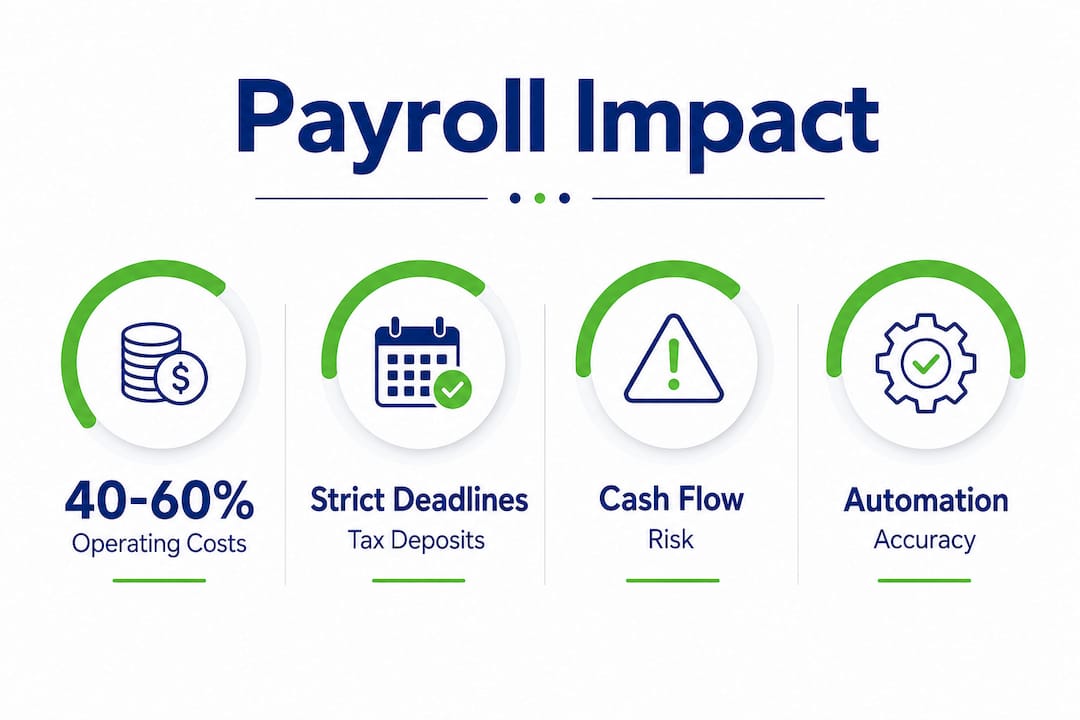
The timing of payroll deposits matters as much as the amounts. Federal tax deposits follow strict IRS schedules tied to your deposit frequency, either monthly or semi-weekly depending on your lookback period. Missing those windows triggers penalties before you even file a return.
Automated payroll systems improve accuracy and provide financial insights that assist cash flow management directly. Real-time labor cost data lets you see exactly what payroll will cost before you run it, which removes the guesswork from cash planning.
Recurring cash flow gaps that cause payroll shortfalls typically signal a structural business failure, not just a temporary cash crunch. If you are regularly scrambling to fund payroll, the problem is not payroll. The problem is your underlying financial model.
| Cash flow risk | Trigger | Consequence |
|---|---|---|
| Late tax deposit | Missing IRS deposit deadline | Penalties starting at 2%, rising to 15% |
| Payroll shortfall | Insufficient cash reserves | Employee turnover, morale damage |
| Covenant breach | Bank notified of missed payroll | Loss of credit line or loan acceleration |
| Supplier credit loss | Operational disruption spreads | Reduced vendor terms, supply chain gaps |
Pro Tip: Maintain a dedicated payroll reserve account funded at least one full pay cycle ahead. This buffer absorbs revenue delays without putting employee pay at risk.
How does payroll affect regulatory compliance and risk?
Payroll compliance is the process of correctly calculating, withholding, depositing, and reporting taxes as required by the IRS, the EDD, and other federal and state agencies. Failure at any step creates legal and financial exposure that grows quickly. Failing to deposit federal payroll taxes promptly triggers IRS penalties starting at 2% for deposits 1–5 days late, rising to 15% after the IRS issues a notice. Those percentages apply to the full deposit amount, not just the overdue portion.
The most serious risk is personal liability. The IRS Trust Fund Recovery Penalty allows the agency to collect 100% of unpaid withheld taxes directly from business owners, officers, or anyone deemed a "responsible party." Corporate structure provides no protection here.
The Trust Fund Recovery Penalty bypasses the corporate veil entirely. If your business withholds income tax and FICA from employee paychecks but fails to remit those funds to the IRS, you become personally liable for the full amount. The IRS can seize personal assets, bank accounts, and property to satisfy the debt.
Key compliance obligations every business must meet include:
- Federal income tax withholding calculated per IRS Publication 15 (Circular E)
- FICA taxes covering Social Security (6.2%) and Medicare (1.45%) for both employee and employer
- Federal Unemployment Tax (FUTA) deposited quarterly
- State income tax withholding per California EDD schedules for California businesses
- State Disability Insurance (SDI) and Paid Family Leave (PFL) deductions for California employees
Payroll compliance is a strategic safeguard, not just an administrative task. The cost of a single IRS audit or penalty notice almost always exceeds the annual cost of proper payroll management.
How does payroll influence employee retention and business scaling?
Payroll accuracy and punctuality are the foundation of employee trust. Workers accept deferred bonuses, reduced hours, and benefit changes. They do not accept being paid late or paid incorrectly. Nearly half of employees consider leaving after two payroll errors. That statistic should concern every business owner because replacing a single employee typically costs more than a full year of proper payroll management.
The role of payroll in workforce planning goes beyond retention. Payroll data reveals labor cost trends, overtime patterns, and department-level spending that inform hiring decisions. When you know exactly what each role costs in total compensation, including wages, employer taxes, and benefits, you can model growth scenarios with real numbers.
Scaling a business without scaling your payroll function creates compounding risk. Here is how payroll supports growth at each stage:
- Startup phase: Establish correct worker classifications from day one. Misclassifying employees as independent contractors under California's ABC test creates retroactive tax liability that can bankrupt a young company.
- Growth phase: Implement standardized payroll procedures before headcount grows. Processes that work for 10 employees break at 50.
- Expansion phase: Add workforce analytics to your payroll function. Track cost per hire, overtime ratios, and total compensation by department to keep labor costs aligned with revenue.
- Acquisition phase: In mergers and acquisitions, payroll due diligence uncovers hidden liabilities including unpaid back taxes, misclassified workers, and unfunded deferred compensation. These findings directly affect deal valuation.
Only 6% of organizations treat payroll data as a strategic asset for workforce planning, while 23% still handle payroll reactively. That gap represents a real competitive advantage for businesses willing to use payroll data proactively.
Payroll professionals are evolving from transaction processors to strategic advisors, intersecting finance, compliance, and employee experience. Businesses that recognize this shift and invest accordingly outperform those that treat payroll as a back-office cost center.
Key Takeaways
Payroll is the most consequential recurring business function because it directly controls cash flow, legal exposure, employee retention, and the quality of data available for strategic decisions.
| Point | Details |
|---|---|
| Payroll drives cash flow | At 40%–60% of operating expenses, payroll requires dedicated cash reserves and advance planning. |
| HR and Finance must align | Segregation of duties between HR and Finance is the primary control against payroll errors and fraud. |
| IRS penalties escalate fast | Late tax deposits trigger penalties from 2% to 15%, and personal liability applies under the Trust Fund Recovery Penalty. |
| Errors cost you talent | Nearly half of employees consider leaving after two payroll mistakes, making accuracy a retention issue. |
| Payroll data informs growth | Only 6% of businesses use payroll as a strategic data source, creating a clear advantage for those who do. |
Payroll is a strategic function, not a back-office task
After working with businesses across Glendale, Burbank, Pasadena, and Greater Los Angeles, I have seen the same pattern repeat: business owners treat payroll as a monthly chore until something goes wrong. Then it becomes a crisis.
The conventional wisdom is that payroll is an administrative function. I disagree. Payroll is a live data stream. Every pay cycle produces real-time information about labor costs, overtime exposure, and total compensation spend. Businesses that read that data make better hiring decisions, catch cost overruns early, and avoid the year-end surprises that derail financial planning.
The owners who struggle most are not the ones with complex payroll situations. They are the ones who delegate payroll entirely without understanding the legal exposure they retain personally. The Trust Fund Recovery Penalty is not a corporate liability. It is yours. That reality changes how seriously you should take payroll oversight.
My recommendation is to treat payroll as you would treat your bank relationship. Review it regularly, understand what the numbers mean, and get professional help before problems appear. Waiting until the IRS sends a notice is the most expensive way to learn this lesson.
— Glendale Payroll Staff
How Glendale Payroll helps you stay compliant and in control
Running payroll correctly in California requires more than a basic software subscription. California's SDI rates, EDD deposit schedules, and AB5 worker classification rules add layers of complexity that generic platforms miss.

Glendale Payroll assigns dedicated payroll professionals, not call center representatives, to each client account. Every client receives a free comprehensive payroll audit to identify compliance gaps before they become penalties. Whether you need California payroll tips for a growing team or a full review of your current process, Glendale Payroll provides the expert oversight your business needs. Businesses in Glendale, Burbank, Pasadena, and across Greater Los Angeles rely on Glendale Payroll to keep their payroll accurate, compliant, and on time. Schedule your free audit today at glendalepayroll.com.
FAQ
What is the role of payroll in business operations?
Payroll manages employee compensation, tax withholding, and regulatory compliance. It is also the largest recurring cash outflow for most businesses, typically representing 40%–60% of total operating expenses.
What happens if a business misses a payroll tax deposit?
The IRS imposes a Failure to Deposit penalty starting at 2% for deposits 1–5 days late, escalating to 15% after an IRS notice is issued. Business owners can also face personal liability under the Trust Fund Recovery Penalty for unpaid withheld taxes.
How does payroll affect employee retention?
Payroll errors directly damage employee trust. Nearly half of employees consider leaving after two payroll mistakes, making accurate and timely payroll a direct factor in staff retention.
What is the role of HR in payroll management?
HR manages the data inputs that drive payroll accuracy, including employee classifications, pay rates, benefit deductions, and termination records. Finance then processes payments and handles tax remittance based on that data.
How does payroll support business scaling?
Payroll data tracks labor costs, overtime trends, and total compensation by department, giving business owners the numbers they need to make informed hiring and growth decisions. Businesses that use payroll as a strategic asset gain a measurable advantage over those that manage it reactively.
Recommended
- Payroll Process Documentation: A Guide for Small Business | Glendale Payroll Inc.
- Payroll Tips for California Small Businesses | Glendale Payroll Inc.
- How Payroll Automation Saves Small Businesses Time and Money | Glendale Payroll Inc.
- Employee Self-Service Payroll Setup: A 2026 Guide | Glendale Payroll Inc.