
Yes, California permits employer-mandated tip pooling, but only within strict boundaries. Labor Code §351 makes every gratuity the employee's property, so pools must be fair and reasonable, exclude owners and managers entirely, and never substitute for full minimum wage. If you run payroll for a restaurant, salon, or hotel, confirm your exclusion list, your passthrough timing, and your paper trail before your next pay period.
TL;DR:
- Tip pools must exclude managers, owners, and supervisors, regardless of their involvement in service, to comply with California law.
- Digital tips through mobile payments and platforms must be fully passed to employees by the next payday, without deducting processing fees.
- Employers need written, documented policies on tip eligibility, distribution formulas, and recordkeeping to defend against DLSE audits and claims.
- Pooling arrangements should reflect fair industry practices and roles directly contributing to guest experience, with clear documentation for each method used.
- California law requires full minimum wage payment separate from tips, making tip pooling a supplement and never a replacement for base wages.
Table of Contents
- What Labor Code §351 and DLSE Guidance Actually Require
- Who Can Share in a California Tip Pool?
- Employer Do's and Don'ts on Wages, Deductions, and Records
- Building a Tip Pool That Holds Up as Fair and Reasonable
- Payroll Mechanics: Getting Tips From Register to Paycheck
- Common Violations That Trigger DLSE Complaints
- An Employer Checklist for Documented, Defensible Tip Pooling
- How Recent California Law Has Shaped Tip Pooling Rules
- Does Tip Pooling Apply Beyond Restaurants?
- How Tip Credits Interact With California Tip Pooling
- Handling Non-Cash Tips: Mobile Payments and Digital Wallets
- Why We Treat Tip Pool Policy as a Payroll Problem, Not Just an HR One
- Get Your Tip Pooling Policy Payroll-Ready
- Sources
- FAQ
What Labor Code §351 and DLSE Guidance Actually Require
California's tip pooling rules trace back to one statute and decades of interpretation built on top of it. Labor Code §351 states plainly that a gratuity belongs to the employee who received it, not the business. Employers and their agents cannot collect, deduct, or credit any portion of it against wages owed. Credit-card gratuities must reach the employee in full, by the next regular payday, with no processing-fee deduction.
The DLSE's Tips and Gratuities FAQ fills the gap the statute leaves open. It confirms that employers may require tip pooling among employees, provided the arrangement is fair and reasonable and excludes anyone with management or ownership authority. Courts lean on Leighton v. Old Heidelberg, Ltd. when a pool's fairness gets challenged, since that decision shaped how California evaluates distribution among employees who jointly produce the guest experience.
Every gratuity is the sole property of the employee for whom it was left, and no employer or agent may collect, take, or receive any part of it.
| Legal source | What it establishes |
|---|---|
| Labor Code §351 | Tips are employee property; no employer collection or deduction |
| DLSE FAQ | Mandatory pooling allowed if fair, reasonable, manager-free |
| Leighton v. Old Heidelberg | Judicial standard for evaluating pool fairness |
Who Can Share in a California Tip Pool?
The DLSE draws its line around "chain of service," meaning the pool should include employees who work together to deliver the customer experience. Direct table service roles clear this bar easily. So do many support positions, as long as the connection to that service chain is real rather than nominal.
Eligible in most pools:
- Servers and bartenders who interact directly with paying guests
- Bussers who clear and reset tables during service
- Bartenders and barbacks supporting drink service
- Hosts, in some arrangements, when they actively assist guest flow
Excluded in nearly every case:
- Managers, supervisors, and owners, regardless of how much floor work they do
- Back-of-house cooks and dishwashers, unless they perform genuine front-of-house service
- Anyone functioning as the employer's agent for scheduling, discipline, or payroll decisions
The DLSE treats managerial exclusion as close to absolute. A shift lead who bartends during a rush still cannot draw from the pool if that person holds real supervisory authority over the staff being pooled.
Employer Do's and Don'ts on Wages, Deductions, and Records
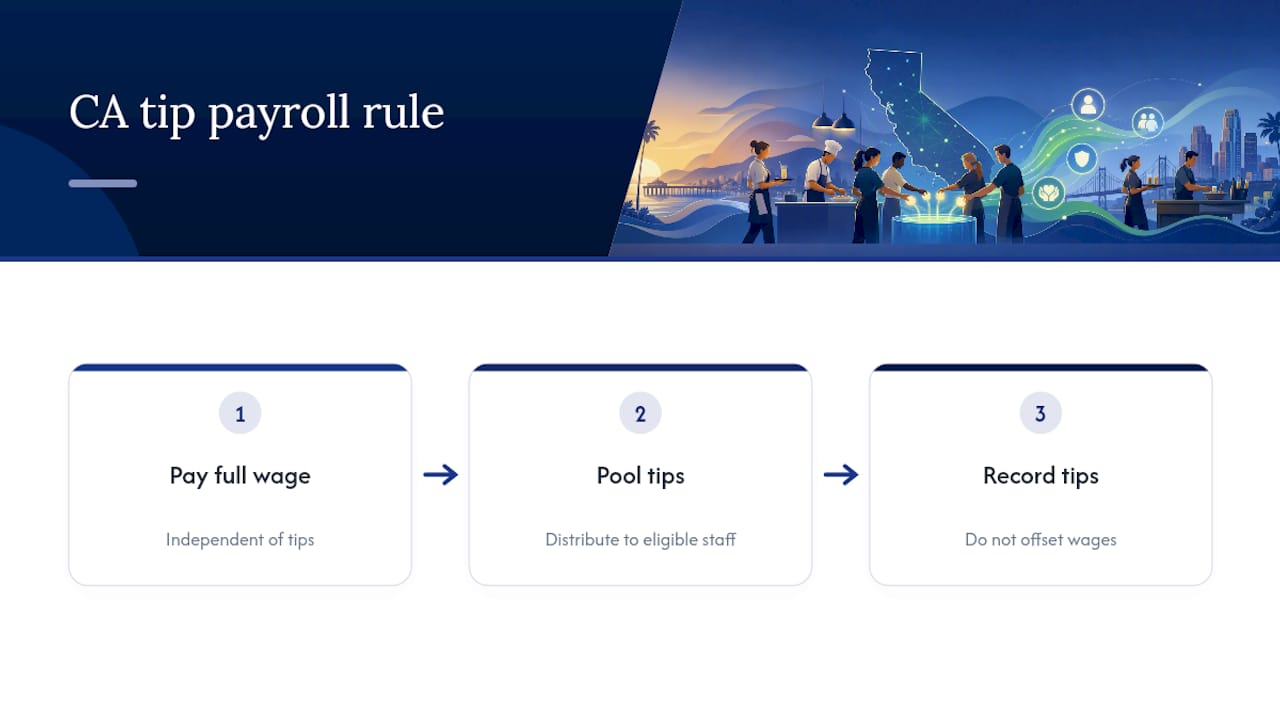
California never lets an employer treat tips as part of the minimum wage. You owe full minimum wage on every hour worked, and tips arrive as a separate, additional payment on top of that obligation, not a substitute for it.
- Pay full minimum wage regardless of how much staff earn in tips.
- Never let a manager, supervisor, or owner draw from the pool, even occasionally.
- Never deduct credit-card processing fees from the tip amount on the slip.
- Pass through credit-card tips by the next regular payday, without exception.
- Keep records of gratuities received and how they were distributed.
One overlooked detail: the prohibition on fee deductions applies to the full tip amount shown on the slip, not a net figure after card fees. Many employers who deduct a few percentage points to cover processing costs are violating §351 without realizing it, and that pattern shows up repeatedly in wage claims once an employee compares their tip total against the receipt.
Building a Tip Pool That Holds Up as Fair and Reasonable
"Fair and reasonable" isn't a fixed percentage. DLSE guidance and the Leighton line of reasoning treat it as a standard tied to industry practice and each employee's role in serving the customer, which gives employers room to design a system that fits their floor plan and staffing model.
Common distribution approaches include:
- Percentage splits by role, similar to the arrangement examined in Leighton, where servers retain a larger share and support staff receive a smaller, defined cut
- Hour-weighted distribution, where each employee's share reflects hours worked during the shift the tips were earned
- Points systems, assigning weighted values to different roles based on their proximity to direct guest service
Whatever method you pick, document it. Your written policy should spell out eligibility criteria, the exact distribution formula, how often the pool is settled, and a clear process for resolving disputes. Include sample calculations from a real pay period so the math is easy for both staff and investigators to verify.
Pro Tip: Write down the business reason behind your split, not just the split itself. That rationale is what turns a number into a defensible standard if the DLSE ever asks you to explain it.
Payroll Mechanics: Getting Tips From Register to Paycheck
Credit-card tips need to move through payroll cleanly. The full amount collected has to reach the employee by the next regular payday, with nothing skimmed for card processing costs along the way.
On the reporting side, the IRS requires tip income on Form W-2, so your payroll process needs a system for tracking what each employee actually received from the pool, not just what the pool collected in total.
- Separate "tips collected" from standard business receipts in your point-of-sale and payroll system
- Reconcile pooled tips against distribution records every pay period, not just at year-end
- Build a checklist into your payroll process review so passthrough timing gets checked automatically, not caught after a complaint
A short internal audit here catches misallocation before it becomes a wage claim.
Common Violations That Trigger DLSE Complaints
Certain mistakes show up again and again in wage claims, and most of them come from a policy that was never written down clearly in the first place.
- A manager who occasionally serves tables and takes a cut of the pool
- Treating pooled tips as a credit against the minimum wage obligation
- Withholding or delaying credit-card tips past the next regular payday
- Deducting card processing fees from the tip total
- No written policy or signed acknowledgment, leaving no proof of what employees agreed to
When an employee files a wage claim, the DLSE investigates and can order back pay plus penalties if it finds a violation. The exposure grows with the number of affected employees and the length of time the practice went unaddressed. If you notice inconsistent tip totals, employee complaints about pool math, or gaps in your distribution records, treat those as red flags worth an internal review before the DLSE gets there first.
An Employer Checklist for Documented, Defensible Tip Pooling
A tip pool that survives scrutiny rests on paperwork as much as good intentions. Build your file around these five items:
- A written tip-pool policy naming eligible roles and excluding all management
- Signed employee acknowledgments confirming they've read and agree to the policy
- A distribution schedule showing the formula and settlement frequency
- Payroll evidence proving credit-card tips passed through by the next payday
- A retention log for tip records, kept for several years in case of audit
Sample distribution calculations for a few representative pay periods belong in this file too, since they show regulators exactly how the formula applies in practice, not just what it says on paper.
Pro Tip: During payroll audits, the two most common problem areas are misapplied credit-card fees and manager participation. A free payroll audit can surface both before they turn into a wage claim, especially in businesses running tip pools across multiple shifts or locations.
How Recent California Law Has Shaped Tip Pooling Rules
The core framework under §351 has stayed remarkably stable, but enforcement patterns and interpretive guidance keep sharpening around its edges. The DLSE has continued to refine what counts as a legitimate "chain of service" as service models diversify, particularly as counter service, fast-casual, and hybrid dining formats blur the line between traditional front-of-house and back-of-house roles.
Wage and hour litigation across California has also kept pressure on employers to document their reasoning, not just their math. Courts examining pooling disputes tend to ask whether the employer can show a coherent business rationale connecting each included role to the guest experience. A pool that looks fair on a spreadsheet but has no documented logic behind it is more vulnerable in a dispute than one with a thinner margin but a clear paper trail.
Minimum wage increases have amplified the stakes as well. As the wage floor employers must guarantee climbs, the temptation to treat tip income as an offset grows, and that's precisely the maneuver §351 forecloses. Employers who once ran informal pooling arrangements without much scrutiny now find that the same practices draw more attention, both from employees who understand their rights better and from the DLSE itself.
None of this changes the fundamental rule: pools must exclude managers, must be fair and reasonable, and must never reduce the wage obligation. What has changed is the expectation that employers can prove it, in writing, when asked. A policy sitting in someone's memory rather than in a signed document is a liability that grows every year enforcement attention increases.
Does Tip Pooling Apply Beyond Restaurants?
Tip pooling rules under §351 apply to any California employer where gratuities are customary, not just restaurants. Salons, spas, valet services, hotels, and bars all operate under the same statutory framework, even though the "chain of service" looks different in each setting.
A hotel, for example, might pool tips among bell staff and front-desk employees who jointly handle guest arrivals, while excluding the concierge manager who oversees them. A salon might pool tips among stylists and the assistants who wash and prep clients, while excluding the owner who also happens to work the chair on busy days. The DLSE's fairness standard travels across industries because it was never written around restaurant service specifically. It was written around who actually contributes to the service the customer paid to receive.
Valet operations present an interesting variant, since tips there often arrive individually rather than through a single point of sale, and pooling decisions hinge on whether multiple attendants jointly handle a single vehicle's arrival and departure. Spas face similar questions when a treatment involves both a therapist and a support staff member who preps the room.
The practical takeaway for employers outside the restaurant world: don't assume tip pooling rules are a restaurant-specific concern. If your business collects gratuities and you want to distribute them among staff, the same manager exclusion, the same fairness standard, and the same recordkeeping expectations apply, regardless of whether you're running a dining room or a day spa.
How Tip Credits Interact With California Tip Pooling
Here's where California diverges sharply from many other states, and where out-of-state operators most often trip up. Federal law and many state wage laws allow a "tip credit," letting employers pay tipped employees a lower cash wage on the assumption that tips make up the difference to reach minimum wage.
California doesn't allow that. Employers here must pay the full state or local minimum wage, in cash, before a single dollar of tip income is counted. Tips are always additional income on top of full wages, never a substitute for part of them. This distinction matters enormously for any multi-state employer importing payroll practices from a jurisdiction that permits tip credits.
Tip pooling doesn't change this calculation. Pooling redistributes tip income among eligible employees, but it has no bearing on the wage floor the employer owes each person. An employee who receives a smaller share from the pool because they worked fewer service-heavy shifts still must have received full minimum wage for every hour worked, calculated entirely apart from tips. The IRS documentation on tipped occupations reflects federal tip credit concepts that simply don't apply once you're operating under California wage law.
Employers building payroll systems around a tip credit model, even unintentionally through templated software or multi-state payroll defaults, risk a direct violation. The fix is straightforward: configure payroll to calculate minimum wage independently of tip income, then layer pooled tip distributions on top as a separate, additional payment stream.
Handling Non-Cash Tips: Mobile Payments and Digital Wallets
Tip collection has moved well past cash and printed credit-card slips. Point-of-sale tablets, QR code payments, and app-based tipping now generate a growing share of gratuities at California businesses, and the same §351 protections apply to every dollar of it.
The statute's language covers gratuities regardless of payment method. Whether a customer taps a card, scans a QR code, or tips through a delivery app, that money remains the employee's property from the moment it's designated as a gratuity. Employers cannot treat digital tips differently from cash tips when it comes to full passthrough or timing requirements.
The practical challenge is tracking, not legality. Digital and mobile-payment tips often route through third-party platforms before they reach a business's payroll system, which creates more opportunities for delay or miscalculation than a cash drawer ever did. Employers need a reconciliation process that captures tips from every collection point, whether that's a countertop tablet, an online ordering system, or a delivery platform, and feeds them into payroll on the same schedule as traditional tips.

The next-payday requirement doesn't bend for platform settlement delays. If a digital payment processor takes several days to settle funds to the business, the employer still needs a system that gets tips to employees by the next regular payday, which sometimes means fronting the payment before the processor's funds arrive. Building this into your payroll process now avoids a scramble when a digital tipping platform's payout schedule doesn't match your pay periods.
Why We Treat Tip Pool Policy as a Payroll Problem, Not Just an HR One
Across the payroll audits we run, the same two issues surface repeatedly: managers quietly drawing from pools, and credit-card fees shaved off tip totals before they reach employees. Both are payroll configuration problems, not just policy gaps. When tip tracking lives inside the same controls that already separate wages, taxes, and deductions, those violations get caught before a paycheck goes out, not after a wage claim arrives.
— Glendale Payroll Staff
Get Your Tip Pooling Policy Payroll-Ready
You've seen what a defensible tip pool requires: exclusion documentation, passthrough timing proof, and distribution records that hold up under scrutiny. That's a lot to build and maintain manually, especially alongside everyday payroll runs, tax filings, and new-hire reporting.

A free payroll audit can check key areas like manager exclusion, credit-card fee deductions, and passthrough timing, using your actual payroll data instead of a generic template. Payroll professionals often assist local businesses with payroll processing, tax filing, and ongoing compliance support built around strong recordkeeping standards. If your tip pool policy exists mostly in someone's memory rather than a documented, audit-ready file, start with a payroll compliance review and find out where your exposure actually sits.
Sources
- California Labor Code §351 (Gratuities)
- Division of Labor Standards Enforcement — Tips and gratuities FAQ
FAQ
Is tip pooling a good idea?
Tip pooling can smooth out income differences among staff who all contribute to service, but it only works legally in California when the policy is documented, fair, and excludes anyone with managerial authority.
What is the 7 minute rule in California?
The rule governing time-clock rounding allows employers to round punch times to the nearest quarter hour, provided the rounding doesn't systematically shortchange employees over time. This rule applies to timekeeping, not tip pooling.
Who can be included in a tip pool?
Employees who provide direct table service or work within the same chain of service, such as servers, bussers, and bartenders, can share in a pool, while managers, owners, and supervisors cannot.
Which businesses use tip pooling?
Restaurants use it most visibly, but salons, spas, hotels, bars, and valet services all rely on the same §351 framework whenever gratuities are customary and multiple employees contribute to the service.