Yes: California requires you to pay non-exempt employees for travel time whenever you control their movements or direct their assignments. The legal trigger is being "suffered or permitted to work" under the state's wage orders, not whether the employee is behind the wheel or a passenger. If travel to a temporary site exceeds the employee's normal commute, you owe the difference. Employer-directed out-of-town travel is compensable in full, and travel time counts toward daily and weekly overtime thresholds.
TL;DR:
- Employers must pay for travel time when they control employees' movements or direct their assignments, including differences in commute to temporary sites.
- Travel between job sites during work or out-of-town trips are fully compensable, regardless of whether the employee is a passenger or driver.
- To avoid wage claims, employers should record start and stop times for all travel, disclose rates in writing, and ensure reimbursements follow Labor Code §2802.
- The calculation requires comparing normal commute time to actual travel to temporary or out-of-town sites, with overtime applying if total hours exceed 8 daily or 40 weekly.
- Employers in industries covered by Wage Order 16, like construction, must confirm the governing wage order and follow the specific rules for travel pay.
Table of Contents
- Travel Time Pay in California: The Legal Basics You Need to Know
- Common Travel Scenarios and Whether You Owe Pay
- How to Calculate Compensable Travel Time and Overtime
- Expense Reimbursement: What Labor Code §2802 Requires
- Recordkeeping Practices That Prevent Travel-Time Violations
- Travel Time Pay Checklist for California Employers
- How Glendale Payroll Supports Travel-Time Compliance
- When in Doubt, Pay It: An Employer's Practical Take
- Sources
- FAQ
Travel Time Pay in California: The Legal Basics You Need to Know
California's definition of "hours worked" comes from the Industrial Welfare Commission (IWC) wage orders, and it hinges on employer control, not physical effort. If you require an employee to report somewhere, ride in a company vehicle, or wait before starting a task, that time counts as hours worked even if the employee isn't lifting a finger.
The California Supreme Court's decision in Morillion v. Royal Packing Co. settled this in 2000. Agricultural workers required to meet at parking lots and ride employer-provided buses to the fields sued for that travel time, and the court sided with them. Once an employer mandates the method and timing of travel, that travel stops being a personal commute and becomes compensable work.
This is stricter than federal law under the Fair Labor Standards Act, which gives employers more latitude on ordinary commuting. California doesn't follow that lead. A few sources worth bookmarking:
- DLSE opinion letter on travel time for alternative worksites, which lays out the calculation method
- DLSE's Wages and hours guidance for IWC wage order definitions
- Case summary of Huerta v. CSI Electrical Contractors, which reinforces that "control" remains the deciding factor in more recent litigation
Common Travel Scenarios and Whether You Owe Pay
Most disputes fall into a handful of recognizable patterns. Here's how to sort them:
- Temporary worksite assignments. Apply the difference-in-time rule: compare the employee's normal commute to their regular job site against the actual travel time to the temporary location. Only the excess is compensable.
- Job-to-job travel during the workday. Any time spent traveling between job sites once the workday has started counts as hours worked, full stop. There's no offset calculation here.
- Out-of-town or overnight assignments. Travel time is compensable, including waiting to purchase tickets, checking baggage, and boarding, according to a 1989 DLSE opinion. Passenger time counts too, even overnight, if the employer directed the trip.
- Ordinary commutes and personal detours. The daily drive from home to a fixed job site is not compensable, and neither is a personal errand tacked onto a work trip.
- Employees without a fixed workplace. Traveling salespeople or field technicians who start their day from home may have different rules depending on whether the employer designates a reporting location.
The pattern across all of these: California measures compensability in time spent under your direction, not miles driven or effort exerted.
How to Calculate Compensable Travel Time and Overtime
Calculating travel pay correctly comes down to three steps, and skipping any one of them is how employers end up with wage claims.
- Step 1: Establish the employee's normal home-to-work commute time for their regular job site.
- Step 2: Measure the actual travel time to the temporary work location for that assignment.
- Step 3: Pay the difference between the two as compensable hours worked.
You must pay travel time at the employee's regular hourly rate, or at least minimum wage, whichever applies. Once total hours for the day, including travel, exceed 8, or weekly hours exceed 40, overtime kicks in on that travel time just like any other work.
Statistic Callout: Employers covered by Wage Order 16 (construction, drilling, and certain logging occupations) face modified travel-pay rules once workers report to their first required location. If you operate in one of these industries, confirm which wage order governs your workforce before setting a policy, and put any alternative travel rate in writing.
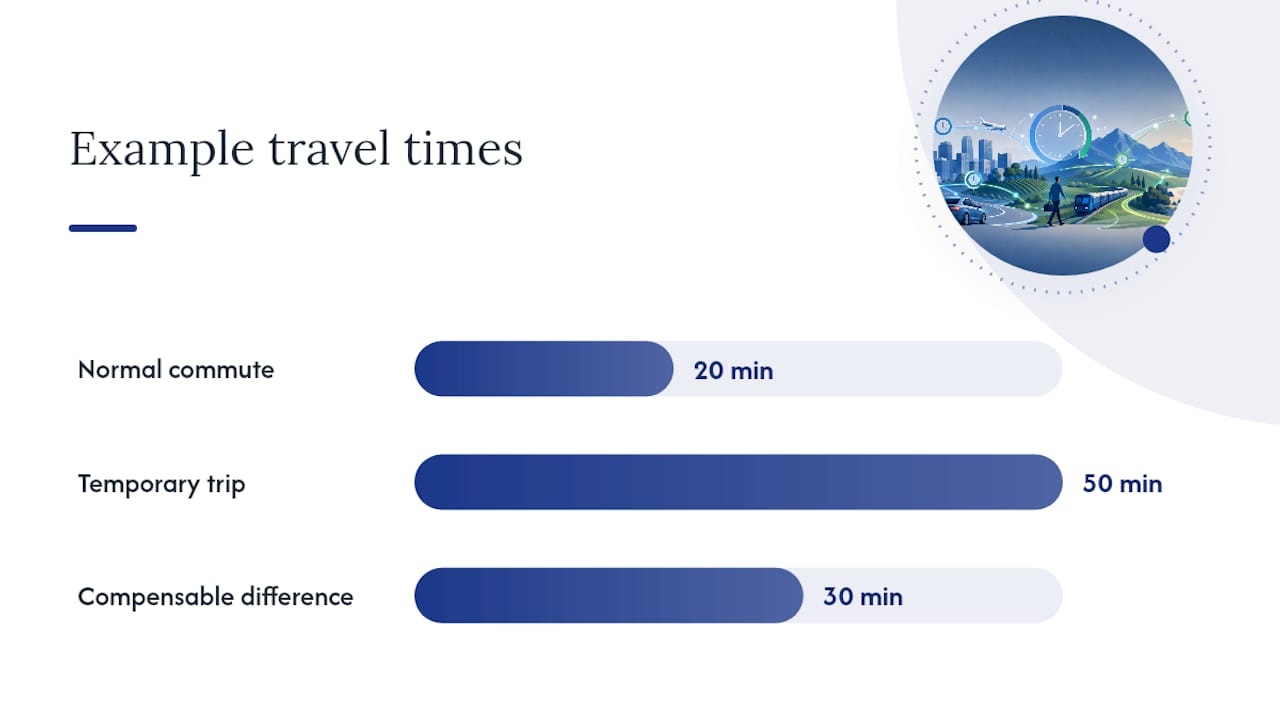
Example: An employee normally commutes 20 minutes to their regular site. Today they're assigned to a temporary location 50 minutes away. You owe 30 minutes of compensable travel time. If that pushes their total hours past 8 for the day, that 30 minutes gets paid at the overtime rate.
Expense Reimbursement: What Labor Code §2802 Requires
Travel pay covers wages for time spent. Labor Code §2802 covers something different: actual out-of-pocket costs. Employers must reimburse employees for necessary expenditures incurred while doing their jobs, including mileage, airfare, lodging, and parking.
- Track reimbursements separately from wages on pay stubs and in your accounting records.
- Require receipts or mileage logs before reimbursing, not estimates.
- Avoid flat monthly allowances unless you can show they cover the employee's actual necessary costs. A flat number that falls short of real expenses is a §2802 violation waiting to surface.
Recordkeeping Practices That Prevent Travel-Time Violations
Most travel-time wage claims trace back to a timekeeping gap, not a policy failure. Fix the process and you fix most of the risk.
- Require employees to log start and stop times for travel, along with the destination, on every assignment.
- Route travel entries through manager signoff before payroll processes them.
- Flag any travel entry that pushes an employee past 8 hours for the day so payroll can calculate overtime correctly.
- Convert salaried non-exempt employees to a true hourly regular rate by dividing salary by actual hours worked that week as explained in household staff payroll guidance. Getting this wrong is a common source of travel-time overtime claims.
- Reconcile travel logs against expense reports before finalizing payroll, and retain records in case of a DLSE audit.
Pro Tip: Schedule a quarterly review of travel-time entries against mileage and expense reports. Patterns of unpaid or underpaid travel time tend to hide in outlier weeks, like a rush project that sent three employees to a job site 90 minutes away, and those weeks are exactly what a DLSE auditor will pull first.
Travel Time Pay Checklist for California Employers
A written policy protects you far more than an informal understanding, especially once an employee disputes what they were told.
- Define an approval workflow for any assignment requiring travel outside the normal commute.
- Set time-entry rules that capture start/stop times and destination for every trip.
- Disclose any alternative travel pay rate in writing, in the employee handbook or wage notice.
- Set submission timelines for expense reports tied to travel.
- Train managers to recognize when a "quick errand" or job-to-job trip triggers compensable time.
| Policy Element | What to Include |
|---|---|
| Compensable travel definition | Difference-in-time method for temporary sites; full time for out-of-town travel |
| Reporting requirement | Start/stop times, destination, manager approval |
| Pay rate disclosure | Written statement of travel rate, included in handbook |
| Reimbursement statement | Reference to Labor Code §2802 obligations |
How Glendale Payroll Supports Travel-Time Compliance
Getting the difference-in-time calculation right, every pay period, for every traveling employee, is exactly the kind of detail that slips through the cracks in a manual payroll process. Glendale Payroll's payroll processing and compliance audit services are built to catch that. A free comprehensive payroll audit reviews your existing timekeeping and pay practices to flag missed travel pay, misclassified employees, or reimbursement gaps before the DLSE finds them for you. Combined with account setup and tax filing support, it offers comprehensive payroll oversight.
When in Doubt, Pay It: An Employer's Practical Take
If employer control is even arguably present, pay the travel time. The cost of an extra 30 minutes on a paycheck is nothing next to a wage claim with penalties and back pay attached. Document every travel directive in writing, then get a payroll audit and manager training scheduled this quarter, not next.
— Glendale Payroll Staff
This article is general information, not a substitute for advice from a qualified lawyer. Consult a qualified legal professional about your own circumstances before acting on anything here.
Sources
- DLSE opinion — Travel Time For Employee With Alternative Worksites (2003)
- DLSE opinion — Request for Opinion on Travel Time as Hours Worked (1989)
- DLSE — Wages and hours guidance (Wages.pdf)
- California Labor Code §2802
- Morillion v. Royal Packing Co. (2000) — California Supreme Court opinion
FAQ
Should I Be Compensated for Travel Time in California?
Yes, if your employer directs the travel and exercises control over your schedule or transportation, that time counts as hours worked under California's wage orders, and it must be paid at least at minimum wage or your regular rate.
Do You Get Paid for Vacation Time in California?
Vacation time is a separate issue from travel pay. California law treats earned vacation as a form of wages that vests as it accrues, but there's no statewide mandate requiring employers to offer paid vacation in the first place.
Do Hourly Employees Get Paid for Travel?
Hourly, non-exempt employees must be paid for travel time whenever the employer requires it, whether that's a trip to a temporary worksite (measured by the difference-in-time method) or an out-of-town assignment paid in full, per DLSE guidance.
How Is Travel Time Paid Under Prevailing Wage in California?
Prevailing wage projects generally require travel time to be paid according to the applicable wage determination when the employer mandates travel between job sites or to a designated reporting location; check the specific prevailing wage determination for the project, since terms can vary by trade and locality.