
California employers must recognize more than a dozen legally protected leave categories, and the single most important action you can take right now is to audit your policies, update your workplace postings, and verify that your leave-request forms reflect current law. The types of California employee leave requirements span job-protected leaves under the California Family Rights Act (CFRA) and the federal Family and Medical Leave Act (FMLA), Pregnancy Disability Leave (PDL), California Paid Sick Leave (minimum 40 hours or five days per year as of January 1, 2024), State Disability Insurance (SDI), Paid Family Leave (PFL), workers' compensation, bereavement, jury duty, military leave, victims' leave, reproductive-loss leave, organ and bone marrow donation leave, voting leave, and several others.
One distinction every HR professional must internalize: wage-replacement programs (SDI and PFL) are not the same as job-protected leave. SDI and PFL pay a portion of an employee's wages during qualifying absences, but they do not guarantee reinstatement. Job protection comes from CFRA, FMLA, PDL, and other statutes. These two "buckets" can run at the same time, but they operate under entirely different legal frameworks.
Your immediate action items:
- Review and update your employee handbook to reflect current California leave laws.
- Post all required workplace notices, including updated paid sick leave posters.
- Update leave-request forms to capture the "designated person" category under CFRA.
- Train managers on the difference between wage replacement and job protection.
- Establish a centralized leave-tracking record for each employee.
Key Takeaways
California employers face more than a dozen legally required leave categories, and the most consequential compliance step is maintaining separate, centralized records for job-protected leave and wage-replacement benefits so that reinstatement, payroll, and EDD obligations can all be documented in a single audit-ready file.
| Point | Details |
|---|---|
| Job protection vs. wage replacement | SDI and PFL pay wages but do not protect jobs; CFRA, FMLA, and PDL provide job protection separately. |
| CFRA covers small employers | CFRA applies to employers with five or more employees, far below FMLA's 50-employee threshold. |
| PDL plus CFRA sequencing | A new parent eligible for both can take up to approximately seven months of combined protected leave. |
| Paid sick leave minimum | California requires at least 40 hours (five days) per year as of January 1, 2024, with mandatory updated postings. |
| Glendale Payroll compliance support | Glendale Payroll integrates leave tracking with payroll processing and EDD account management to reduce audit exposure for California employers. |
Table of Contents
- What are the types of California employee leave requirements?
- How do CFRA and FMLA job-protected leaves work for your employees?
- What does Pregnancy Disability Leave require from California employers?
- Why SDI and PFL don't automatically protect your employees' jobs
- How does California paid sick leave work for your business?
- What are your obligations when an employee is injured at work?
- What other leaves does California law require you to provide?
- What compliance steps must every California employer complete?
- How should HR process a leave request from intake to return?
- The leave compliance mistake that costs California employers the most
- How Glendale Payroll supports your leave-related payroll compliance
- Sources
What are the types of California employee leave requirements?
The table below gives HR a rapid reference for each major leave category. Use it to categorize an incoming request before diving into the detailed sections that follow.
The DLSE's leave summary provides a statutory reference for many of these categories. Detailed employer obligations for each major type follow in the sections below.
How do CFRA and FMLA job-protected leaves work for your employees?
CFRA provides up to 12 work weeks of unpaid, job-protected leave in a 12-month period. Eligibility requires 12 months of service with the employer and at least 1,250 hours worked in the prior 12 months. CFRA covers employers with a relatively small number of employees, which is a lower threshold than FMLA's typical larger employer size minimum. That gap matters: many small California businesses are subject to CFRA but not FMLA.
Who qualifies as a family member under each law?
CFRA's definition of "family member" is broader than FMLA's. It includes a spouse, child, parent, grandparent, grandchild, sibling, domestic partner, and a "designated person," which is any individual related by blood or whose association with the employee is the equivalent of a family relationship. The designated-person category is a meaningful expansion. Under FMLA, the covered family members are more narrowly defined, so when both laws apply, the employee receives the more protective benefit under California law.
Employer obligations under CFRA and FMLA
Your duties begin the moment an employee gives notice of a qualifying need, not when they submit formal paperwork.
- Eligibility and rights notice: Provide written notice of eligibility within five business days of learning of a qualifying leave need.
- Designation notice: Once you have enough information to determine whether the leave qualifies, issue a written designation notice.
- Medical certification: You may request certification from a healthcare provider. The employee generally has 15 calendar days to return it.
- Health benefit continuation: Maintain group health coverage on the same terms as if the employee had continued working.
- Reinstatement: Return the employee to the same or a comparable position upon return from leave.
When both CFRA and FMLA apply to the same event, the leaves typically run concurrently, and you must apply whichever law is more protective. CalHR maintains designation and certification forms (CalHR 752 through 757) that state-covered employers use; private employers may adapt these or use equivalent forms.
Intermittent leave
Both CFRA and FMLA permit intermittent leave when medically necessary or for qualifying exigency. Employees may take leave in blocks as small as one hour. This creates real scheduling complexity, so build a tracking system that logs each intermittent absence against the employee's 12-week annual bank. A payroll process review that integrates leave-hour tracking with your payroll records is the most reliable way to prevent over-designation or under-tracking.
| CFRA vs. FMLA | CFRA | FMLA |
|---|---|---|
| Employer size threshold | 5+ employees | five or more employees |
| Designated person category | Yes | No |
| Domestic partner coverage | Yes | No |
| Duration | 12 weeks | 12 weeks |
| Administering agency | CRD (formerly DFEH) | U.S. DOL |
What does Pregnancy Disability Leave require from California employers?
PDL entitles employees disabled by pregnancy, childbirth, or related medical conditions to up to four months of leave. Unlike CFRA, PDL applies to employers with five or more employees and carries no minimum service requirement. An employee is eligible from day one of employment.
Four months translates to 17.3 weeks for a full-time employee working 40 hours per week, or the equivalent number of hours for part-time employees. PDL is measured by the hours the employee would have worked, not by calendar weeks.
How PDL and CFRA interact for new parents
This sequencing is one of the most common compliance questions HR teams face. When an employee is eligible for both PDL and CFRA:
- PDL covers the period of actual medical disability related to pregnancy and childbirth.
- Once the employee is medically cleared, CFRA child-bonding leave begins, providing an additional 12 weeks of job-protected leave.
- The two leaves do not run concurrently for the same qualifying reason. A new parent who uses PDL for medical recovery and then CFRA for bonding can take up to approximately seven months of combined protected leave.
During PDL, the employee may receive SDI wage-replacement benefits through EDD. During the CFRA bonding period, PFL may apply. Document each period separately in your records, and make sure your payroll team knows how to process EDD reimbursements or coordinate benefit supplements for each phase.
Reinstatement and accommodation under PDL
At the end of PDL, you must reinstate the employee to the same position. If that position no longer exists for a legitimate business reason unrelated to the leave, you must offer a comparable position. Failure to reinstate is a violation of FEHA and can trigger a complaint with the California Civil Rights Department (CRD).
PDL also requires you to engage in the interactive process for pregnancy-related accommodations before and during leave. If an employee needs a modified duty assignment or a temporary transfer, that request is separate from the leave itself and governed by FEHA's reasonable-accommodation rules.
Pro Tip: Update your leave-request forms to include a field for "pregnancy-related accommodation needs" and a separate field for "designated person" (for CFRA requests). Using outdated forms that omit these fields is one of the most common reasons employers inadvertently deny leave they were legally required to grant.
Why SDI and PFL don't automatically protect your employees' jobs
SDI and PFL provide wage-replacement benefits only; they do not provide job protection. This distinction trips up employers and employees alike. An employee receiving SDI payments while recovering from surgery is not automatically entitled to return to their job. Job protection comes from a separate legal source: CFRA, FMLA, PDL, or another qualifying statute.
What SDI and PFL actually pay
Both programs are administered by the California Employment Development Department (EDD):
- SDI (State Disability Insurance): Covers an employee's own non-work-related disability, including pregnancy. Benefits can extend up to 52 weeks in certain circumstances. The wage-replacement percentage is set annually by EDD based on the employee's base period earnings.
- PFL (Paid Family Leave): Covers bonding with a new child or caring for a seriously ill family member. PFL provides benefits for a limited duration.
Neither program is funded by employers directly. Employees pay SDI premiums through payroll withholding, which is one reason your payroll records must accurately reflect each employee's SDI-taxable wages.
When wage replacement and job protection run concurrently
When an employee is on CFRA or FMLA leave and also qualifies for SDI or PFL, the two programs run at the same time. You may also require employees to use accrued paid leave (vacation, PTO, or sick leave) concurrently with CFRA/FMLA, subject to your written policy. The practical effect is that the employee's income during leave comes from multiple sources: SDI/PFL from EDD and any employer-paid supplement you provide.
Key distinction: Track wage replacement and job protection as two separate records in your HR system. Conflating them is the most common compliance gap Glendale Payroll sees when reviewing employer leave records.
For EDD claim filing guidance and forms, direct employees to EDD's SDI and PFL portal. HR's role is to confirm the employee's leave designation and respond promptly to any EDD employer verification requests.
How does California paid sick leave work for your business?
Starting January 1, 2024, California requires employers to provide at least 40 hours (five days) of paid sick leave per year for most employees. This doubled the prior three-day minimum and applies to virtually all California employers regardless of size.
Accrual methods and caps
You have two main options for providing the minimum:
- Accrual method: Employees earn one hour of paid sick leave for every 30 hours worked. You may cap accrual at 80 hours and cap usage at 40 hours per year.
- Up-front (lump sum) method: Grant at least 40 hours at the start of the year or benefit period. No accrual tracking required, but you must still allow carryover or re-grant the full amount each year.
Unused accrued sick leave carries over to the following year under the accrual method, subject to the 80-hour cap. Under the up-front method, carryover is not required if you re-grant the full 40 hours at the start of each year.
Posting and notice obligations
The DIR requires employers to:
- Post the current paid sick leave notice in a conspicuous location at each worksite.
- Provide individualized notice to each employee (on the wage statement or a separate document) showing the amount of paid sick leave available.
- Update postings when the law changes. The 2024 increase triggered a mandatory poster update.
Updating your employee handbook is not sufficient on its own. The Labor Commissioner expects current posters on the wall and individualized notices delivered to each employee, including remote workers via electronic delivery where permitted by agency guidance.
Local ordinances
Several California cities and counties, including Los Angeles, San Francisco, and San Diego, have paid sick leave ordinances that exceed the state minimum. Your obligation is to follow whichever rule is most generous. If you have employees in multiple jurisdictions, track each location's requirements separately.
For field-service employers managing mobile workforces, such as HVAC, electrical, or plumbing contractors, coordinating sick leave across job sites adds another layer of complexity. Resources like HVAC software tools for California field teams can help track employee hours and locations, which feeds directly into accurate sick leave accrual calculations.
What are your obligations when an employee is injured at work?
Workers' compensation covers medical care and partial wage replacement for work-related injuries and illnesses. Every California employer with at least one employee is required to carry workers' compensation insurance. Failure to do so is a criminal offense under California law.
Immediate steps after a workplace injury
- Provide first aid and arrange medical care immediately.
- Give the injured employee a DWC-1 claim form within one working day of learning of the injury.
- File a First Report of Injury with your workers' compensation carrier.
- Post the required "Notice to Employees" poster at each worksite.
Temporary disability (TD) payments replace a portion of the employee's lost wages while they recover. Permanent disability (PD) payments apply when the injury results in lasting impairment. Neither TD nor PD constitutes job protection on its own.
Return-to-work and accommodation
When an injured employee is medically cleared to return, even with restrictions, you must engage in the interactive process under FEHA to determine whether a reasonable accommodation is possible. If the injury also qualifies as a disability under FEHA, the accommodation obligation is independent of workers' compensation. Many employers miss this overlap: a workers' comp claim closed by the insurer does not end your FEHA obligations.
If the injury-related absence also meets CFRA or FMLA eligibility criteria, designate the leave accordingly. Running workers' comp and CFRA concurrently, where applicable, protects both the employee's benefits and your ability to manage the position.
The DIR's Division of Workers' Compensation provides employer forms, claim guides, and return-to-work program resources.
What other leaves does California law require you to provide?
California law recognizes a substantial list of additional leave categories beyond the major medical and family leaves. Labor Code § 230 and related statutes protect employees who take time off for jury duty and for relief related to qualifying acts of violence, and prohibit employers from discriminating or retaliating against employees who exercise these rights.
Here is a concise reference for each category:
-
Jury duty and court appearances: Unpaid under state law (employers may pay voluntarily). Duration equals the length of service. You may not discharge or threaten an employee for serving. Documentation: a copy of the jury summons is sufficient.
-
Bereavement leave: Employers with 25 or more employees must provide up to five days of unpaid bereavement leave for the death of a qualifying family member. Employees must have worked at least 30 days. You may require documentation (death certificate, obituary, or similar) within 30 days of the first day of leave.
-
Military leave: Federal USERRA and California Military and Veterans Code protect employees called to active duty. Reinstatement rights are strong: employees returning from military service are entitled to reemployment in the same or a comparable position. Differential pay policies are common for employers who wish to supplement military pay.
-
Victims' leave (domestic violence, sexual assault, stalking, and other qualifying crimes): Employees who are victims of qualifying crimes, or whose immediate family members are victims, may take leave to obtain restraining orders, seek medical attention, or participate in safety planning. This leave is unpaid under state law but job-protected. Documentation may be requested after the fact.
-
Reproductive-loss leave: Employers with five or more employees must provide up to five days of unpaid leave following a failed adoption, failed surrogacy, miscarriage, stillbirth, or unsuccessful assisted reproduction. Employees must have at least three months of service. Leave need not be taken consecutively.
-
Organ and bone marrow donation: Employers with 15 or more employees must provide up to 30 business days for organ donation and up to five business days for bone marrow donation, in addition to any other leave entitlement. Partial wage replacement may be available through SDI.
-
Voting leave: Registered voters who do not have sufficient time outside working hours to vote may take up to two hours of paid leave at the beginning or end of their shift. Employers may require advance notice.
-
School activity leave: Employers with 25 or more employees must allow parents and guardians to take up to 40 hours per year (up to 8 hours per month) to participate in school activities. Unpaid, but employees may use accrued vacation or PTO.
-
Substance abuse rehabilitation leave: Employers with 25 or more employees must reasonably accommodate an employee who voluntarily enters a drug or alcohol rehabilitation program, provided it does not impose undue hardship.
-
Literacy education leave: Employers with 25 or more employees must reasonably accommodate an employee who requests time off to participate in a literacy education program.
A common employer question: "Can I require documentation before approving victims' leave?" The legally safe answer is no, not before the leave. You may request documentation after the fact, and the employee has a reasonable time to provide it. Requiring proof upfront as a condition of approval exposes you to a retaliation claim.
What compliance steps must every California employer complete?
Employers must maintain required posters and notices, send eligibility and rights notices within specified timeframes, accept appropriate medical certification, and keep leave records for at least three years. The DLSE's leave poster and guidance directs employers to post and distribute required notices to employees, including remote workers via electronic delivery where permitted.
Compliance checklist
- Update your employee handbook. Reflect all current California leave laws, including the 2024 paid sick leave increase, reproductive-loss leave, and the CFRA designated-person category.
- Post required workplace notices. Current required posters include: CFRA/FMLA notice, PDL notice, paid sick leave notice, SDI/PFL notice, workers' compensation notice, and the DLSE leave summary. Post in a conspicuous location at each worksite and deliver electronically to remote employees.
- Deliver individualized Notice to Employee. The wage notice (Labor Code § 2810.5) must reflect current paid sick leave balances. Update the form when the law changes.
- Maintain individual leave records. For each employee, track: leave category, legal basis (statute), start and end dates, hours used, wage-replacement amounts (SDI/PFL), and certifications received. Retain records for at least three years.
- Respond to leave requests within required timeframes. Provide an eligibility and rights notice within five business days of learning of a qualifying need. Issue a designation notice once you have sufficient information.
- Request and process medical certification properly. Give employees at least 15 calendar days to return certification. Keep certifications in a confidential medical file, separate from the general personnel file.
- Coordinate benefits during leave. Continue group health coverage on the same terms. Notify employees of premium payment obligations during unpaid leave.
- Plan for reinstatement. Document the employee's position, pay, and benefits before leave begins. Reinstate to the same or comparable position upon return.
- Prepare for EDD audits. Maintain records of SDI/PFL claims, employer responses, and leave designations. An EDD audit preparation checklist can help you organize these records before an audit request arrives.
- Train managers. Supervisors must know how to recognize a leave request (even informal ones), how to escalate to HR, and what they cannot say or do in response.
Key compliance timelines
| Action | Timeframe |
|---|---|
| Provide eligibility and rights notice | Within 5 business days of learning of qualifying need |
| Issue designation notice | Within 5 business days of having sufficient information |
| Employee returns medical certification | Generally 15 calendar days from request |
| Respond to EDD employer verification | Per EDD notice (typically 2–3 business days) |
| Retain leave records | Minimum 3 years |
Posting for remote employees: The Labor Commissioner permits electronic delivery of required notices to remote workers when the employer cannot post physically. Keep a record of the delivery date and method for each employee as part of your audit defense file.
CalHR's leave benefits page is the authoritative source for designation and certification forms (CalHR 752 through 757). Private employers may use equivalent forms, but the content must meet the statutory requirements.
How should HR process a leave request from intake to return?
A short, ordered process prevents most compliance errors. The goal is to move from intake to documentation to benefits coordination without gaps.
Step-by-step leave request process
- Intake: Receive the request, whether formal or informal. Any communication that suggests a need for leave for a qualifying reason triggers your obligations. Log the date and method of notice.
- Eligibility check: Verify the employee's length of service, hours worked, and the employer's size threshold for the applicable leave type. Check whether multiple leaves apply (e.g., PDL and CFRA for a pregnancy-related absence).
- Provide notices and forms: Issue the eligibility and rights notice within five business days. Provide the appropriate certification form and a copy of the employee's rights under applicable law.
- Collect certifications: Set a clear deadline (15 calendar days for CFRA/FMLA medical certification). Follow up in writing if certification is not returned on time. Store all certifications in a confidential medical file.
- Track leave and benefits: Record each day or hour of leave against the employee's annual entitlement. Coordinate SDI/PFL claims with EDD. If your policy requires or permits concurrent use of accrued PTO, document that election in writing.
- Plan return to work: Confirm the expected return date in writing. If the employee needs a fitness-for-duty certification, request it before the return date. Prepare the reinstatement position and notify payroll to resume regular pay.
Sample policy language
Eligibility clause (CFRA): "Employees who have worked for [Company] for at least 12 months and have logged at least 1,250 hours in the preceding 12-month period are eligible for up to 12 weeks of unpaid, job-protected leave under CFRA for a qualifying family care or medical reason."
Intermittent leave clause: "Employees approved for intermittent CFRA leave must notify their supervisor as soon as practicable before each absence and must record each intermittent absence in [HR system]. The Company will track intermittent leave against the employee's 12-week annual entitlement."
Confidentiality clause: "Medical certifications and related health information are maintained in a confidential file separate from the employee's general personnel record. Access is limited to HR personnel with a need to administer the leave."
Sample email: acknowledging a leave request
Integrating leave tracking with your payroll process is where many employers lose accuracy. When SDI payments begin, payroll must stop or reduce regular pay accordingly, and any employer supplement must be calculated correctly. The California payroll compliance guide from Glendale Payroll covers how to coordinate these adjustments without triggering overpayment or tax errors.
For field-service businesses managing crews across multiple sites, tools like electrical contractor software for California can help track hours and locations, which feeds directly into accurate leave accrual and payroll records.
The leave compliance mistake that costs California employers the most
The single operational change that most reduces employer audit risk is centralizing leave tracking and tying it directly to payroll records. Glendale Payroll sees this gap repeatedly: employers maintain leave records in one system (or a spreadsheet) and payroll in another, and the two never reconcile. When an EDD audit or a CRD complaint arrives, the employer cannot produce a coherent record showing which leave type applied, when it started and ended, what wage-replacement was paid, and whether reinstatement occurred on time.
The practical consequence is significant. An employer who cannot document that a leave was properly designated, that the employee received required notices, and that reinstatement was offered on schedule faces penalties from multiple agencies simultaneously. The CRD can pursue FEHA violations. The Labor Commissioner can cite notice failures. EDD can challenge wage-replacement coordination. Each agency operates independently, and a single leave event can generate overlapping exposure.
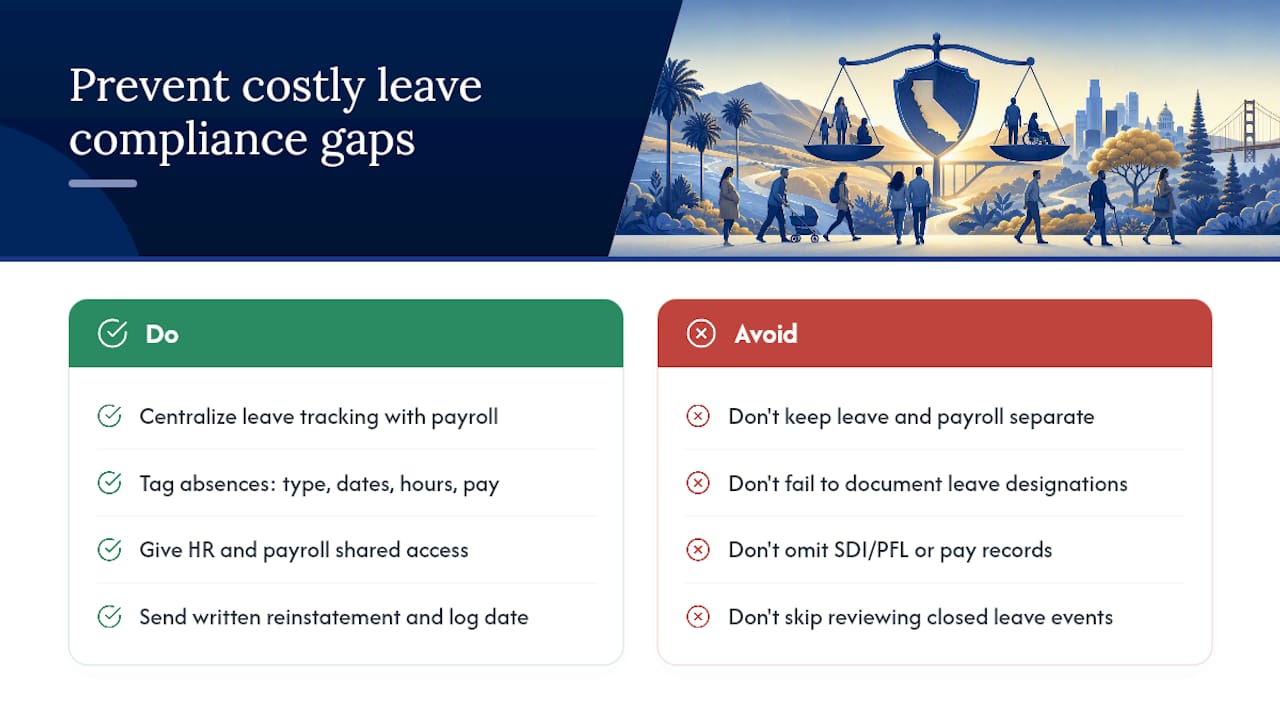
The fix is straightforward: one centralized leave record per employee that tags each absence with the leave category, the legal basis, start and end dates, hours used, SDI/PFL amounts paid, and certifications on file. That record should be accessible to both HR and payroll, and it should be reviewed every time a leave event closes.
Pro Tip: When an employee's SDI claim ends and CFRA bonding leave begins, send a written reinstatement confirmation to the employee and log the date in your leave record. This single step closes the most common reinstatement-dispute gap Glendale Payroll identifies during compliance reviews.
How Glendale Payroll supports your leave-related payroll compliance
California's leave laws create real payroll complexity: SDI supplements, PFL coordination, benefit continuation during unpaid leave, and accurate wage statements for employees returning from intermittent absences. Glendale Payroll provides payroll and compliance services specifically designed to help California employers in Glendale, Burbank, Pasadena, and Greater Los Angeles manage this complexity without penalties.
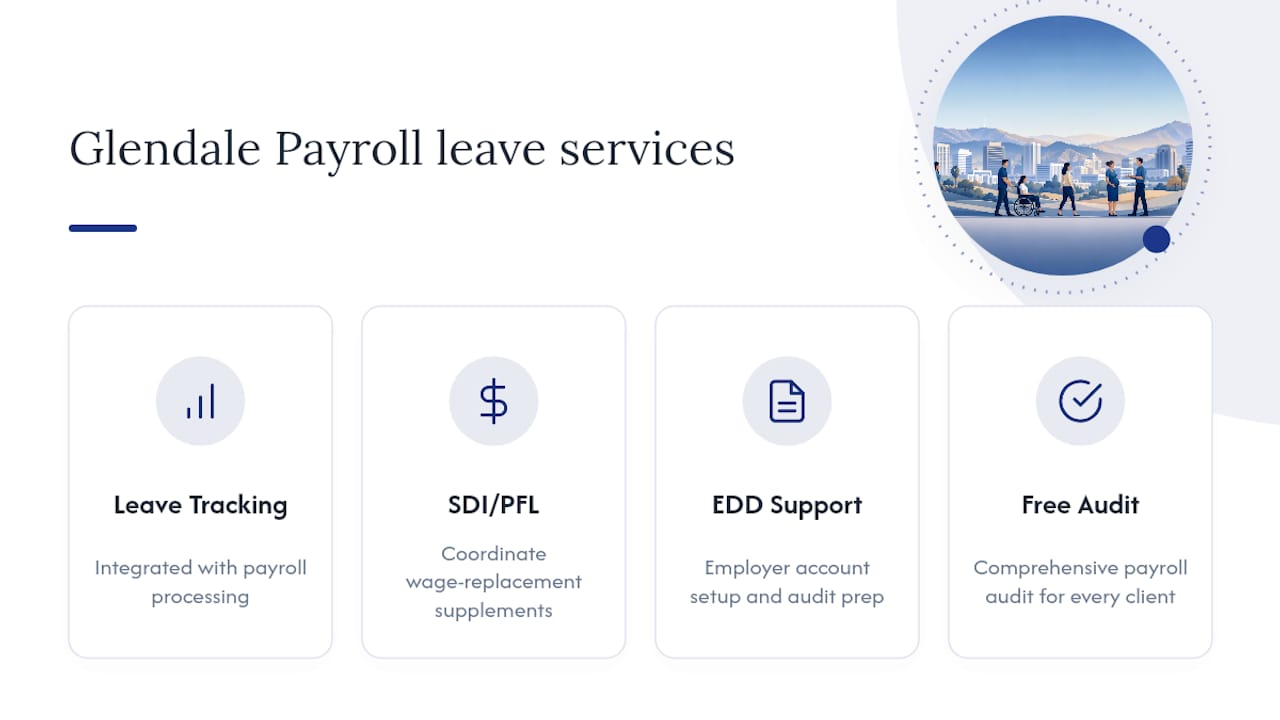
Services directly relevant to leave management include: leave-balance tracking integrated with payroll processing, coordination of SDI/PFL wage-replacement supplements, California EDD employer account setup and audit preparation, required posting compliance support, year-end W-2 preparation that accurately reflects leave-period earnings, and new hire reporting. Every client receives a free comprehensive payroll audit to identify gaps before an agency does.
Glendale Payroll is not employment counsel, and this article is general information, not legal advice. For legal interpretation of specific leave situations, consult a qualified California employment attorney. For the payroll and compliance mechanics, schedule a compliance review with Glendale Payroll to see exactly where your current process has gaps.
Sources
Keep a record of the date you downloaded each poster or form. In an audit, that date demonstrates you were using the current version at the time of the leave event.
- Family and Medical Leave Act and California Family Rights Act FAQs
- Family Care Medical Leave | CRD
- Worker Leave and Pay Benefits (DLSE poster and guidance PDF)
- Leave Benefits - CalHR Website - CA.gov
- California Labor Code § 230 (jury duty, victims' leave, protections)
This article is general information, not a substitute for advice from a qualified lawyer. Consult a qualified legal professional about your own circumstances before acting on anything here.