
A W-2 form goes to a payroll employee whose employer directs how, when, and where the work gets done. A 1099 form goes to an independent contractor who runs their own business and controls the method of their work. The line between them turns on one factor above all others: control. Whoever controls the "how" of the work, not just the "what," usually determines the classification.
That single distinction carries real financial weight. On a W-2, your employer withholds income tax and splits Social Security and Medicare (FICA) with you, each side paying 7.65%. On a 1099, you owe the full 15.3% self-employment tax yourself, pay estimated taxes quarterly, and get none of the unemployment insurance or workers' compensation protections built into employee status.
For small-business owners, this isn't just a paperwork choice. Misclassifying a worker exposes you to back taxes, penalties, interest, and in states like California, aggressive enforcement under the ABC test. Here's what you need to know before you sign a contract, file a form, or decide how to structure your next hire.
- Workers: Your classification determines your tax bill, your benefits, and your legal protections.
- Businesses: Classification determines your cost structure and your audit exposure.
- Everyone: The label on a contract doesn't decide status. The actual working relationship does.
Key Takeaways
Classification depends on who controls the work, not on what the contract calls the worker, and getting it wrong creates tax and legal exposure for both sides.
| Point | Details |
|---|---|
| Control decides status | Behavioral, financial, and relationship factors together determine W-2 versus 1099 status, not the contract label. |
| Tax burden shifts to contractors | 1099 workers pay the full 15.3% self-employment tax; W-2 employees split 7.65% FICA with their employer. |
| California applies a stricter test | The ABC test presumes employee status unless the business proves all three prongs, beyond federal IRS rules. |
| Misclassification has real remedies | Form SS-8 and the VCSP offer paths to correct status with reduced penalties if you act before an audit starts. |
| Glendale Payroll offers a free audit | Their compliance review checks classification, W-2/1099 prep, and EDD setup for California employers. |
Table of Contents
- W-2 vs 1099 at a Glance
- How Do You Determine Employee vs Contractor Status?
- What Are the Tax Differences Between W-2 and 1099?
- Is It Better to Be a 1099 Contractor or W-2 Employee?
- Weighing 1099 Contractors Against W-2 Hires as an Employer
- What Should You Check Before Classifying a Worker?
- What Happens If You Misclassify a Worker?
- When Should You Bring in a Payroll Partner?
- How Glendale Payroll Helps You Get Classification Right
- Frequently Asked Questions
- Sources
W-2 vs 1099 at a Glance
The differences between these two statuses show up in seven places that matter to your wallet and your legal exposure. Here's the breakdown across each one.
| Factor | W-2 Employee | 1099 Contractor |
|---|---|---|
| Who controls the work | Employer directs schedule, methods, tools | Worker controls how and when work gets done |
| Financial control & structure | Paid a wage or salary; no business investment required | Often has own tools, invests in equipment, can work for multiple clients |
| Benefits & legal protections | Eligible for unemployment insurance, workers' comp, FLSA minimum wage/overtime | Generally no unemployment, no workers' comp, no FLSA coverage |
| Tax treatment | Employer withholds income tax; FICA split 7.65%/7.65% | Contractor pays 15.3% self-employment tax and quarterly estimates |
| Employer obligations & cost | Employer pays FUTA, SUTA, workers' comp, often benefits | Employer generally pays only the contracted fee |
| Paperwork & deadlines | Form W-2 furnished by January 31 | Form 1099-NEC furnished by January 31 |
| Misclassification risk | Low, since status is already correct | High if the working relationship resembles employment |
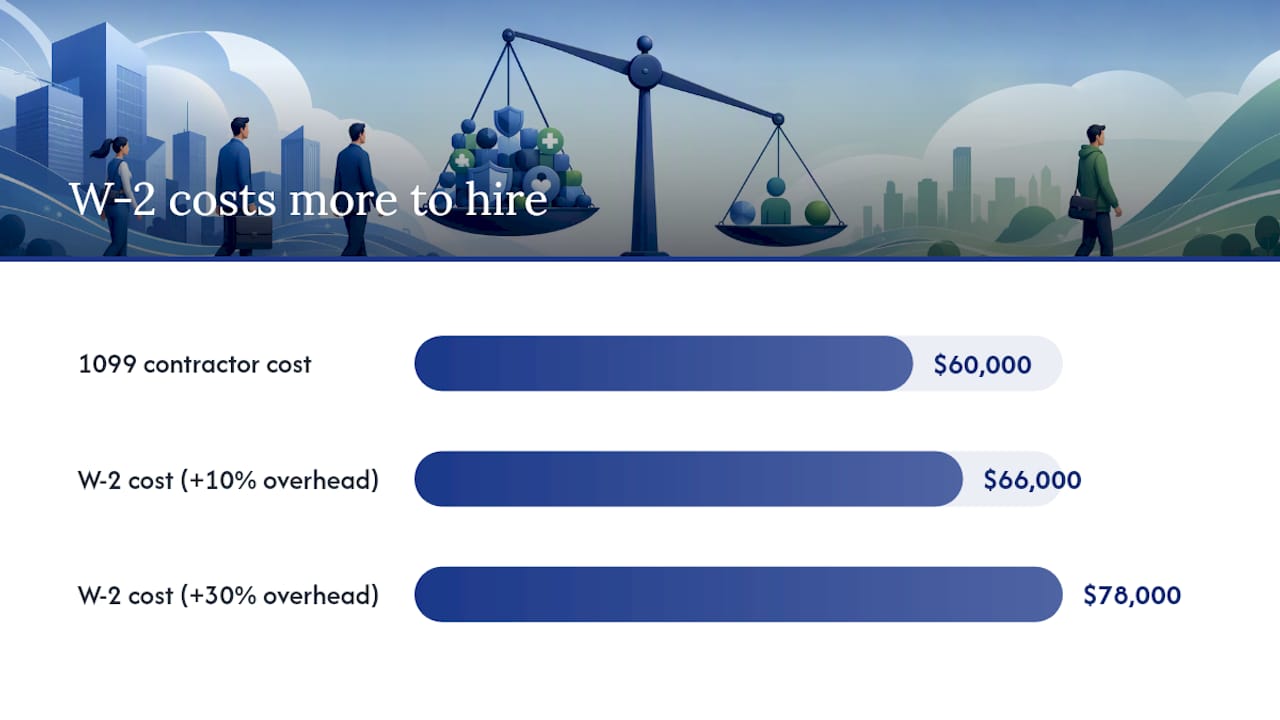
A few things worth flagging beyond the table. Employer-side costs for a W-2 hire typically run 10% to 30% above base salary once you add FUTA, SUTA, workers' comp, and any benefits package. That overhead is real money, but it buys you something a 1099 arrangement can't: legal control over how the work gets done.
Pro Tip: Run the math both ways before you post a job listing. A $60,000 W-2 salary often costs a small business $66,000 to $78,000 fully loaded, while a $60,000 contractor engagement typically costs exactly $60,000, plus the risk if the classification is wrong.
- Contractors invoice for services; employees receive regular paychecks with withholding already applied.
- Employees get FLSA overtime and minimum wage protection; contractors negotiate their own rate.
- A contract calling someone a "1099 contractor" means nothing if the IRS or a state agency finds employee-level control.
- Multi-state hiring multiplies your compliance obligations, since some states apply stricter tests than the federal government does.
How Do You Determine Employee vs Contractor Status?
Three separate tests can classify the same worker three different ways, and that's exactly why this trips up so many small businesses. The federal government alone runs two distinct frameworks, and states often layer a third on top.
The IRS common-law test
The IRS evaluates three factor categories and weighs them together rather than picking one deciding factor. No single answer settles the question; the agency looks at the totality of the relationship.
Behavioral control asks whether the business directs how the work gets done, not just what gets delivered. A graphic designer who sets her own hours and chooses her own software looks like a contractor. A graphic designer required to work 9 to 5 in your office, using your software, following your step-by-step process, looks like an employee, regardless of what the contract says.

Financial control looks at who bears the economic risk. Contractors typically invest in their own equipment, can lose money on a job, and often serve multiple clients at once. An employee usually has none of that exposure; the paycheck arrives whether the project goes well or badly.
Type of relationship considers permanence and centrality to the business. A bookkeeper who works for you every month for three years, doing work central to your operations, looks far more like an employee than a contractor hired for a single, time-limited project.
The DOL economic-reality test
For wage-and-hour purposes, the Department of Labor applies a different lens: whether the employer has the right to control what work gets done and how it gets done. This test governs minimum wage and overtime claims under the Fair Labor Standards Act (FLSA), and it can produce a different answer than the IRS test applied to the identical facts.
State-level ABC tests: California's stricter standard
California doesn't stop at the federal frameworks. Since the Dynamex decision and the passage of AB 5, California applies the ABC test, which presumes a worker is an employee unless the hiring business proves all three of the following: the worker is free from the company's control, performs work outside the company's usual business, and is customarily engaged in an independently established trade. Missing even one prong means the worker is legally an employee in California, even if the IRS would call the same relationship a contractor arrangement. Businesses hiring across state lines need to check the California-specific rules separately from federal guidance.
Here's where this gets confusing in practice: a freelance bookkeeper working ten hours a week for a Glendale bakery might pass the IRS common-law test as a contractor, because she sets her own hours and works for other clients. But if bookkeeping is core to how the bakery tracks its finances daily and she's been doing it for two years with no other clients, California's ABC test could classify her as an employee. Same worker, same duties, two different legal answers depending on which test applies.
The IRS itself warns against treating classification as a matter of convenience. A 1099-NEC form is a reporting document, not a legal determination. Issuing one doesn't settle the question if an audit or a worker complaint challenges it later.
Pro Tip: Document the reasoning behind every classification decision the day you make it, not after an audit letter arrives. Keep the signed contract, the invoices, evidence of other clients the worker serves, and notes on who set the schedule. That file is your best defense if the California ABC test or an IRS review ever questions the call.
What Are the Tax Differences Between W-2 and 1099?
The tax mechanics diverge sharply between the two statuses, and this is usually where the real financial surprise hits new contractors and first-time employers alike.
On a W-2, your employer withholds federal income tax based on your Form W-4 elections, along with state income tax where applicable. FICA gets split evenly: you pay 7.65% and your employer pays a matching 7.65%, covering Social Security and Medicare. Your employer also handles unemployment insurance contributions and, in California, State Disability Insurance (SDI) withholding.
On a 1099, none of that withholding happens. You receive your full gross pay and are responsible for self-employment tax at 15.3%, which covers both the employer and employee shares of Social Security and Medicare combined. You can deduct half of that self-employment tax when calculating adjusted gross income, which softens the blow slightly, but you still need to set aside money throughout the year and pay estimated taxes quarterly rather than waiting for one annual bill.

| Item | W-2 Employee | 1099 Contractor |
|---|---|---|
| FICA responsibility | 7.65% employee / 7.65% employer split | 15.3% self-employment tax, paid entirely by worker |
| Income tax withholding | Employer withholds based on Form W-4 | No withholding; worker pays estimated taxes |
| Estimated tax deadlines | Not applicable | Generally April 15, June 15, September 15, January 15 |
| Business expense deductions | Limited, unreimbursed expenses rarely deductible | Broad deductions for equipment, mileage, home office, and supplies |
| Retirement plan access | Employer-sponsored 401(k), possible match | Solo 401(k) or SEP IRA, self-funded |
Contractors planning for retirement have more flexibility on paper but no employer match to lean on. Weighing a Solo 401(k) against a SEP IRA is worth doing early, since contribution limits and administrative requirements differ meaningfully between the two.
Forms and filing deadlines
Three forms drive most of the reporting obligations here, and businesses need to track each one separately.
Form W-2 reports annual wages and withholding for employees. Employers must furnish it to employees and file it with the Social Security Administration by January 31 following the tax year.
Form 1099-NEC reports nonemployee compensation of $600 or more paid to a contractor during the year. It's also due to the contractor and to the IRS by January 31.
Form 1099-K reports payments processed through third-party platforms and payment card networks. Reporting thresholds for this form have shifted in recent years, so businesses paying contractors through payment apps or platforms should confirm current threshold rules before assuming a 1099-K isn't required.
A fully loaded example makes the cost gap concrete. A business paying a contractor $70,000 a year in gross fees pays exactly that: $70,000, with no additional payroll tax obligation. The same $70,000 salary as a W-2 hire typically costs the business closer to $77,000 to $91,000 once you add the employer's 7.65% FICA match, FUTA, SUTA, and any benefits contribution, based on the 10% to 30% overhead range typical for W-2 hiring.
State withholding adds another layer. California requires SDI withholding and State Unemployment Tax Act (SUTA) contributions from employers, on top of federal FUTA. Businesses hiring across state lines, or growing fast enough to lose track of filing deadlines, are exactly where a dedicated payroll partner earns its fee back many times over.
Is It Better to Be a 1099 Contractor or W-2 Employee?
The honest answer depends on what you value more: predictable protection or maximum flexibility. Here's how the trade-offs actually break down.
Independent contractor status gives you control over your schedule, the ability to work for multiple clients simultaneously, and access to business expense deductions that W-2 employees rarely get. You can write off a home office, mileage, equipment, and software subscriptions directly against your income. But you also absorb the full 15.3% self-employment tax, manage your own health insurance, and get zero unemployment insurance if the work dries up.
W-2 status trades flexibility for security. Your employer withholds taxes automatically, so tax season involves less math and fewer surprises. You're covered by FLSA minimum wage and overtime rules, eligible for unemployment benefits if you're laid off, and often get access to employer-sponsored health insurance and retirement matching that a contractor has to fund alone.
- Contractors gain: schedule control, multiple income streams, broader tax deductions, no employer oversight of daily methods.
- Contractors lose: unemployment insurance, workers' comp, FLSA overtime protection, employer-subsidized benefits.
- Employees gain: predictable paycheck, benefits, legal protections, simpler tax filing.
- Employees lose: schedule autonomy, most deduction opportunities, and any share of business upside.
A $50 hourly W-2 equivalent often needs to become a $60 to $65 hourly contractor rate to land in the same place financially.
Pro Tip: When you're quoting a contractor rate, itemize what a W-2 role would have included: health insurance, paid leave, the employer's half of FICA, and any 401(k) match. Add those dollar figures on top of your target take-home pay before you name your price.
Weighing 1099 Contractors Against W-2 Hires as an Employer
Hiring a contractor feels cheaper in the moment, and often it is, at least on the invoice. You skip payroll tax contributions, workers' comp premiums, and benefits costs. For project-based work outside your core operations, a website redesign, a one-time marketing campaign, a contractor arrangement can be the right call with minimal risk.
The trade-off shows up later. Contractors owe you nothing in terms of loyalty or availability beyond the contract terms, so turnover between engagements is common. You also lose day-to-day control over methods, which matters if the work is central to how your business operates. And if a contractor relationship starts looking like employment in practice, regular hours, ongoing core duties, close supervision, you're exposed to the same misclassification risk regardless of what the contract says.
The employer-cost gap is where this decision usually gets made. Adding a W-2 employee typically costs 10% to 30% above the base salary once FUTA, SUTA, workers' comp, and benefits enter the picture. That's a meaningful number for a small business weighing a $55,000 hire against a $55,000 contractor engagement, but it isn't the whole story: control, consistency, and legal exposure matter just as much as the invoice total.
- Contractors save cash flow now; employees build institutional knowledge over time.
- Contractors reduce your immediate payroll tax burden; employees reduce your audit exposure.
- A contractor doing project-scoped work outside your core business is usually low risk.
- A contractor performing ongoing duties central to your operations is usually high risk, regardless of the contract label.
Pro Tip: If you find yourself renewing the same "contractor" agreement every month for over a year, with the person doing the same core work under your direction, that's the moment to run a classification review, not the moment an auditor forces you to.
What Should You Check Before Classifying a Worker?
Run through this checklist before you sign a contract or issue a first paycheck. It takes fifteen minutes and can save months of dispute later.
- Who sets the schedule? If you dictate specific hours, that points toward employee status.
- Who provides the tools and equipment? Contractors typically supply their own; employees typically use company resources.
- Can the worker take on other clients? A true contractor usually can and often does.
- How is payment structured? A flat project fee suggests contractor status; a regular hourly or salary wage suggests employee status.
- How long is the engagement? Ongoing, indefinite work looks more like employment than a fixed-term project.
- Is the work central to your business? A core, ongoing function performed under supervision tilts toward employee status.
- Do you provide training? Training someone in your specific methods is a strong employee signal.
- Do you supervise the work directly, or just review the final result? Direct supervision of process, not just outcome, points toward employee status.
Red flags that usually mean you're looking at a misclassified employee: a set schedule you control, ongoing duties that mirror what your actual employees do, training you provide, and payment structured like a salary rather than an invoice for defined deliverables.
Keep documentation on file the moment you make the call: a signed written agreement describing scope and payment terms, invoices from the contractor showing they operate as a business, and evidence they serve other clients if that's genuinely true. Good payroll process documentation protects you if a worker or an agency later challenges the classification.
Pro Tip: Build classification review into your annual calendar, not just your hiring process. A contractor's duties can drift toward employee territory over a year without anyone noticing until an audit flags it.
What Happens If You Misclassify a Worker?
Getting this wrong costs more than a corrected form. Misclassification exposes a business to back taxes, penalties, interest on unpaid employment taxes, potential wage-and-hour liability under the FLSA, and state-level penalties that can be severe in states with strict enforcement, California among them.
Two remedial paths exist depending on your situation.
Form SS-8 lets either the worker or the business ask the IRS for an official determination of status. The process requires detailed documentation of the work relationship and years involved, and resolution commonly takes six months or longer. It's the right tool when you genuinely don't know the answer and need an authoritative call.
The Voluntary Classification Settlement Program (VCSP) offers a lower-cost fix when you already suspect you've been misclassifying workers and want to correct course going forward. Eligible businesses pay just 10% of the employment tax liability for the most recent tax year, avoid interest and penalties on prior years, and must file Form 8952 at least 120 days before the desired reclassification date. It requires consistent prior treatment as nonemployees and no current IRS audit in progress.
If you decide to correct a misclassification, the practical steps are:
- Document the reasoning and evidence behind the original classification and the correction.
- Convert the worker to payroll and begin proper withholding going forward.
- Issue corrected forms, W-2c where wages were previously misreported, following Publication 15-A guidance.
- File amended payroll tax returns if back taxes are owed.
- Apply for VCSP if you qualify, or file Form SS-8 if the classification itself remains genuinely unclear.
When Should You Bring in a Payroll Partner?
Classification questions rarely stay simple once a business starts growing. Hiring across state lines, converting a long-term contractor to an employee, or scaling headcount quickly all raise the stakes on getting this right the first time.
The pattern we see most often: a business hires a contractor for a short project, that engagement quietly extends past a year, and nobody revisits whether the relationship still fits the original classification. By the time an audit or a worker dispute forces the question, the fix costs far more than a review would have.
Pro Tip: Time your classification review before a growth spurt or before year-end reporting, not after. Reviewing headcount and contractor relationships in Q3 gives you room to correct course before W-2 and 1099-NEC forms go out in January.
How Glendale Payroll Helps You Get Classification Right
Getting classification wrong isn't usually a mistake made on purpose. It's a status that drifted over time while nobody checked it against the actual rules. Glendale Payroll exists to catch that drift before the IRS or the California Employment Development Department (EDD) does.

Every new client starts with a free, comprehensive payroll audit that reviews your current worker classifications, payroll tax filings, and EDD account setup against federal and California-specific rules. Glendale Payroll's team consists of dedicated payroll professionals, not a call center, so you get direct answers on whether a contractor relationship holds up, how to prepare year-end W-2s and 1099-NECs correctly, and how to structure new hire reporting from day one. For businesses across Glendale, Burbank, Pasadena, and Greater Los Angeles, that means fewer surprises at tax time and far less audit exposure.
If you've got a contractor relationship you're not fully sure about, or you're about to add headcount and want the paperwork right from the start, request a payroll compliance review before you make your next hire.
Frequently Asked Questions
What's the main difference between W-2 and 1099? A W-2 employee works under the direction and control of an employer, who withholds taxes and splits FICA. A 1099 contractor runs an independent business, controls their own methods, and pays the full 15.3% self-employment tax themselves.
Can a worker be both W-2 and 1099 for the same employer? Generally no, if the duties are similar. A worker can hold a W-2 job and separately do unrelated 1099 work for the same company, but performing the same duties under both statuses invites IRS scrutiny.
Does California's ABC test apply to every industry? No. AB 5 includes exemptions for certain professions, doctors, lawyers, and some freelance writers among them, but most working relationships default to the ABC test unless a specific exemption applies.
What happens if I file a Form SS-8 and disagree with the IRS determination? You can appeal the determination, though the process adds more time. Most businesses treat SS-8 as a last resort when the classification is genuinely unclear, given the six-month-plus timeline.
Is a payroll service like ADP or TurboTax enough to handle classification questions? General payroll software like ADP or tax software like TurboTax handles calculations and filings, but neither evaluates whether a specific worker meets IRS or state classification tests. That judgment call benefits from a dedicated payroll professional who reviews your actual working relationships, not just your numbers.
This article is general information, not a substitute for advice from a qualified financial advisor. Consult a qualified financial professional about your own circumstances before acting on anything here.