
Use Form W-4 if you're an employee, so your employer can withhold federal income tax from every paycheck. Use Form W-9 if you're an independent contractor or vendor, so the business paying you can collect your Taxpayer Identification Number for year-end reporting. The outcome diverges fast: employees get a W-2 with tax already withheld, contractors get a 1099-NEC with nothing withheld, and starting in 2026 that 1099-NEC only has to be filed once payments to a contractor cross $2,000 for the year.
TL;DR:
- Correctly collecting W-4 forms at hiring and updating them whenever personal circumstances change helps ensure accurate withholding and avoids over- or underpayment of taxes.
- Asking contractors for W-9 forms before making initial payments ensures proper reporting and minimizes backup withholding risks.
- The $2,000 threshold for 1099-NEC reporting starting in 2026 significantly reduces reporting for small payments but does not affect classification decisions based on the working relationship.
- Misclassifying employees as contractors or vice versa can lead to costly IRS penalties and denial of benefits, making proper classification checks essential.
- Regularly reviewing worker classification and maintaining current forms can prevent costly compliance mistakes and streamline year-end reporting.
Table of Contents
- W-4 vs W-9 Differences at a Glance
- What Is Form W-4 and How Does It Set Your Withholding?
- What Is Form W-9 and Why Doesn't It Trigger Withholding?
- How to Tell Which Form Actually Applies to Your Situation
- Tax and Reporting Consequences You Can't Ignore
- If You Were Asked for the Wrong Form, Here's What to Do
- Glendale Payroll's Practical Checklist for Small Employers
- Does Your Form Choice Affect Your Benefits or Paycheck Deductions?
- Real Scenarios: When Does W-4 or W-9 Actually Apply?
- Updating or Correcting a Form After Circumstances Change
- Our Take: Get the Form Right Before You Worry About the Rate
W-4 vs W-9 Differences at a Glance
The two forms serve completely different functions in the tax system, even though both often land on a new worker's desk during the same onboarding conversation.
- Who fills it out: W-4 is completed by employees; W-9 is completed by independent contractors, freelancers, and vendors.
- Primary purpose: W-4 tells an employer how much federal income tax to withhold; W-9 simply hands over a Taxpayer Identification Number for reporting purposes.
- When it's submitted: W-4 is completed at hire and updated after life changes; W-9 is collected once, typically before the first payment goes out.
- Year-end paperwork: W-4 leads to a W-2; W-9 leads to a 1099-NEC.
Reporting threshold alert: Beginning with payments made in 2026, businesses only need to issue a 1099-NEC once total nonemployee compensation to a contractor hits $2,000, up from the longstanding $600 threshold. That's a meaningful shift for small employers who pay occasional contractors small amounts throughout the year.
What Is Form W-4 and How Does It Set Your Withholding?
Form W-4, officially the Employee's Withholding Certificate, tells your employer how to calculate the federal income tax withheld from your paycheck. You're not reporting income here. You're telling your employer how to treat the income you're about to earn as their employee.
The form asks for a handful of specific inputs:
- Filing status (single, married filing jointly, head of household, and so on)
- Multiple jobs or a working spouse adjustment
- Dependents you plan to claim
- Other income, deductions, or extra withholding you want applied
Employers take those answers and run them through Publication 15-T's withholding tables to land on a dollar figure per pay period. If you never submit a valid W-4, your employer has no choice but to withhold as if you're single with no adjustments, which usually means a bigger bite out of every check than you'd otherwise see, per IRS Tax Topic 753. That same guidance requires employers to retain your W-4 on file, generally for at least four years after the related tax return is filed.
You should update your W-4 whenever your situation changes in a way that affects your tax bill: a new job, a second job, a marriage, a new dependent, or a big swing in outside income. Waiting until tax season to fix a stale W-4 just means a bigger surprise on April 15.
What Is Form W-9 and Why Doesn't It Trigger Withholding?
Form W-9, Request for Taxpayer Identification Number and Certification, does something entirely different. It collects your legal name, business name if applicable, address, and TIN (either a Social Security number or an Employer Identification Number), plus your federal tax classification.
That's the whole job of the form. A W-9 doesn't set any withholding rate, because contractors and vendors generally aren't subject to payroll withholding at all. The business that requests it keeps the completed W-9 on file, not the IRS, and uses it later to prepare your 1099-NEC when tax season rolls around.
There's one major exception worth flagging: backup withholding. If you fail to provide a TIN, provide an incorrect one, or the IRS notifies the payer that your number doesn't match its records, the payer may be required to withhold a flat statutory rate from your payments and remit it to the IRS. Small businesses handling backup withholding for the first time often miss that they also need to file Form 945 to report the withheld amounts, a detail that trips up a lot of first-time payers.
The practical timing rule: collect the W-9 before you cut the first check, not after. Chasing down a contractor's TIN in January while you're trying to file 1099s is a self-inflicted headache.
How to Tell Which Form Actually Applies to Your Situation
Classification isn't a preference either party gets to choose. The IRS uses three groups of common-law factors to determine whether a worker is an employee or an independent contractor:
- Behavioral control: Does the business direct how, when, and where the work gets done, or does the worker set their own methods?
- Financial control: Who supplies the tools and equipment, and does the worker have a genuine opportunity for profit or loss?
- Type of relationship: Is there a written contract, are benefits like insurance or paid leave offered, and is the work expected to continue indefinitely?
Real-world red flags for misclassification include a "contractor" who works set hours on-site using company equipment, or an "employee" who invoices monthly and covers their own tools. When the classification is genuinely unclear, either party can file Form SS-8 and ask the IRS to make the call directly. Getting a worker's classification wrong at the start is one of the more expensive mistakes a small business can make.
Tax and Reporting Consequences You Can't Ignore
The financial outcomes split sharply depending on which form you submitted. An employee who filed a W-4 sees federal income tax, Social Security, and Medicare withheld from every paycheck, and that withholding shows up on the annual W-2.
A contractor who submitted a W-9 gets the full payment with nothing withheld, then owes self-employment tax (Social Security and Medicare combined, roughly 15.3% on net earnings) plus ordinary income tax. Most contractors need to make quarterly estimated tax payments rather than waiting until April, since there's no employer withholding to cover the bill along the way.
- W-4 submitted correctly: employer withholds, W-2 reflects taxes already paid.
- W-9 submitted correctly: no withholding, contractor handles self-employment tax and quarterly estimates independently.
- W-9 with a missing or bad TIN: payer applies backup withholding at the statutory rate and files Form 945.
- Payments to a single contractor exceeding $2,000 in 2026: payer must issue a 1099-NEC, per updated IRS guidance.
That $2,000 threshold means a business paying a contractor $1,500 for a one-off project in 2026 technically owes no 1099-NEC. Cross that line even by a dollar, and full reporting requirements kick in.
If You Were Asked for the Wrong Form, Here's What to Do
Getting handed the wrong form usually means someone upstream misjudged the working relationship. Fix it before it becomes a filing problem.
- Workers: Ask in writing why you were classified that way, document your actual job duties and schedule, and request clarification from whoever runs payroll.
- Workers, if unresolved: Consider filing Form SS-8 or consulting a tax professional if the classification still doesn't match the reality of the work.
- Employers: Stop and reassess the working relationship against the IRS common-law factors before issuing any form.
- Employers: Collect the correct form immediately, apply backup withholding if a valid TIN still isn't on file, and keep every version on record.
- Either party: Escalate to a tax professional or the appropriate state labor agency if misclassification appears intentional or widespread.
Glendale Payroll's Practical Checklist for Small Employers
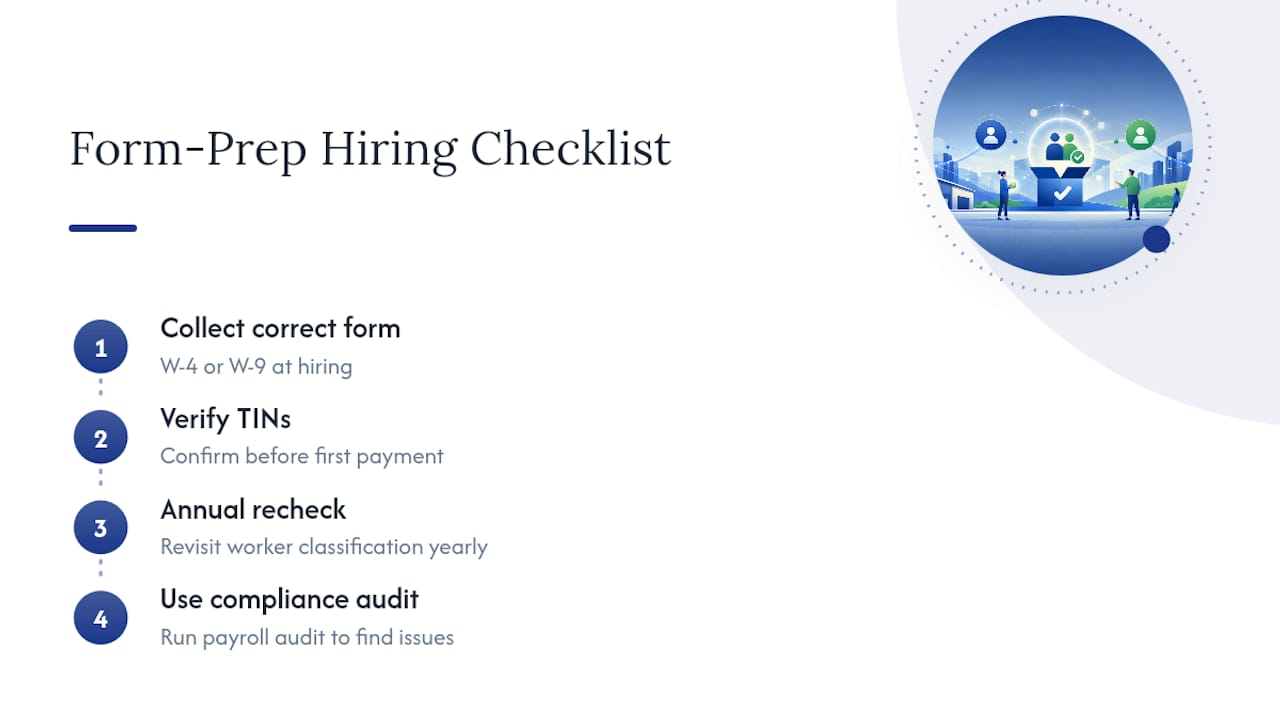
Getting the right form at the right time is the cheapest compliance move a small business can make. This should be part of every client onboarding:
- Collect the correct form (W-4 or W-9) before the first payment goes out, not after.
- Store completed forms alongside payroll records, not in a separate filing drawer nobody checks.
- Run an annual internal audit comparing worker classification against actual job duties.
- Verify TINs on every W-9 before you rely on it for 1099 prep.
Pro Tip: The single most common small-business slipup isn't misclassification itself, it's realizing the mistake in January when 1099s and W-2s are due, rather than catching it during onboarding. A quarterly ten-minute review of your worker roster against their job duties catches this early. A free payroll audit can catch these gaps before the IRS does.
Does Your Form Choice Affect Your Benefits or Paycheck Deductions?
Submitting a W-4 versus a W-9 doesn't just change your tax paperwork. It determines whether you're eligible for employer-sponsored benefits at all.
Employees who file a W-4 are generally the only workers eligible for group health insurance, 401(k) matching, paid sick leave, and unemployment insurance coverage, because those benefits are structured around the employer-employee relationship the W-4 confirms. Independent contractors who submit a W-9 typically receive none of these, since they're treated as running their own business rather than working for one.
Payroll deductions follow the same split. A W-4 employee sees Social Security, Medicare, and often state disability insurance deducted automatically from every check, with the employer matching a portion of Social Security and Medicare on the employer's own side. A W-9 contractor sees no deductions at all on the payment they receive, but owes the full self-employment tax equivalent when they file their own return.
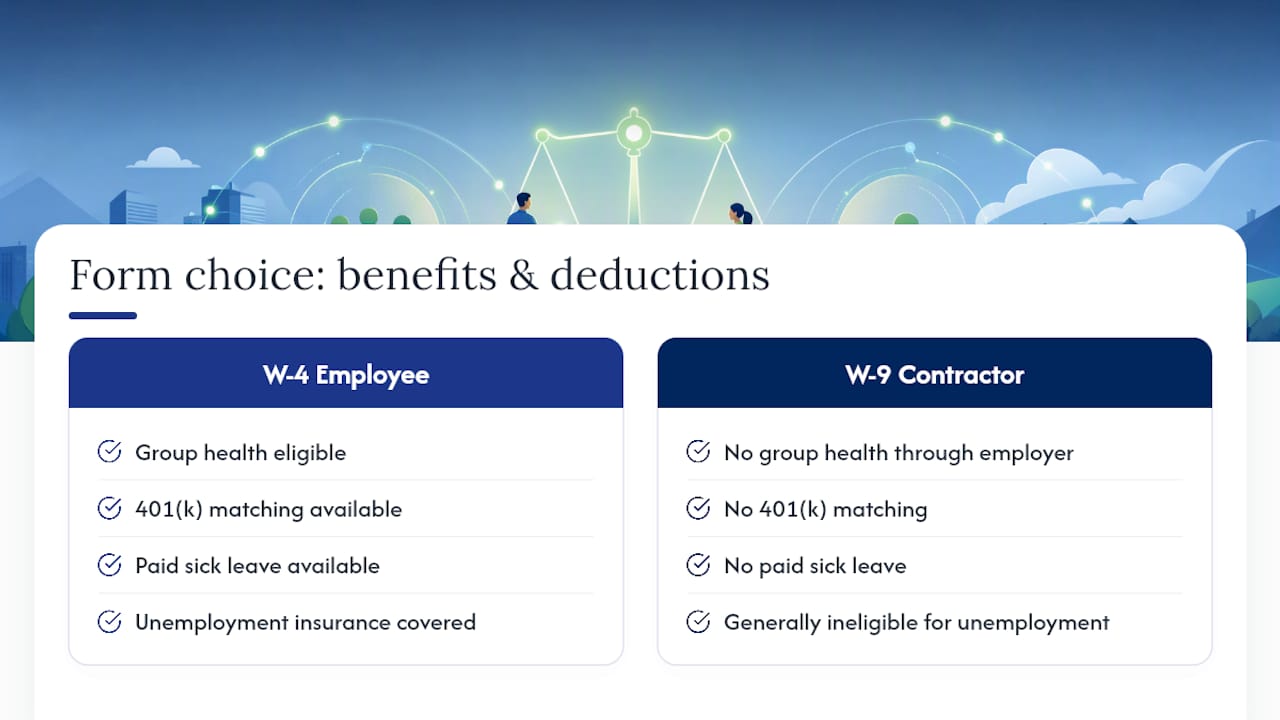
This is exactly why classification matters beyond the form itself. A business that mislabels an employee as a contractor to skip benefits and payroll taxes isn't just risking a paperwork error. It's denying that worker legitimate access to unemployment insurance, workers' compensation coverage, and retirement contributions they may be legally entitled to. If a dispute ever surfaces, the IRS and state labor agencies look at the actual working relationship, not which form happened to get signed.
Real Scenarios: When Does W-4 or W-9 Actually Apply?
Borderline cases are where most classification mistakes happen. A few common ones illustrate the pattern.
The part-time retail worker. Someone working 15 hours a week at a set schedule, using the store's registers and following a manager's instructions, is an employee regardless of how few hours they work. W-4, full stop.
The freelance graphic designer. A designer who sets their own hours, uses their own software and equipment, and completes discrete projects for multiple clients is a contractor. W-9 applies, and the client tracks total annual payments against the $2,000 threshold for 2026.
The "1099 employee" red flag. A worker who reports to the same office five days a week, uses company equipment, and takes direction on how (not just what) to do gets a W-9 anyway because it's cheaper for the employer. This is textbook misclassification and one of the most common triggers for IRS or state labor investigations.
The seasonal consultant. A bookkeeper brought in for two months to close out year-end books, working from home on their own schedule with their own tools, is a legitimate contractor situation. W-9, and likely under the new $2,000 threshold if the engagement is brief.
The marketplace reseller's helper. Someone helping fulfill online orders for a small e-commerce business, using the business's inventory system and following set procedures, tends toward employee status even if paid per order. That distinction matters for reporting obligations across marketplace and reseller arrangements as well.
Updating or Correcting a Form After Circumstances Change
Neither form is a one-time formality. Circumstances change, and both forms need to keep up.
For a W-4, submit a new one anytime your filing status, dependents, or income changes materially, and the IRS recommends doing so as soon as the change happens rather than waiting for the next tax season. There's no limit on how often you can update it. Employers who are transitioning from older W-4 versions to the current design can use the IRS's computational bridge to reconcile withholding calculations across the two formats, which matters for businesses with long-tenured employees who haven't touched their W-4 in years.
For a W-9, updates are needed whenever your legal name, business structure, or TIN changes, such as converting a sole proprietorship to an LLC or getting a new EIN. Submit the corrected W-9 to every business that currently has your old one on file, since each payer relies on their own copy to prepare that year's 1099-NEC. Waiting until the payer flags a TIN mismatch means dealing with backup withholding you could have avoided with a five-minute update.
Small businesses should build a habit of confirming both forms are current for every worker at least once a year, ideally right before year-end reporting season starts.
Our Take: Get the Form Right Before You Worry About the Rate
The conventional advice on this topic spends too much time on withholding math and not enough on the decision that actually causes problems: picking the wrong form in the first place. Misclassification, not miscalculated withholding, is the mistake that draws IRS attention and creates back-tax liability years after the fact.
The 2026 threshold increase to $2,000 for 1099-NEC reporting is a genuine relief for businesses juggling small, occasional contractor payments, but it doesn't change the underlying test. A worker is an employee or a contractor based on the actual relationship, not on which form is more convenient to file. Small-business owners who treat form selection as an afterthought during a rushed hiring process are the ones who end up facing penalties two years later.
Our recommendation: build form collection into your hiring checklist on day one, verify TINs before the first payment, and revisit every worker's classification annually rather than assuming last year's answer still holds. That single habit prevents more IRS correspondence than any amount of withholding fine-tuning ever will.
— Glendale Payroll Staff
If your business is juggling W-4s, W-9s, and the classification calls that come with them, compliance guidance can help you sort it out before it becomes a filing problem. A free payroll audit through Glendale Payroll's services identifies misclassified workers, missing TINs, and outdated withholding elections before the IRS finds them for you, and it's built specifically for employers across Glendale, Burbank, Pasadena, and the Greater Los Angeles area navigating California's payroll rules on top of federal ones.