
Yes: under California Labor Code §2810.5, you must give every non-exempt employee a written wage theft notice at hire, using the DLSE's official template. Reissue it within seven days of most changes to pay rate, payday, or other listed terms, unless the change already appears on a timely wage statement or another required writing. The notice must be in the employee's normal language of communication.
TL;DR:
- Employers must issue or update the wage theft notice within seven days of any material pay change, including raises, payroll switches, or new workers' compensation carriers.
- The notice must be in the employee’s primary language and use the latest official DLSE template updated for 2024, including disaster and emergency declaration disclosures.
- Accurate documentation, including issue date, template version, language, and change triggers, is essential to defend against potential enforcement actions or wage claims.
- Most compliance issues stem from outdated templates or missed reissuance after pay adjustments, which can be prevented with a systematic process and regular template updates.
- Posting or issuing the notice is only the first step; employers must maintain a continuous, documented process for tracking all pay changes and reissuing notices timely.
Table of Contents
- Understanding California Wage Theft Laws and Who They Cover
- What Must Be Included on the Wage Theft Notice?
- When Do You Have to Issue or Update the Notice?
- Which Language Version and Template Should You Use?
- What Penalties Apply for Missing or Incorrect Notices?
- Your Step-by-Step Compliance Checklist
- What We See in Payroll Audits Across California Employers
- What Employers Consistently Get Wrong About This Notice
- Let Glendale Payroll Handle Your Notice and Compliance Workload
- Primary Sources for Wage Theft Notice Compliance
- Sources
Understanding California Wage Theft Laws and Who They Cover
The requirement traces back to the Wage Theft Protection Act of 2011, also known as AB 469, which added §2810.5 to the Labor Code. Lawmakers built it around a simple idea: wage disputes shrink when employees know their pay terms in writing from day one, and employers who document those terms have less exposure when a dispute lands at the Labor Commissioner's office.
The Division of Labor Standards Enforcement (DLSE) administers and enforces the statute. Coverage is broad, but not universal.
- Nearly all non-exempt, private-sector employees must receive the notice.
- Exempt employees (those meeting the executive, administrative, or professional exemption tests) are excluded.
- Employees covered by a qualifying collective bargaining agreement with specified wage and grievance provisions are also excluded.
- Public employees generally fall outside the statute's scope.
For HR teams, the practical takeaway is this: default to issuing the notice for every new hire, then carve out exceptions only when you can document why an employee qualifies for one. That order of operations catches far fewer people in a compliance gap than trying to sort exemptions before onboarding starts.
What Must Be Included on the Wage Theft Notice?
The DLSE's Notice to Employee template exists precisely so employers don't have to guess at formatting. It's a fill-in-the-blank form, and every blank corresponds to a statutory field. Skipping one, even accidentally, technically puts the notice out of compliance.
The required fields include:
- Rate(s) of pay, and whether the employee is paid by hour, shift, day, week, salary, piece, commission, or another method
- Overtime rate(s), if different from the standard rate
- Allowances claimed as part of the minimum wage, such as meals or lodging
- Regular payday
- Employer's legal name, including any "doing business as" names
- Employer's physical address of the main office or principal place of business, and a mailing address if different
- Employer's phone number
- Name, address, and phone number of the workers' compensation insurance carrier
- Any applicable paid sick leave policy language
- For employees on H-2A visas, a supplemental section listing worksite location, wage rates, and hours
Statistic Callout: The statute has required this exact field set since 2011, but the template itself changed effective January 1, 2024, adding disclosure language tied to state or federal disaster and emergency declarations. If your file cabinet still holds a pre-2024 version, it's outdated.
Piece-rate employers need to list both the piece rate and how overtime is calculated on top of it, since piece-rate overtime math confuses more auditors than any other field on the form. And one nuance HR often gets wrong: the employee's signature on the notice acknowledges receipt only. It is not a binding agreement to the wage terms, and it doesn't waive any wage claim the employee might later bring.
When Do You Have to Issue or Update the Notice?
"At the time of hiring" means before the employee starts performing work, not sometime during the first pay period. The cleanest practice is to include the notice in your new-hire packet alongside the I-9 and W-4, signed on day one.
The seven-day reissue rule works like this:
- Any change to a listed field (pay rate, payday, workers' comp carrier, and so on) triggers a new written notice within seven calendar days of the change.
- Exception one: if the change is already reflected on the employee's next timely wage statement, a separate notice isn't required.
- Exception two: if the change is documented in another writing required by law, such as a new offer letter, that can substitute for a fresh notice.
- Common triggers include a promotion with a new pay band, a payroll processor switch that changes the payday, or a new workers' comp carrier after a policy renewal.
Miss the seven-day window and you're technically out of compliance, even if the underlying pay change was entirely lawful.
Which Language Version and Template Should You Use?
The DLSE requires the notice in whatever language you normally use to communicate employment terms to that employee. If you hire a Spanish-speaking crew and communicate scheduling and pay information in Spanish, the notice needs to be in Spanish, not English with a verbal explanation.
- Download official translated versions directly from the DLSE's posters and notices page rather than translating the English version yourself.
- Confirm you're using the version updated for 2024, which added the disaster/emergency declaration disclosure section.
- Avoid heavily customized or internally modified templates. Once you start deleting fields "because they don't apply," you risk cutting something the statute still requires.
Pro Tip: Keep a dated screenshot or download record every time you pull a new template version from the DLSE site. If a wage claim surfaces two years from now, you'll want proof you were using the current form at the time you issued it.
What Penalties Apply for Missing or Incorrect Notices?
The DLSE can cite employers directly for failing to provide a compliant notice, and that citation authority extends beyond just the missing paperwork. A wage claim that surfaces later, whether it's about unpaid overtime or a disputed pay rate, becomes harder to defend without a signed notice showing what you told the employee at hire.
- DLSE enforcement actions in this area typically include administrative citations, civil penalties, and orders for restitution when unpaid wages are found alongside notice violations.
- Willful violations, particularly where an employer knowingly used outdated information or refused to correct it after notice, tend to draw enhanced penalties.
- A missing notice doesn't create a wage claim by itself, but it strips away one of your strongest pieces of documentary evidence when an employee disputes what they were told about pay.
Statistic Callout: The DLSE's own enforcement listings show a steady pattern of citations and settlements tied to wage documentation failures, reinforcing that this isn't a paperwork formality regulators ignore. Also worth flagging: starting in 2026, California employers must separately track the new annual workplace rights notice under SB 294, due each February 1. That notice runs on its own calendar and doesn't replace the event-driven §2810.5 notice. Confusing the two is becoming one of the more common mistakes HR teams make this year.
Your Step-by-Step Compliance Checklist
Building a repeatable process beats scrambling every time a new hire or pay change comes through. Here's the sequence that holds up in an audit.
- Adopt the current DLSE template directly from the official site and store the download date.
- Map each employee's primary language of communication and match the correct translated version.
- Issue the notice before the employee's first shift, as part of the standard onboarding packet.
- Log every issuance: date, template version, language, and who signed off.
- Tie payroll change events (raises, carrier switches, payday shifts) to an automatic reissue trigger within the seven-day window.
- Retain signed copies for at least four years, matching the statute of limitations window for most wage claims.
- Run a periodic internal audit comparing active employee files against your notice log to catch gaps before the DLSE does.
Pro Tip: Build a simple notice register, a spreadsheet or HR system field logging template version, issue date, language, issuer, and the triggering event for every notice you send. It turns "did we give this employee a notice?" from a scramble into a lookup.
Retention matters as much as issuance. Auditors don't just want to see that you provided a notice once; they want a documented trail showing you kept it current every time pay terms changed. If you're managing a workforce with mixed part-time, temporary, and seasonal staff, treat each classification the same way: the seven-day rule and field requirements don't loosen just because someone works fewer hours. Independent contractors fall outside the notice requirement, but misclassifying a worker as a contractor when they function as an employee creates far bigger exposure than a missing form.
What We See in Payroll Audits Across California Employers
Glendale Payroll Staff work with California businesses across Glendale, Burbank, Pasadena, and Greater Los Angeles, and the same handful of mistakes show up again and again in compliance audits. Outdated templates top the list, usually a version predating the January 2024 disaster-disclosure update, still sitting in an onboarding folder from years back. Second most common: notices never reissued after a pay raise or a workers' comp carrier switch, because payroll and HR weren't talking to each other about the change.
The fix in both cases is procedural, not complicated. Pull a fresh template from the DLSE site quarterly, and connect payroll change events directly to a reissue checklist so nothing depends on someone remembering. Dedicated payroll professionals who watch these triggers for a living catch far more of these gaps than a generalized HR checklist reviewed once a year.
What Employers Consistently Get Wrong About This Notice
Most employers treat the wage theft notice as a one-time onboarding formality, and that's the single biggest misread of what the statute actually demands. It's not a hire-day checkbox. It's a living document that has to track every material change to pay terms for as long as someone works for you.
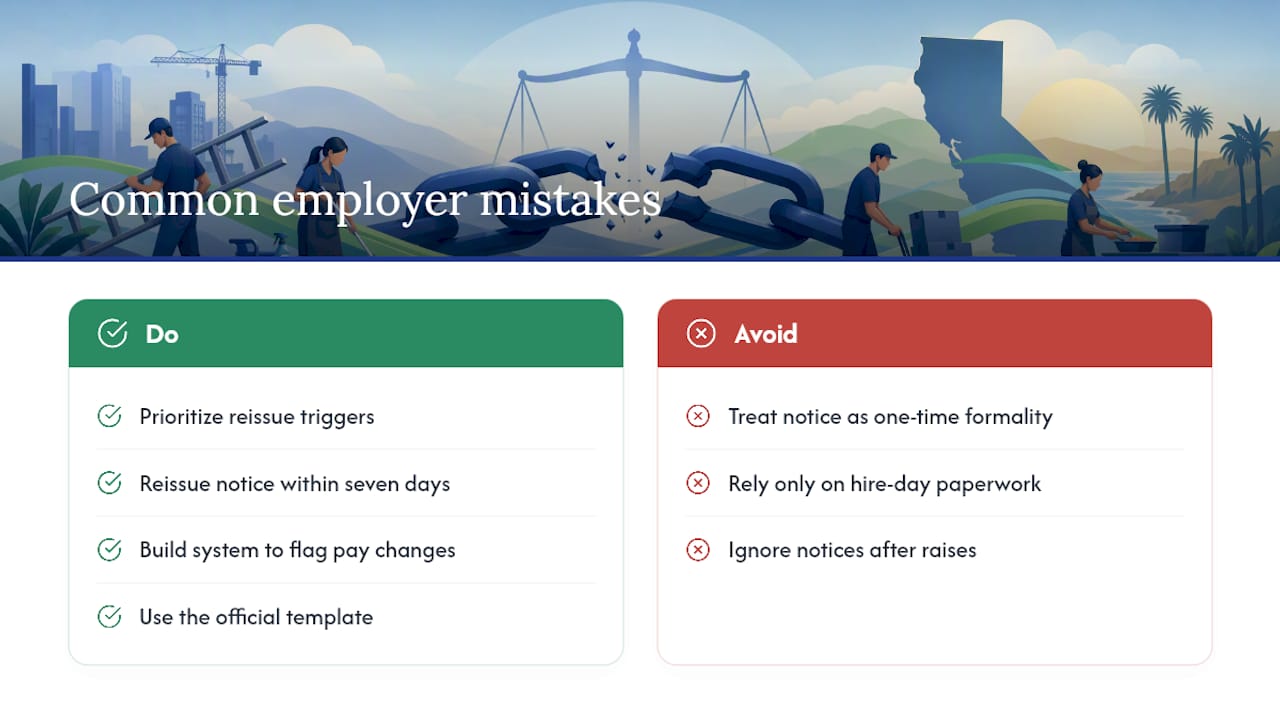
The conventional advice, "just use the template," is correct but incomplete. The harder discipline is building a system that flags when a change happened and forces a reissue within seven days, because that's where nearly every real-world violation actually occurs. Employers rarely forget the notice at hire. They forget it exists three months later when a raise goes through.
If you take one thing from this guide, prioritize the reissue trigger over the initial notice. Getting the hire-day paperwork right is table stakes. Catching every subsequent change, quietly and consistently, is what actually keeps you out of a DLSE citation.
— Glendale Payroll Staff
Let Glendale Payroll Handle Your Notice and Compliance Workload
Glendale Payroll is the alternative to managing this process manually spreadsheet by spreadsheet: our dedicated payroll professionals track template versions, flag pay-change triggers, and reissue notices before the seven-day window closes, so you're not relying on memory or a calendar reminder.

Our services map directly onto the gaps outlined above: template management, change-tracking tied to your payroll runs, federal and California state tax filing, and recordkeeping that holds up if the DLSE comes calling. Every new client starts with a free comprehensive payroll audit that flags exactly where your current notices, records, or filings fall short. If you want practical, ongoing guidance beyond the audit, our payroll tips resource covers the everyday compliance questions California small businesses run into most. Reach out to schedule your audit and see where your current process stands.
Primary Sources for Wage Theft Notice Compliance
- California Labor Code §2810.5
- DLSE Notice to Employee template (PDF)
- Wage Theft Protection Act overview
- DLSE FAQs on the Notice to Employee
Sources
- California Labor Code §2810.5
- Notice to Employee (Labor Code section 2810.5)
- Wage Theft Protection Act – Notice to Employees (FAQ)