
Yes, California law imposes a waiting time penalty when an employer willfully fails to pay all final wages owed to a discharged or resigning employee. Under Labor Code §203, that penalty equals the employee's daily rate of pay for every day the wages stay unpaid, up to a 30 calendar day cap. The Labor Commissioner's Office (DLSE) treats this penalty as a deterrent, not a wage substitute, and California courts have leaned on it heavily in cases like Mamika v. Barca to enforce prompt final pay.
Here's who this affects and how:
- Discharged employees are owed all wages immediately on termination.
- Employees who quit without notice must be paid within 72 hours; those who give 72 hours' notice are owed pay on their last day.
- Wages that count include base pay, earned commissions, regularly scheduled overtime, and accrued vacation under Labor Code §227.3.
The waiting time penalty exists to punish delay, not to compensate for lost income. That distinction shapes almost every dispute over how much is owed and why.
Key Takeaways
California's waiting time penalty punishes delay in final wages at up to 30 calendar days of daily pay, and paying undisputed wages immediately is the single most reliable way to avoid it.
| Point | Details |
|---|---|
| Penalty formula | Daily rate of pay multiplied by calendar days unpaid, capped at 30 days under Labor Code §203. |
| Deadlines differ by exit type | Discharged employees are owed pay immediately; resigning employees get 72 hours unless they gave advance notice. |
| Good faith defense is narrow | Employers must pay all undisputed wages immediately or the defense fails entirely. |
| Only two things stop accrual | Full payment or filing a court action stops the clock; a DLSE claim alone does not. |
| Prevention beats disputes | Glendale Payroll's free payroll audit reviews final-pay timing and documentation before a missed deadline turns into a claim. |
Where to Verify Waiting Time Penalty Rules
For primary sources on waiting time laws in California, start with the state agencies that write and enforce them directly.
- DLSE Waiting Time Penalty FAQ for official guidance on triggers and defenses.
- The DLSE opinion letter on vacation pay calculations for guidance on what counts toward the daily rate.
Table of Contents
- What Triggers Waiting Time Penalties in California
- How to Calculate a Waiting Time Penalty in California
- When 'Good Faith' Protects an Employer From Penalties
- How Employees Recover Waiting Time Penalties in California
- Employer Checklist to Avoid Waiting Time Penalties
- Steps for Employees to Recover Unpaid Final Wages
- Frequently Asked Questions
- Sources
What Triggers Waiting Time Penalties in California
The penalty clock starts running the moment an employer misses a final-pay deadline set by Labor Code §201 or §202. Section 201 requires immediate payment when you fire, lay off, or discharge someone. Section 202 gives quitting employees 72 hours unless they gave 72 hours' advance notice, in which case final pay is due on their last working day. Section 203 is the enforcement mechanism that turns a missed deadline into a daily financial penalty.
"Willful" failure doesn't mean the employer set out to cheat anyone. The DLSE's own guidance defines it as simply failing to act when payment was due and the employer knew, or should have known, wages were owed. An HR department that forgets a departing employee's commission check, or a payroll system that runs on a two-week cycle regardless of termination dates, still counts as willful under this standard.
Common scenarios that trigger the clock:
- An employee is fired on a Friday and doesn't receive their check immediately, but only at the next scheduled payroll run.
- An employee quits without notice and isn't paid within 72 hours, missing the required payment window.
- An employee gives two weeks' notice, but the employer waits until the regular pay period to issue the final check instead of paying on the last working day as required.
Independent contractors and volunteers fall outside this rule entirely, since §203 protects employees only. Exempt and nonexempt employees, however, get identical treatment. Salary status changes nothing about the deadline or the penalty exposure.
How to Calculate a Waiting Time Penalty in California
The math behind waiting time laws in California is straightforward once you know which wages belong in the calculation. The formula is:
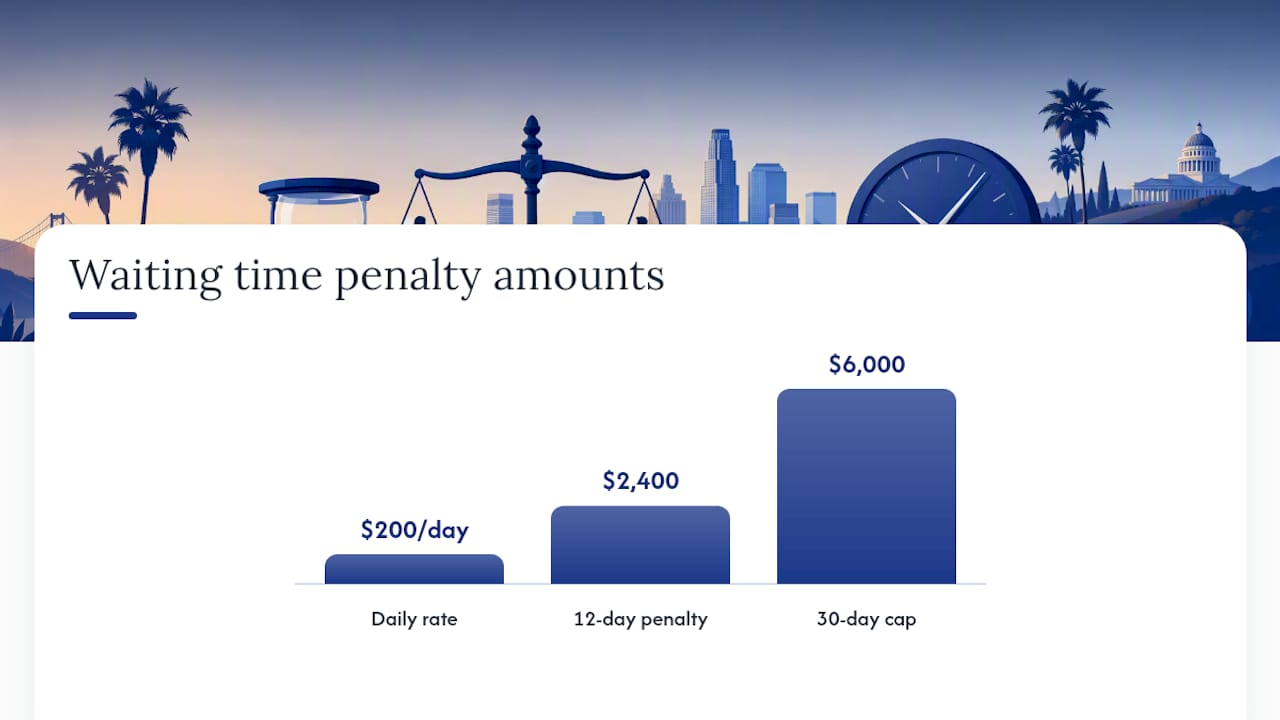
Daily rate of pay × number of calendar days unpaid, up to a maximum of 30 days.
What counts as part of the "daily rate" matters more than most employers realize. Case law from Mamika v. Barca and DLSE guidance in the Zara Santos opinion letter support folding in commissions, guaranteed bonuses, and regularly scheduled overtime when those amounts were genuinely part of the employee's compensation. Vacation pay owed under §227.3 also gets included. Expense reimbursements typically do not, since they aren't wages for labor performed.
Here's a worked example:
- An employee earns $25 per hour and works an 8-hour day, giving a daily rate of $200.
- The employer discharges the employee on a Monday but doesn't issue the final check until 12 days later.
- Penalty = $200 × 12 days = $2,400.
- If the same employer waited 45 days instead of 12, the penalty caps at 30 days: $200 × 30 = $6,000, regardless of how much longer the wages stayed unpaid.
Pro Tip: The 30-day cap counts calendar days, not business days. Weekends and holidays add up just as fast as workdays, so a two-week delay over a holiday stretch can quietly turn into a much larger number than it looks like on a calendar.
A $2,400 penalty on a single missed final check is not rare. It's the predictable outcome of treating final pay like a routine payroll cycle instead of an immediate obligation.
When 'Good Faith' Protects an Employer From Penalties
Not every late final check results in a penalty. California recognizes a "good faith dispute" defense, but it's narrower than most employers assume. To use it, an employer needs a genuine, reasonable legal or factual basis for withholding the disputed portion of pay, and the employer must still pay every undisputed dollar immediately.
If an employer withholds wages that aren't actually in dispute, the good faith defense collapses. Paying only the contested amount late while sitting on money you already know is owed defeats the whole purpose of the defense.
That last requirement trips up more employers than the dispute itself. Say a departing employee's regular wages are undisputed but a commission calculation is genuinely unclear. The employer must pay the regular wages right away and can only delay the commission piece while it sorts out the calculation.
Arguments that routinely fail as defenses under DLSE guidance:
- Claiming the business couldn't afford to pay on time.
- Blaming a slow payroll processor or a delayed direct deposit run.
- Pointing to an out-of-state payroll vendor unfamiliar with California's timing rules.
None of these hold up, because California law penalizes willful nonpayment, and an employer's internal logistics problems don't erase that willfulness. Inability to pay is treated the same as refusal to pay.
How Employees Recover Waiting Time Penalties in California
Penalty accrual doesn't stop just because an employee files a complaint. Under DLSE guidance, only two things stop the clock: full payment of the wages owed, or the employee filing a court action. A pending wage claim with the Labor Commissioner's Office does not pause accrual, though the 30-day cap still limits total exposure.
Employees generally choose between two paths to recover unpaid wages and the associated penalty:
- File a wage claim with the DLSE. This is faster and cheaper, with no attorney required, and works well for straightforward final-pay disputes.
- File a civil lawsuit. This suits larger claims, especially when other violations (unpaid overtime, meal break penalties) are bundled in, since courts can award broader remedies than the administrative process.
AB 673 expanded recovery options further by amending Labor Code §210, letting employees recover statutory penalties for late wage payment even while still employed elsewhere, rather than only after separation. Statutory penalties go to the employee; civil penalties collected under the same section go to the state.
A practical timeline looks like this:
- Day 0: Final wages become due under §201 or §202.
- Days 1 to 30: Penalty accrues daily at the employee's full daily rate.
- Any point: Employee sends a written demand and gives the employer a chance to cure the violation.
- If unresolved: Employee files a DLSE claim or civil action, generally within three years for the wage claim itself under California's statute of limitations for wage violations.
Employer Checklist to Avoid Waiting Time Penalties
Preventing these penalties comes down to a handful of payroll habits, not a legal overhaul. Most violations trace back to timing gaps in otherwise routine processes.
Build these checks into your final-pay procedure:
- Audit every termination and resignation against §201/§202 deadlines before the check goes out.
- Confirm commissions, guaranteed bonuses, and accrued vacation are included in the final wage calculation.
- Verify whether payment will arrive by mail or direct deposit, since mailing delays don't excuse a missed deadline.
- Document any 72-hour notice an employee gives in writing, with a timestamp.
- Set a standing procedure for tendering payment the same day a termination decision is made.
Pro Tip: If you discover a late payment after the fact, pay every undisputed wage immediately, even if part of the amount is genuinely contested. That single step preserves your good faith defense on the disputed portion and often stops the bleeding before it reaches the 30-day cap.
When a gap surfaces, move fast:
- Confirm the exact date wages became due.
- Calculate the daily rate and days elapsed.
- Pay the undisputed amount immediately, by the fastest method available.
- Document the correction and update your payroll cutoff procedures to prevent a repeat.
A payroll process review built around these checkpoints catches most final-pay gaps before they become penalty exposure. Businesses that automate payroll processing also tend to catch termination-date mismatches earlier, since the system flags the final check the moment a separation date is entered.
Steps for Employees to Recover Unpaid Final Wages
If your final paycheck arrived late or short, you have a straightforward path to pursue what you're owed, and documentation is your strongest asset from day one.
Start with these steps:
- Send a written demand for payment, stating your last day worked, the wages owed, and a deadline to respond.
- Gather your pay stubs, timesheets, offer letter, and any text or email records showing your resignation or discharge date.
- Calculate your own estimate of the waiting time penalty using your daily rate and the days elapsed.
- Decide whether to file with the DLSE or pursue a civil action based on the size of your claim.
Your evidence checklist before filing:
- Recent pay stubs showing your regular rate and any commission structure.
- Your employment agreement or offer letter.
- Proof of your resignation date or discharge date, ideally in writing.
- Any record of the date you actually received payment, including bank deposit records.
A DLSE wage claim starts with a filed complaint, followed by a settlement conference and, if unresolved, a hearing before a deputy labor commissioner. It's designed to work without a lawyer. If your claim involves a large commission dispute or multiple violations layered together, a civil action may recover more, but it also takes longer and usually requires legal representation.
Why timely final pay protects more than your bottom line
Every waiting time penalty we've broken down here traces back to the same root cause: a payroll process that wasn't built to handle terminations and resignations as immediate events. We built our approach around that gap. A business that treats final pay as an afterthought to its regular payroll cycle is the business most likely to get hit with a penalty it never saw coming, and the damage isn't limited to the check itself. Wage claims become part of the public record, and repeat violations draw closer DLSE scrutiny.

We'd rather see employers catch this before it becomes a claim. When the calculation gets complicated, especially around commissions or vacation payout, it's worth confirming your numbers against DLSE guidance or a payroll professional rather than guessing.
Protect Your Business From Final-Pay Violations
Most waiting time penalties trace back to a payroll system built for routine cycles, not sudden terminations or resignations. Glendale Payroll is built the other way around: dedicated payroll professionals, not a call center, handle your final-pay processing, so a termination on a Tuesday doesn't wait for Friday's regular run.

Our free payroll audit checks exactly the spots where waiting time penalties usually start, including commission inclusion in final checks, direct deposit timing, and documentation of 72-hour resignation notices. For businesses across Glendale, Burbank, Pasadena, and the greater Los Angeles area, that audit often catches gaps a generic payroll vendor misses entirely, because we're not managing your account from a script. If you want a clear picture of where your final-pay process stands, browse our payroll tips for California small businesses or reach out to request your free compliance audit today.
Frequently Asked Questions
Does the 72-hour rule apply to every resignation? It applies whenever an employee quits without giving 72 hours' advance notice. If notice is given, final pay is due on the last day worked instead.
Can an employer avoid the penalty by claiming a payroll processing delay? No. DLSE guidance treats processing delays and payroll vendor issues as internal problems that don't excuse a missed final-pay deadline.
Do waiting time penalties apply to independent contractors? No. Labor Code §203 only covers employees, so independent contractors and volunteers fall outside its protection.
What is the maximum waiting time penalty an employee can recover? The maximum is 30 calendar days of pay at the employee's daily rate, even if the wages remain unpaid for much longer than 30 days.
Does filing a DLSE claim stop the penalty from growing? No. Only full payment or filing a court action stops accrual. A pending DLSE wage claim does not pause the clock.
This article is general information, not a substitute for advice from a qualified lawyer. Consult a qualified legal professional about your own circumstances before acting on anything here.