
A payroll service bureau is a third-party company that handles payroll processing, tax withholding, tax deposits, and government filings on behalf of small and mid-size employers, all under the employer's own EIN. You keep full control of hiring, compensation decisions, and HR policy. The bureau handles the calculations, remittances, and paperwork that consume hours every pay period.
A bureau tends to be the right fit when:
- You have employees in multiple states and can't keep up with each state's withholding and filing rules.
- Your pay structure includes overtime, garnishments, or variable commissions that make gross-to-net calculations error-prone.
- You lack a dedicated payroll professional in-house and the owner is spending hours on compliance research instead of running the business.
Deloitte's 2020 Global Payroll Benchmarking Survey found that 73% of organizations outsource at least part of their payroll function, citing efficiency and compliance expertise as the primary drivers. For California employers specifically, the California Employment Development Department (EDD) adds another layer of state-specific obligations that make the case for a bureau even stronger.
Table of Contents
- What does a payroll service bureau actually do each pay period?
- How do the different bureau models compare?
- Why small businesses use payroll bureaus: real-world gains
- What does a payroll bureau typically cost?
- How do you decide between a bureau, DIY software, or a PEO?
- What does onboarding with a bureau look like?
- How bureaus protect your payroll data and what liability stays with you
- The compliance risks that make a specialist worth it
- Key Takeaways
- What we see most often at Glendale Payroll
- How Glendale Payroll can help you get compliant fast
- Useful sources
What does a payroll service bureau actually do each pay period?
A bureau takes over the full cycle of payroll tasks, from the moment you submit hours to the moment employees see funds in their accounts and the IRS receives its deposit. Core services typically include gross-to-net calculations, federal and state tax withholding, tax deposits, direct deposit or check issuance, quarterly Form 941 filings, annual W-2 and 1099 generation, new-hire reporting, and garnishment processing.

Think of it as a recurring calendar your bureau manages for you:
| Frequency | Task the bureau handles |
|---|---|
| Each pay run | Gross-to-net calculations, direct deposit, check printing |
| Monthly/semi-weekly | Federal and state tax deposits (per IRS schedule) |
| Quarterly | Form 941 filing, state unemployment filings |
| Annually | W-2 and 1099 distribution, year-end reconciliation |
| As needed | New-hire reporting, garnishment remittances |
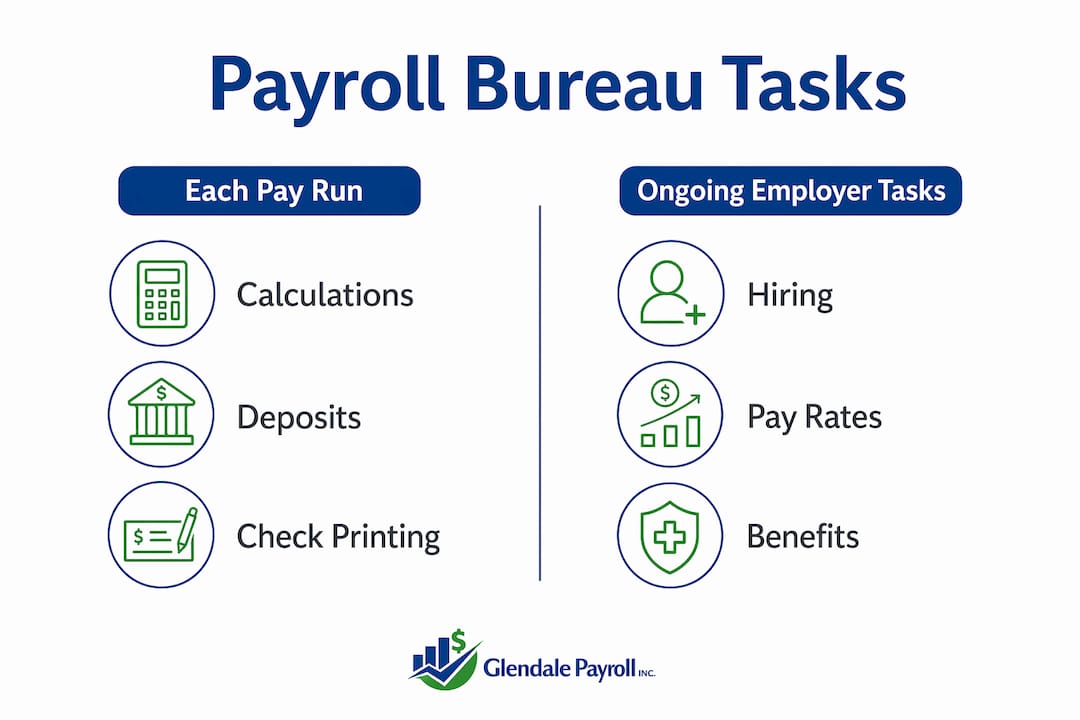
What stays with you as the employer: hiring and termination decisions, setting pay rates, managing benefits elections, and HR policy. The bureau is not your HR department. It executes the payroll you authorize, accurately and on time.
How do the different bureau models compare?
Not every bureau operates the same way. Understanding the main models helps you match the right delivery format to your business.
- Full-service commercial bureaus handle the entire payroll cycle with a dedicated account manager. They typically serve businesses that want a human point of contact and a complete hands-off experience for processing and filings.
- Cloud-based/online bureaus deliver payroll through a self-service portal where you enter data and the bureau handles tax filings and deposits in the background. These suit tech-comfortable owners who want lower fees and 24/7 access to reports.
- Government/centralized payroll bureaus are operated by state agencies (the Virginia Department of Accounts runs a well-documented example) to process payroll for multiple state agencies from a single platform. These are not available to private employers but illustrate how the bureau model scales.
- Accounting-firm bureaus are offered as an add-on by CPA firms. They work well when your accountant already knows your books, though the payroll function may not be their primary specialty.
- Hybrid models combine a software portal with access to a live specialist for complex issues, garnishments, or multi-state compliance questions.
One distinction worth knowing: a bureau is not a Professional Employer Organization (PEO). A PEO co-employs your workforce and assumes certain employer liabilities under a shared EIN. A bureau processes payroll under your EIN, so you retain full employer status and statutory liability. If control and brand identity matter to you, a bureau preserves both.
Why small businesses use payroll bureaus: real-world gains
The most immediate benefit is time. Payroll compliance research, deposit scheduling, and quarterly filings can consume several hours per pay period for a small-business owner with no payroll background. A bureau converts that unpredictable time drain into a predictable monthly expense.
Beyond time, the gains are concrete:
- Compliance accuracy. A bureau tracks IRS deposit schedules, SSA wage-base updates, and state-specific rules (California SDI rates, EDD reporting deadlines) so you don't have to.
- Penalty avoidance. Late or incorrect federal tax deposits trigger IRS failure-to-deposit penalties that start at 2% and escalate to 15% of the unpaid amount. A bureau's compliance calendar and automated reminders reduce that exposure significantly.
- Scalability. Adding five employees doesn't require hiring a payroll clerk. You notify the bureau, and the per-employee fee adjusts.
- Reliable pay for employees. Consistent, accurate paychecks reduce employee complaints and support retention.
- Audit trails. Bureaus maintain detailed records suitable for IRS audits, lender due diligence, or workers' compensation audits.
Pro Tip: Ask any bureau you're evaluating whether they provide a named specialist, not just a support queue. Dedicated payroll specialists handle complex scenarios like garnishments and benefit deductions faster and with fewer errors than generic help desks.
The non-obvious advantage is pooled regulatory knowledge. A bureau serving dozens of California employers stays current on EDD rule changes, minimum wage updates, and new-hire reporting requirements as a matter of daily business. You benefit from that expertise without paying for a full-time payroll compliance officer. For more on how integrated payroll workflows reduce administrative burden, the Glendale Payroll resource library covers California-specific scenarios in detail.
What does a payroll bureau typically cost?
Pricing is more transparent than many small-business owners expect. Most commercial bureaus use a combination of a flat monthly base fee plus a per-employee charge per pay period. A one-time setup fee covers onboarding, EDD account registration (in California), and data migration.
| Fee type | What it typically covers | What often costs extra |
|---|---|---|
| Monthly base fee | Processing, tax deposits, standard filings | Custom reporting, integrations |
| Per-employee fee | Each active employee per pay run | Terminated-employee W-2s |
| Setup/onboarding fee | Data migration, EDD setup, initial configuration | Parallel run support |
| Add-on fees | Garnishment remittances, 1099 processing | Same-day ACH, check printing |
Comparing bureau pricing to DIY payroll software requires an honest accounting of hidden costs. DIY payroll's real cost includes the owner's time researching compliance, the risk of IRS penalties for missed deposits, and the opportunity cost of hours spent on payroll instead of revenue-generating work. A bureau fee that looks higher than a software subscription often comes out ahead once you factor in those variables.
How do you decide between a bureau, DIY software, or a PEO?
Use this checklist to assess your situation before you start talking to providers.
Signs a bureau is the right fit:
- You have five or more employees and payroll takes more than two hours per pay period.
- You operate in more than one state or plan to hire remotely.
- You've had a payroll error, a late deposit, or an IRS notice in the past 12 months.
- You want a human specialist available for complex issues, not just a chatbot.
- Your pay structure includes garnishments, commissions, or multiple pay rates.
Questions to ask a potential bureau:
- Who files our federal and state taxes, and how are deposits scheduled?
- Do we get a named payroll specialist, or does every call go to a general queue?
- What is your SLA for correcting a payroll error?
- How do you handle secure data transfer (SFTP, API, TLS-encrypted portal)?
- Do you have experience with California EDD filings and SDI withholding?
Red flags to watch for:
- Fee schedules that are vague or change without notice.
- No documented experience with your state's filing requirements.
- No secure data transfer method for sensitive employee information.
- Inability to provide references from businesses of similar size or industry.
If you're still weighing the decision, 5 signs it's time to outsource your payroll offers a practical self-assessment for small-business owners.
What does onboarding with a bureau look like?
Most bureaus can process your first live payroll within two to six weeks, depending on your complexity and how quickly you provide the required documents. Typical onboarding follows this sequence:
- Discovery call. The bureau reviews your pay schedule, employee count, states of operation, and any existing payroll history.
- Data gathering. You provide your EIN, bank account details, prior payroll records (year-to-date figures), employee details (SSNs, addresses, W-4s), and benefits carrier information.
- System setup. The bureau configures your account, registers with state agencies (including EDD in California), and maps your pay codes.
- Parallel run. You run one payroll cycle simultaneously through your old method and the bureau's system, then reconcile net pay and tax deposits to confirm accuracy before going live.
- First live payroll. Once the parallel run reconciles cleanly, the bureau processes your first authorized payroll and initiates bank transfers.
The parallel run is the step most businesses skip when they're in a hurry, and it's the one that prevents the most problems. Reconciling net pay and tax deposits before authorizing live bank transfers catches timing errors and data mismatches before they affect employees or trigger IRS notices.
How bureaus protect your payroll data and what liability stays with you
Reputable bureaus use encrypted data transfers (SFTP, API connections, or TLS-secured portals) to move sensitive employee information. SOC 2 Type II certification is the most common compliance framework you'll see referenced; it covers security, availability, and confidentiality controls. Role-based access limits who inside the bureau can view your data, and periodic internal audits verify those controls are working.
For payroll communications specifically, protecting against email impersonation matters. Secure email practices for financial data reduce the risk of fraudulent payroll change requests reaching your bureau or your employees.
Pro Tip: Before signing with any bureau, ask for their SOC 2 report or equivalent security documentation. A bureau that can't produce it hasn't been independently audited for data protection.
One liability point that surprises many employers: the bureau handles your filings, but you remain the statutory taxpayer. If a bureau makes a late deposit using your funds, the IRS penalty notice comes to you. A well-structured service agreement should specify the bureau's liability for errors caused by their own processing failures, but you should read that clause carefully before signing.
The compliance risks that make a specialist worth it
The most common payroll compliance failures for small businesses are misfiled Form 941s, late federal tax deposits, and multi-state withholding errors. IRS failure-to-deposit penalties range from 2% (1–5 days late) up to 15% for deposits more than 10 days past due. Multi-state withholding errors can trigger audits in multiple jurisdictions simultaneously.
A bureau reduces these risks through a compliance calendar, automated deposit reminders, and centralized filing teams that specialize in multi-state withholding rules. The combination of process controls and dedicated specialists is what separates a bureau from a software subscription.
Bureaus reduce penalties by maintaining that compliance calendar and by having specialists who track rule changes across jurisdictions as their primary job. Audit trails produced by a bureau, including timestamped records of every payroll run, tax deposit, and filing, are exactly what lenders and auditors ask for. Secure payroll records also speed up workers' compensation audits and SBA loan applications.
Deloitte's benchmarking data showing 73% outsourcing rates reflects a straightforward calculation: the cost of a bureau is predictable, while the cost of a compliance failure is not. Glendale Payroll's free payroll audit is designed to surface exactly those hidden risks before they become penalties.
Key Takeaways
A payroll service bureau processes payroll, files taxes, and handles remittances under your EIN, giving small businesses compliance accuracy and time savings without the cost of an in-house payroll department.
| Point | Details |
|---|---|
| Bureau vs. PEO | A bureau keeps your EIN and employer status intact; a PEO co-employs and shares liability. |
| Core services covered | Calculations, tax deposits, 941 filings, W-2s, direct deposit, garnishments, and new-hire reporting. |
| Pricing structure | Flat monthly base fee plus per-employee charge, with a one-time setup fee at onboarding. |
| Onboarding timeline | Plan for two to six weeks; always run a parallel payroll cycle before going live. |
| Glendale Payroll | Offers dedicated payroll specialists, flat-rate monthly pricing, and a free audit for California small businesses. |
What we see most often at Glendale Payroll
The clients who come to us most often share a familiar story: they've been handling payroll themselves or through a generalist bookkeeper, and something has gone wrong. A missed EDD deposit. A W-2 with the wrong state wages. A garnishment that wasn't remitted on time. These aren't failures of effort; they're failures of specialization.
At Glendale Payroll, every client works with a dedicated payroll professional, not a rotating support queue. Our model is straightforward: a flat monthly fee plus a per-employee charge, with a one-time setup fee that covers EDD account registration and data migration. We handle federal and California state payroll tax filing, direct deposit, year-end W-2 preparation, and new-hire reporting. What we don't do is hand you a software login and call it outsourcing.
The businesses we serve in Glendale, Burbank, Pasadena, and Greater Los Angeles often have seasonal hiring patterns, multi-rate pay structures, or a history of compliance notices they want to put behind them. A bureau relationship works best when you treat it as a partnership, not a transaction.
How Glendale Payroll can help you get compliant fast
California payroll compliance carries obligations that go beyond federal requirements: EDD employer account registration, SDI withholding, quarterly DE 9 and DE 9C filings, and strict new-hire reporting deadlines. Getting any of those wrong costs money.
Glendale Payroll's free payroll audit reviews your current setup, identifies compliance gaps, and gives you a clear picture of your risk exposure before you commit to anything. There's no obligation. If you decide to move forward, our flat monthly fee plus per-employee pricing means you know exactly what you're paying from day one, with no surprise add-ons for standard filings. Businesses across Greater Los Angeles use our California payroll compliance services to stay current with EDD requirements and avoid IRS penalties. Ready to see where your payroll stands? Request your free audit and get a clear answer within one business day.
Useful sources
- Deloitte Global Payroll Benchmarking Survey (2020) — outsourcing rate data and efficiency benchmarks
- LegalClarity: What Is a Payroll Bureau and How Does It Work? — bureau vs. PEO distinction
- The Credit People: What Is a Payroll Service Bureau? — core services, onboarding, and audit trail practices
- IRIS: Payroll Bureaus Overview — compliance calendar and multi-state risk reduction
- PeopleHR: Payroll Bureau vs. Outsourcing — dedicated specialist model
- Virginia Department of Accounts: Payroll Service Bureau — government/centralized bureau model reference
- Glendale Payroll: Services — processing, compliance, and dedicated specialist model
- Glendale Payroll: California Payroll Compliance Guide — EDD, SDI, and California-specific filing guidance