
A payroll service level agreement (SLA) is a contract schedule that defines measurable performance standards, assigns responsibilities to both parties, and specifies remedies when those standards are not met. It sits as an appendix or schedule to your master services agreement (MSA) or statement of work, not as a standalone document. According to the Deloitte Global Payroll Benchmarking Survey, 81% of large businesses use payroll SLAs to formalize provider commitments. Industry practice commonly sets high accuracy targets, and every well-drafted SLA should reflect federal filing deadlines set by the IRS and applicable state agencies such as California's Employment Development Department (EDD).
TL;DR — what a payroll SLA covers:
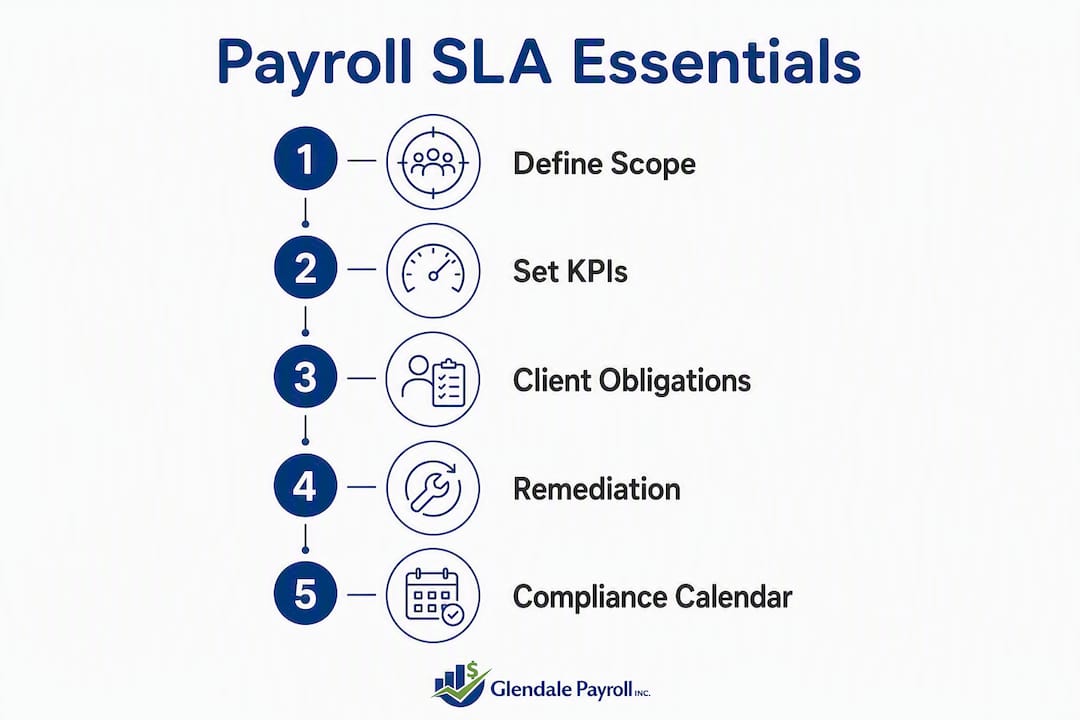
- Scope: Which payroll tasks the provider owns (processing, tax filing, W-2 distribution, direct deposit)
- KPIs: Measurable targets for accuracy, timeliness, portal uptime, and response times
- Client obligations: Data submission deadlines your team must meet for SLA coverage to apply
- Remedies: Service credits or other agreed remedies when the provider misses a target
- Legal placement: Always an appendix or schedule to the MSA, not a freestanding contract
Table of Contents
- What is a payroll service level agreement in legal and practical terms?
- Why should your business use a payroll SLA?
- Which businesses should require a payroll SLA?
- What core components does every payroll SLA need?
- What KPIs and targets should you include in a payroll SLA?
- What sample SLA clauses and negotiation checklist should you use?
- How do you monitor, manage, and enforce a payroll SLA after signing?
- What are the red flags and pitfalls in payroll SLAs?
- How does industry data and Glendale Payroll's approach support SLA best practices?
- Key Takeaways
- What payroll providers often wish their clients understood about SLAs
- Glendale Payroll's SLA-backed payroll services for California employers
- Useful sources and references
What is a payroll service level agreement in legal and practical terms?
The primary contract between you and a payroll provider covers scope and pricing. The SLA translates that scope into operational standards: how accurately payroll must be processed, how quickly errors must be corrected, and what happens when something goes wrong. Think of the MSA as the "what" and the SLA as the "how well."
As a legally binding schedule, the SLA carries the same contractual weight as the main agreement. Courts and arbitrators treat its metrics and remedies as enforceable obligations, which is why vague language in an SLA is a real liability for buyers.
From a compliance standpoint, your SLA should reflect the actual filing deadlines your provider must meet. Federal payroll tax deposits follow IRS schedules (semi-weekly or monthly depending on your lookback period), and California employers face additional EDD deadlines for SDI, UI, and PIT. Documenting those deadlines inside the SLA creates a clear audit trail if a filing is late.
Pro Tip: Ask your provider to attach a compliance calendar as an exhibit to the SLA. Listing specific IRS and EDD deadlines by quarter removes ambiguity about what "timely filing" means.
Why should your business use a payroll SLA?
The primary job of an SLA is risk transfer. When performance expectations are measurable and written into a contract, the provider bears accountability for failures rather than your business absorbing the cost of errors, late filings, or IRS penalties.
81% of large businesses use payroll SLAs — Deloitte Global Payroll Benchmarking Survey
That figure matters for small businesses too. If 81% of large enterprises consider SLAs standard practice, accepting a payroll engagement without one puts you at a structural disadvantage. Many clients still accept boilerplate terms without negotiating, which means the provider's default language often favors the provider.
The core benefits of a well-negotiated payroll service agreement include:
- Compliance protection: Deadlines tied to IRS and state agency schedules are contractually enforceable
- Measurable performance: Accuracy rates and processing windows are documented, not assumed
- Predictable turnaround: Bank file delivery windows and pay date commitments are locked in
- Vendor accountability: Missed targets trigger defined remedies rather than informal apologies
- Employee experience: Consistent, on-time pay builds workforce trust and reduces HR escalations
Service credits convert operational failures into quantifiable outcomes. If a provider misses the bank file delivery window and employees are paid late, a credit against your next invoice makes the cost of that failure concrete and recoverable.
Which businesses should require a payroll SLA?
Not every payroll relationship carries the same risk profile, but the bar for requiring an SLA is lower than most small-business owners assume.
You should insist on a formal SLA if your business:
Even a single-state employer with a small headcount benefits from documented service standards. The SLA creates a paper trail that is useful during audits, provider disputes, or transitions to a new vendor. Raise SLA expectations during vendor selection, before you sign anything, and revisit them at every contract renewal. Waiting until a problem occurs is the most expensive time to negotiate.
What core components does every payroll SLA need?
A payroll SLA that actually protects you covers nine distinct component groups. Missing any one of them creates a gap a provider can exploit.

| Component | What it covers |
|---|---|
| Scope of services | Exact tasks owned by the provider: processing, tax filing, W-2s, direct deposit, new hire reporting |
| Service level metrics (KPIs) | Accuracy targets, processing deadlines, uptime, response times |
| Client obligations | Data submission deadlines, approval windows, change-request procedures |
| Reporting and audit rights | Frequency of performance reports, right to request audit logs and SOC 2 reports |
| Data security and privacy | Encryption standards, access controls, breach notification timelines |
| Change management | Process for adding states, new pay codes, or regulatory changes mid-contract |
| Exit and transition assistance | Data export, parallel-run period, cooperation with successor provider |
| Liability and indemnities | Caps on provider liability, indemnification for IRS penalties caused by provider error |
| Dispute resolution | Escalation path, mediation or arbitration clause, governing law |
Pro Tip: Require not just an accuracy target but an explicit remediation workflow. For critical errors, the SLA should specify that the provider will run an off-cycle manual pay run within a defined window, such as two business days, so the clause is actionable in an emergency rather than aspirational.
One clause that buyers routinely overlook: client obligations and their effect on SLA coverage. If your team misses the data submission cutoff, the provider's SLA guarantees for that pay cycle are typically voided. That carve-out is reasonable, but it must be clearly defined. Vague language like "timely submission" without a specific cutoff time and date creates disputes. Require a documented submission schedule as part of the SLA, and make sure your internal team knows it.
What KPIs and targets should you include in a payroll SLA?
Concrete targets are what separate an enforceable SLA from a list of good intentions. The table below shows common KPI categories, example targets, and how each is typically measured.

| KPI | Example target | How measured |
|---|---|---|
| Payroll accuracy rate | 99.8% or higher | Errors per pay run, verified against audit log |
| Payroll run timeliness | Bank files delivered 2 business days before pay date | Timestamped bank file transmission records |
| Tax filing timeliness | Filed by statutory IRS/EDD deadline | Filing confirmation receipts |
| Portal uptime | 99.8% minimum | System availability logs |
| Severity 1 initial response | Within 4 business hours | Ticket timestamp vs. acknowledgment timestamp |
| Critical error remediation | Off-cycle run within 2 business days | Confirmed pay date for affected employees |
Setting targets requires a trade-off between ambition and cost. Aggressive uptime and response-time commitments typically come with higher service tiers. For a small business in Greater Los Angeles, a tiered approach works well: apply the strictest targets to payroll accuracy and tax filing (where IRS and EDD penalties are real), and accept more flexible windows for portal uptime or non-critical report delivery.
Measurement discipline matters as much as the targets themselves. Agree on:
- The data source for each metric (audit logs, bank confirmation timestamps, ticket system records)
- The reporting frequency (monthly dashboard minimum, quarterly review)
- The sample size or population for accuracy calculations (all employees, or a statistically valid sample for large payrolls)
- Who owns the measurement and how disputes about the data are resolved
Automating payroll processing reduces the manual touchpoints that introduce errors and makes KPI measurement more reliable, since system-generated timestamps are harder to dispute than manual logs.
What sample SLA clauses and negotiation checklist should you use?
Before you sign any payroll service agreement, work through this checklist with your provider.
Pre-contract questions to ask:
- What is your documented accuracy rate for the past 12 months?
- Can you provide a current SOC 2 Type II report?
- What is your standard bank file delivery window?
- How do you handle IRS or EDD penalty notices caused by your filing error?
Red-line items to insist on:
- Explicit accuracy target (99.8% minimum) with a defined remediation workflow
- Named bank file delivery window (e.g., 2 business days before pay date)
- Defined client data submission cutoff with consequences for both parties
- Right to audit logs and access to SOC 2 or ISO 27001 reports on request
- Service credit schedule tied to specific missed targets
- Exit assistance clause: data export in a standard format within 30 days of termination
- Change-management clause covering new state registrations or regulatory updates
Sample clauses (adapt to your engagement):
Accuracy and remediation: "Provider warrants a high payroll accuracy rate per pay run. For any error affecting employee net pay, Provider will issue a corrected payment within two (2) business days of written notification by Client."
Data submission deadline: "Client shall submit all variable payroll data no later than 5:00 PM Pacific Time on the agreed cutoff date. Provider's service level obligations for a given pay cycle are contingent on Client meeting this deadline."
Service credits: "For each pay cycle in which Provider fails to deliver bank files within the agreed window, Client shall receive a service credit equal to [X]% of the monthly service fee, applied to the following invoice."
Audit access: "Provider shall make available to Client, upon written request and no more than once per calendar year, a current SOC 2 Type II report or equivalent third-party security assessment."
Exit assistance: "Upon termination, Provider shall deliver all Client payroll data in a mutually agreed format within thirty (30) days and shall cooperate with Client's successor provider for a transition period of up to sixty (60) days."
Providers often resist explicit financial penalties. A practical compromise is service credits, where the provider discounts a future invoice rather than paying a fine. Credits are easier to enforce and less likely to trigger provider pushback during negotiation.
How do you monitor, manage, and enforce a payroll SLA after signing?
Signing an SLA is the beginning of the governance process, not the end. An agreement that sits in a drawer provides no protection.
- Set a monthly reporting cadence. Require the provider to deliver a performance dashboard each month showing actual results against each KPI. Agree on the format and delivery date in the SLA itself.
- Establish an escalation matrix. Map severity levels (Severity 1: employees not paid; Severity 2: tax filing delayed; Severity 3: report delivery late) to escalation contacts and response-time commitments. Both parties should sign off on this matrix.
- Document evidence sources. Agree in writing that bank file timestamps, tax filing confirmation numbers, and ticket system records are the authoritative data sources for SLA measurement. This prevents disputes about whether a target was met.
- Apply service credits promptly. When a target is missed, issue a written notice within the agreed window (typically 10–15 business days after the reporting period). Credits not claimed within a defined period are often forfeited under standard contract terms.
- Trigger remediation plans for repeated breaches. If a provider misses the same KPI in two consecutive months, the SLA should require a written remediation plan with a corrective timeline. Repeated failure after a remediation plan is typically grounds for termination for cause.
Pro Tip: Schedule a formal quarterly SLA review with your provider and document any agreed amendments in writing. Payroll regulations change, your headcount grows, and the SLA should keep pace. A quarterly cadence also gives you a structured moment to raise concerns before they become disputes.
Keeping essential payroll records on the client side supports enforcement. If you need to dispute a provider's accuracy claim, your own records are the evidence.
What are the red flags and pitfalls in payroll SLAs?
Most SLA weaknesses are predictable. Watch for these during contract review.
- Vague accuracy language such as "best efforts" or "commercially reasonable accuracy" with no numeric target and no remediation workflow
- No client obligation clauses: an SLA that places all obligations on the provider but sets no data submission deadlines creates a one-sided document the provider can easily challenge
- Absent audit rights: if the provider will not commit to making SOC 2 reports or audit logs available, that is a compliance risk, especially for California employers subject to wage-and-hour audits
- No defined bank file delivery window: "timely delivery" is not a KPI; a specific number of business days before pay date is
- Provider refusal to include any measurable KPIs or remedies: a provider unwilling to commit to numbers is signaling that they do not expect to meet them
- Liability caps that are practically unenforceable: a cap set at one month's service fee is unlikely to cover an IRS penalty caused by a late filing
Providers who offer only boilerplate language and refuse to negotiate KPIs are a meaningful red flag. The negotiation guidance from industry practitioners consistently shows that accuracy KPIs, processing windows, and audit rights are standard asks, not unusual demands. A provider who treats them as unreasonable is telling you something about how they operate.
How does industry data and Glendale Payroll's approach support SLA best practices?
The Deloitte Global Payroll Benchmarking Survey finding that 81% of large businesses use payroll SLAs reflects a broader shift: payroll is increasingly treated as a compliance-critical function, not just an administrative task. For small businesses in California, that shift is especially relevant given the state's wage-and-hour enforcement environment and PAGA exposure.
Consider a typical small business in Glendale or Burbank with 15–40 employees. Under a structured SLA engagement, Glendale Payroll tracks payroll accuracy against the 99.8% benchmark, confirms bank file delivery timestamps against the agreed window, and documents all IRS and EDD filing confirmations. If an error occurs, the remediation workflow specifies the correction timeline and the client receives written notification within one business day. That documentation is available for any state or federal audit.
Glendale Payroll's free payroll compliance audit is a practical starting point for businesses that want to assess their current SLA coverage or identify gaps before renewing a provider contract. The audit reviews existing agreements, identifies missing KPIs or remediation clauses, and maps your current payroll process against IRS and EDD compliance requirements.
Key Takeaways
A payroll SLA is only as strong as its measurable KPIs, documented client obligations, and enforceable remediation workflows — all three must be present for the agreement to provide real protection.
| Point | Details |
|---|---|
| Define measurable KPIs | Set numeric targets for accuracy, bank file delivery, tax filing, and response times. |
| Document client obligations | Specify data submission cutoffs; missed deadlines typically void SLA coverage for that cycle. |
| Require remediation workflows | Accuracy targets alone are insufficient; require a defined correction timeline for critical errors. |
| Set reporting and audit rights | Monthly dashboards and access to SOC 2 reports are standard asks, not unusual demands. |
| Glendale Payroll as your SLA partner | Glendale Payroll tracks per-run accuracy, delivers monthly compliance reports, and offers a free audit to identify SLA gaps. |
What payroll providers often wish their clients understood about SLAs
Most SLA disputes trace back to the same root cause: the client did not treat the agreement as a two-way document. Providers hold up their end when clients hold up theirs, and the SLA is the mechanism that defines what "holding up your end" actually means.
The most common client mistake is treating the data submission deadline as a suggestion. When your team submits variable payroll data late, the provider's ability to meet the bank file delivery window is compromised. Under a properly drafted SLA, that late submission voids the provider's timeliness guarantee for that cycle. That is not a loophole; it is a logical consequence of how payroll processing works. The fix is straightforward: standardize your internal payroll procedures so that data submission is a scheduled, documented step, not an ad hoc task.
Change requests are the second most common friction point. Adding a new pay code, changing a pay frequency, or registering in a new state mid-cycle creates work that falls outside the original SLA scope. Clients who submit change requests without following the agreed change-management process then expect SLA guarantees to apply to the modified run. They should not, and a well-drafted SLA will say so explicitly.
The practical advice: keep your internal processes aligned with the SLA's cutoffs, document every change request in writing, and treat the SLA review meeting as a genuine governance checkpoint rather than a formality. Providers who see clients operating this way deliver better service, because the relationship is predictable on both sides.
Glendale Payroll's SLA-backed payroll services for California employers
For small businesses in Glendale, Burbank, Pasadena, and Greater Los Angeles, the gap between a generic payroll engagement and a structured SLA-backed service is the difference between hoping your provider performs and knowing they are contractually required to.
Glendale Payroll provides managed payroll processing with documented performance standards, monthly compliance reporting, and a free payroll audit that reviews your current agreements for missing KPIs, absent remediation clauses, and compliance gaps tied to IRS and California EDD requirements. Every engagement includes direct access to dedicated payroll professionals, not a call center, so when a question arises about your SLA coverage or a filing deadline, you get a specific answer from someone who knows your account.
Review your California payroll compliance obligations and see where your current provider's commitments fall short. Then contact Glendale Payroll to schedule your free audit and discuss adding a structured SLA schedule to your payroll engagement.
Useful sources and references
The following sources informed this article and are recommended for further reading on SLA templates, benchmarking data, and regulatory filing deadlines.
| Resource | What it covers |
|---|---|
| Deloitte Global Payroll Benchmarking Survey | SLA prevalence data and payroll benchmarking among large enterprises |
| IBC — Service Level Agreements (HRD) | Federal HR/payroll SLA framework with accuracy targets and operational workflows |
| Payroll Outsourcing SLA: What to Negotiate — BIPO | Practical negotiation guidance covering KPIs, audit rights, and exit terms |
| Payroll SLA Examples — Cloudforce HR | Sample SLA tables mapping metrics to severity levels and remedies |
| The Definitive Guide to Payroll SLAs — Lano | Severity-tier examples, KPI templates, and remediation timelines |
| Outsourcing SLA Definitions and Solutions — CIO | Service credit mechanics and provider accountability frameworks |
| Top Benefits of a Payroll SLA — Mondaq | Business case for SLA negotiation and common client mistakes |
| IRS Payroll Tax Deposit Schedules | Federal payroll tax filing deadlines for SLA compliance calendar |
| California EDD Employer Guide | California SDI, UI, and PIT filing deadlines for state SLA clauses |
| Glendale Payroll — California Compliance | California-specific payroll compliance resources and SLA support |
For SLA templates, start with the Cloudforce HR and Lano resources above. For regulatory filing dates, the IRS deposit schedule and California EDD employer guide are the authoritative primary sources. SLAs are negotiable documents; use these resources as a baseline, then adapt targets to your business size, pay frequency, and state exposure.